Australia has exported its retirement system to the world. Policymakers from London to Santiago study its compulsory savings model, and a new global scorecard published this week confirms the reputation is earned. Yet the same scorecard finds Australia dead last among the countries examined on a basic transparency measure that ordinary investors depend on to compare one fund against another.
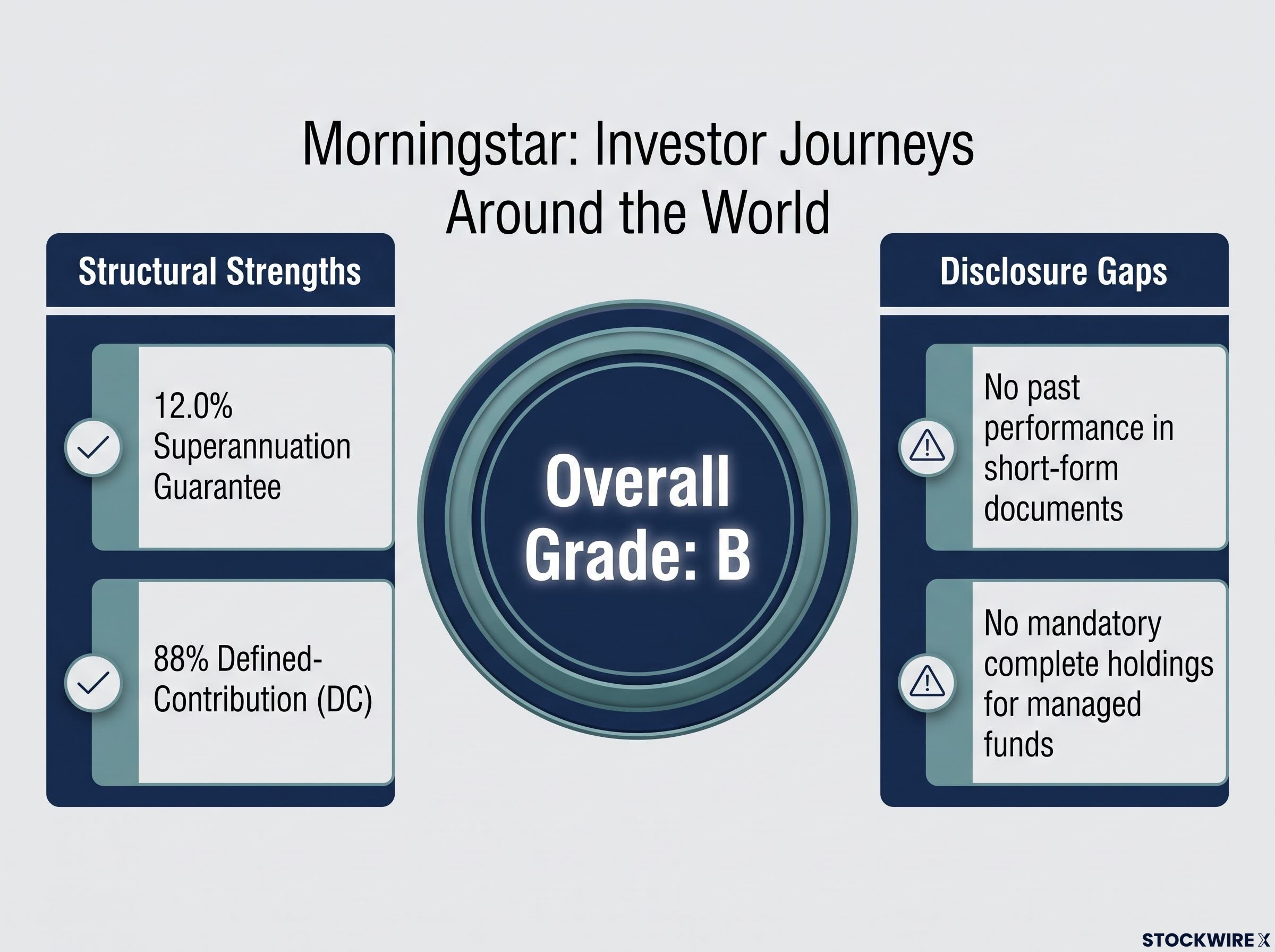
That tension sits at the centre of Morningstar’s “Investor Journeys Around the World” report, published on 17 September 2026 by senior analyst Lia Mitchell and chief policy officer Andy Pettit. The report grades investor culture broadly, not just the fund experience, and Australia lands an overall B. That grade blends genuine structural achievement with specific, named shortfalls, and it arrives in a country where superannuation now dominates household financial assets more than in almost any comparable market.
Here is what the scorecard actually says about whether your retirement savings are working as hard for you as the system’s global reputation suggests. What sits below is a structured account of where Australia’s framework genuinely protects you, and where the burden quietly shifts back onto you.
Where Australia genuinely earns its global reputation
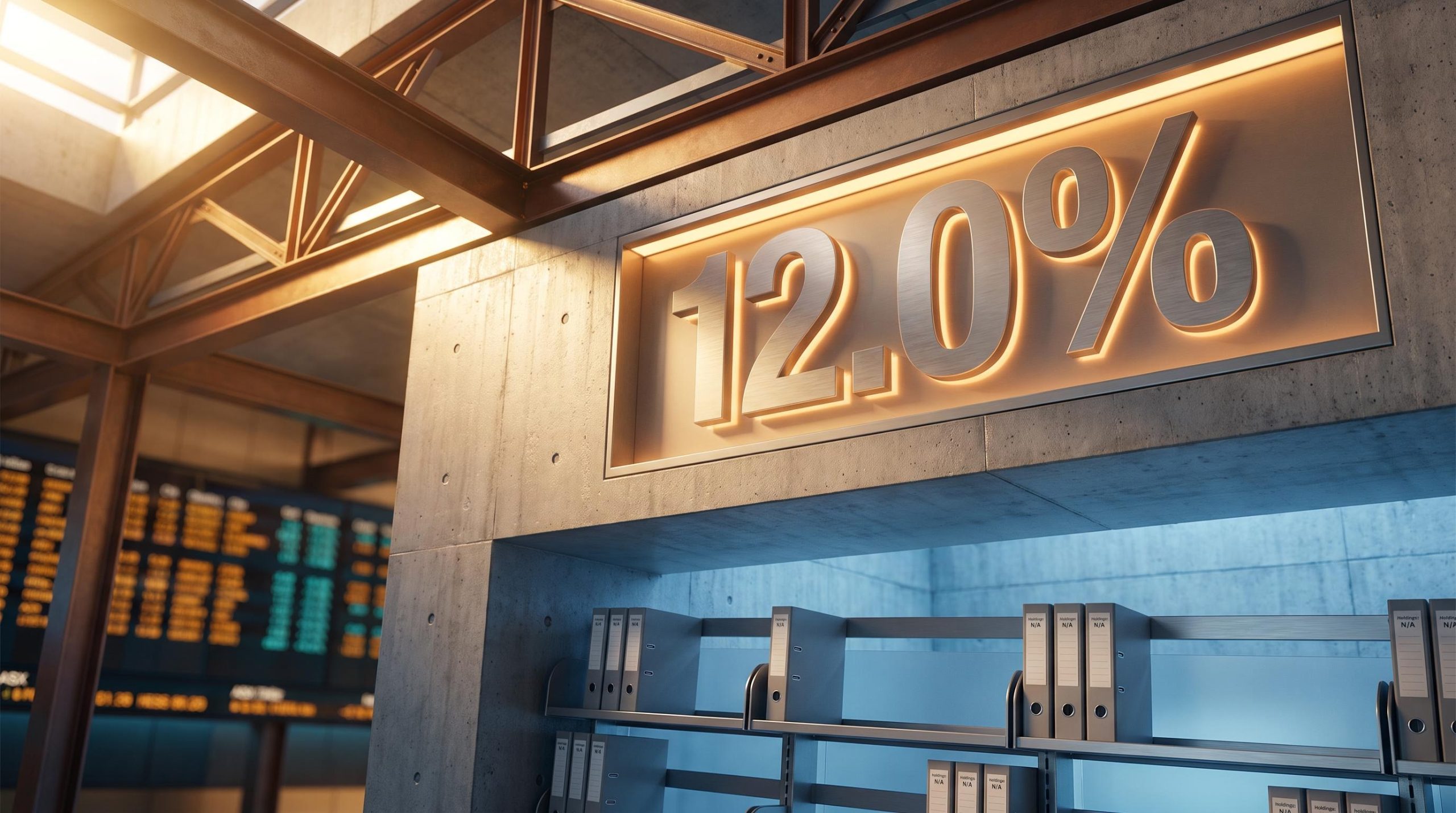
Start with what the B grade rewards, because the achievement is real. Australia’s Superannuation Guarantee (SG), the compulsory contribution employers must pay into your retirement account, reached 12.0% on 1 July 2025, up from 11.5% the year before. That was the final step in a legislated climb, and Morningstar identifies the underlying architecture as a genuine global model.
What makes it a model is the structure. Contributions flow into individual accounts that travel with you between employers, rather than into a shared pension pool. Roughly 88% of Australian pension funds are defined-contribution (DC), meaning the balance depends on contributions and returns rather than a guaranteed formula, a sharp contrast with the defined-benefit systems that still dominate other leading pension markets.
Treasurer Jim Chalmers underscored the point at the Super Members Council Super Summit on 9 September 2026.
Morningstar Investor Journeys Around the World evaluates investor culture holistically across markets, grading not just fund structure but the information environment retail investors actually receive, which is why disclosure gaps carry as much weight in the methodology as mandatory contribution rates.
“Because of super, no other developed country will do a better job than Australia at taking pressure off the pension system, while boosting retirement incomes at the same time.” Treasurer Jim Chalmers, 9 September 2026.
The report credits several distinct areas where Australia outperforms its peers:
- The compulsory SG architecture, with portable individual accounts, cited as a model for defined-contribution design.
- FOFA legislation, which addressed commission-driven conflicts of interest across financial advice and left behind a considerably stronger advice ecosystem.
- An approach to risk classification that measures how often a fund is expected to post negative returns across a 20-year period, rather than using a conventional label scale.
- Performance-fee reporting transparency, where Australia stands out among the markets studied.
For you, the SG rate and the account structure carry a practical meaning. Your savings accumulate inside a system that is both mandatory and portable, which means the risk of simply missing out on contributions, a common failure in voluntary systems, is largely removed by law. That is a real advantage, and it explains why the B is credible rather than generous. It is also, importantly, not an A.
The compulsory SG structure carries an advantage beyond forced saving: the superannuation tax wrapper alone is projected to create a $230,000 wealth gap between identical portfolios held inside and outside super over 25 years, driven by the 15% contributions tax rate and 0% earnings tax in pension phase.
When big ASX news breaks, our subscribers know first
The disclosure gaps that hold Australia’s grade below the top tier
The distance between B and the top tier is measured in disclosure, and the gaps are specific. Morningstar found that no other market it studied places investors in a position where the primary short-form document omits past performance data entirely, and that Australia stands alone among the countries examined as having no mandatory complete portfolio holdings requirement for managed funds. Taken together, these are not minor omissions.
Past performance in short-form documents
The reason performance data often disappears from the documents you receive is regulatory caution. ASIC’s Regulatory Guide RG 168, updated in December 2025, warns that performance statements can mislead depending on the period chosen and the way returns are presented, and requires any such statement to carry a prominent warning that past performance is not necessarily a guide to future performance.
ASIC’s Regulatory Guide RG 168 sets out the disclosure principles governing short-form Product Disclosure Statements, and its treatment of performance statements reflects a deliberate trade-off between investor access to data and the misrepresentation risk that selective return periods can create.
- Short-form Product Disclosure Statements are designed to stay brief, especially for mass-market products.
- Including performance tables carries misrepresentation risk unless carefully framed, so many issuers simply omit them.
- The result: retail investors are pushed to search websites and dashboards for performance figures that other markets place in the core document.
The effect on you is direct. The one page you are most likely to read may not contain the historical returns you need for a side-by-side comparison, which means the standard document is not enough on its own.
Portfolio holdings for managed funds
The second gap divides the market in two. APRA-regulated super funds have been required to publish their holdings twice yearly since 31 March 2022, but managed funds outside super carry no equivalent obligation. Morningstar’s director of manager research, Grant Kennaway, described the broader regime as a “watered-down asset-allocation requirement.”
- Super funds: complete portfolio holdings disclosure, mandatory since 31 March 2022.
- Managed funds generally: no legal requirement to disclose full holdings to investors or the public.
- The consequence: no standardised way to verify what a non-super fund actually owns.
Here is the practical read. If you are choosing between two non-super managed funds, you cannot reliably confirm whether either holds what its strategy claims, which directly affects how much weight you should give a fund’s stated approach.
| Disclosure area | Australia’s position |
|---|---|
| Past performance in short-form documents | Only market studied that does not mandate it in the primary investor document |
| Portfolio holdings for managed funds | Only country in the study with no mandatory complete-holdings requirement for funds generally |
| Board independence standards | Less comprehensive than leading international markets |
| Value-for-money assessments | Requirements trail leading peer markets |
Stacked together, these gaps explain why B is the ceiling. The retirement architecture is world-class; the information you receive to navigate it is not.
ETFs and the self-directed investor: what Australia’s fastest-growing vehicle reveals about the culture gap
The disclosure gaps might read as abstract regulatory quibbles if Australians were passive investors. They are not. The exchange-traded fund (ETF), a low-cost investment that trades on the ASX like a share and typically tracks an index, has become the clearest evidence that investors want more control and transparency than the current framework provides.
The scale is striking. Australia’s ETF industry reached $375.6 billion in funds under management following record monthly inflows of $7 billion in August 2026, according to AAP News on 11 September 2026. Calendar 2025 delivered 34.2% year-on-year growth, per BetaShares.
The August 2026 record ETF inflows of $7 billion reflected not just volume but a decisive rotation: international equities ETFs absorbed $3.8 billion of that total, more than half, while domestic Australian equities captured just $1.2 billion, a composition that the disclosure gaps identified by Morningstar make harder for ordinary investors to evaluate.
| Date | FUM (AUD billions) | Source |
|---|---|---|
| June 2025 | $280.5B | BetaShares (14 July 2025) |
| September 2025 | $309.3B | BetaShares (14 October 2025) |
| December 2025 | $330.6B | BetaShares (14 January 2026) |
| August 2026 | $375.6B | AAP News (11 September 2026) |
VanEck projects the Australian ETF industry will reach $400 billion by end-2026. Source: AAP News, 11 September 2026.
The DC superannuation culture explains the fit. Self-managed super funds (SMSFs) account for more than 60% of ASX AQUA exchange-traded product ownership, per ASIC’s REP 282, and the fee-consciousness that FOFA encouraged aligns neatly with the low-cost, index-tracking structure of major ETFs.
But simple products still carry real risks that standard disclosure does not fully surface:
- Liquidity and bid-offer spread risk, which can widen in stressed markets and erode the low-cost proposition.
- Deviation from net asset value (NAV), particularly in less liquid ETFs.
- Behavioural trading risk, where easy trading tempts frequent, return-damaging activity.
- Currency exposure, since international ETFs bundle foreign currency risk with foreign securities.
Worth noting: Morningstar assigns only Bronze ratings to ASX 200 tracking ETFs, observing that some active managers have beaten Australian equity benchmarks net of fees. Passive is not risk-free.
Here is the read for you. Record inflows are colliding with a disclosure regime that does not cover managed fund holdings, which means more Australians are taking control of investment decisions at exactly the moment the system hands them less standardised information than investors in comparable markets receive.
The adequacy question: what the system promises versus what it delivers
Structure and disclosure are one thing. What the system actually pays out is another, and here the numbers deliver an honest reckoning.
“Australia’s unique defined contribution (DC) super system is arguably the best in the world.” ASFA media release, February 2023.
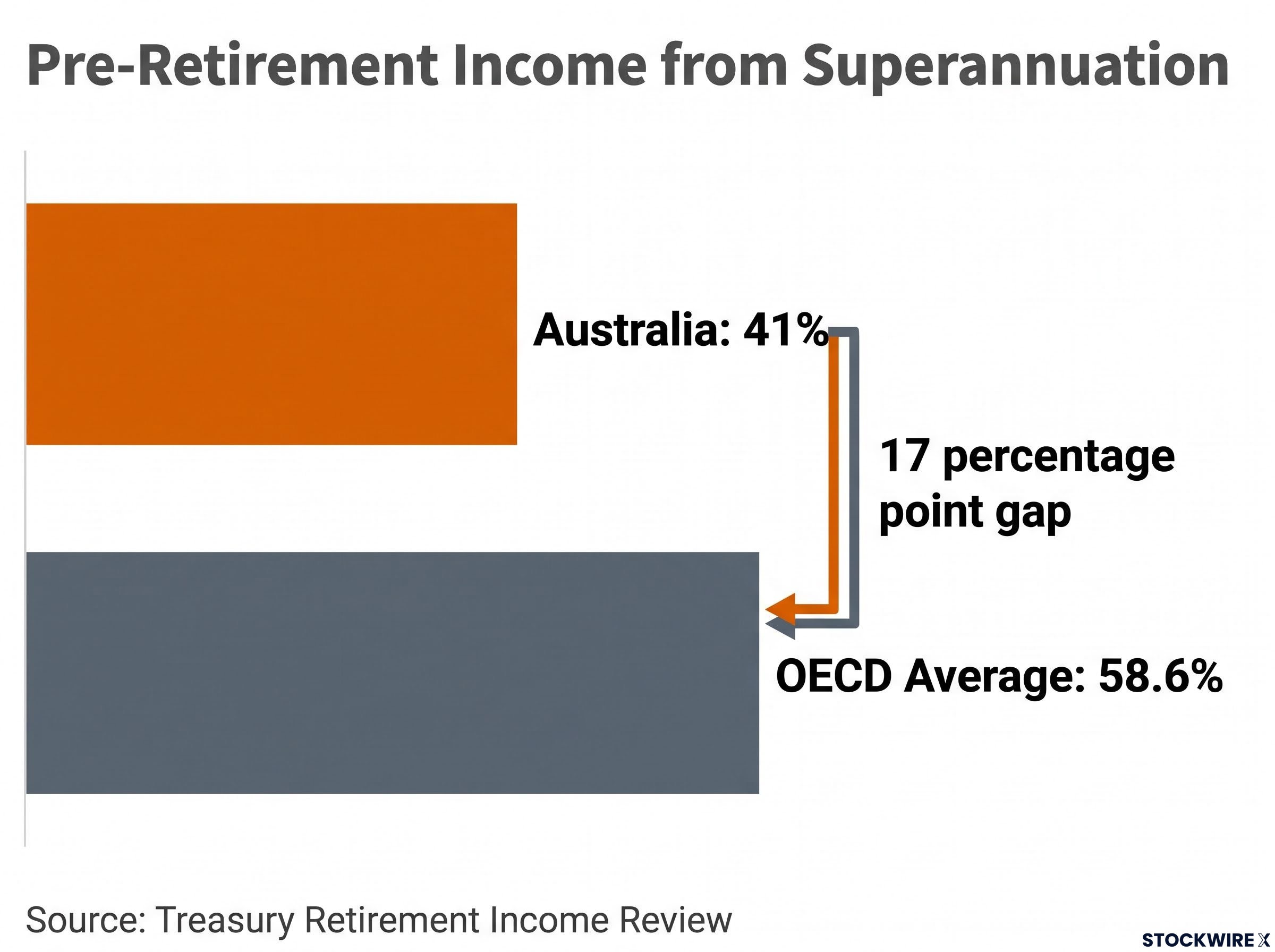
Set that reputation against the output. Average Australian earners receive roughly 41% of pre-retirement income from superannuation, against an OECD average of 58.6%, according to the Treasury Retirement Income Review. That is a gap of more than 17 percentage points.
The 17-percentage-point gap between Australian superannuation output and the OECD average is visible at the individual level too, where retirement savings benchmarks show the average 50-54 year old holds approximately $198,400, more than $430,000 below what ASFA defines as a comfortable retirement threshold.
This is not evidence the system is poorly designed. It reflects a system still maturing from its 1990s origins, where full contribution histories have not yet worked through to today’s retirees. But the gap is real, and it exposes vulnerabilities the Morningstar grade does not capture:
- The DC structure shifts investment, longevity, and sequencing risk onto individual members rather than pooling it.
- Contributions accrue little during career breaks, such as parental leave.
- The decumulation phase, where you convert savings into retirement income, remains complex, with no strong incentive to take benefits as an income stream.
- Temporary disclosure relief for private credit holdings is due to expire in 2027, per ASFA’s submission to ASIC Report 813, a live tension over how far transparency should extend.
The read for you is uncomfortable but useful. A 17-percentage-point shortfall against the OECD average tells you that compulsory savings alone are unlikely to fund a comfortable retirement, which means your own decisions, fund selection and voluntary contributions above all, carry more weight than the mandatory architecture implies. The system’s reputation should not lull you into treating it as complete.
Making sense of a B: where your money is protected and where it is not
Pull the threads together and the B grade stops being a score and becomes a map. Australia genuinely protects you on the things hardest to fix alone: a compulsory 12.0% SG paid into portable accounts, an advice framework cleaned up by FOFA, transparent performance-fee reporting, and a considered risk-classification method. These are structural strengths most countries would trade for.
What the grade tells you now
The offsetting truth is that Australia carries less standardised disclosure than most comparable markets. It is the only market studied that does not mandate past performance in short-form documents, and the only one without mandatory complete portfolio holdings disclosure for managed funds broadly. With ETF funds under management at $375.6 billion as of August 2026, that gap now affects a large and growing population of self-directed investors.
The practical consequence is that due diligence falls more heavily on you than the system’s reputation suggests. A handful of direct questions closes much of the gap:
Our dedicated guide to a superannuation check covers locating lost accounts via myGov, verifying Payday Super compliance, and reading APRA’s 2026 performance test results — all free and requiring no financial adviser.
- Can I see this fund’s complete portfolio holdings, or only a high-level asset allocation?
- Where is the past performance data published, and is it in the document I received or buried on a website?
- If this is a super fund, has it passed APRA’s performance test?
- Does the fund’s stated strategy match what its disclosed holdings actually contain?
What to watch in the next 12-18 months
The 2027 expiry of the private credit disclosure relief is the near-term signal worth monitoring. It will show whether Australia’s disclosure trajectory moves toward its international peers or further from them.
This article is for informational purposes only and should not be considered financial advice. Investors should conduct their own research and consult with financial professionals before making investment decisions. Past performance does not guarantee future results, and financial projections are subject to market conditions and various risk factors.