
The Australian Taxation Office (ATO) confirmed in August 2026 that $21.2 billion in superannuation is sitting lost or unclaimed across the country. Some of it may be yours, and you would have no way of knowing without looking.
Here is the uncomfortable part. Lost accounts are only one of three drains quietly working against your retirement balance at the same time: unclaimed super you have forgotten about, employer contributions that were never paid, and a fund that may be underperforming its benchmark year after year.
A major structural change makes this the moment to act. Payday Super took effect on 1 July 2026, changing how and when your employer must pay your contributions.
This guide is a practical diagnostic. By the end, you will know how to run a proper superannuation check on all three drains, what each one is costing you, and the specific step to take for each. Every check is free, and none of them requires a financial adviser.
Where did $21.2 billion in super go, and could some of it be yours?
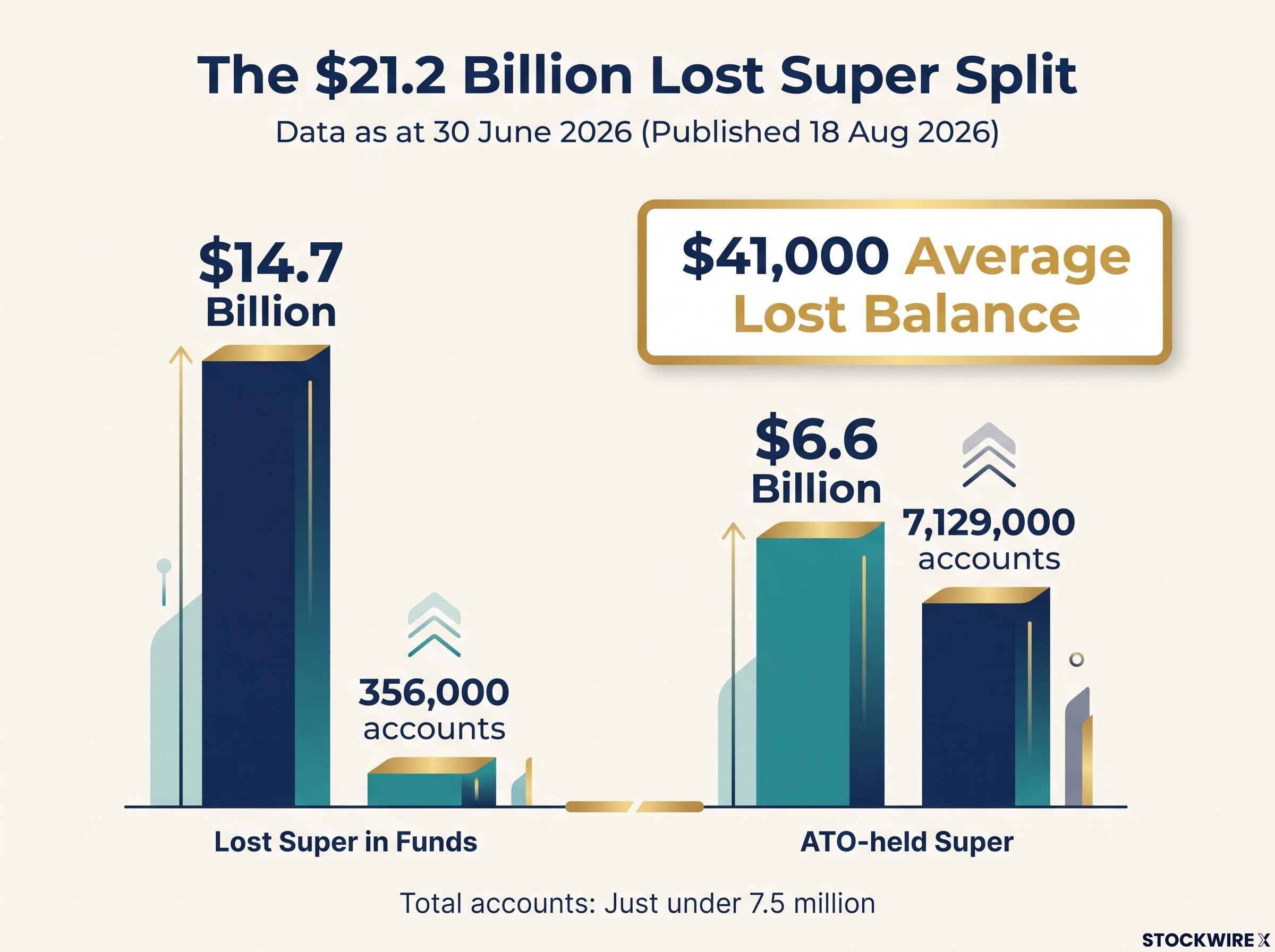
Just under 7.5 million accounts hold that $21.2 billion, according to ATO data published on 18 August 2026 and current as at 30 June 2026. That is a number large enough to feel abstract. So narrow the lens.
The average lost super account holds around $41,000. That is not spare change. That is a figure capable of reshaping your retirement income if you recover it and let it compound in an active fund.
Recovering a lost balance and consolidating it into a performing fund matters more when you know how far your total balance sits from the ASFA comfortable retirement threshold; retirement savings benchmarks by age give you the comparison point most fund members never stop to calculate.
The total splits into two pools. $14.7 billion sits as lost super still held inside funds across 356,000 accounts, where the fund cannot reach the member. The larger pool by account count is ATO-held super: $6.6 billion across 7,129,000 accounts, money the ATO now holds on members’ behalf.
Super gets classified as “lost” under specific ATO rules. Here are the main triggers:
- Members over 65 with no contributions for two years and who cannot be contacted for five years
- Accounts inactive for 12 months where the fund lacks the information needed to pay the member
- Balances transferred to the ATO as unclaimed super money, for example low-balance inactive accounts, former temporary residents, or members the fund cannot locate
How does this happen to ordinary people? Usually through job changes without updating contact details, a new default fund created at every new employer, and the simple drift of disengagement over years. The ATO’s transfer rules then move balances into its custody to protect small accounts from being eaten by fees. That protection is real, but it creates a visibility gap: your money can shift to the ATO without you ever noticing.
The number to sit with: $41,000 Recovering the average lost balance at age 40 and consolidating it into an active, well-performing fund produces a materially different retirement outcome than leaving it dormant in ATO custody. This is recoverable money, not gone money.
The scale of recovery is proven. The ATO returned more than $1.1 billion in unclaimed super to members through consolidations and direct payments in the prior reporting period.
How to find your lost super right now
The search takes minutes and costs nothing:
- Log in to myGov and link the ATO to your account.
- Go to “Manage” then “Super” to see every account in your name, including any ATO-held balances.
- If accounts appear, initiate a consolidation request directly within ATO online services.
You do not need a financial adviser for the search, and there is no fee. The ATO’s online tool even lets you consolidate ATO-held amounts into a nominated fund within the same session.
When big ASX news breaks, our subscribers know first
Is your employer actually paying your super?
The ATO estimates the net superannuation guarantee (SG) shortfall at roughly $6.2 billion for the 2022-2023 financial year, about 6% of what employers were legally obligated to pay. Industry and regulatory commentary in mid-2026 puts the recent-year gap at over $6 billion.
That shortfall persists largely because your contributions are invisible to you. It arises from misclassification of workers, late payment, and missed contributions, not solely deliberate fraud. And because the money moved behind the scenes on a quarterly cycle, non-payment could run for months before anyone noticed.
Here is the personal benchmark that changes everything. The SG rate is 12% of qualifying income. On an $80,000 salary, that means roughly $9,600 should land in your fund each year.
| Salary | Annual SG at 12% | Monthly equivalent | Quarterly (pre-July 2026 reference) | Per fortnightly pay |
|---|---|---|---|---|
| $60,000 | $7,200 | $600 | $1,800 | $277 |
| $80,000 | $9,600 | $800 | $2,400 | $369 |
| $100,000 | $12,000 | $1,000 | $3,000 | $462 |
| $120,000 | $14,400 | $1,200 | $3,600 | $554 |
Do not treat a shortfall as a minor administrative annoyance. A $5,000 gap at age 30 is not a $5,000 problem. Left unrecovered and denied 37 years of compounding to age 67, its true retirement cost runs many times larger than the figure on the payslip.
Verifying your own super is a five-minute job:
- Calculate your expected annual SG using the 12% benchmark above.
- Check your payslips for the SG line item.
- Log into your fund and confirm the contributions were actually received.
- Contact your employer if there is a discrepancy.
- Report to the ATO if it stays unresolved.
The new standard from 1 July 2026 Under Payday Super, contributions must be received and allocated by your fund within 7 business days of each payday, with the fund required to allocate or return them within 3 business days of receipt.
That change matters for detection. The old quarterly cycle made non-payment easy to miss; the new rule gives you a near real-time trigger to check against.
What superannuation fund performance actually costs you over a lifetime
Now for the drain most people never think to check: the fund itself. Let the arithmetic make the case.
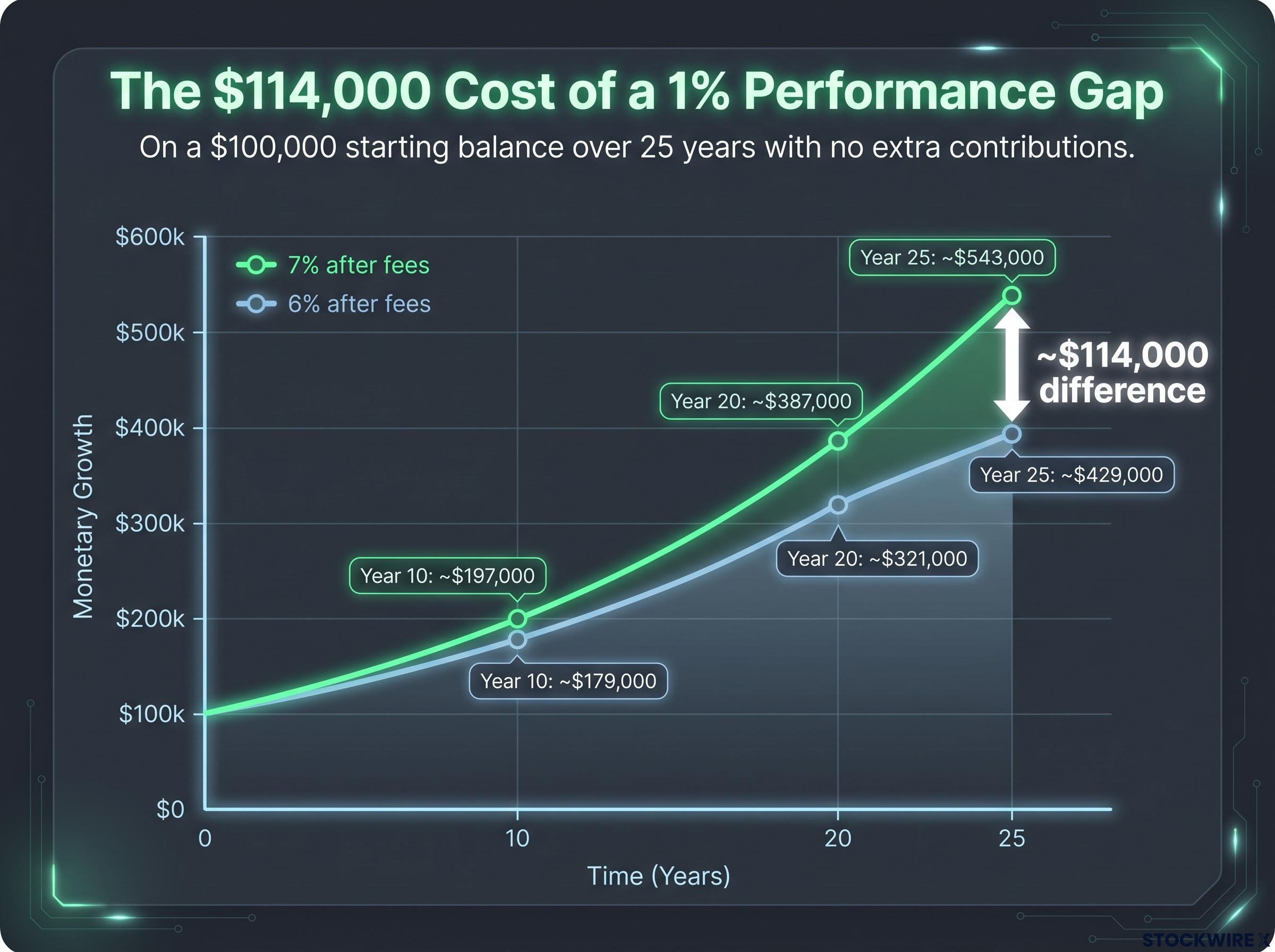
Take a $100,000 balance, no further contributions, and give it 25 years to grow. At 7% a year after fees, it reaches roughly $543,000. At 6% a year, it reaches roughly $429,000.
That single percentage point costs you around $114,000.
| Return rate | Balance at year 10 | Balance at year 20 | Balance at year 25 |
|---|---|---|---|
| 6% after fees | ~$179,000 | ~$321,000 | ~$429,000 |
| 7% after fees | ~$197,000 | ~$387,000 | ~$543,000 |
$114,000 That is the price of staying in an underperforming fund for 25 years on a single $100,000 balance. It is money you never see leave, which is exactly why it goes unchallenged.
This is where the Australian Prudential Regulation Authority (APRA) does the reader a genuine service. Each year it runs a performance test that measures a product’s net returns over an eight-year period against a benchmark, then publicly names the products that fail. Funds that fail must notify their members directly.
The 2026 results, published in APRA’s Comprehensive Product Performance Package 2026 in September, assessed 547 products. 12 failed, up from 7 the year before: 1 MySuper product (BUSS(Q)’s MySuper Balanced Growth portfolio) and 11 platform trustee-directed products, including offerings from Insignia Financial and Bendigo Superannuation. The investment component drove every failure. 5 products failed for at least two consecutive years and can no longer accept new members.
APRA’s 2026 performance test insights paper confirms the methodology used to assess all 547 products, including the eight-year net return benchmark that determines pass or fail status, giving members a transparent framework for interpreting their own fund’s result.
If your fund is on that list, or has quietly trailed its benchmark for years, you are not a bystander to a statistic. You are personally absorbing a six-figure retirement cost that switching can avoid, and the barriers to switching are lower than most people assume.
How to check whether your fund passed the 2026 APRA performance test
Do this yourself rather than waiting for a letter:
- Visit the APRA website and open the 2026 Comprehensive Product Performance Package.
- Look up your fund by product name or trustee.
- Cross-check fees and returns using the ATO’s YourSuper comparison tool.
Failed funds are legally required to write to members, but there is no reason to wait for the post. Check the name yourself.
The risks hiding inside a superannuation consolidation
Everything so far points toward one action: find your accounts and bring them together. That is generally the right move. But consolidating without checking a few things first is exactly how a sensible decision creates a new problem.
The biggest risk is insurance. Many funds attach default life and total and permanent disability (TPD) cover to your account, sometimes with occupational or health features that suit your situation. Closing that account can cancel the cover, and the destination fund may not replicate it on equal terms or price.
The other risks are worth a quick scan:
Consolidating into a better-performing fund is not the same as switching investment options in response to short-term market movements; reactive switches to cash during a downturn can crystallise losses and cause members to miss the recovery, compounding the cost beyond the original underperformance.
- Loss of insurance cover when you close the account holding it
- Exit costs and lost benefits: formal exit fees are largely gone, but buy-sell spreads and transaction costs still apply, and legacy or defined-benefit funds may carry favourable terms you would forfeit
- Timing and market conditions: consolidating during a downturn can crystallise losses when investments are sold to roll over
- Employer contribution errors: if payroll records are not updated, contributions may keep flowing to the closed fund
- Destination fund quality: consolidating into a weaker or pricier fund defeats the purpose
Note the fee angle that makes consolidation attractive in the first place. Holding three or four small accounts means paying duplicate fixed administration fees and insurance premiums, quietly losing hundreds of dollars a year to charges rather than growth.
Check your insurance before you close anything. This is the single most important step. Confirm equivalent cover is active at the destination fund before you shut the old account, not after.
For most people with a few small accounts and no unusual insurance, consolidation is the right call and the risks are manageable with a short checklist:
- List every existing account and its insurance details.
- Confirm the destination fund’s insurance offering.
- Check for exit costs in the product disclosure statement of accounts you are closing.
- Update your employer’s payroll records immediately after consolidating.
- Verify the first post-consolidation contribution lands correctly.
Payday Super helps here too: the 7-business-day rule makes it far easier to spot if contributions are not reaching your new fund.
Payday Super and what it changes for workers starting now
Payday Super is easy to file under “regulatory technicality.” That would be a mistake. For the first time, it hands you a real-time tool to notice a missed contribution within days of payday rather than months after the fact.
The mechanics are straightforward. From 1 July 2026, employers must pay SG so it is received and allocated by your fund within 7 business days of each payday, replacing the quarterly cycle. Funds must then allocate or return contributions within 3 business days of receipt.
The reform sits under the Treasury Laws Amendment (Payday Superannuation) Act 2025, which received Royal Assent on 6 November 2025, with supporting regulations made in February 2026.
| Dimension | Pre-July 2026 | From 1 July 2026 |
|---|---|---|
| Payment frequency | Quarterly | Every payday |
| Time to detect non-payment | Months | Within days |
| Contribution timing rule | Quarterly cycle | Within 7 business days of payday |
| Fund allocation obligation | No equivalent short window | Within 3 business days of receipt |
| Enforcement trigger speed | Slow, quarterly lag | Near real time via STP |
The employer concerns are legitimate and worth acknowledging. Small businesses face tighter cash flow when SG moves from quarterly to per-payday. Payroll systems and SuperStream processes need reconfiguring. Industries with irregular pay, like hospitality, construction, and gig work, face real reconciliation complexity. The ATO’s first-year approach is risk-based and graduated for this reason, with the superannuation guarantee charge, interest, and administrative penalties available for non-payment.
The rule to remember: 7 business days. Contributions must reach and be allocated by your fund within 7 business days of each payday from 1 July 2026.
Combined with Single Touch Payroll reporting, this makes non-payment detectable almost immediately. The ATO’s Superannuation Industry Stewardship Group identified Payday Super in August 2026 as a key mechanism to close the SG gap of over $6 billion. Here is what to do with that visibility:
- Check your fund statement after each pay cycle, not once a year.
- Set a calendar reminder for a monthly review.
- Report a missing contribution to the ATO online if your statement shows nothing within 7 business days of payday.
Your superannuation action plan: three checks to run before the end of this month
You do not need to remember every figure in this guide. You need three checks, and you can start today.
- Find your lost money. Log into myGov, link the ATO, and check for lost or ATO-held super accounts under “Super.”
- Confirm you are being paid. Calculate your expected annual SG at 12% and compare it against what your fund statement actually shows.
- Check your fund’s grade. Search APRA’s 2026 Comprehensive Product Performance Package for your fund by name.
If you find multiple accounts, consolidate. But consolidate with your eyes open, after confirming a few things, not before:
- Insurance cover at the destination fund
- Exit costs in the accounts you are closing
- Your employer’s payroll records, updated straight after
All three checks are free, and none needs a financial adviser. The ATO returned over $1.1 billion in unclaimed super in the prior reporting period, so this is real money recovered, not a paper exercise. Payday Super now makes a monthly contribution check both possible and worthwhile.
Once you have confirmed your employer is paying correctly and your fund is performing, concessional contribution cap strategies become the next lever, particularly for members with a Total Super Balance below $500,000 who can access carry-forward unused cap amounts from earlier years.
Complete all three within 30 days and you are in a materially stronger position than most Australian super members, not because the checks are hard, but because almost nobody does them.
$21.2 billion is sitting there. Finding your share of it starts with one login.
This article is for informational purposes only and should not be considered financial advice. Investors should conduct their own research and consult with financial professionals before making investment decisions. Past performance does not guarantee future results. Financial projections are subject to market conditions and various risk factors.