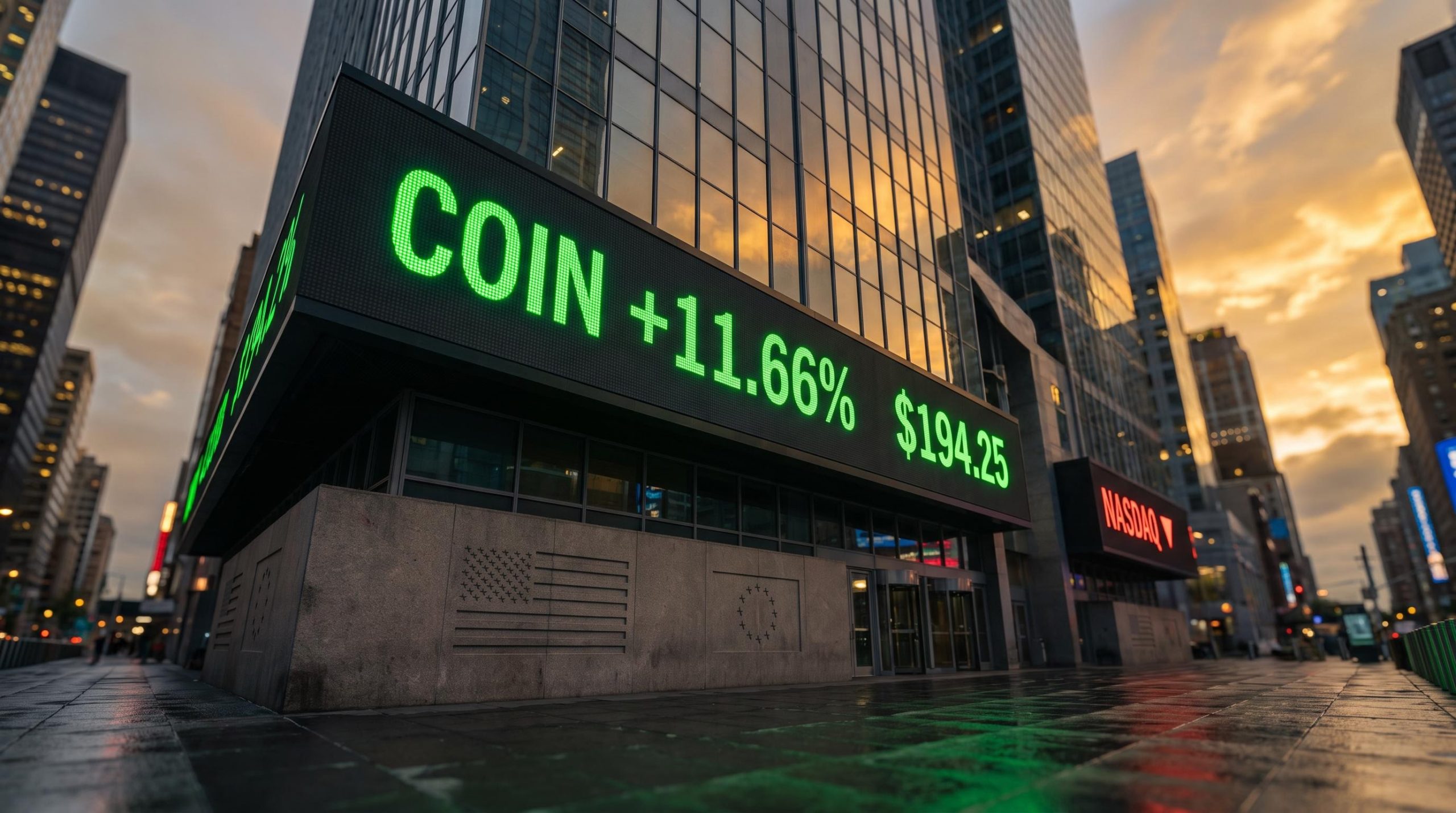
Coinbase (COIN) stock closed up 11.66% on 18 September 2026, a session in which the Nasdaq fell and Bitcoin gained roughly half as much. That divergence tells a more specific story than “crypto rallied.”
The move was not random. A European Central Bank intervention that effectively pushed Binance out of major EU markets redirected trading flows toward Coinbase, which holds MiCA authorisation and can legally passport its services across the European Economic Area.
That regulatory displacement, layered on top of aggressive call-side options positioning and a Federal Reserve rate decision the market chose to read as crypto-friendly, produced one of the stock’s largest single-day moves of the year.
The question worth holding onto is what this Coinbase stock surge actually reflects: a structural competitive gain, a sentiment spike, or something in between. Here is the framework for answering that yourself, built from the price action, the regulatory mechanics, the options data, and the macro backdrop that all landed on the same Friday.
Coinbase posts an 11% single-session gain as broader markets sold off
A crypto-adjacent equity outperforming Bitcoin by nearly two-to-one on a day the Nasdaq declined should feel odd. That is the right instinct.
Coinbase closed at $194.25 on 18 September 2026, a gain of $20.28 or 11.66% from the prior close of $173.97. Trading volume reached roughly 21.92 million shares.
The stock opened near $178, ran to an intraday high of $196.21, and traded a full session range of $177.67 to $196.21. The $195 area had been a known technical ceiling, a price level buyers had previously failed to push through.
Here is the core price action at a glance:
- Close: $194.25, up 11.66% from $173.97
- Intraday range: $177.67 to $196.21, open near $178
- Volume: approximately 21.92 million shares
- Bitcoin: cleared $80,941, a gain of roughly 6%
- Ethereum: advanced approximately 6.4%
- Nasdaq and E-mini futures: traded lower on the same session
The magnitude of the single-day bar rivalled a two-day rally seen back in mid-May, and it marked a steep recovery from the annual lows the stock touched at the end of March.
On a session when Bitcoin cleared $80,941 for a gain of about 6%, Coinbase stock rose 11.66%. The equity moved nearly double the underlying asset it is meant to track.
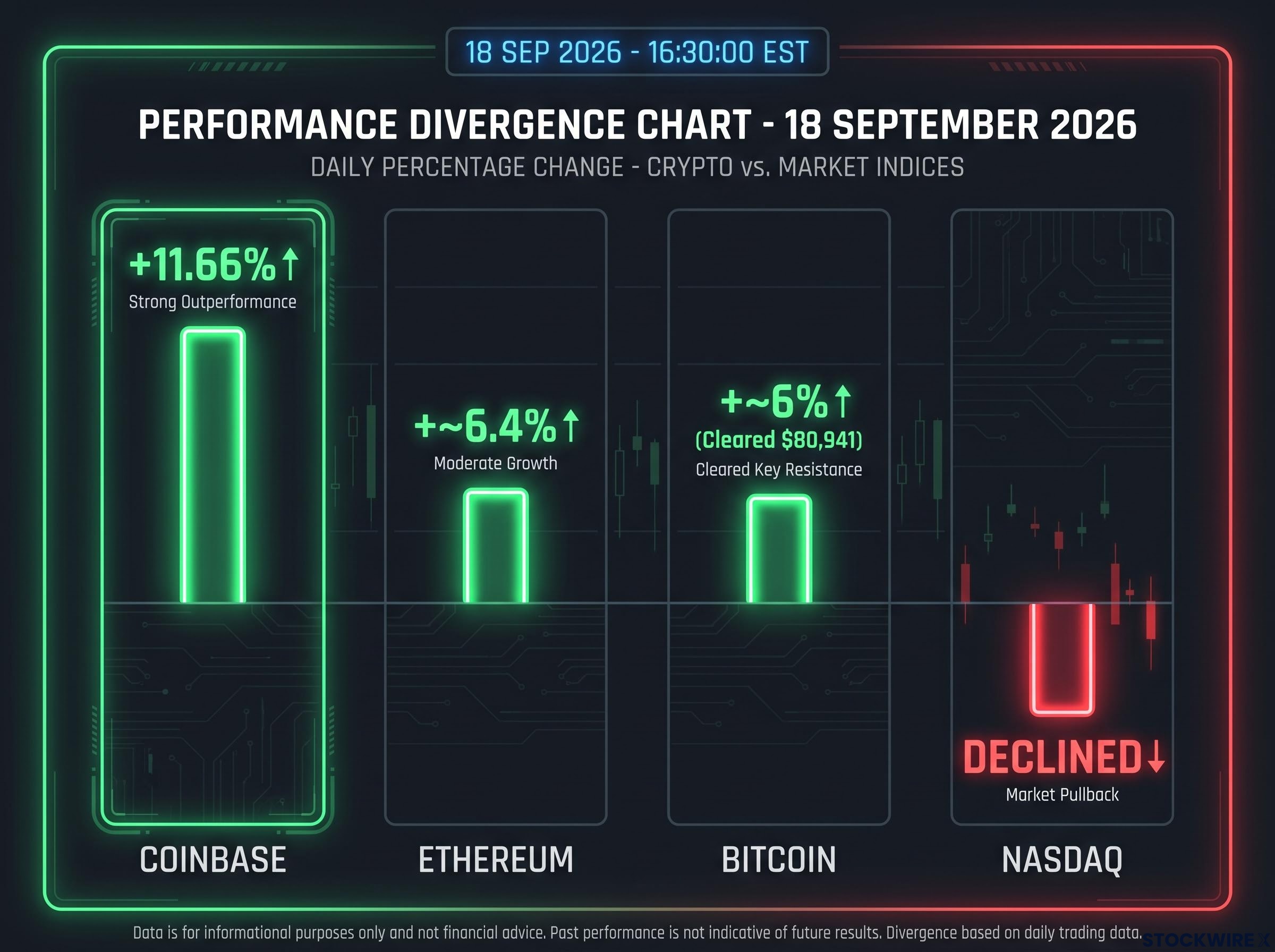
That gap is the signal worth sitting with. When a crypto exchange’s stock outruns crypto itself by that margin, something company-specific is driving the move, not just broad digital-asset sentiment. The rest of this article is the explanation of what that something was.
When big ASX news breaks, our subscribers know first
How EU regulatory pressure on Binance became a tailwind for Coinbase
This was not coincidence. A chain of regulatory actions in Brussels and Athens produced a concrete operational consequence for Binance, and Coinbase had already built the legal infrastructure to catch what fell.
The proximate event was the EU’s Markets in Crypto-Assets (MiCA) framework, the bloc’s single rulebook that requires crypto firms to be authorised before operating across member states. European Central Bank President Christine Lagarde reportedly asked Greek Prime Minister Kyriakos Mitsotakis to reject Binance’s authorisation application. On 24 June 2026, Binance formally withdrew its Greek MiCA bid.
The sequence ran like this:
- The ECB intervened directly with Greek leadership over Binance’s application.
- Binance withdrew its Greek MiCA bid on 24 June 2026.
- The European Securities and Markets Authority (ESMA) issued guidance that unauthorised crypto firms must wind down EU operations.
- From 1 July 2026, Binance suspended new activity for EU-based customers.
ESMA’s MiCA transitional period guidance explicitly required unauthorised crypto-asset service providers to cease onboarding new EU clients and limit activity to asset transfers or position closures, establishing the regulatory mechanism that made Binance’s operational suspension in France, Italy, Poland, and Spain a formal obligation rather than a voluntary business decision.
The operational hit was specific. Binance stopped taking new spot orders, deposits, account registrations, and yield-generating products for customers across France, Italy, Poland, and Spain. That is not a warning letter; it is a functional shutdown of new business in four of the EU’s largest economies.

Coinbase was positioned for exactly this. Having obtained its MiCA authorisation in 2025, it holds passporting rights, the legal ability to offer its services across the entire European Economic Area from a single approval. When Binance was forced to stop onboarding, Coinbase was the compliant, ready alternative sitting next to the exit.
| Attribute | Binance | Coinbase |
|---|---|---|
| MiCA status | Greek bid withdrawn 24 June 2026 | Authorised in 2025 |
| EU operational status (July 2026) | New orders, deposits, registrations, yield products suspended | Full operation with EEA passporting rights |
| Affected markets | France, Italy, Poland, Spain | None; positioned to absorb flows |
| Market share direction | Losing EU share | Gaining, per Kaiko data |
According to Kaiko data, Coinbase and Bybit have been the primary beneficiaries of Binance’s regulatory troubles, picking up share particularly during European trading hours. There is precedent for this pattern: after Binance’s earlier $4 billion settlement with US authorities, its global market share slipped from roughly 60% to 52%, while Coinbase’s US share climbed from 48.4% to 55%.
That is the structural read for you. Coinbase’s MiCA authorisation is not a compliance box ticked; it is an operational moat in a market where its largest competitor has just been forced to retreat. If Binance keeps bleeding EU share, Coinbase is the pre-positioned party set to collect it.
What the options market was pricing in before and during the rally
The options data is not a technical exhibit here. It is a record of conviction, showing that professional traders were leaning long well before the closing bell.
The constant-maturity implied volatility, a measure of how much price movement traders expect, closed around 69.8%. For the 18 September expiration, the 25-delta risk reversal, a gauge of whether upside or downside options are more expensive, ran between +5.01 and +7.6 points. Call implied volatility sat at 87.08% against put implied volatility of 82.07%.
A positive risk reversal of that size means one thing: upside bets cost more than downside protection because more traders wanted them. The specific pricing made the skew tangible:
- A call roughly 25 points above the price, near the 220 strike: about $6.00 per contract
- A put roughly 25 points below the price, near the 170 strike: about $4.00 per contract
- A far out-of-the-money call leg roughly 65-70 points above: about $1.70
- A comparable downside leg at the same distance: about $1.30
At every distance from the money, the call cost more than the equivalent put. Traders were paying a premium specifically for the right to bet on the stock going up.
Total market positioning: call premium dominates at the close
When the aggregate positioning is tallied, the tilt is stark. Total call premium traded reached $99.39 million against put premium of $33.27 million, with a put/call volume ratio near 0.70.
Call premium of $99.39 million versus put premium of $33.27 million: nearly a 3:1 imbalance in favour of upside bets on expiration day.
Some sources cited call volumes of 224,666 contracts, roughly 40% above typical levels, and an earlier session of 189,275 calls, around 18% above average. Those figures are not independently confirmed and are best treated as directionally indicative rather than settled data.
A call-to-put premium ratio near 3:1 on an expiration day tells you the options market was not hedging neutral exposure. It was expressing a directional view. Skew that pronounced typically signals that sophisticated participants expected near-term momentum to keep building, and on this occasion it did.
The Fed rate rise as unexpected fuel, and the risks that remain
Higher interest rates are usually framed as bad news for crypto. On 18 September, the market read the opposite. Understanding why requires holding both sides of the argument at once.
The macro anchor was the Federal Open Market Committee decision two days earlier. On 16 September 2026, the FOMC voted to raise the federal funds target range by 25 basis points to 3.75%-4.00%. Interest on reserve balances rose to 3.90% and the primary credit rate to 4.00%, both effective 17 September. It was the first rate increase since 2023.
The FOMC voted 12-0 on 16 September 2026 to lift the funds rate to 3.75%-4.00%, the first hike since 2023, under Chair Kevin Warsh. Forward guidance flagged one more possible 25 basis point rise if inflation does not moderate.
The two readings of what higher rates mean for crypto pull in opposite directions:
The headwind case:
- Higher rates lift returns on cash and Treasuries, raising the opportunity cost of holding non-yielding assets like Bitcoin.
- Tighter policy drains liquidity from the system and reduces the appeal of the leverage that speculative crypto often runs on.
The tailwind and neutral case:
- Markets often read moderate tightening as evidence inflation is being contained, which supports risk appetite.
- Higher front-end yields can benefit crypto infrastructure such as stablecoins and tokenized Treasuries.
Immediately after the decision, Bitcoin held in the mid-$75,000s and Ethereum sat near $2,400 before the subsequent breakout that carried into the 18 September session. On the day, the crypto complex decoupled from flat-to-lower equities, and the tailwind interpretation won.
How markets read Fed decisions often matters more than the decision itself: the September 2025 cut was labelled hawkish yet produced no selloff and a gold record above $3,700, because over 90% probability was already priced into futures before the announcement.
The regulatory picture on Coinbase’s own doorstep is less one-sided. The SEC charged the company on 6 June 2023 with operating as an unregistered securities exchange, alleging at least 13 listed tokens were securities. Reuters reported in February 2025 that the SEC planned to dismiss the case, but legal analysts caution that dropping one lawsuit does not create a settled rulebook.
US legislation remains unresolved. The Digital Asset Market Clarity Act and the CLARITY Act have yet to fix statutory definitions for digital assets. And MiCA authorisation, while an advantage today, binds Coinbase to strict conduct, reserve, and transparency obligations it must maintain flawlessly to avoid Binance’s fate.
The CLARITY Act defeat three days earlier had sent Coinbase down 10% to $172.11, meaning the 18 September rally was partly a recovery from a session in which US legislative failure had been priced in as a direct business risk.
The question you are left with is whether 18 September reflects durable competitive repositioning or a sentiment event that has borrowed against future regulatory risk. The evidence points both ways, which is the honest answer.
What the September 18 move actually signals about where Coinbase stands
Three forces converged on the same session: regulatory displacement handing Coinbase a competitor’s market share, an options market positioned hard for upside, and a macro backdrop the market chose to read as supportive. Together they explain why a stock outran the asset it tracks by nearly double.
The read that holds up is a genuine duality. Coinbase is the best-positioned regulated exchange in the EU right now, with passporting rights across the European Economic Area and a competitor in retreat. But that moat demands constant upkeep, and unresolved US legislative risk means the story is not a one-way trade.
Exchange liquidity moats have historically proved more durable than disruption narratives suggest, with the CME failing to capture even 1% of market share from a direct competitor despite financial incentives to traders, a pattern that adds structural weight to Coinbase’s EU positioning argument.
For anyone tracking Coinbase, three variables will decide whether 18 September was the start of a trend or a high-water mark:
- Binance’s EU market share trajectory, and whether Coinbase keeps absorbing the displaced flow
- The next FOMC meeting and whether the Fed signals that additional 25 basis point hike
- The pace of US legislative clarity on how digital assets are classified
Watch those three, and you will see the thesis confirm or crack in real time.
For investors wanting to place Coinbase’s single-session move in the broader context of how regulated exchange businesses are priced across cycles, our full explainer on global exchange stock valuations examines why CME and ICE have sold off despite record results and what that pattern implies for regulated crypto exchange multiples.
This article is for informational purposes only and should not be considered financial advice. Investors should conduct their own research and consult with financial professionals before making investment decisions. Past performance does not guarantee future results, and forward-looking statements are speculative and subject to change based on market and regulatory developments.