Ninepoint Partners listed two new income ETFs on the Toronto Stock Exchange in mid-September, expanding its HighShares platform from single-stock products into diversified basket portfolios for the first time.
The Ninepoint Enhanced U.S. Equity HighShares ETF (TSX: USHI) began trading on 14 September 2026, followed by the Ninepoint Enhanced Aerospace and Defence HighShares ETF (TSX: EDHI) on 15 September 2026.
The timing is not accidental. Retail appetite for high cash flow has intensified through 2026, and the defence sector has become one of the year’s most talked-about themes as NATO members raise spending commitments and governments accelerate military modernisation.
For income-focused investors, these launches raise an obvious question: can a fund really pay a double-digit distribution without giving something up elsewhere?
Here is what the mechanics of these new products actually involve, the earlier fund performance that convinced management to expand, and the structural trade-offs baked into every high-yield covered call strategy.
The active architecture beneath USHI and EDHI
Both funds are now live on the TSX, and both share the same underlying machinery. Each is an actively managed equity portfolio paired with a covered call overlay and leverage of up to 33% of net asset value.
A covered call is an options contract sold against a stock the fund already owns. It generates upfront income (the premium) in exchange for capping how much the fund gains if that stock rises sharply. Ninepoint writes these calls on up to 50% of portfolio NAV across both products.
The two funds diverge sharply on what they hold.
USHI carries a sector-balanced basket of roughly 20-25 US large-cap companies spanning technology, financials, health care, energy and utilities. EDHI takes a narrower, thematic route: global aerospace, defence and security equities, including defence contractors, space names and cybersecurity firms.
That defence mandate matters, because EDHI arrived as a first-of-its-kind product in Canada. Domestic investors already had index-based defence ETFs, but none paired that sector exposure with a covered call income overlay before this launch.
Behind the stock picking sits BlackRock’s Aladdin software, an institutional risk and portfolio platform Ninepoint uses to model market scenarios and position the funds. The presence of Aladdin and active selection tells you something important: your management fee is not buying passive index tracking. It is paying for tactical decisions that will either soften or amplify the volatility inherent in these sectors.
Both funds pay distributions twice a month, with an inaugural payout of $0.0625 per unit payable on or about 6 October 2026 to unitholders of record on 29 September 2026.
| Ticker | Theme | Management fee | Risk rating |
|---|---|---|---|
| USHI | US large-cap, multi-sector | 0.40% | Medium to High |
| EDHI | Global aerospace, defence and security | 0.55% | High |
How a 44 percent proof of concept triggered the expansion
Ninepoint did not launch these funds on a hunch. The blueprint was an earlier product that delivered a standout first year.
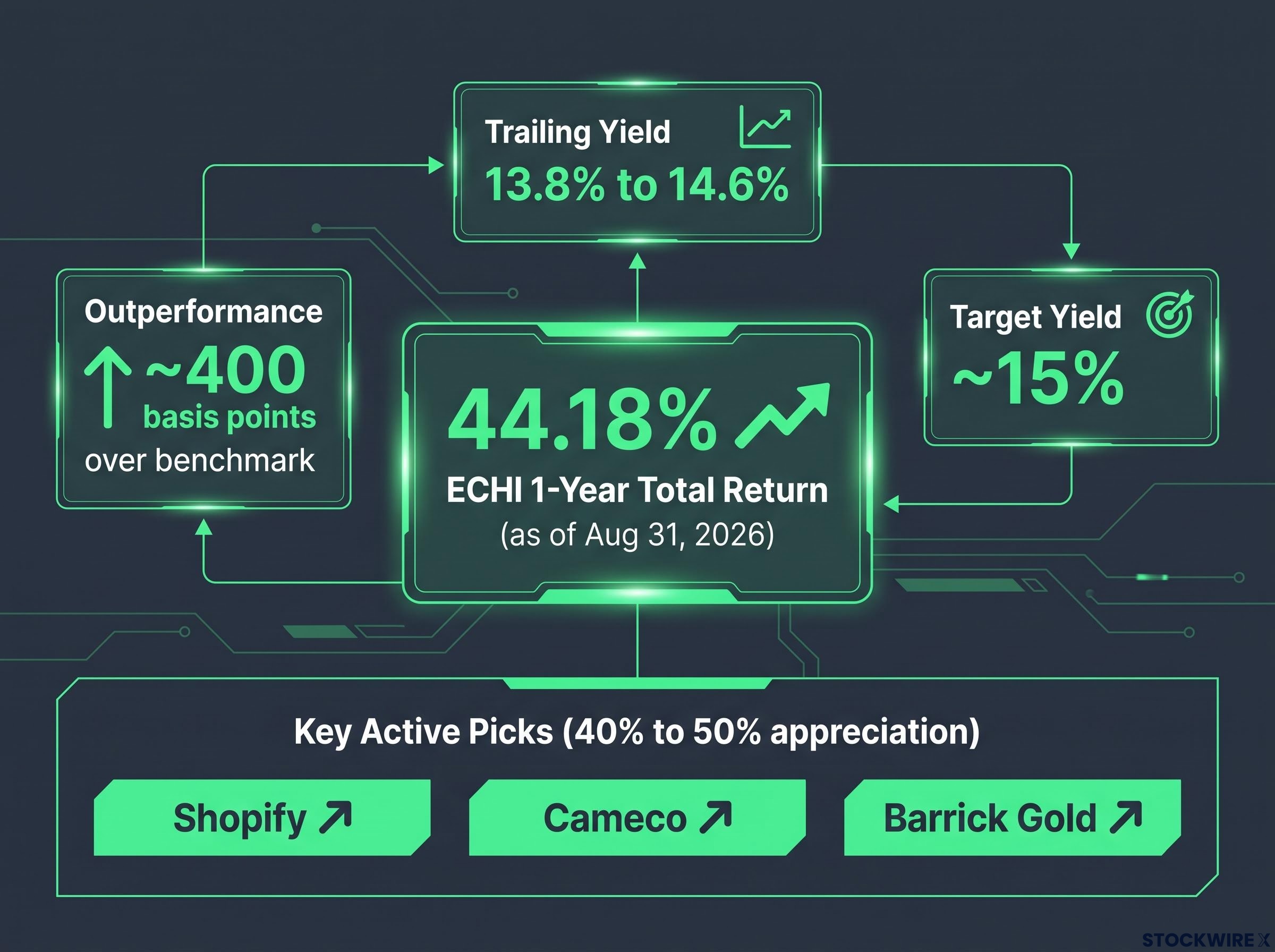
That fund is the Ninepoint Enhanced Canadian HighShares ETF (TSX: ECHI), the original proof of concept for the HighShares platform. It combined the same leveraged equity plus covered call structure, applied to Canadian names, and its numbers gave management the confidence to push into US equities and global defence.
Its first-year performance sheet is the reason USHI and EDHI exist.
- 1-year total return of 44.18% as of 31 August 2026
- Benchmark outperformance of approximately 400 basis points over the period
- Trailing distribution yields in the mid-teens range, roughly 13.8% to 14.6%
- A targeted distribution yield of around 15%, which management views as sustainable given the portfolio’s option-writing capacity
- Standout active picks including Shopify, Cameco and Barrick Gold, with certain holdings appreciating 40% to 50% in the fund’s first year
Those numbers are genuinely strong, and the mid-teens yield is the headline that draws income investors in. But there is a caveat worth holding onto.
ECHI produced that return during a powerful bull market in specific Canadian equities. The option premiums that funded its distributions were richest precisely because those underlying stocks were moving hard. There is no guarantee that US large-caps or global defence names will replicate that exact dynamic, which means the predecessor’s track record sets an optimistic baseline, not a promise.
The empirical record on covered call ETFs vs index funds shows leveraged structures came close to matching benchmark returns through the 2023-2026 bull run, but the same structures lost nearly 31% in the 2022 bear market, an asymmetry that shapes how much weight any single-year proof-of-concept track record should carry.
Weighing mid-teens yields against total return trade-offs
Here is where the excitement needs to meet reality. A double-digit distribution looks like free income, but the covered call structure that generates it always extracts a cost, and that cost is your upside.
By writing calls on up to half the portfolio, these funds surrender a portion of any strong rally. In sideways or moderately rising markets, that trade works well, as Morningstar Canada has noted about covered call strategies generally. In a raging bull run, the capped upside means the fund can lag a simple equity holding.
The long-term evidence is sobering. Rational Reminder’s analysis of one studied covered call fund found it trailed the underlying index by roughly 2.6 to 2.7 percentage points annually since inception, outperforming in less than 1% of rolling three-year windows.
Mackenzie Investments’ ETF Lab commentary repeatedly stresses that investors choosing covered call ETFs over unhedged equity exposure are sacrificing longer-term capital appreciation for short-term cash distributions.
There is a second erosion risk. When a fund pays out more each year than its portfolio actually grows, its net asset value can shrink over time, meaning future dollar distributions may fall even if the percentage yield looks steady.
NAV erosion is the mechanism that can make a consistent percentage yield misleading over time: when distributions exceed the portfolio’s actual earnings growth, the fund’s unit price drifts lower, reducing the dollar value of future payouts even as the stated yield holds steady.
Notably, Ninepoint’s own management has told investors to judge USHI and EDHI on total return, dividends plus option premiums plus price changes, rather than on headline yield alone. Carl Chong, Executive Vice President and Head of ETFs at Ninepoint, was the primary spokesperson at launch and reminded investors to factor in all-in costs including financing charges, not just the stated management fee.
The mechanics of return of capital
Part of the yield illusion comes down to how distributions are classified. Return of capital (ROC) is the portion of a distribution that is not earned income or realised gains; it is effectively your own money handed back to you.
Covered call ETFs frequently distribute a meaningful share of ROC. In one studied fund, more than half of the distributed income was classified as ROC, and Ninepoint’s own Energy Income Fund has been cited by DecodeETF as an example where over half of recent distributions fell into this category.
Why this matters to you directly: ROC reduces your adjusted cost base dollar for dollar. That defers tax now but builds a larger liability later, and once your cost base hits zero, further ROC becomes an immediate capital gain. When you see a mid-teens distribution target, assume a slice of that cash is principal being returned, which changes how you should calculate both your real profit and your future tax bill.
The distribution tax treatment across covered call ETFs can split a single payout into up to five separate T3 categories, each taxed at a different rate, so two funds advertising an identical 15% yield can produce materially different after-tax returns depending on how their premiums are classified.
This article is for informational purposes only and should not be considered financial advice. Investors should conduct their own research and consult with financial professionals before making investment decisions. Past performance does not guarantee future results, and financial projections are subject to market conditions and various risk factors.
Evaluating geopolitical hedges in an income portfolio
The launch of USHI and EDHI lands squarely within 2026’s dominant investment themes: retail hunger for cash flow and surging capital into defence.
Defence has drawn heavy inflows as NATO members lift spending and modernisation programmes accelerate, and Morningstar’s Bryan Armour has noted that security and defence ETFs performed exceptionally well through 2025. EDHI gives Canadian investors a domestic tool to monetise that sector’s volatility through option premiums, something no covered call competitor offered before.
The framework for using these funds is clear. They are actively managed, leveraged income instruments built to shine in sideways or moderately rising markets, not set-and-forget core equity holdings. If you understand that the mid-teens yield trades away long-term upside and often includes return of capital, they can serve a defined income role. If you expect them to match a pure equity fund in a bull run, the structure works against you.
For investors wanting a structured framework to decide whether USHI or EDHI fits their specific income situation, our dedicated guide to covered call ETF selection covers the reinvestment capacity metrics, organic income ratios, and distribution streak criteria that distinguish suitable products from yield traps.