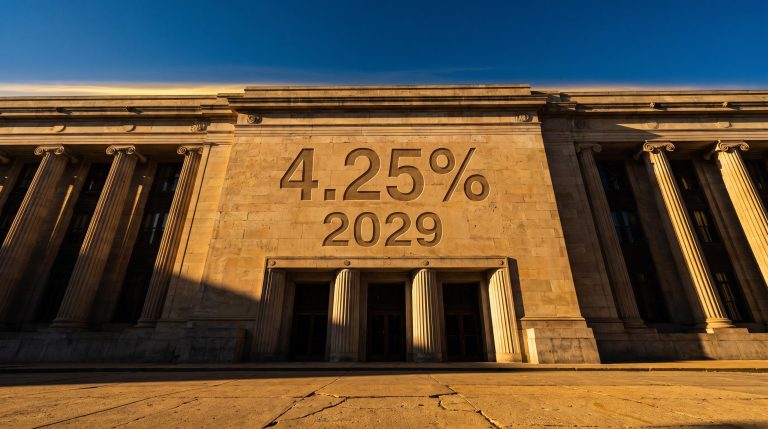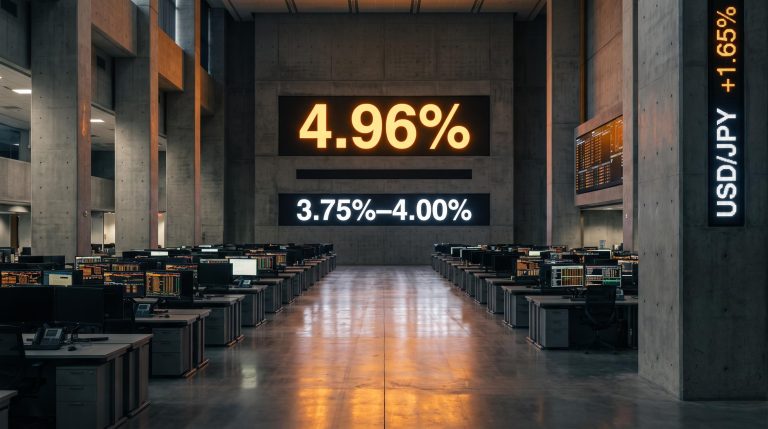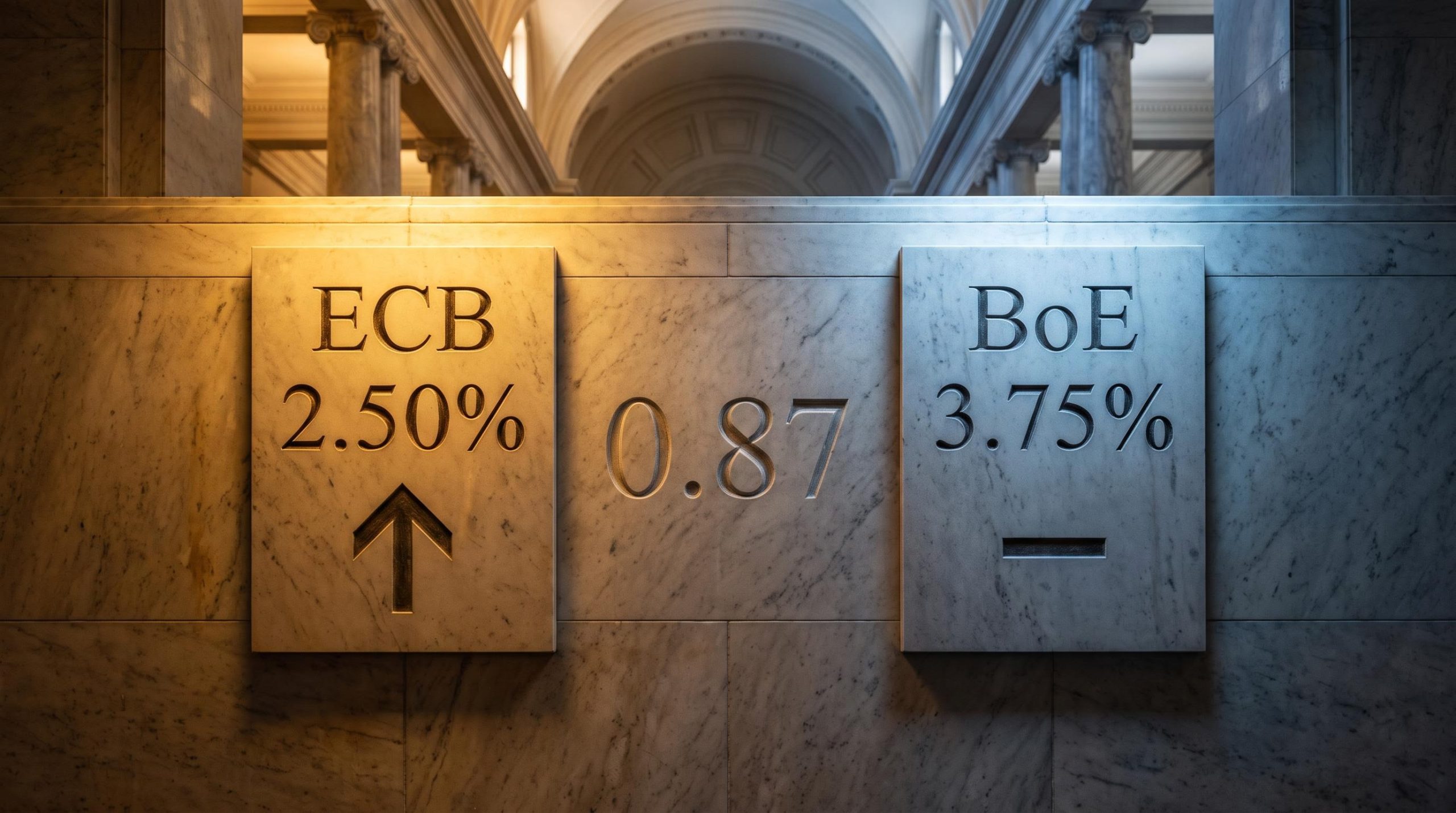
The European Central Bank has just raised its deposit rate to 2.50% and left the door open to more, while the Bank of England sits at 3.75% after six consecutive holds. Two central banks, same regional neighbourhood, same energy shock, opposite postures.
That is the puzzle, not the summary. As of September 2026, the Middle East conflict has repriced energy across both economies, yet the ECB and BoE are reading identical external conditions through different policy lenses. The divergence is not academic; it is already visible in EUR/USD and EUR/GBP pricing, in bond positioning, and in the internal dissent fracturing the BoE’s Monetary Policy Committee (MPC).
Here is what the policy gap actually means for your rates, currency, and equity exposure: why two banks facing similar shocks produce different outputs, what that historically does to portfolios, and what positioning follows.
Why the ECB is raising while the BoE holds
Start with the fact that anchors everything. On 10 September 2026, the ECB Governing Council lifted all three key rates by 25 basis points, effective 16 September 2026. The gap between the two banks is not just a number. It is two institutions reading the same energy shock through different domestic mixes, and that distinction determines which way each moves next.
| Institution | Current Rate | Last Move | Next Meeting | Policy Bias |
|---|---|---|---|---|
| ECB (deposit) | 2.50% | +25bp, 10 Sep 2026 | Late October 2026 | Hawkish, hikes “not excluded” |
| Bank of England | 3.75% | Held (6th time) | 17 September 2026 | Cautious wait-and-see |
The ECB’s case for another move
The ECB’s main refinancing rate now sits at 2.65% and its marginal lending facility at 2.90%. Its stated rationale: inflation above target, upside risks from energy, and core inflation that has not yet eased decisively.
The ECB rate corridor, comprising the deposit facility, main refinancing rate, and marginal lending facility, means the headline deposit rate of 2.50% is the true policy signal for overnight funding costs across the banking system, while the other two rates form the ceiling and floor of a channel that rarely features in market commentary.
Gabriel Makhlouf, Governing Council member and Governor of the Central Bank of Ireland, said additional hikes “cannot be excluded.” Isabel Schnabel of the Executive Board went further, telling Bloomberg that “interest rates must rise further” because current settings are unlikely to bring inflation back to target.
President Christine Lagarde framed the September move bluntly.
The hike was a “no-brainer” in light of renewed energy-driven inflation, Lagarde said, warning that the return of inflation to 2% could be further delayed.
The ECB now projects that return only by end of 2027 at the earliest, and the IMF baseline has euro-area inflation above 2% into 2028. That is a bank acting pre-emptively under uncertainty.
The BoE’s case for staying put
The BoE is weighting a different mix. Its 6-3 vote on 30 July 2026 held Bank Rate at 3.75%, with three members favouring a hike, but the majority chose to wait.
The committee’s own language matters here. It has acknowledged that rates “may no longer be restrictive” once inflation falls back, a signal that it fears over-tightening credit for fragile households more than it fears under-reacting to energy.
For you, this is the read: the ECB’s next probable move is up, the BoE’s is sideways or eventually down. The direction of travel, not just the current level, is what a durable divergence trade depends on.
When big ASX news breaks, our subscribers know first
What the data says about ECB and BoE monetary policy divergence historically
To understand what a sustained gap does, look at the last major episode: the ECB-Fed divergence of 2014-2017. That period offers the mechanics before you apply them to 2026.
European Parliament studies of the 2014-2016 window found that rate differentials weakened the euro against the dollar. That in turn boosted euro-area export competitiveness, raised import prices, and reduced deflation risk. The currency did the adjusting.
The funding market told the same story. An ECB Occasional Paper found that a persistent negative EUR/USD basis, effectively a euro funding discount, ran from 2014-2017 and was largely driven by monetary policy divergence.
The mechanism is simpler than it sounds. When one central bank expands liquidity while another holds or drains it, the relative funding differential shifts. Institutional capital then flows toward the higher-yielding or more aggressively easing jurisdiction, and cross-currency funding costs adjust to reflect it.
The historical record boils down to three repeatable effects when divergence is large and sustained:
- The lower-rate currency tends to weaken.
- That economy’s exports gain competitiveness on the cheaper currency.
- Portfolio flows tilt toward the higher-yield market.
Here is the discipline you need before extrapolating. Those effects show up most clearly when the gap is wide, one-directional, and durable. The current ECB-BoE gap is none of those to a dramatic degree.
BNP Paribas makes exactly this point. In its September 2026 currencies focus, the bank held its 3- and 12-month EUR/GBP targets steady.
BNP Paribas maintains its EUR/GBP target at 0.87, arguing the current divergence is too modest to drive a strong currency trend.
The read for you: the 2014-2017 template is real, but it fires hardest at extremes. With both the ECB and BoE still in broadly restrictive territory, growth and external balances may matter as much as the rate gap. Treat divergence as a signal, not a certainty.
How the currency markets are pricing the gap
If the rate story were mechanical, the euro would have strengthened on the September hike. It did the opposite.
EUR/USD: why the hike did not strengthen the euro
On 11 September 2026, Reuters had EUR/USD around 1.1595. Immediately after the 10 September hike, it slipped to roughly 1.1612, down about 0.19% on the session.
| Date | EUR/USD Level | Trigger | Direction |
|---|---|---|---|
| 11 Sep 2026 | 1.1595 | Post-hike, US CPI digestion | Lower |
| 10 Sep 2026 | 1.1612 | ECB 25bp hike | Down 0.19% |
| 23 Jul 2026 | 1.1375 | ECB hawkish hold | Down 0.3% |
The counterintuitive part is the point. The euro fell on a hike because markets focused on the growth cost of further tightening, not the yield pickup. That tells you currency markets are pricing credibility and growth risk, not simply rewarding the higher-rate currency.
Dollar dynamics muddy the picture further. An earlier dip near 1.1465, associated with Makhlouf’s remarks, was driven mainly by a US dollar rebound rather than any direct ECB signal. In EUR/USD, dollar moves can drown out the ECB-BoE story entirely.
EUR/GBP as the cleaner policy trade
This is why strategists point to EUR/GBP as the cleaner expression of the divergence. FXStrategyAnalyzer describes the cross as capturing the policy gap without dollar noise.
Sterling positioning ahead of today’s MPC decision reflects a market caught between a 6-3 vote for hold, with Pill, Greene, and Mann all pushing for a hike to 4.0%, and structural terms-of-trade pressures that Goldman Sachs argues point toward 1.3250 regardless of near-term rate outcomes.
The tactical setups follow directly. Short EUR/GBP on a BoE hawkish surprise paired with an ECB dovish hold; long EUR/GBP when the ECB signals hawkishly while the BoE stays cautious.
The disciplining counter-view remains BNP Paribas at 0.87 for both the 3- and 12-month horizon, its argument being that rate differentials are unlikely to dominate the cross. For you, the takeaway is to pick the pair that isolates what you actually want to trade, and not to assume the higher rate wins the FX.
What diverging ECB and BoE paths mean for fixed income, equities, and currency positioning
Now translate the macro into positions, moving from the most rate-sensitive asset class outward.
Fixed income is where the ECB hike bites first. JPMorgan’s guidance is to focus on liquidity and diversification, keep exposures high-quality, and actively manage duration given increased two-way volatility. Riviera Wealth Management is more specific on the mechanics.
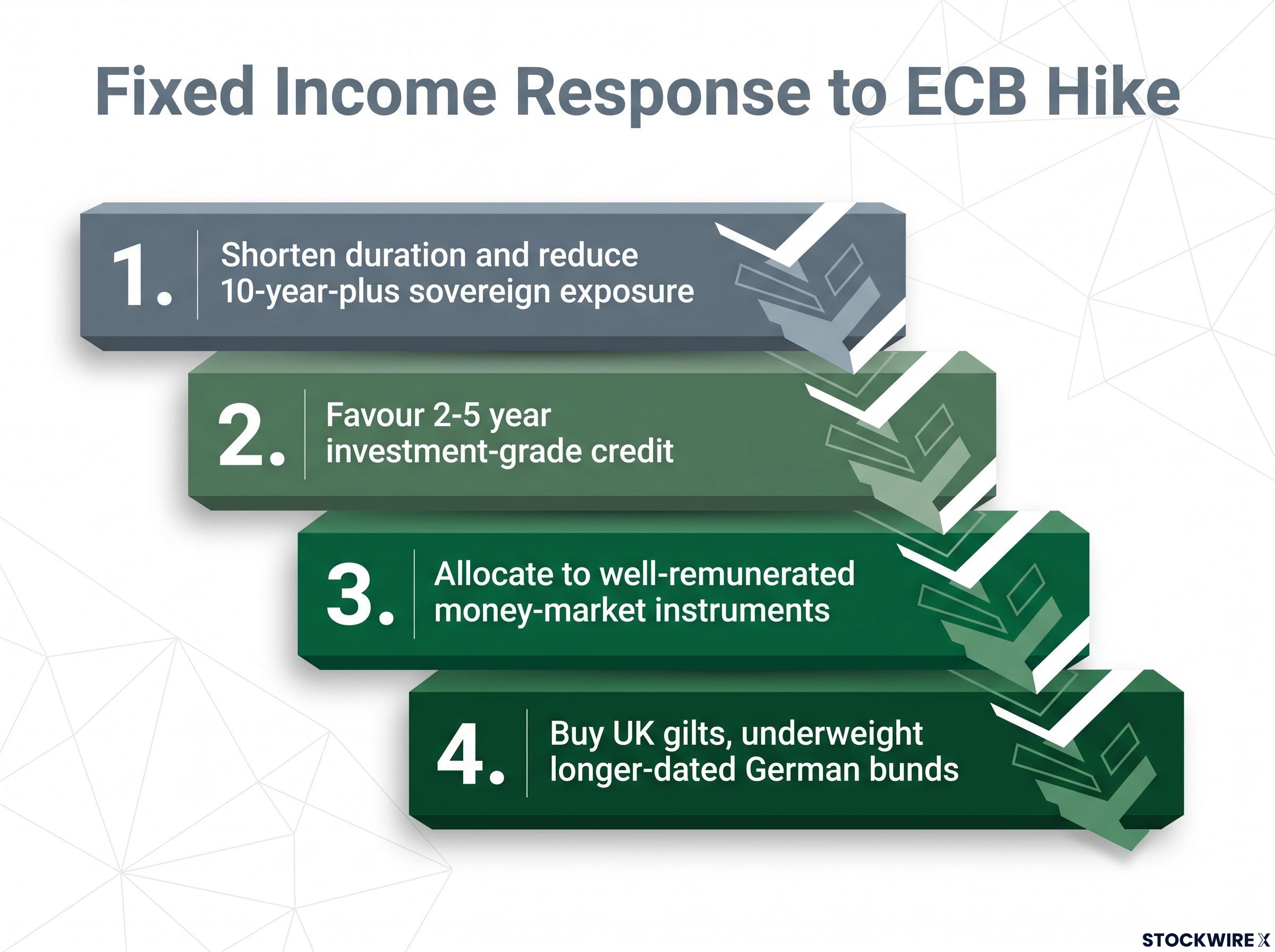
In order of priority, the ECB-hike response looks like this:
- Shorten duration and reduce 10-year-plus sovereign exposure.
- Favour 2-5 year investment-grade credit.
- Allocate to well-remunerated money-market instruments.
- Consider a relative-value trade: buy UK gilts, underweight longer-dated German bunds.
That last trade rests on the BoE’s more stable front end versus Eurozone duration still exposed to ECB hawkishness.
In equities, the rotation logic runs along net interest margins. European financials stand to benefit modestly from higher rates through improved margins, while rate-sensitive growth sectors suffer. In the UK, prolonged BoE restraint tends to weigh on domestically focused, leveraged names, while international, cash-rich UK companies are relatively insulated.
The risk anchor keeps the bullish tightening thesis honest. Berenberg’s Holger Schmieding warned in May 2026 that further ECB hikes could tip a stagflation into recession.
Additional ECB hikes in this environment would be a “big mistake,” Schmieding said, risking turning stagflation into a mild recession rather than stabilising inflation.
The stagflation risk scenario gives concrete shape to Schmieding’s warning: Brent crude sustained in the $90-$100 range driven by unresolved geopolitical supply constraints represents Barclays’ near-term base risk, with escalation above $100 raising recession probability materially and potentially forcing the ECB to reverse course before its own inflation target is met.
That two-sidedness is the whole point. Allianz Research notes a sharp drop in energy prices could push the ECB toward cuts, reversing the divergence narrative fast. Four uncertainties could narrow or flip the gap:
- The Middle East conflict trajectory and energy prices.
- The resilience of euro-area and UK growth under restrictive policy.
- The behaviour of inflation expectations after recent high-inflation scars.
- Sharp data surprises on either inflation or growth.
For you, the divergence gives real directional signals on duration and sectors, but both banks are explicitly data-dependent. Over-committing in either direction carries genuine reversal risk if the energy trajectory shifts.
This article is for informational purposes only and should not be considered financial advice. Investors should conduct their own research and consult with financial professionals before making investment decisions. Past performance does not guarantee future results, and financial projections are subject to market conditions and various risk factors.
Reading the gap correctly before the next ECB and BoE decisions
The central finding holds together like this. The divergence is real, showing up in rate levels, communication tone, and voting patterns, but it is modest in absolute terms and could compress quickly.
The immediate watchpoints are the calendars. The BoE decides today, 17 September 2026, and the ECB meets again in late October. This is not background context: the BoE decision is a live event that could move the dissent count and reprice the gap in real time.
The dissent trajectory is the tell. Three MPC members voted for a hike on 30 July 2026, up from two at the prior meeting. If that number grows toward a majority, the BoE’s cautious posture is closer to breaking than the headline hold suggests.
MPC dissent signals carry real predictive weight because a shift of only one or two members from the hold camp flips the vote outcome, and the three data variables the committee watches most closely, CPI, wage growth, and services inflation, each have release dates that fall before the next scheduled decision.
Reuters polls still expect the BoE to hold at 3.75% through 2026 and into 2027 unless inflation surprises. The IMF assumes cumulative 50bp of ECB increases across 2026 for a broadly neutral stance. Both frameworks are conditional.
Three variables are worth monitoring from here:
- The BoE dissent count at today’s decision, and whether the hawks gain ground.
- The Middle East conflict and energy price path through October, the primary driver for both banks.
- The ECB’s late-October guidance on whether another hike is actively on the table or merely “not excluded.”
Investors who treat the divergence as conditional are better positioned than those trading it as a structural given. These statements are speculative and subject to change based on market developments. The gap is a live situation, not a settled one, and the next fortnight will tell you how durable it really is.