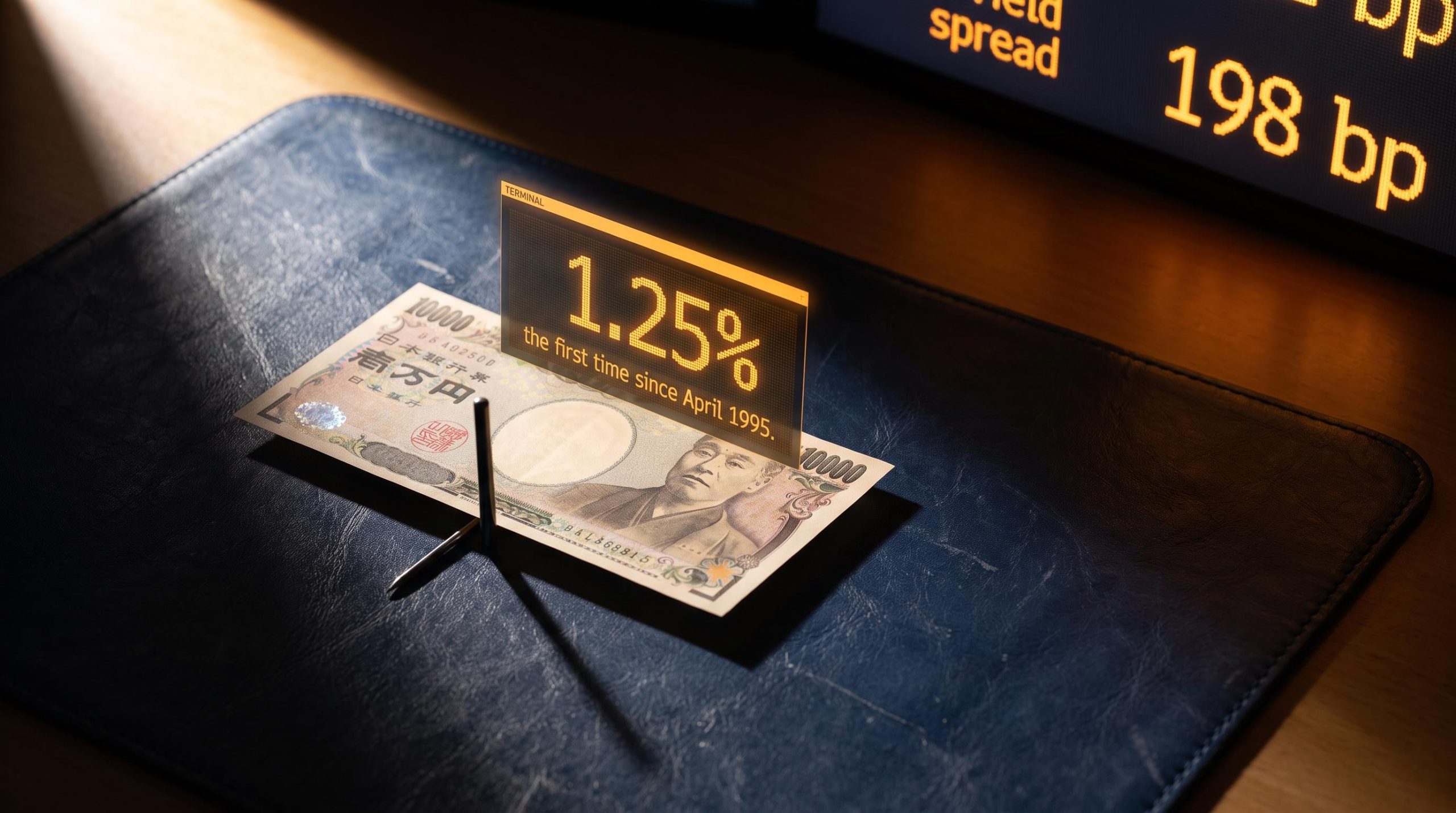
Japan’s central bank is expected to lift its policy rate to 1.25% today, a level the country has not operated at since April 1995. The meeting is live right now, and if the hike lands, the last time borrowing costs sat this high in Japan, the internet was barely a household concept.
That is the weight behind today’s Bank of Japan rate decision. This would be the fourth step in a normalisation cycle that started in July 2024, moving from near-zero to 1.25% in roughly two years. The move arrives against competing forces: a yen already strained by Middle East energy costs, a US-Japan yield gap near 198 basis points, and markets waiting on Governor Kazuo Ueda for any hint about how fast the next hikes come.
By the time you finish this, you will understand why this particular meeting matters far beyond the 25 basis points, what is working against the yen even as policy tightens, and what the AUD/JPY chart is signalling about where traders are positioned right now.
A 31-year high: what the BoJ is expected to decide today
The expected outcome is straightforward on paper: a 25-basis-point increase from 1.0% to 1.25% at the September 17-18 Monetary Policy Meeting. As of today, that outcome is a forecast, not a confirmed decision. The policy rate remains at 1.0% going into the room.
But the forecast has broad backing. Reuters reported on 11 September 2026 that the Bank was “set to raise” the rate to 1.25%. Jiji Press flagged the same 0.25-point move on 4 September 2026, and Seoul Economic Daily, citing Kyodo, reported the Bank had settled on the increase.
What makes 1.25% significant is not the size of the step. It is the destination. According to Jiji Press and Reuters, this would be the first time Japan has held its policy rate at that level since April 1995, a 31-year gap.
The June 2026 rate decision established the 1.0% floor from which today’s expected move departs, delivered by a 7-1 board vote alongside a structured JGB tapering schedule that signalled sustained normalisation rather than a one-off adjustment.
That figure is not historical decoration. It is the clearest signal yet that Japan’s zero-rate era is definitively over, and the question markets are now pricing is no longer whether the Bank tightens, but how quickly. To see why, it helps to watch the cycle build in sequence.
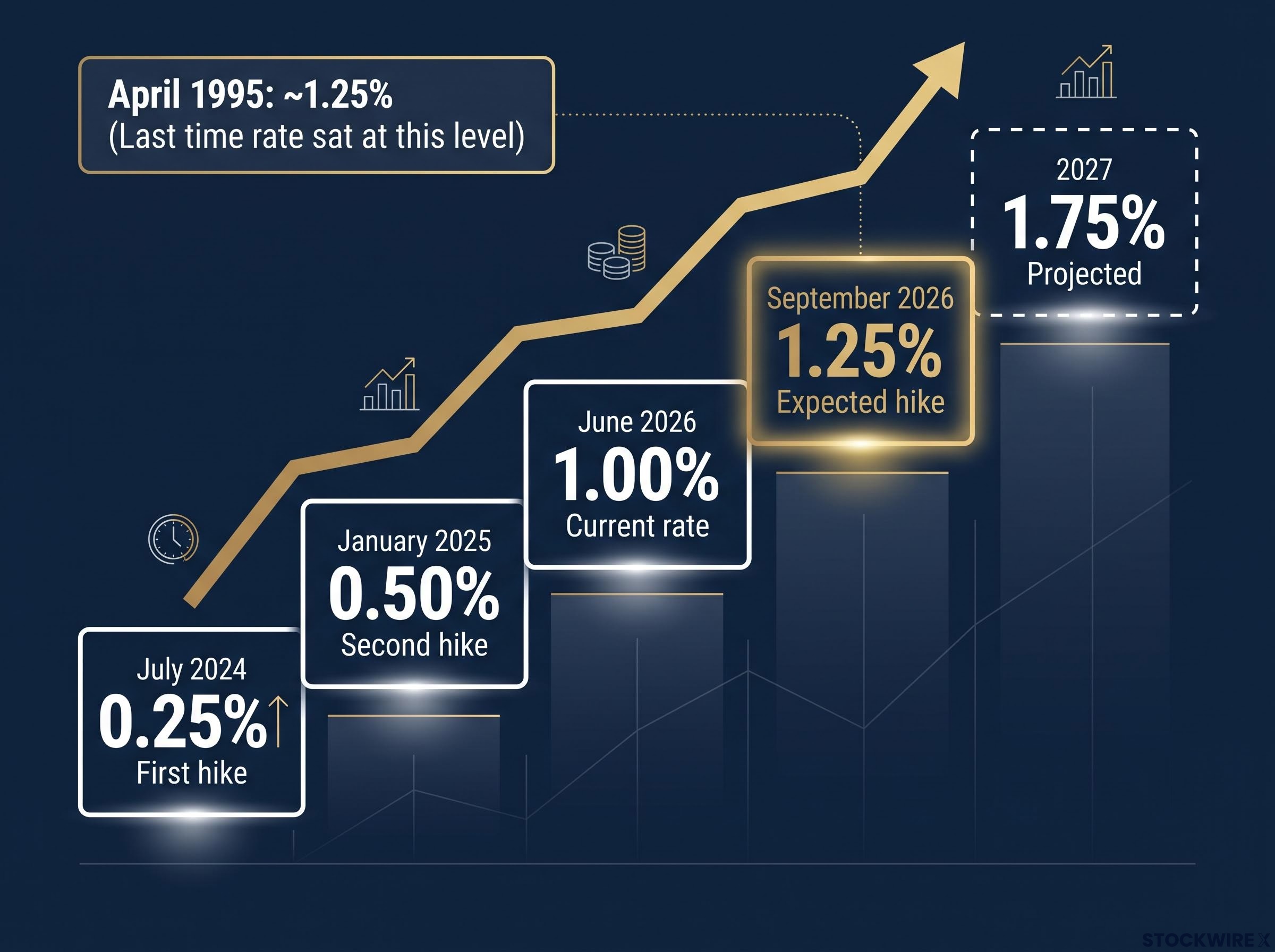
| Date | Event | Policy Rate |
|---|---|---|
| April 1995 | Last time rate sat at this level | ~1.25% |
| July 2024 | First hike of the cycle | 0.25% |
| January 2025 | Second hike | 0.50% |
| June 2026 | Current rate took effect | 1.00% |
| September 2026 | Expected hike (not confirmed) | 1.25% |
Today is a waypoint, not the finish line. A Reuters poll published on 9 September 2026 projects a further increase to 1.75% in 2027, which is why Governor Ueda’s post-decision remarks matter as much as the hike itself. Traders will be listening for any signal on pace, because that trajectory, not the 25 basis points, is what they are trying to price.
The BoJ rate hike path to a projected 1.75% by April 2027 is complicated by Japan’s planned food consumption tax cut, which could mechanically suppress headline CPI by up to 1.5 percentage points and force markets to look past the headline number when reading future policy signals.
When big ASX news breaks, our subscribers know first
Why the BoJ is tightening now, and why the market believes it
Start with the mechanism the Bank itself leans on. Governor Ueda has signalled that exit from ultra-low rates depends on a wage-price virtuous cycle taking hold, a self-reinforcing loop in which a tight labour market pushes up wages, which lifts spending, which supports prices, which in turn justifies further wage rises. According to a RIETI policy note, this cycle is the condition the Bank treats as necessary to move Japan away from chronic low inflation.
The Bank of Japan Outlook for Economic Activity and Prices, published July 2026, projects that wage-driven inflation will persist through the forecast horizon, providing the institutional foundation for the normalisation path Governor Ueda has been signalling to markets.
The domestic data is cooperating. Standard Chartered analysts cite revised Q2 GDP growth, robust exports, resilient investment indicators, and rising real wages as factors suggesting the economy has sufficient capacity to withstand another moderate rate increase.
Japan’s official CPI data, published by the Statistics Bureau of the Ministry of Internal Affairs and Communications, shows headline inflation has remained above the Bank’s 2% target for an extended stretch, a sustained overshoot that reinforces the case for continued rate normalisation.
Three structural conditions underpin the Bank’s confidence:
- Wage growth supported by persistent, not temporary, labour shortages
- An upwardly revised GDP trajectory with resilient investment
- A tight labour market that keeps firms proactive on pay
Nomura Research Institute argues those labour shortages are structural rather than cyclical, which is precisely what makes higher rates sustainable in Governor Ueda’s framing. NRI also notes that many press reporters remain sceptical about whether these wage-price dynamics are durable enough to carry the normalisation path, a reminder that the internal case is not universally accepted.
Real wages rose 2.4% year-on-year in July 2026, the seventh consecutive monthly gain, reinforcing the wage-price dynamic the Bank cited as a precondition for tightening; yet with the hike itself fully priced, the forward guidance on pace carries more market-moving potential than the 25 basis points.
Oxford Economics assessment The Bank is likely to front-load hikes because inflation is increasingly wage-driven rather than a temporary cost shock. Front-loaded hikes should have a “manageable impact” given Japan’s ageing society, its high share of net-saving households, and limited corporate leverage after decades of deleveraging.
Then there is the external layer. Reuters reported on 9 June 2026 that a weak yen and a still-hawkish Federal Reserve are adding pressure to accelerate hikes, both to contain imported inflation and to slow yen depreciation. The read for you is direct: the pace of future moves will hinge as much on what the yen does as on what Japanese wages do, so watch USD/JPY and the wage data together.
The energy variable: why the yen is not strengthening the way the textbook says it should
Here is the assumption worth checking at the door. A central bank hiking rates should, by conventional logic, strengthen its currency as higher yields attract capital. In Japan’s case right now, that logic is being overwhelmed.
The reason is oil. Japan imports the overwhelming majority of its energy, so when crude prices climb, the import bill climbs with it. According to Maybank’s Saktiandi Supaat, companies then sell yen to buy dollars to pay for fuel, a direct currency flow that pushes the yen down regardless of what the policy rate is doing.
Maybank’s Saktiandi Supaat The “energy shock is dominating the risk-off effect,” which explains why the yen has failed to strengthen despite elevated geopolitical risk, overriding its traditional safe-haven behaviour.
The numbers show the strain. TradingEconomics reported the yen sliding past ¥158.5 per dollar in early March 2026 as oil surged above US$100 per barrel on fears of prolonged Middle East disruption. A June 2026 TMGM piece notes that conflict in Iran and the closure of the Strait of Hormuz kept fossil-fuel prices elevated, worsening Japan’s trade balance.
There is a second problem beneath the first. The yield gap that historically anchored USD/JPY still favours the dollar heavily, and its trajectory has been widening.
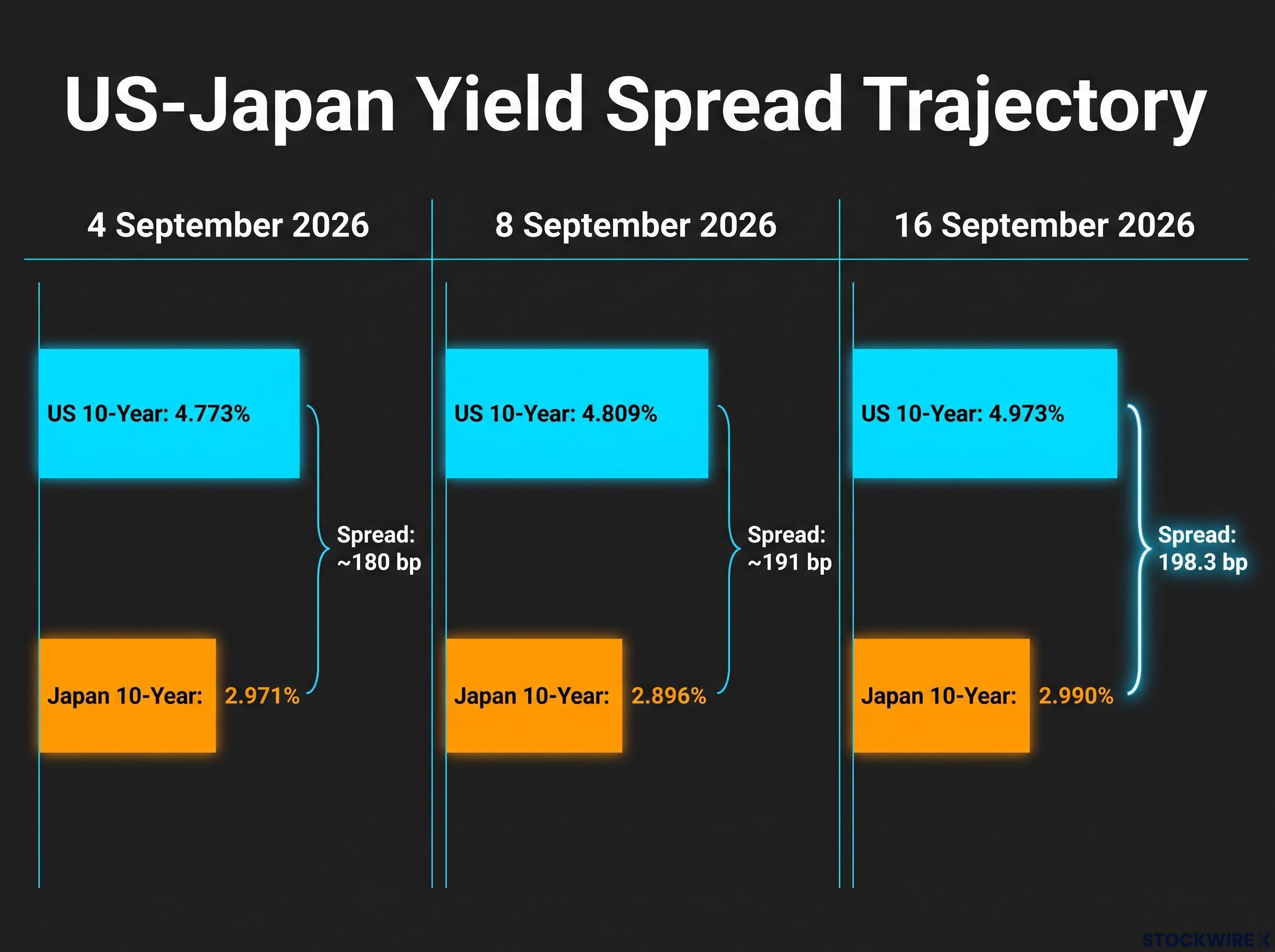
| Date | US 10-Year | Japan 10-Year | Spread (bp) |
|---|---|---|---|
| 4 September 2026 | 4.773% | 2.971% | ~180 |
| 8 September 2026 | 4.809% | 2.896% | ~191 |
| 16 September 2026 | 4.973% | 2.990% | 198.3 |
Yet the differential no longer tells the whole story. A macro commentary from early September 2026 notes the traditional US-Japan 10-year yield anchor for USD/JPY appears to have broken down since mid-2025, with the yen now driven more by Japan’s own yield curve, fiscal risk, and term premium. Commerzbank expects the yen to stay weighed down until Middle East tensions ease, and BNP Paribas projects it stabilising around 160 per dollar despite normalisation.
The practical implication for you is that a hike delivered today may produce only a muted or short-lived yen rally. Energy costs and the yield differential are structural headwinds that 25 basis points alone does not resolve, which changes how any yen or cross-pair position should be sized and timed.
AUD/JPY at 110.90: what the technical picture is saying ahead of the decision
The macro forces above translate into concrete price levels on the AUD/JPY chart, and the setup going into the decision is bearish. According to FXStreet analysis authored by Lallalit Srijandorn, the pair was trading near 110.90 in the early European session Thursday, with the Australian dollar benefiting from yen weakness driven by those higher energy costs.
The structure confirms the bias. Both the 20-day Bollinger simple moving average and the 100-day moving average sit above current price, while the pair’s position within the Bollinger Band range tilts toward the lower band rather than the upper.
Momentum indicators: RSI and Bollinger Bands in context
The Relative Strength Index (RSI), a momentum gauge that runs from 0 to 100, was reading 38.58 on the 14-period setting. That matters because it sits below the neutral 50 line but well above the 30 oversold threshold. In practical terms, the pair is not stretched enough to signal an imminent bounce, and momentum is pointing steadily lower rather than showing signs of exhaustion.
The Bollinger position tells the same story. With price hugging the lower band and momentum below neutral, the two indicators are pointing in the same direction. That agreement strengthens the bearish read rather than muddying it.
Key levels to watch during and after the decision
If the decision or Governor Ueda’s tone triggers a relief rally, these are the ceilings to watch:
- 111.63 (10 August low), the first immediate resistance
- 112.45 (20-day Bollinger middle band)
- 112.90 (100-day moving average)
- 115.85 (upper Bollinger Band), the distant ceiling
On the downside, the floor structure looks like this:
- 109.05 (lower Bollinger Band)
- 108.79 (31 March low)
- 107.73 (16 February low)
- 100.00, the psychological level flagged as the trigger for accelerated declines
For you, the map is clear: with RSI below 50 and price under both key moving averages, momentum traders are positioned for further downside, and 100.00 is not a distant abstraction. It is the threshold where the bearish trade either accelerates or finds its floor. FXStreet has disclosed that this technical analysis was partially AI-assisted.
Three variables that will determine whether today’s hike actually moves the yen
The hike is only half the event. Governor Ueda’s post-decision press conference is the variable that decides whether today produces a sustained yen move or a single-session reaction, because markets are pricing the trajectory signal, not just the 25 basis points.
The two paths run in opposite directions. Hawkish communication that signals a faster route to 1.75% could offer short-term yen support through a yield-curve recalibration. Analysts disagree even on this: Katsutoshi Inadome of Sumitomo Mitsui Trust Asset Management notes hawkish signalling could lower bond yields by easing inflation fears, or raise them by advancing terminal-rate expectations.
CGTN’s framing of the dilemma If the Bank lets yields rise, government financing costs climb and fiscal strains intensify. If it leans on bond buying to cap yields, its commitment to normalisation looks less credible, which risks weakening the yen again. That is the asymmetric trap the Bank cannot simply hike its way out of.
MUFG warned in April 2026 that insufficient hike velocity could force the Bank or government into FX intervention, which past episodes suggest may not succeed against energy-driven fundamentals. The honest takeaway for you is that even a delivered hike does not resolve the yen’s structural exposure. Durable appreciation needs lower oil prices and a narrower yield differential, and neither is within the Bank’s control.
Japan’s record 11.7 trillion yen intervention campaign in 2026 illustrated the FX intervention limits that MUFG warned about: the currency still collapsed to its weakest level since 1986 because unilateral spending cannot substitute for a change in the underlying yield and energy cost incentive structure.
So watch three things from here:
- Oil prices and the intensity of Middle East conflict
- The cadence of Japanese wage data
- The trajectory of the US-Japan yield differential
Today’s decision carries real historical scale, the highest rate in 31 years. But the yen’s direction from here runs through forces the Bank does not command, and Governor Ueda’s tone is the first clue as to which path the market prices next.
This article is for informational purposes only and should not be considered financial advice. Investors should conduct their own research and consult with financial professionals before making investment decisions. Past performance does not guarantee future results, and financial projections are subject to market conditions and various risk factors. Forward-looking statements are speculative and subject to change based on market developments.