Every diagnostics merger announcement uses the same handful of words. Familiar terms like complementary capabilities, cost synergies, and a stronger combined balance sheet appear across virtually every deal you will encounter, yet they tell you almost nothing concrete about whether the combination will actually deliver results.
Here is the problem specific to diagnostics. Two companies can look perfectly aligned on a strategy slide while sharing no operational infrastructure on the ground at all. One runs its tests on a completely different analyser to the other. One sells to hospitals, the other sells to consumers. On paper they are complementary. In practice they are two separate businesses being held together with a press release.
This is a practical, eight-question framework you can use to test the genuine operational reality of any future diagnostics combination. It lets you judge deals on structure rather than narrative, so you can tell the difference between a real fit and a financial arrangement dressed up in strategic language.
A disclosure before beginning. StockWire X has a commercial relationship with a life sciences client that is currently subject to market interest. This piece is a general framework built exclusively on historical, publicly available data. It refers to no current or proposed transaction.
Why standard merger announcements fail diagnostic investors
When a deal lands and you have no framework to test it, you do what almost everyone does. You look for the number. The stated cost saving becomes the whole investment case, because it is the one concrete-looking figure in an announcement otherwise full of soft language.
That instinct is exactly what the historical data warns against. Deal descriptions labelled complementary tend to be accepted without interrogation, while integration costs, management distraction, and staff attrition go unquantified because they are harder to estimate than a headline saving.
The broader record on mergers is sobering, and in healthcare it is worse than most sectors.
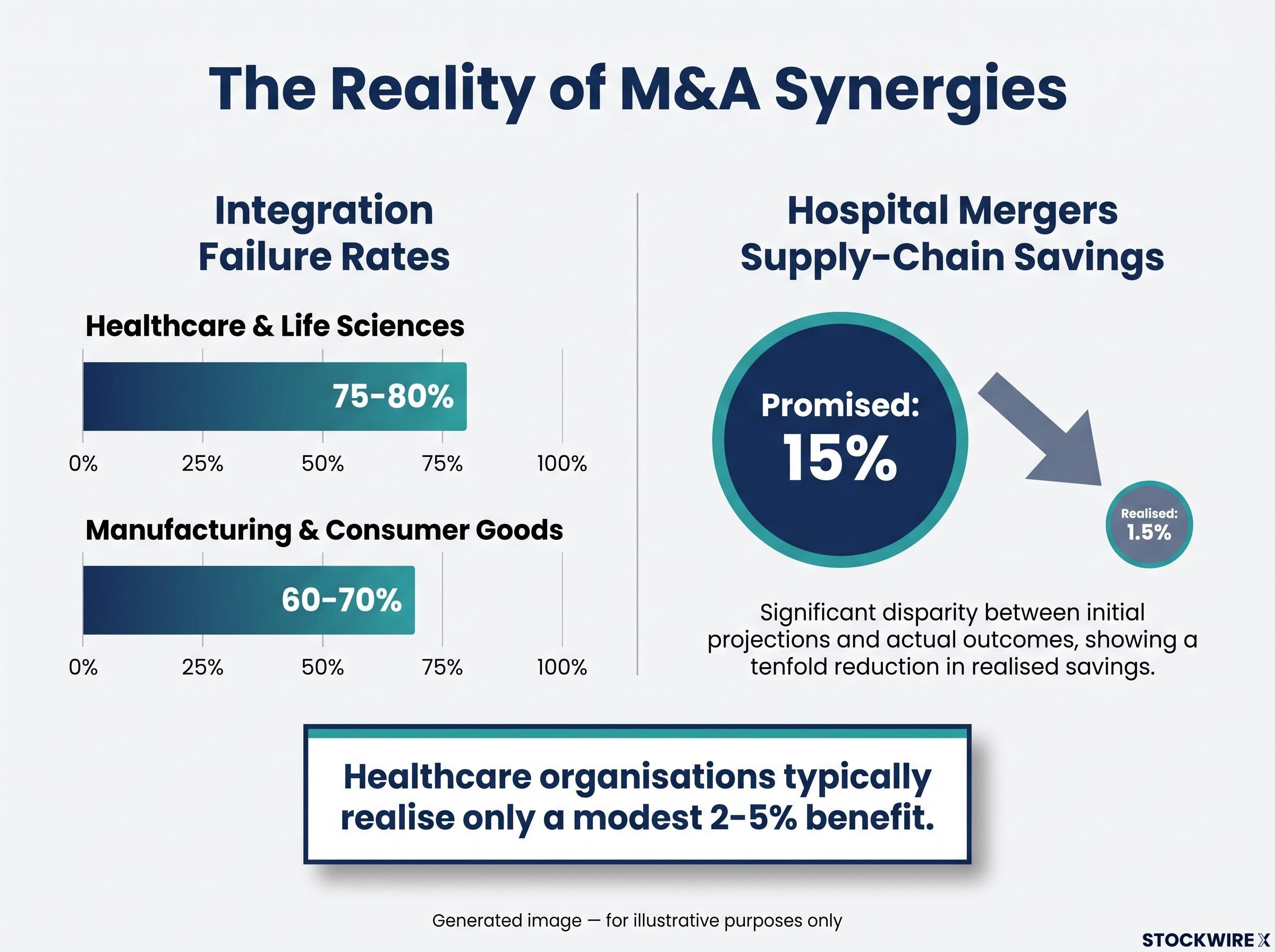
Healthcare and life sciences integrations are estimated to fail at a rate of 75-80%, higher than manufacturing and consumer goods at an estimated 60-70%.
That failure rate should reset your baseline. It tells you the default expectation for any announced deal is that the promised savings will not fully materialise, so structural evidence, not narrative, is what you should demand before committing capital.
The gap between what management identifies and what actually lands is the core of the issue. Healthcare organisations often flag substantial theoretical synergies but typically realise only a modest 2-5% benefit. Hospital mergers frequently promise around 15% supply-chain savings and, on average, deliver roughly 1.5%. The theoretical number and the realised number live in different worlds.
Scale alone does not guarantee a deal even gets over the line, and Australia offers two useful reference points here. In March 2023, Australian Clinical Labs (ACL) launched a roughly $1.52 billion all-scrip reverse takeover of Healius. By December 2023, the ACCC blocked it, noting the combination would join two of the three largest providers and hand them over 50% of Approved Collection Centres nationally, substantially lessening competition.
Contrast that with imaging. In July 2024, Integral Diagnostics and Capitol Health agreed to combine around 60 radiology sites. The ACCC cleared that deal in December 2024, subject to divesting a single clinic in Victoria to address local overlap.
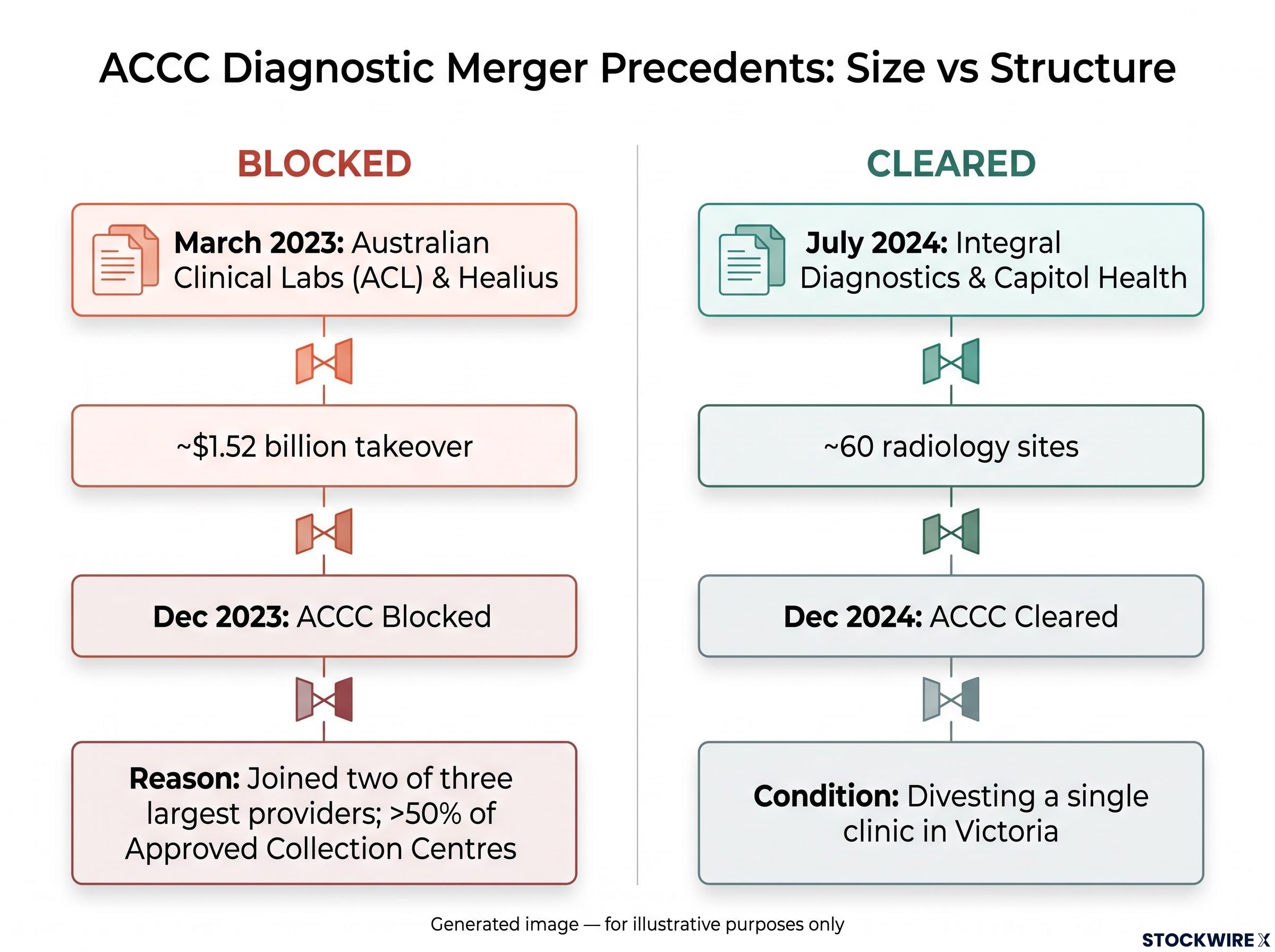
The lesson from both is the same. Sheer size does not make a deal work or even make it permissible. What matters is the structural reality underneath, and that is exactly what the next questions test.
The structural tests in this framework sit alongside the broader pre-bid positioning discipline that shapes how investors approach Australian small-cap M&A, where takeover premiums typically run 20-40% above pre-bid trading prices and the structural form of a deal, scheme versus bid, materially affects the final offer price.
When big ASX news breaks, our subscribers know first
Assessing structural fit across platforms and buyers
The first four questions require no insider knowledge and no financial modelling. They test the absolute baseline of whether these two businesses can actually share anything, and you can answer most of them from public filings alone.
The diagnostics sector is instrument-dependent in a way that few other industries match. The analyser a test runs on determines which resources two products can share between them. Get this wrong and everything downstream, the synergies, the headcount savings, the efficiency story, falls apart.
Questions 1 and 2: the instrument and the customer
Question one is the single most determinative test available to you. Do the two products run on a shared analyser platform?
If they do, the two tests can jointly use manufacturing, service infrastructure, field support, and customer training. If they run on different platforms, they share almost none of that. You are looking at duplicated everything.
There is a second, quieter problem when platforms differ. Merged laboratory groups often inherit clashing standard operating procedures and a tangle of customised laboratory information management systems, sometimes called a “LIMS zoo”. A laboratory information management system is the software that tracks samples and results through a lab. When those systems and procedures do not match, samples and data cannot be routed efficiently, and the promised savings never arrive.
Question two tests the buyer. Exposure to the same broad healthcare sector is not the same as a shared customer.
Each of a hospital microbiology lab, an oncology department, and a direct-to-consumer buyer represents a fundamentally distinct customer type, with its own budget cycle, purchasing process, and approving stakeholders. Sales experience built in one of those channels barely transfers to another.
Questions 3 and 4: revenue structure and predictability
Question three asks whether the two revenue streams are reimbursed or discretionary. Reimbursed revenue is tied to billing codes, payer relationships, and jurisdiction-specific approvals that can take years to secure. Consumer-paid revenue runs on different margins, different volatility, and heavy marketing spend.
Combine the two and you do not get a blended average. You get management running two unrelated commercial models at once.
Question four looks at recurring versus transactional revenue. Long-term contracted revenue from an installed base of instruments behaves nothing like episodic, one-off test sales. The cash flow profiles differ, the forecasting reliability differs, and the valuation logic differs, which makes a combined entity hard to assess through any single lens.
The simple test to hold in your head is this.
| Shared platform realities | Separate platform realities |
|---|---|
| Shared manufacturing and reagent supply | Duplicated manufacturing and facilities |
| Common field service and support teams | Two separate service infrastructures |
| Unified training and standard procedures | Clashing SOPs and a “LIMS zoo” |
| One buyer profile and sales motion | Multiple distinct buyers and sales models |
If the two companies share neither a hardware platform nor a specific buyer profile, treat them as two separate businesses being duct-taped together, not a unified operation.
Testing the hidden infrastructure of regulations and sales
Even where the products look aligned, integrations get killed by the unglamorous parts nobody puts on a slide. Questions five and six force you to look past the product and at the infrastructure sitting behind it.
Question five is regulatory. Clearances such as TGA or FDA approvals are technology- and platform-specific, and they do not transfer between products. A clearance won for one test on one platform gives you no shortcut, no precedent, and no transferable expertise for a different technology.
That means a combined company usually has to maintain two entirely separate regulatory files through the transition and often well beyond it. There is a compliance risk layered on top. Migrating data into a central system carries validation risk, and accreditation standards like ISO 17025, ISO 15189, and GxP do not tolerate integration errors. A botched IT or regulatory migration can put accreditation itself at risk.
Question six is about the sales force. Diagnostics sales teams are not interchangeable parts you can slot into any product.
Selling a high-throughput laboratory instrument, a consumer subscription, and a specialist oncology test each demand meaningfully different skills. Management frequently discovers, after the deal closes, that both original sales teams have to stay, which quietly deletes the anticipated headcount savings.
Attrition makes it worse. In diagnostics acquisitions, employees, suppliers, and distributors often resist being moved onto a new platform or entity, and the people most likely to leave are the ones holding knowledge that is hardest to replace.
The elements that simply do not transfer between two differing diagnostics companies include:
- Regulatory clearances and approval pathways, which are tied to specific technologies
- Quality management systems and accreditations such as ISO 17025, ISO 15189, and GxP
- Standard operating procedures and laboratory information systems
- Specialist sales knowledge specific to each buyer and product type
When there are no shared regulatory files and no shared sales expertise, the read is straightforward. The combined company will likely keep paying for both original teams indefinitely, so you should adjust any promised headcount savings toward zero.
Evaluating synergy math and leadership execution
Here is the uncomfortable part. A combination can pass every structural test above and still destroy value, either because the synergy math was forced or because the people running the integration have never done one. Questions seven and eight move from structural fit to execution.
Question seven asks whether the stated cost synergies are realistic. In small-cap life sciences, the genuinely removable costs are usually concentrated in corporate overhead: one board instead of two, one audit engagement, one set of listing fees. Operational headcount rarely comes out if the businesses run different platforms, serve different buyers, and keep separate regulatory files.
The costs of getting there are real and consistently understated. In life sciences M&A, the median integration cost sits at 10.3% of target revenue, the highest of any major sector. That is the figure most announcements leave out.
So run the payback test yourself.
- Take the stated annual saving from the announcement.
- Estimate the one-off integration cost, using the life sciences median of around 10.3% of target revenue as a starting reference.
- Divide the integration cost by the annual saving to get the payback period in years.
- Treat any multi-year payback as a red flag.
A payback that stretches over several years tells you the synergy figure is probably not the real reason for the deal.
Question eight is about who is running the integration. Executing a merger is a distinct skill, separate from operating a business or negotiating a transaction, and in diagnostics, sector-specific integration experience carries more weight than general dealmaking experience.
The evidence here is consistent. So-called programmatic acquirers, teams that do frequent, disciplined deals, tend to outperform sporadic dealmakers who take on one large transaction and suffer organisational indigestion. Frequent acquirers with prior industry experience are also better at spotting targets where synergies genuinely exist, through simple learning-by-doing.
The read for you is defensive. Where leadership and the board have never run a comparable integration, execution risk rises, and that risk should be reflected in the price you are willing to pay.
The performance gap between programmatic acquirers and sporadic dealmakers is most visible in software, where Constellation Software’s decentralised acquisition architecture, closing sub-$20 million deals without head-office approval, has compounded returns over decades in a way that one-off large transactions rarely replicate.
This article is for informational purposes only and should not be considered financial advice. Investors should conduct their own research and consult with financial professionals before making investment decisions.
Past performance does not guarantee future results. Financial projections are subject to market conditions and various risk factors.
Calculating the final score on any proposed combination
Put the eight questions together and you have a simple scoring method you can apply to any diagnostics deal, including ones not yet announced.
Questions one through six test structural fit. Six affirmative answers point to credible grounds for genuine operational overlap. One or two affirmative answers tell you something different: this is a primarily financial transaction, which is not inherently bad, but it should be judged on financial criteria and described in financial language, not dressed up as “complementary capabilities”.
Questions seven and eight are a separate fail-safe. A deal can pass every structural test and still fall over if the synergy math needs a multi-year payback to work, or if the leadership has never run an integration in this sector. Structural fit and execution capability are independent. You need both.
None of this argues against consolidation. Industry combinations routinely create value when the businesses genuinely share a platform and a buyer, and when the team steering the integration has done it before.
The point is narrower and more durable. Before you accept the word “complementary”, test it against these eight questions. If it survives, the deal may be exactly what it says. If it does not, you have just protected yourself from mistaking a press release for a strategy.
For investors wanting to move from structural assessment to active target identification, our dedicated guide to spotting biotech acquisition signals examines the five pre-bid indicators that correlate most strongly with large-pharma takeout interest in life sciences small-caps.