Takeover premiums in Australian small-cap acquisitions typically run 20% to 40% above pre-bid trading prices, yet most retail investors only learn about a deal after the share price has already moved. The gap between those who capture that premium and those who chase it comes down to one thing: understanding why deals happen, which companies attract them, and how to act at each stage of the process.
The mid-2026 Australian market is running an active gold and resources merger and acquisition cycle alongside technology sector consolidation, making small-cap M&A a live and immediately relevant topic. What follows is a structural framework for reading these cycles, identifying high-probability targets before a bid lands, and making the correct hold, arbitrage, or redeployment decision at each stage of a deal. Three recent Australian case studies put the framework to work with real numbers.
Why Australian small-cap M&A happens in waves, not randomly
Takeovers are not random events. They cluster into sector-specific waves, and those waves are driven by three structural forces that, when they converge, make deal activity not just likely but close to inevitable.
- Cost of capital: When interest rates fall, debt financing costs for private equity acquirers drop. PE funds sitting on accumulated dry powder begin deploying it, and small-cap companies, with their lower enterprise values and wider valuation discounts, become natural targets.
- Commodity price cycles: High commodity prices generate the cash flows and elevated scrip values that fund resource sector acquisitions. Within a single bull market, deal activity cascades down the capitalisation spectrum in a predictable sequence.
- Valuation gaps: Broad sector de-ratings, driven by macro forces rather than company-specific deterioration, create windows where acquirers can buy strategic assets at prices that would not exist in a normally valued market.
The 2024-26 period is a convergence moment. Falling rates, significant PE dry powder, and historically wide small-cap valuation discounts to large caps are all pointing in the same direction. Small caps have historically outperformed during monetary easing and early-cycle recoveries, and those same periods coincide with higher M&A activity.
The commodity supercycle thesis underpinning the current gold and resources M&A wave rests on four demand pillars: AI data centre copper intensity, grid expansion, EV adoption, and defence spending on rare earths; major mining companies currently trade at roughly 7-8x EV/EBITDA compared to approximately 14x during the 2008-2010 boom, a valuation gap that institutional capital has been closing at pace and that sustains the financing conditions for further consolidation.
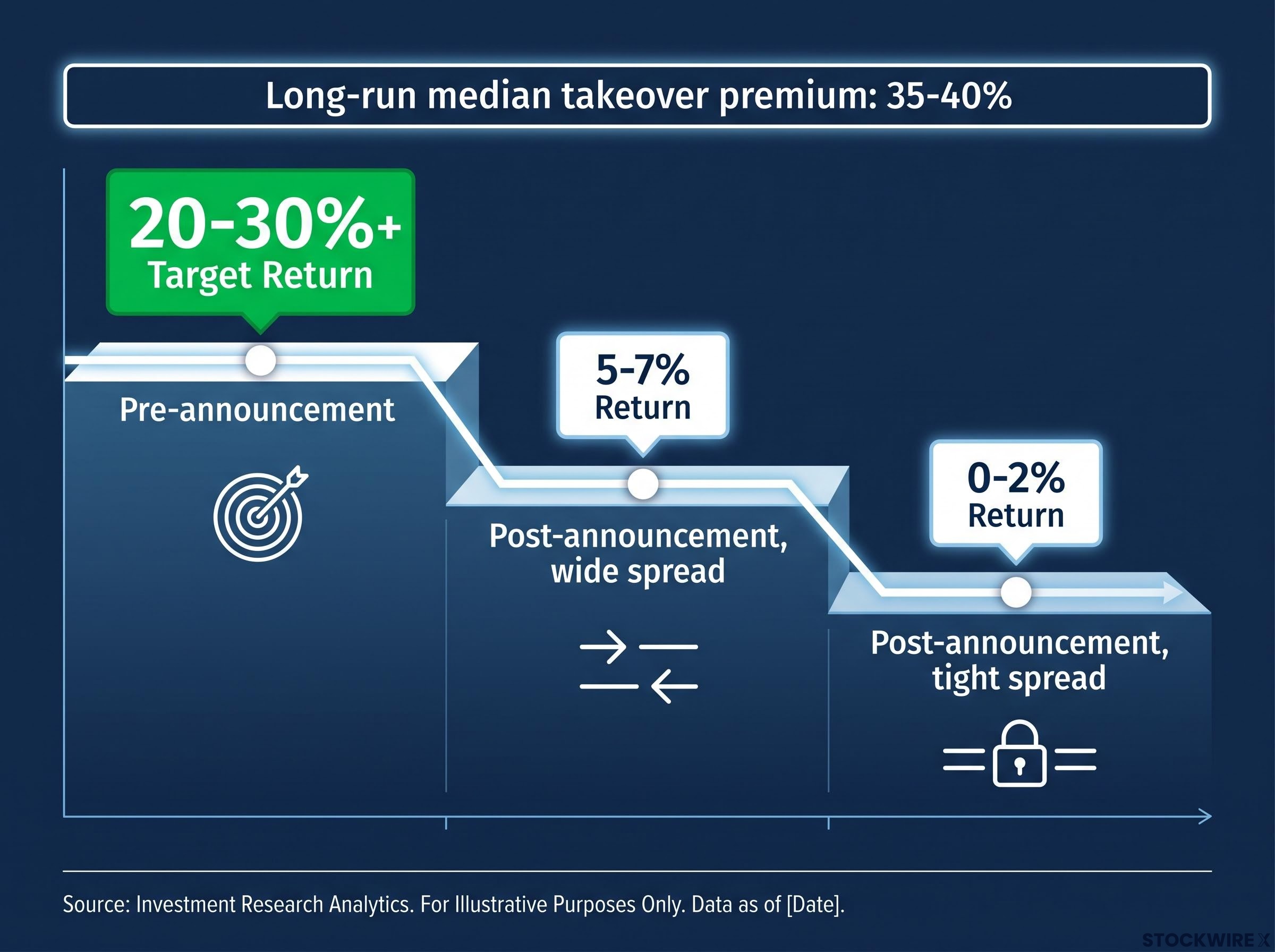
The long-run median takeover premium for Australian small caps sits around 35-40% over pre-bid trading prices, anchoring the structural case for why pre-bid positioning generates returns that post-announcement arbitrage cannot replicate.
Understanding these three drivers shifts M&A from an unpredictable event to a structurally anticipatable one. The rest of this framework builds on that foundation.
When big ASX news breaks, our subscribers know first
How commodity cycles move M&A down the cap spectrum
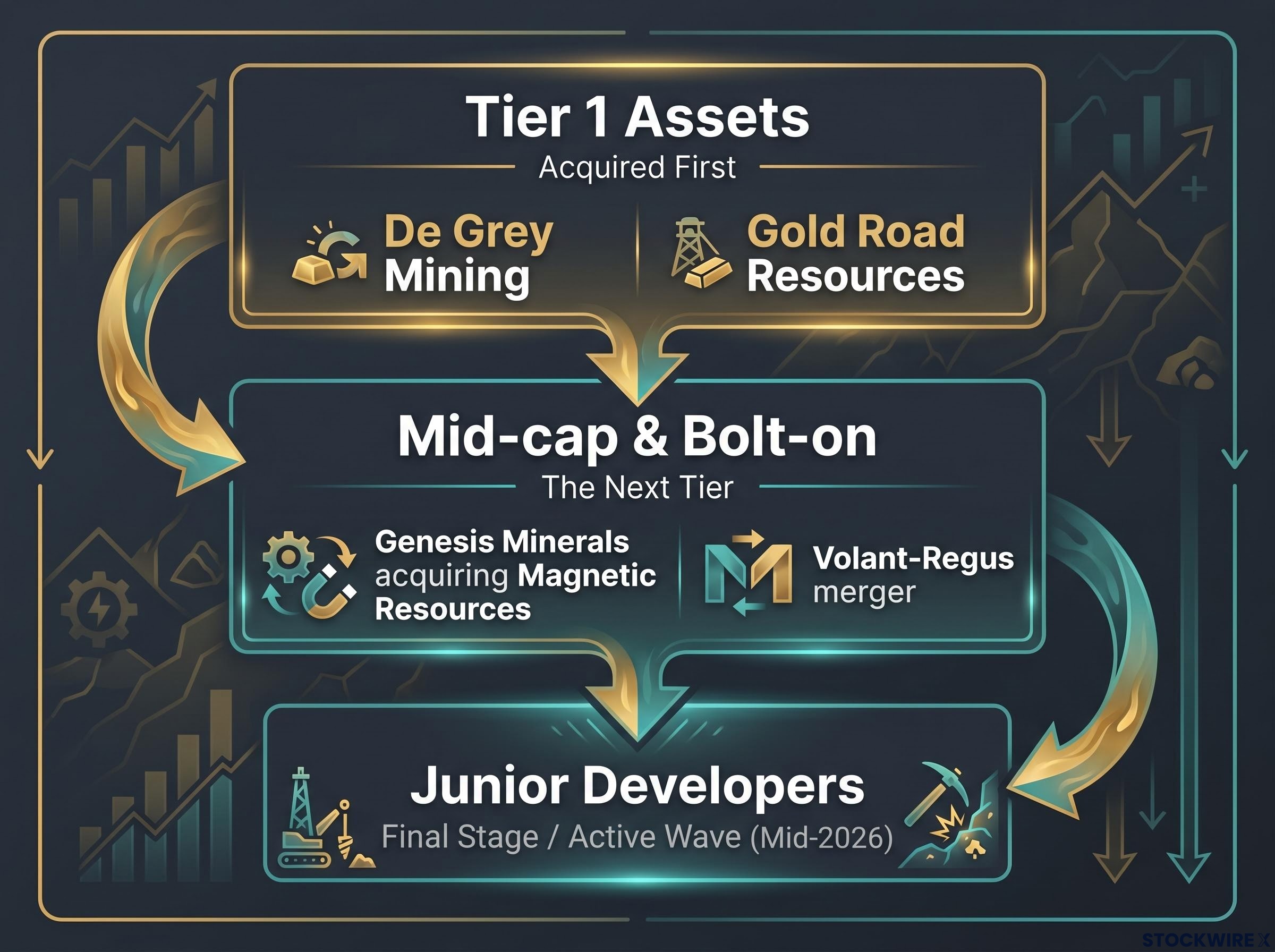
Within a single resource bull market, deal activity does not arrive all at once. It cascades down the capitalisation spectrum in a consistent and observable sequence:
- Tier 1 assets are acquired first, as the largest producers and highest-quality deposits attract bids from major miners flush with cash flow.
- Mid-cap transactions and bolt-on acquisitions follow, as acquirers who missed the Tier 1 window, or who need to replace depleted reserves, turn to the next tier.
- Junior developers are the final stage, as the valuation gap migrates to the smallest companies and the remaining unacquired assets.
This pattern is not theoretical. It is visible in real time.
The current gold and resources cycle in practice
The Australian gold cycle has already moved through its upper tiers. De Grey Mining and Gold Road Resources were acquired at the Tier 1 level. Genesis Minerals acquiring Magnetic Resources and the Volant-Regus merger of equals represent mid-cap consolidation. The wave is now at the junior developer stage.
The Regis and Vault merger, an all-scrip deal creating Australia’s third-largest ASX gold producer at over 700,000 ounces per year, illustrates the mid-cap consolidation phase in real time: Regis shares fell roughly 14% within 48 hours of announcement, consistent with the acquirer sell-off pattern that frequently emerges when the synergy logic is sound but the market prices in execution risk and scrip dilution ahead of deal close.
BHP and Rio Tinto positions in comparable portfolios were reported up approximately 35-40% as of early June 2026, consistent with ongoing commodity market strength that sustains the conditions for further deal activity. In tin, Metals X produces approximately 11,000 tonnes per year (around 4% of estimated global supply), providing the operational scale that makes junior tin developers logical acquisition targets.
The investor edge is positional. Recognising where the wave currently sits, at the junior developer stage, identifies where the next tranche of premiums will be captured before the bids arrive.
The anatomy of a high-probability takeover target
Knowing that a sector is in an active M&A cycle is necessary but not sufficient. The question that converts macro awareness into stock selection is: which specific company actually gets taken over?
A high-conviction M&A setup typically requires three conditions working together:
- Clear pre-deal synergy logic: the acquirer can articulate a specific operational, geographic, or financial rationale for the combination
- A constrained buyer universe: one or two obvious acquirers, reducing the complexity of predicting who will move
- A realistic path to closing: board receptivity, regulatory environment, and deal structure all need to be plausible
The screening criteria differ by sector.
| Resources Targets | Technology Targets |
|---|---|
| Proximity to existing mills or smelters operated by logical acquirers | Recurring revenue above 70%, serving government or institutional clients |
| Sub-scale producers with identifiable larger neighbours | Recent de-rating driven by sector-wide concerns, not company-specific deterioration |
| Development capital requirements creating incentive for processing deals | Founder-led businesses with disclosed strategic reviews or inbound interest |
One additional signal warrants attention: a strategic stake of 10-20% or more by a logical buyer. This validates the thesis and signals acquirer interest, but it also carries a limitation. A blocking stake can deter competing bidders, reducing the probability of a competitive auction and potentially capping the final offer price.
Pre-bid versus post-announcement: the decision that defines your return
Most investors treat M&A investing as a single activity. It is not. There are three distinct stages, and each demands a fundamentally different decision framework.
| Stage of Deal | Key Decision | Target Return Profile |
|---|---|---|
| Pre-announcement | Size position for timing and price uncertainty | 20-30%+ if thesis pays off |
| Post-announcement, wide spread | Assess deal risk against available spread | Single-digit return, high IRR if time to close is short |
| Post-announcement, tight spread | Treat as cash equivalent; redeploy capital | 0-2% remaining; focus on opportunity cost |
Pre-bid positioning targeting 20-30% or more is a structurally different activity from merger arbitrage on a 5-7% narrow spread. Conflating the two leads to either overpaying for a deal already announced or exiting too early on a wide spread that was worth holding.
One structural feature of Australian M&A reinforces this distinction. When an acquirer structures a deal as a scheme of arrangement rather than an off-market takeover bid, the offer price is typically higher.
Schemes of arrangement require 75% approval by votes cast plus a majority of shareholders by number. Acquirers pay up for the certainty and clean execution a scheme provides, which is why scheme offers consistently exceed takeover bid prices for the same target.
ASIC Regulatory Guide 60 on schemes of arrangement sets out the Commission’s role in reviewing scheme documents, the matters it considers before issuing a no-objection statement, and the shareholder approval thresholds that apply under Part 5.1 of the Corporations Act 2001, providing the formal regulatory basis for the premium pricing that scheme structures consistently attract.
Understanding which stage of the deal lifecycle a position occupies determines whether the correct action is to hold, to capture the spread, or to redeploy.
Three Australian deals that show the framework in action
Stellar Resources and Metals X: when validation is not the same as return
Stellar Resources is developing what is classified as the highest-grade undeveloped tin project in Australia (and the third-highest globally), located approximately 18 kilometres from the Metals X-operated Renison processing facility. The synergy logic is specific: Stellar’s ore could be processed through the existing Renison mill rather than requiring a standalone facility, which would be highly capital-intensive.
In April 2026, Metals X acquired a strategic stake in Stellar via a placement at approximately 3.3 cents per share. The thesis was validated. The position was exited.
- The reasoning: a formal takeover bid within the same year as a strategic placement is unlikely. The stake functions as a blocking position and first-mover advantage rather than a signal of imminent acquisition. Reduced competitive tension following the placement further diminished the forward return profile.
- The lesson: reassess the remaining risk-return opportunity after a strategic placement, even when the original thesis is confirmed. Validation and forward return are two separate questions.
RPM Global and Caterpillar: capturing the spread and knowing when to stop
RPM Global, an Australian mining software company, was acquired by Caterpillar in a transaction announced in October 2025 and closed in February 2026. During the post-announcement period, shares traded at approximately $4.70 against a $5.00 offer price.
The rationale for holding through close was straightforward: no competing bidder would realistically challenge Caterpillar’s financial scale, making deal risk low and the spread worth capturing. Once the share price narrowed to within a few cents of the offer price, the position was liquidated and capital redeployed.
- The lesson: the wide-spread hold and the tight-spread exit are two distinct decisions. The first is driven by deal risk assessment; the second is driven by opportunity cost. They should not be conflated.
ReadyTech and Constellation Software: right thesis, wrong return
ReadyTech (ASX: RDY) operates mission-critical software platforms serving TAFEs, education institutions, government, and legal sectors. The takeover thesis proved directionally correct: a subsidiary of Constellation Software (Topicus/Total Specific Solutions) announced an offer in late May/early June 2026, structured at approximately $1.75 per share via takeover bid or $2.00 via scheme of arrangement.
The offer came in below expectations. A February earnings result had disappointed the market, with no meaningful contract progress reported, and the stock’s illiquidity amplified the negative price reaction. As of June 2026, the share price was trading below the stated offer price, and the ReadyTech board had rejected the initial offer.
- The $0.25 differential between the bid price and the scheme price illustrates the structural premium acquirers pay for scheme certainty.
- The lesson: directional correctness on the takeover thesis is necessary but not sufficient. Price, timing, and earnings trajectory all determine realised return.
For investors wanting to understand why Constellation Software was the logical acquirer of ReadyTech rather than a domestic ASX peer, our deep-dive into the Constellation Software acquisition model examines how the company contacts up to 100,000 vertical market software businesses annually, why its decentralised approval structure lets it close deals faster than competitors, and how that engine is now expanding into larger transactions.
Liquidity, sizing, and the margin of safety in small-cap deals
A correct thesis with wrong position sizing produces the same outcome as a wrong thesis. In illiquid small-cap names, both entry and exit can move the price materially, creating a structural asymmetry that demands more conservative sizing and a larger margin of safety than equivalent positions in liquid names.
The ReadyTech earnings miss is a live illustration. In a more liquid stock, the same result would have produced a measured decline. In ReadyTech’s thin trading volumes, the reaction was amplified, compounding losses on a position where the underlying takeover thesis was ultimately validated.
Practical rules for M&A position sizing:
- Size pre-bid positions to reflect both timing uncertainty (no guarantee of when or whether a bid arrives) and liquidity risk (the inability to exit without moving the price)
- Set return thresholds that compensate for illiquidity; a 20-30% minimum expected return for pre-bid positioning reflects this
- Treat post-announcement tight-spread positions as near-cash and redeploy into higher-returning setups
- Reassess the forward return profile after any strategic stake acquisition by a third party, regardless of whether the thesis is validated
A tight-spread position earning 1-2% competes directly against the next pre-bid setup targeting 20-30%. The opportunity cost of holding through close when the spread has collapsed is real and measurable.
Where the next wave is building in mid-2026 Australia
The macro conditions for small-cap M&A in mid-2026 are structurally supportive. Falling rates are reducing acquisition financing costs for both PE and strategic buyers. PE funds are deploying accumulated dry powder. Small caps continue to trade at wide valuation discounts to large caps across multiple sectors.
Two active fronts are visible.
Resources: the junior developer wave
The gold and tin M&A cycles have moved through their Tier 1 and mid-cap phases. The wave is now at the junior developer stage, where the remaining valuation gaps are widest and the pre-bid positioning premiums are available. The Metals X stake in Stellar Resources is a live example of this stage in motion: the strategic logic is established, the blocking position is acquired, and the question is timing rather than whether consolidation occurs.
Technology: mission-critical software consolidation
Falling rates are also catalysing PE-driven M&A in software and services. The high-probability target profile mirrors the ReadyTech setup: recurring revenue above 70%, mission-critical platforms serving government and institutional clients, and recent de-rating driven by sector-wide concerns (interest rate sensitivity, AI disruption) rather than company-specific deterioration. The Constellation Software bid for ReadyTech is a live example of this consolidation trend.
CGT reform timing creates an additional seller-side incentive that is compressing deal windows in the technology sector: with the 50% CGT discount being replaced by cost-base indexation and a 30% minimum rate from 1 July 2027, founder-controlled software businesses face meaningfully higher exit tax burdens after that date, adding urgency to strategic sale processes that would otherwise have extended over a longer horizon.
The framework built in this article exists to identify the next Stellar, the next RPM Global, the next ReadyTech, before the announcement rather than after.
Positioning before the bid: the framework in one place
The six questions that constitute a pre-investment M&A checklist:
- Is there a clear, articulable synergy rationale for a specific acquirer?
- Is the buyer universe constrained, ideally one or two logical acquirers, reducing execution uncertainty?
- Is the path to closing realistic given board dynamics, regulatory environment, and deal structure?
- Has any acquirer already taken a strategic stake, and if so, how does that affect competitive tension and the forward return profile?
- What is the liquidity profile, and is the position sized with sufficient margin of safety?
- What stage of the deal is this (pre-announcement, wide spread, or tight spread) and is the position sized for the correct risk-return profile?
M&A premiums close valuation gaps that organic re-ratings fail to deliver. A long-run median premium of 35-40% is not an anomaly; it is the structural price of speed, certainty, and synergy that acquirers pay and that pre-bid positioning captures. That is why the edge is real, persistent, and worth building a disciplined framework around.
This article is for informational purposes only and should not be considered financial advice. Investors should conduct their own research and consult with financial professionals before making investment decisions. Forward-looking statements regarding M&A activity and market conditions are speculative and subject to change based on market developments and company performance.