
Glioma has been imaged with MRI for decades, yet clinicians have had no reliable way to tell tumour regrowth apart from the inflammation caused by the very treatment meant to kill it. On 11 September 2026, Telix Pharmaceuticals closed that gap with a single FDA approval.
Pixclara (floretyrosine F-18) is now the only FDA-approved radiopharmaceutical imaging drug for glioma in the United States, ending a diagnostic blind spot that has led to premature therapy switches, unnecessary surgeries, and delayed escalation for patients who needed it most.
For Telix shareholders, the approval confirms an ambition that reaches well beyond the company’s prostate imaging roots. It also lands at a moment when brokers are uniformly bullish, but valuation views diverge meaningfully between Morningstar and the wider sell-side.
This maps exactly what the Telix Pixclara stock story does and does not change: clinically, commercially, and for the share price. The gap between the muted net share move and the analyst consensus target is worth understanding before you draw any conclusion about where Telix sits today.
The diagnostic problem Pixclara was built to solve
Picture the moment a neuro-oncologist sits across from a glioma patient with a fresh MRI on the screen. The scan shows change. What it cannot say is whether that change is the cancer coming back or the treatment working exactly as intended.
That ambiguity is not a rare edge case. Glioma is the most common form of brain cancer, accounting for roughly 30% of all brain tumours and around 80% of malignant brain tumours, according to research cited by Morningstar. When the standard imaging tool cannot resolve the central question, the cost falls directly on the patient.
The clinical term for the trap is pseudoprogression: post-treatment imaging changes that mimic true tumour progression. MRI cannot reliably tell the two apart, and acting on the wrong reading carries real consequences.
Misreading pseudoprogression as genuine disease progression can push clinicians to:
- Stop effective chemoradiation too early
- Switch systemic therapy prematurely
- Subject patients to unnecessary surgery or biopsy
The mirror-image error is just as damaging. Dismiss true progression as harmless treatment effect, and escalation to second-line therapy or re-resection arrives too late.
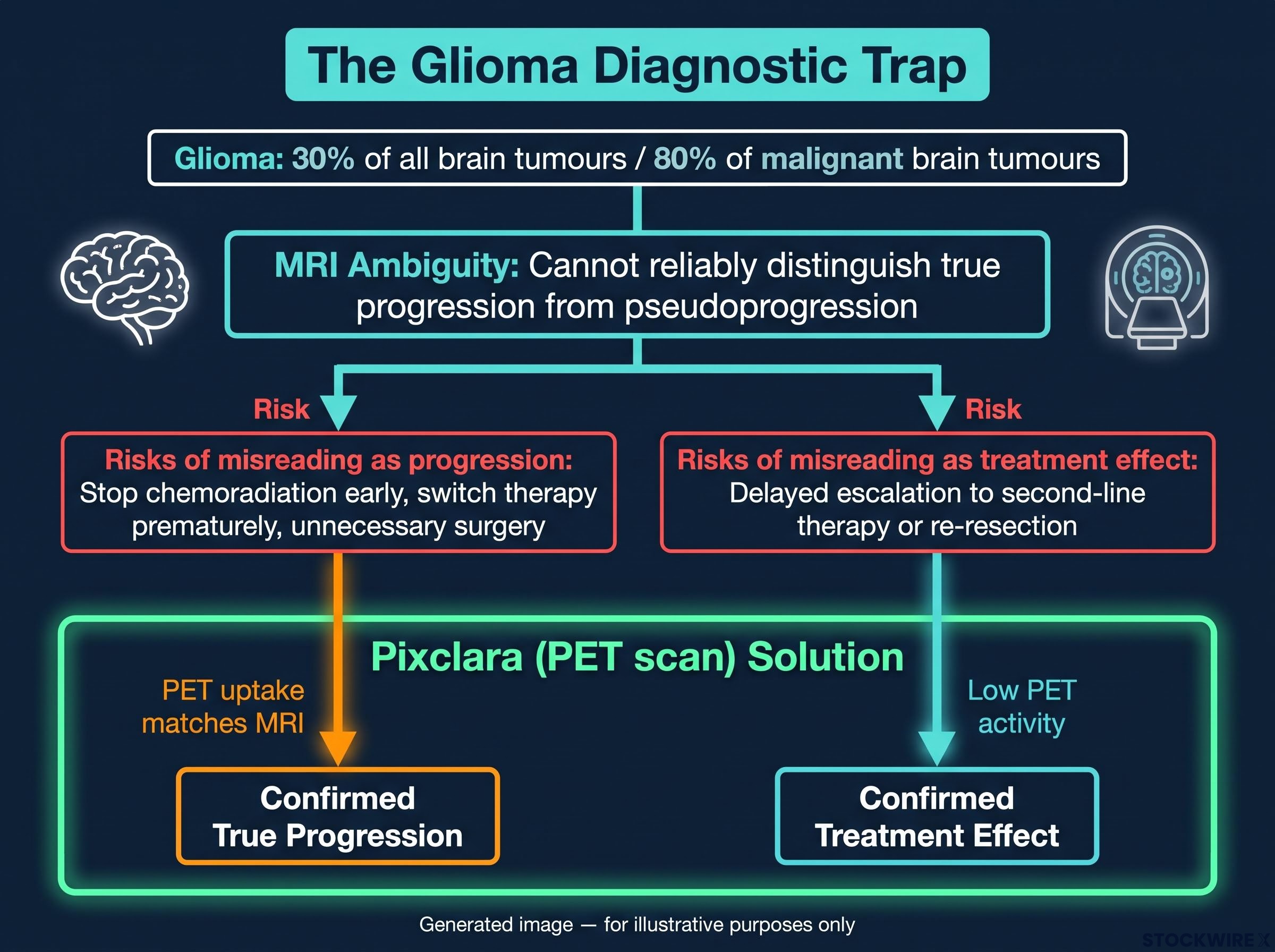
Pixclara is designed to settle that question with a single positron emission tomography (PET) scan, a test that measures how tissue takes up a radioactive tracer to reveal metabolic activity. Where PET uptake matches the MRI changes, true progression is confirmed. Where PET activity is low, the change reads as treatment effect, and the patient avoids an invasive procedure.
Telix’s official FDA approval announcement confirms Pixclara as the first FET-PET imaging agent to hold a US glioma indication, a regulatory milestone that now positions the company to pursue formal payer coding and standard-of-care inclusion across neuro-oncology centres.
FDA labeled indication “For use with positron emission tomography (PET) to differentiate recurrent or progressive glioma from treatment-related change, in conjunction with other diagnostic evaluations, in adults and pediatric patients 1 month of age and older.”
Why the pediatric label matters
The label reaches children from one month of age, and that is clinically significant. Younger patients are especially vulnerable to the fallout of a wrong treatment call, and sparing them an unnecessary biopsy or surgery carries particular weight.
This is why the approval should not be read as a regulatory checkbox. Regulators granted Pixclara both Fast Track and Orphan Drug status precisely because they judged the unmet need serious. An entire category of glioma imaging did not exist at the FDA level in the US until this month.
When big ASX news breaks, our subscribers know first
What the FDA approval actually means for the market opportunity
Clinical validation is one thing. Turning it into revenue is another, and this is where the story gets more complicated.
Pixclara’s first-mover status is not just a marketing line. In the US, an approved label is the precondition for payer coding and payment, which makes regulatory approval a structural asset for reimbursement and standard-of-care positioning. Amino-acid tracers such as FET, FDOPA, and methionine have been used in Europe and in research settings for years, but none carries a formal US glioma indication. Pixclara now does.
That said, the theoretical opportunity and the realised revenue are separated by several friction points, and the order in which they bite matters for anyone modelling the ramp.
| Risk factor | Why it matters for revenue ramp |
|---|---|
| Reimbursement timeline | FDA approval does not guarantee favourable coverage; payers and CMS must be convinced of outcome benefit over MRI-plus-follow-up before coding and payment adoption accelerate. |
| PET workflow gaps | Many community hospitals treating glioma lack neuro-oncology-specific PET workflows, concentrating early uptake in major academic centres. |
| Neuro-oncology behaviour change | Radiologists and tumour boards must learn to interpret and trust FET-PET over MRI in ambiguous cases, a slow shift outside leading centres. |
| Supply and distribution | A short-half-life fluorine-18 tracer demands reliable production and logistics; disruptions directly constrain scan volumes. |
| Competitive entry | Success could draw well-resourced players such as Novartis, GE HealthCare, Siemens, Lantheus, and Bracco into the niche. |
Morningstar assumes Pixclara will be priced comparably to other fluorine-18 imaging agents, with no specific per-scan figure published. That keeps the pricing lever modest and puts the emphasis firmly on volume, which is exactly where the reimbursement timeline and community hospital uptake pace become the variables that decide whether early revenue meets Morningstar’s expectations or falls short.
Where the addressable market sits relative to Telix’s existing franchise
The Orphan Drug designation is itself an admission of scale. It is granted for conditions with limited patient populations, and glioma qualifies on incidence grounds well below prostate cancer.
Read Pixclara, then, as a revenue diversifier rather than a volume engine on the scale of Illuccix, Telix’s established prostate imaging product. It broadens the tumour coverage and reduces single-indication dependence without transforming the top line.
The pediatric label widens the eligible population modestly. It does not rewrite the market size.
The US approval is one half of a two-market regulatory push: Telix’s application for European marketing authorisation for the same compound, filed under the proposed brand name Pixlumi, targets approximately 67,500 annual European brain and CNS tumour diagnoses and, if granted, would extend the addressable population well beyond the US label.
How the share price moved and what the valuation gap tells you
The price data around the approval looks contradictory at first glance, and it is worth resolving rather than glossing over.
On the ASX, Telix traded at A$15.670 when the price-sensitive announcement landed, then climbed to an intraday high near A$17.65 to A$17.75, a gain of roughly 12% to 13%. Morningstar, meanwhile, reported the share price rose only about 4%. Both figures are accurate. The intraday number captures the peak immediately after the news; the 4% figure reflects the net move once the early spike faded through the session.
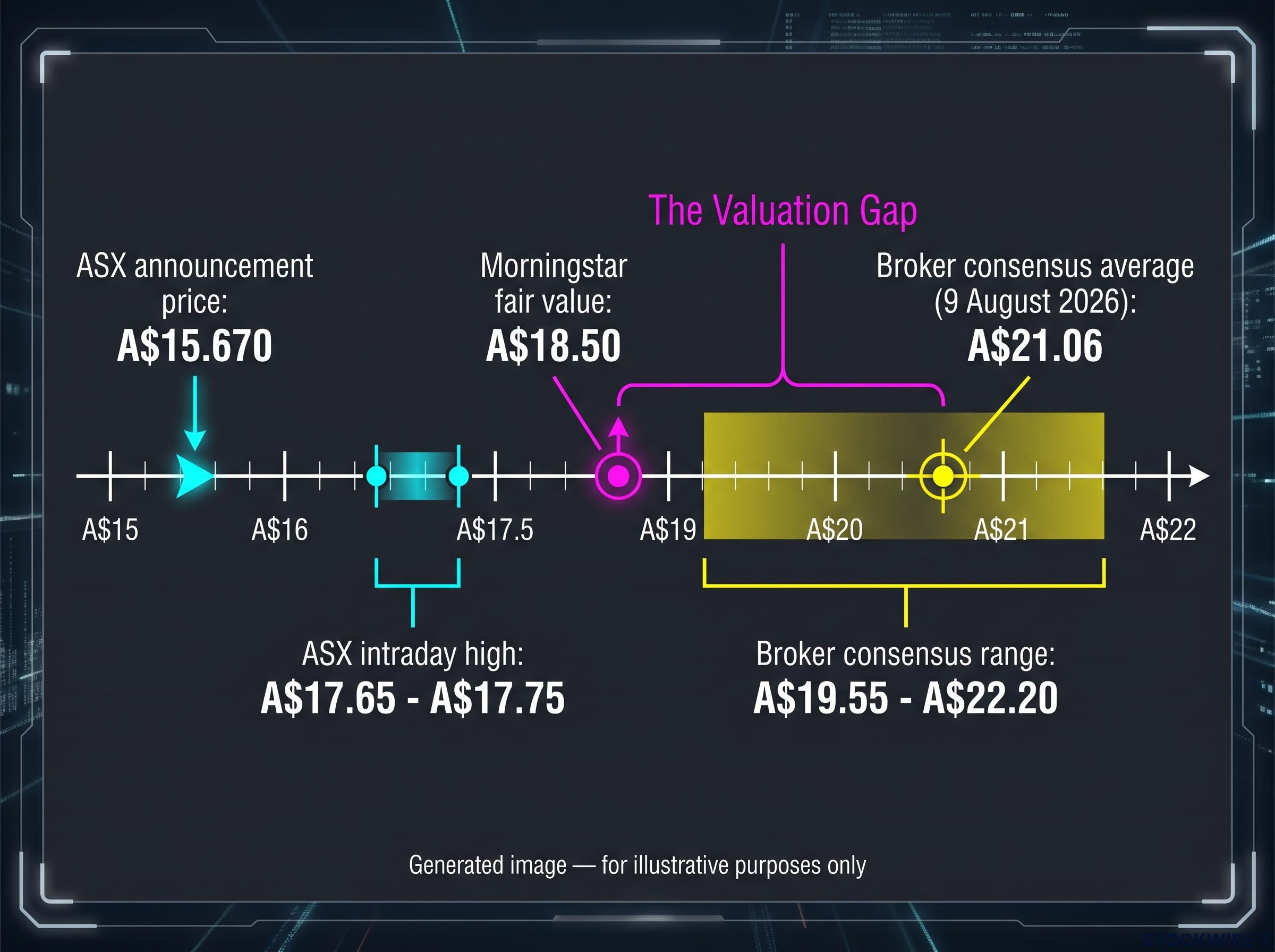
| Metric | Value | Context |
|---|---|---|
| ASX intraday high | A$17.65-A$17.75 | Roughly 12-13% above the A$15.670 announcement price |
| ASX net move | ~4% | Morningstar’s measure, net of the faded intraday spike |
| NASDAQ gap-up open | US$12.20 | Versus prior close of US$11.29 |
| Morningstar fair value | A$18.50 | Maintained unchanged post-approval |
| Broker consensus average | A$21.06 | Strong Buy, 5 of 5 analysts, as of 9 August 2026 |
| Broker consensus range | A$19.55-A$22.20 | Pre-approval targets |
| Morningstar moat rating | No moat | No structural competitive barrier |
The muted net close tells you something specific: the market had already partly priced the approval in. Morningstar, authored by Brian Han, held its fair value steady because prior forecasts had already booked initial Pixclara revenue from 2026. The FDA decision confirmed the base case rather than upgrading it.
Morningstar fair value: A$18.50 Han maintained the estimate unchanged after approval, characterising Telix shares as modestly undervalued.
The more interesting number is the gap between that A$18.50 fair value and the A$21.06 broker consensus. This is not simply a difference in optimism. It reflects genuinely different assumptions about competitive moat and long-term returns.
Morningstar assigns Telix a no-moat rating, meaning it does not see a structural barrier that assures returns above the cost of capital over time. In practice, that tells you Han is not convinced Telix can defend its economics against larger rivals indefinitely. The sell-side consensus, sitting more than A$2.50 higher, implicitly assumes stronger, more durable adoption. Where you land between those two figures depends entirely on which view of Telix’s competitive position you find more credible.
The valuation gap between Morningstar and the sell-side does not operate in isolation: a US$600 million convertible bond overhang and dual-listing arbitrage pressure were already weighing on the share price before the approval, structural headwinds that the A$18.50 versus A$21.06 spread only partly captures.
Pixclara’s role in Telix’s broader platform story
Step back from the single product, and the more consequential argument comes into focus. Pixclara is evidence, not just a launch.
It marks Telix’s shift from a prostate-focused imaging company into a multi-tumour radiopharmaceutical platform. The portfolio now reaches across three cancer types:
- Illuccix (Ga-68 PSMA, prostate): the established commercial product providing manufacturing, distribution, and launch infrastructure
- Pixclara (fluorine-18 FET, glioma): the newly approved neuro-oncology asset
- Gozellix (renal): the pipeline pillar extending coverage further
The regulatory sequence behind Pixclara is the real proof point. Fast Track designation, Orphan Drug status, an NDA resubmission, priority review, and full approval add up to a repeatable template Telix can apply to future niche oncology candidates. Each successful pass through that pathway strengthens the case that the company can secure differentiated imaging labels across multiple tumour types, not just one.
The regulatory sequence behind Pixclara is worth examining in detail: Fast Track designation, Orphan Drug status, and a successful NDA resubmission pathway each contributed to the outcome, and Telix’s FY2026 guidance at that stage excluded any Pixclara revenue contribution, meaning the approval represented pure commercial upside to prior forecasts.
That the approval was already in Morningstar’s numbers reinforces the point. This was anticipated execution, delivered on schedule, which is exactly the kind of predictability that supports a platform thesis.
The moat question and what it means for long-term shareholders
Here the bullish frame meets its most serious counterargument. A no-moat rating means sustained returns above the cost of capital are not structurally assured, and that has direct implications for how durable Pixclara’s advantage really is.
Intellectual property protection for Pixclara is limited relative to larger radiopharmaceutical peers. The same first-mover success that looks attractive today could invite well-capitalised entrants such as Novartis, GE HealthCare, and Lantheus into the glioma niche over a three to five year horizon, with the capital and distribution networks to compete hard.
Label expansion carries its own risk. Broadening Pixclara into earlier-stage disease or treatment-monitoring endpoints would require prospective clinical data and fresh regulatory review. If you weight Telix’s execution capability as a durable edge, the thesis holds together well. If you focus on the structural moat gap, the caution is warranted.
The competitive entry risk Telix faces is partly a function of broader radiopharmaceutical sector dynamics: over USD 6.5 billion in M&A from Novartis, Eli Lilly, and Bristol-Myers Squibb between 2023 and 2025 has positioned well-capitalised players with the distribution networks to contest any niche that demonstrates commercial proof of concept.
What the approval changes, and what it does not
Pull the threads together, and the honest read is neither cheerleading nor dismissal. Some things are now settled. Others remain genuinely open.
What the approval settles:
- Telix holds the first and only US-approved glioma PET imaging agent, a first-mover regulatory position with no competing approved product
- Analyst conviction is unanimous, with a Strong Buy across all five covering brokers as of 9 August 2026
- The share price sits between Morningstar’s A$18.50 fair value and the A$21.06 consensus, with a repeatable pipeline playbook now demonstrated
What remains open:
- The no-moat rating flags that competitive defence is not structurally assured
- Reimbursement pace and community hospital workflow integration are unresolved and will govern the revenue ramp
- The addressable market is smaller than Illuccix, and the broker consensus predates the approval, so it may not fully reflect post-approval modelling
The investor decision, then, is not a binary right-or-wrong call. It is a question of which assumptions you back. Buy Telix at current prices on the approval news, and you are effectively betting that reimbursement adoption and workflow integration proceed faster than the cautious assumptions built into Morningstar’s no-moat, A$18.50 valuation.
Understanding what drives the gap between A$18.50 and A$21.06 lets you weigh your own conviction rather than anchoring on either number as settled truth.
This article is for informational purposes only and should not be considered financial advice. Investors should conduct their own research and consult with financial professionals before making investment decisions.
Making a calibrated call on Telix at current prices
Pixclara’s approval is a genuine milestone. It is also one Morningstar had already baked into its forecasts, which is why the immediate earnings impact is smaller than the headline suggests.
The real test of the bull thesis will play out over the next 12 to 18 months, across three variables worth watching:
- The CMS reimbursement coding timeline, which determines how quickly scans get paid for and adopted at scale
- Scan volume growth at major academic neuro-oncology centres, the leading indicator of clinical uptake before community hospitals follow
- Any sign of competitive product development from larger radiopharmaceutical players moving into the glioma niche
At current prices, Telix trades at or modestly above Morningstar’s A$18.50 fair value and below the A$21.06 analyst consensus. Your margin of safety depends heavily on which framework you find more credible.
The science works. The path from here to shareholder return runs through the less exciting work of reimbursement negotiation, workflow adoption, and competitive defence, and that is where your view, not the FDA’s, will decide the outcome.
Past performance does not guarantee future results. Financial projections are subject to market conditions and various risk factors.