Most investors already know that buy-and-hold beats market timing. What they struggle with is the practical architecture that makes patience possible when markets turn volatile, life gets busy, and doubt creeps in.
Long-term investing is widely accepted as the right approach, but “invest for the long term” is not a strategy in itself. The real question is how you build a structured system that removes the temptation to overtrade, holds discipline through drawdowns, and compounds quietly without demanding your daily attention.
The Million Dollar Long-Term Investor model portfolio from Verified Investing is one specific, real-money answer to that question, co-managed by Chief Market Strategist Gareth Soloway and portfolio manager Lawton Ho. What follows breaks down how this portfolio is built, the evidence behind its approach, and what you should weigh before following a model like this. By the time you finish, you will have a clear mental map of how it works, why the philosophy is defensible, and where the genuine risks sit.
Why hands-off investing is harder than it sounds
Here is the uncomfortable truth about long-term investing: most people who fail at it are not failing because they lack information. They are failing because of how they behave when their money is on the line.
The psychology of investing creates a structural drag that no amount of additional research can fix, because the errors are not informational; they are mechanical responses to price movements that fire regardless of what the investor knows intellectually about long-run returns.
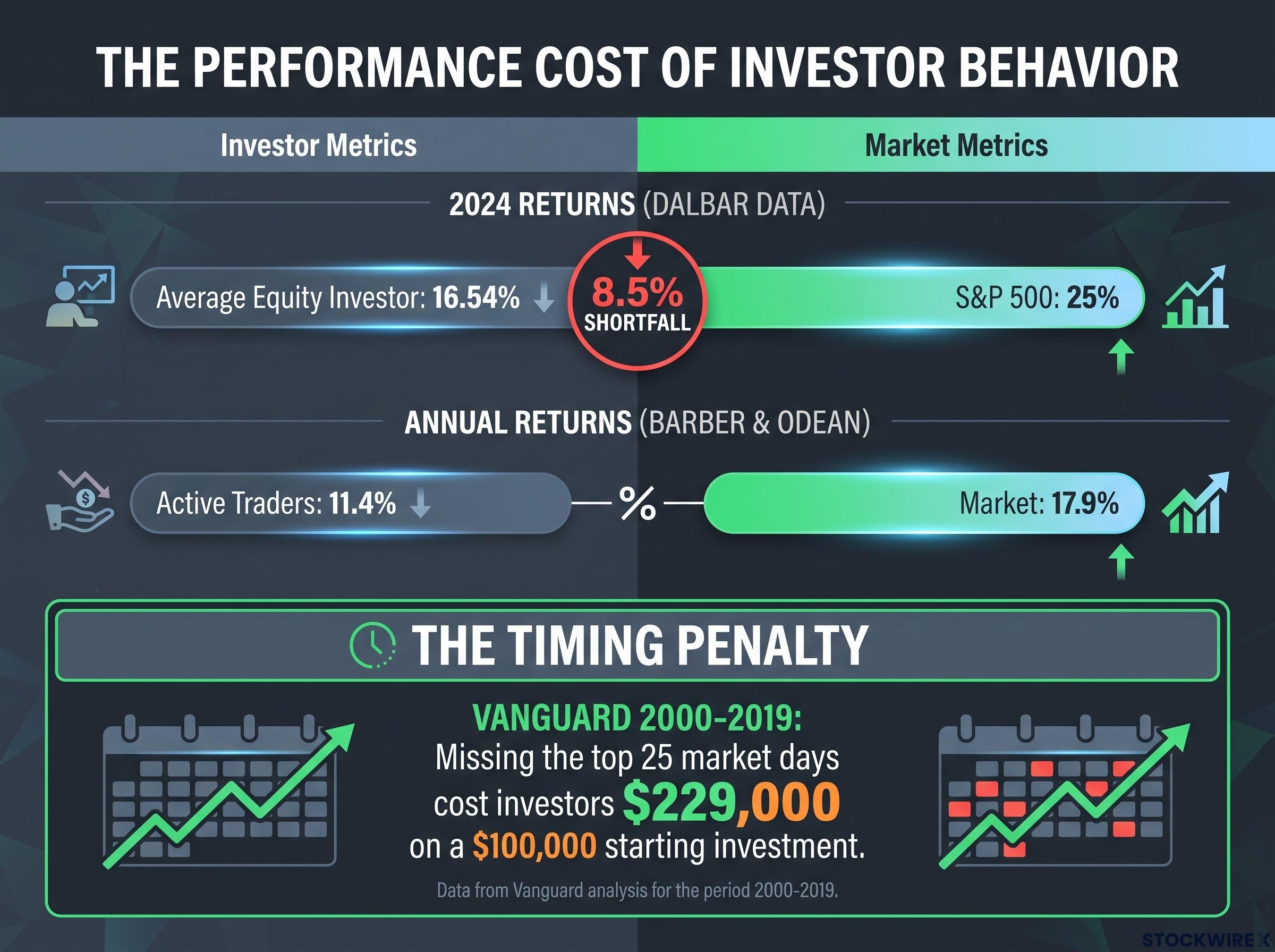
The data is blunt. According to Dalbar’s Quantitative Analysis of Investor Behavior for 2024-2025, the average equity investor earned 16.54% in 2024, while the S&P 500 returned roughly 25%. That is a shortfall of about 8.5 percentage points in a single year, and none of it came from bad stock picks. It came from timing, hesitation, and emotion.
Dalbar attributes this gap to a set of predictable behavioural errors:
- Loss aversion, where the pain of a loss drives you to sell at exactly the wrong moment
- Herding, where you follow the crowd into and out of positions
- Media-driven reactions, where headlines trigger trades
- Regret, where past mistakes distort your next decision
This is not a one-off finding. Barber and Odean’s landmark study, Trading Is Hazardous to Your Wealth, found that the most active individual traders paid a steep price for their activity.
Barber and Odean’s Trading Is Hazardous to Your Wealth established through analysis of more than 60,000 household brokerage accounts that overconfidence drives excessive trading, and that the most active traders paid the steepest performance penalty for it.
The most active individual traders earned just 11.4% annually, against 17.9% for the market itself. The more they traded, the further they fell behind.
The pattern holds when you look at timing specifically. Vanguard’s How America Invests study found that investors who missed the top 25 market days between 2000 and 2019 ended with roughly US$229,000 less on a US$100,000 starting investment than those who simply stayed fully invested. A handful of days, missed through nerves, reshaped the entire outcome.
And it is not as though professionals fix the problem for you. The S&P Dow Jones SPIVA U.S. Year-End 2024 Scorecard found that over the 15-year period ending December 2024, not a single category showed a majority of active managers beating their benchmark.
What all of this tells you is direct: the strategy most investors actually follow, watching the market and adjusting, is statistically likely to cost you several percentage points a year. Over two or three decades, that compounding gap is the difference between a comfortable retirement and a shortfall. For a busy professional juggling a career and a family, decision fatigue only deepens the problem, because every extra decision is another chance to get it wrong.
When big ASX news breaks, our subscribers know first
What the Million Dollar Long-Term Investor portfolio actually looks like
The problem is behavioural, so the solution has to be structural. This is where the model moves from abstract philosophy to something concrete you can actually see.
At the centre sits a transparent, real-money $1,000,000 reference portfolio that members follow. Transparency here is a design feature, not marketing gloss. Every position is visible, and the reasoning behind each decision is published rather than hidden.
The portfolio is co-managed by Gareth Soloway, who provides strategic oversight as Chief Market Strategist, and Lawton Ho, who handles day-to-day operations. Holdings concentrate on three categories, each doing a distinct job.
| Asset category | Primary function | Where it earns its place |
|---|---|---|
| High-quality established equities | Long-duration capital growth from durable businesses | Trending and expanding markets, where fundamentals compound |
| Dividend-paying stocks | Steady cash flow and psychological ballast | Flat or falling markets, where income cushions drawdowns |
| Broad ETFs | Diversification and low-cost market exposure | All conditions, as a stabilising core allocation |
The service intentionally avoids highly speculative or high-volatility assets, which keeps the whole thing aligned with a patient, long-cycle logic.
This is a real-money portfolio where the rationale behind every decision is spelled out, not a black box you are asked to trust on faith.
Activity is deliberately low. Portfolio changes typically average one to two per week, and members receive updates twice weekly covering current holdings, market conditions, the reasoning behind every move, and upcoming opportunities. Quarterly live strategy sessions round out the service, which is built explicitly for busy professionals who prefer a hands-off approach.
That one-to-two-changes-a-week rhythm tells you something important about where this sits. It is not a passive set-and-forget index fund, but it is also not active trading. Decisions are still being made, just on a long-duration logic rather than in reaction to short-term price swings.
Defensive positioning and the role of cash
The managers will move into defensive positions or hold cash during periods of broader market weakness, and this feature exists for a reason grounded in Soloway’s macro view.
In a 11 March 2026 interview, Soloway forecast a roughly 20% drawdown in the S&P 500 by year-end, citing stretched valuations, high inflation, AI-driven bubble risk, and weak consumer spending. Defensive posture is his hedge against exactly that scenario.
The distinction that matters to you is this: holding cash here is capital preservation logic, not panic selling. Panic selling is an emotional reaction to a falling price. A pre-planned defensive shift is a deliberate decision made inside a long-term frame, designed to protect capital so it can be redeployed when conditions improve.
The evidence base for this kind of strategy
To judge whether this hybrid design is sensible, it helps to see the three broad schools of long-term portfolio construction it draws from. Each represents a different bet about how to build wealth over decades.
- Pure indexing captures total market returns through broad ETFs at minimal cost. The trade-off is that you accept the average and give up any chance of doing better than the market.
- Quality-factor selection tilts toward companies with strong fundamentals. MSCI defines the quality factor as high return on equity, stable earnings, and low financial leverage. The trade-off is more concentration and the risk that the screen underperforms in certain cycles.
- Dividend-focused strategies prioritise regular income from durable businesses. The trade-off is potentially lower total growth in exchange for tangible cash flow and steadier nerves during drawdowns.
The Million Dollar Long-Term Investor blends all three. One way to picture the logic is the core-satellite structure many advisers use, such as holding roughly 70% in a broad index for growth and 30% in high-yield dividend stocks for stable cash flow.
The return anchor matters here so you are not overpromised. The S&P 500’s annualised total return including dividends over the 10-year period to end-2024 was 13.1% per year, while the MSCI World Index delivered 13.56% per year in gross USD terms over the 10 years to August 2026. Those are solid, achievable long-run numbers, not fantasy figures.
The case for structure over stock-picking sharpens when you look at how active management fares.
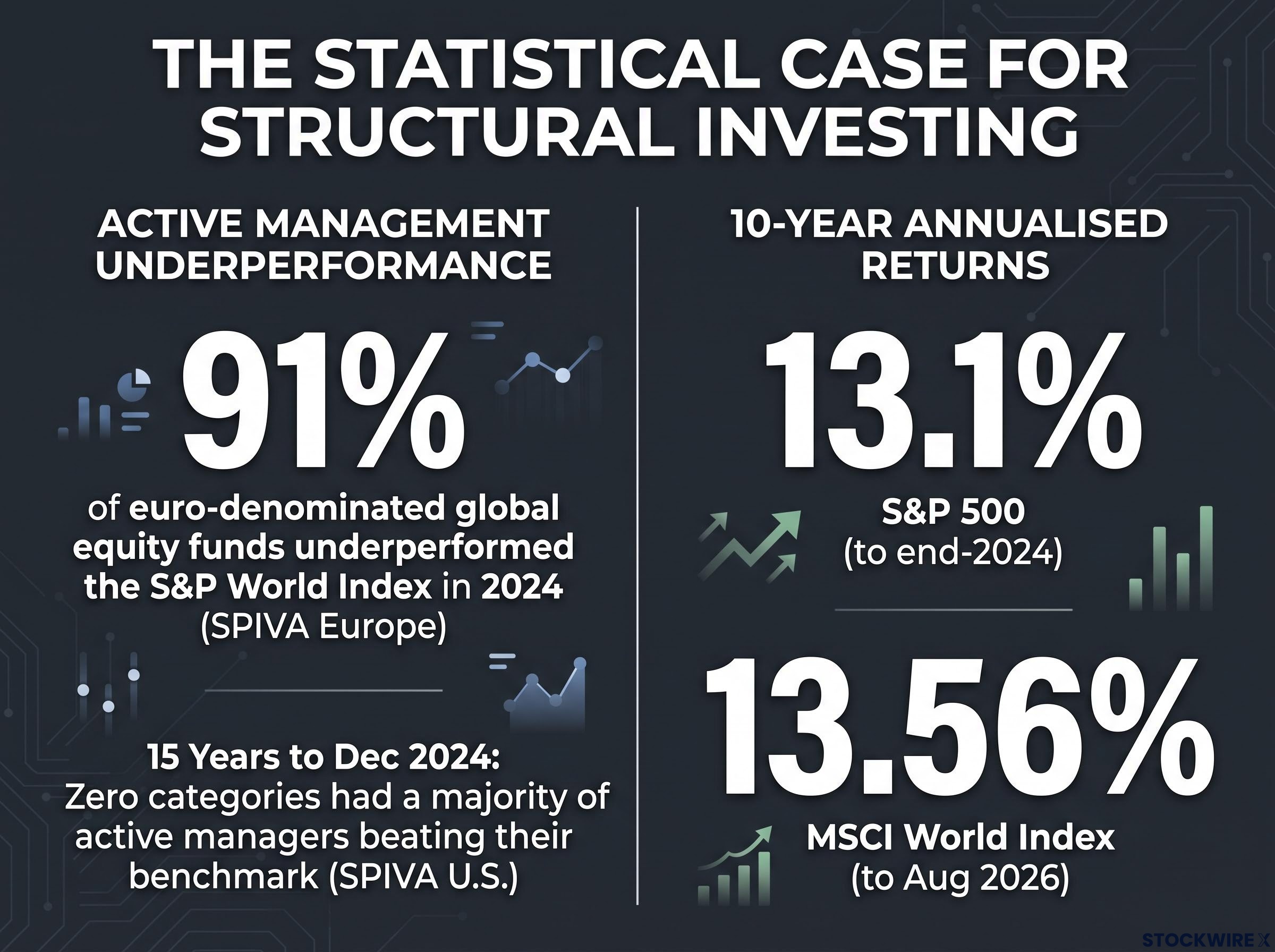
SPIVA Europe’s 2024 report found that 91% of euro-denominated global equity funds underperformed the S&P World Index in 2024.
That 91% figure is not simply an argument for going passive. It is a signal that disciplined quality screening and structure, the kind this portfolio applies, can pursue the upside case of active selection without carrying the statistical near-certainty of active underperformance.
The active vs passive investing debate is ultimately resolved by cost arithmetic rather than by manager skill: William Sharpe’s 1991 arithmetic principle confirms that active managers collectively must underperform after fees because their aggregate pre-cost returns equal the market return by definition.
This is not a niche experiment, either. Cerulli projects U.S. model portfolio assets to reach $2.9 trillion by 2026, and State Street Global Advisors data shows Australian managed accounts grew nearly 30% in a single year and more than doubled over five years. The institutional world has already validated the model portfolio approach with real capital.
What this model does not solve, and what you need to check before following it
No model portfolio is right for everyone, and this one is no exception. There are genuine limitations you need to face squarely before committing a cent.
The first is suitability. A portfolio built around a $1 million reference account carries a specific risk profile and time horizon that may not match yours. The UK’s Financial Conduct Authority (FCA) has been clear that a generic model portfolio can be unsuitable if it is not independently tailored to an individual’s circumstances, whether that is your time horizon, tax situation, liquidity needs, or risk tolerance.
Many wealth-building strategies promoted in financial media are mathematically sound but structurally designed for balance sheets that include diversified collateral, deal access, and operational control that most retail investors simply do not have, which is why survivorship bias systematically overstates the apparent safety of leverage and concentration.
The second is conflict of interest. Institutions including Goldman Sachs Asset Management and Morningstar warn that model portfolio services can embed the sponsor’s product biases, fee structures, and strategic views. You need to read the offering documents for any underlying funds to understand the fees, expenses, and potential losses you are signing up for.
The third is the responsibility gap. Under frameworks like MiFID II, suitability obligations can blur, and formal responsibility for daily investment decisions often sits with the portfolio manager rather than with you or an adviser. Members can mistakenly assume they are receiving continuous personalised tailoring when the reality is a centrally managed allocation. The Million Dollar Long-Term Investor’s transparency features, real-time updates, explicit rationale for every decision, and quarterly live sessions, partially mitigate this, but the ultimate decision to follow the model remains yours.
Before following any model portfolio, ask yourself three questions:
- Does the risk profile and time horizon of this reference portfolio actually match mine, and if not, what would need to change for it to fit?
- What fees, product biases, or embedded incentives sit inside the service and its underlying holdings?
- Who is formally responsible for the decisions I am following, and do I understand that following a model does not transfer the outcome off my own shoulders?
This article is for informational purposes only and should not be considered financial advice. Investors should conduct their own research and consult with financial professionals before making investment decisions. Past performance does not guarantee future results, and forward-looking statements are speculative and subject to change based on market developments.
Answering those three honestly makes you a sharper consumer of these services, whether or not you choose this particular one.
For readers wanting practical tools to measure their actual risk exposure before the next drawdown, our dedicated guide to portfolio risk management walks through beta-weighted position sizing and volatility targeting, the two frameworks that reveal whether your dollar allocation matches your true market exposure.
Building long-term conviction in a structure designed to do the waiting for you
Strip away the branding and the Million Dollar Long-Term Investor is a structural response to a well-documented problem: the behavioural evidence identifies investor behaviour, not investor knowledge, as the main driver of retail underperformance.
Its hybrid design, quality equities for growth, dividends for cash flow and ballast, broad ETFs for diversification, and defensive positioning for capital preservation, is a coherent answer to the three competing philosophies rather than an arbitrary compromise.
The stakes are worth remembering. Closing even half of Dalbar’s 8.5 percentage-point annual gap through structured discipline compounds into a materially different terminal figure over a 20 to 30 year horizon. And with Cerulli projecting $2.9 trillion in U.S. model portfolio assets by 2026 and Australian managed accounts growing nearly 30% in a year, this reflects a broad institutional shift rather than a passing product.
A model like this is worth pursuing further if your circumstances match its long horizon, you value discipline over control, and you genuinely lack the time or temperament for self-directed investing. It becomes unsuitable the moment its risk profile, tax position, or liquidity needs diverge from yours. The framework is now yours. The call, as always, is too.