Standard S&P 500 index options (SPX) require tens of thousands of dollars in buying power to hold a single defined-risk spread, which quietly prices most retail traders out of the most liquid index options market in the world.
The Mini-S&P 500 Index options (XSP) change that arithmetic precisely, delivering the same exposure at exactly one-tenth the scale.
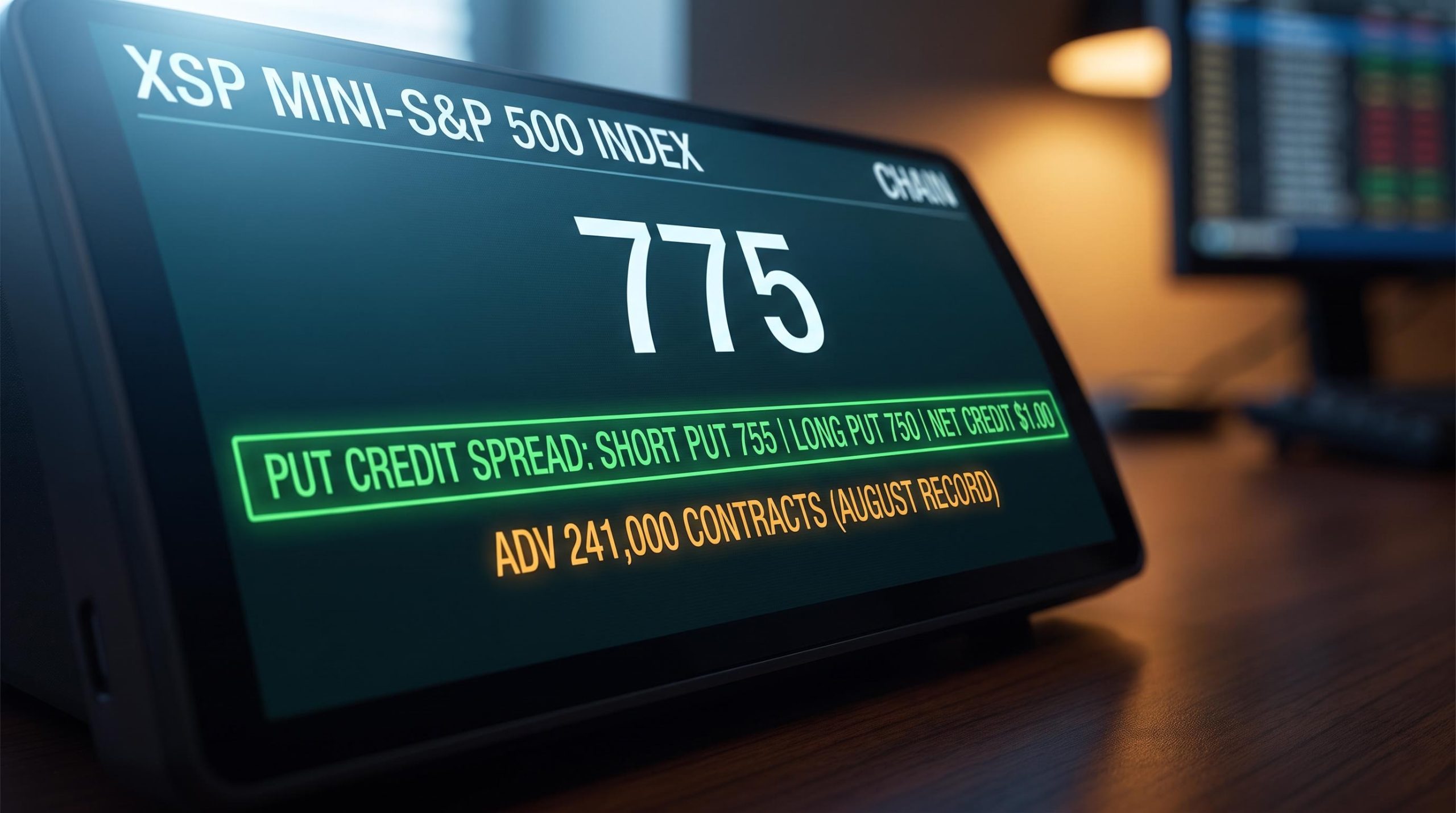
The timing matters. Retail access to defined-risk options has never been broader, XSP set a new monthly average daily volume record of 241,000 contracts in August 2026, and the put credit spread sits right where income generation meets capped, known risk. You have probably encountered options in general, but likely have not built a repeatable process for this specific structure on this specific instrument.
Here is what this guide gives you: a complete process for constructing a put credit spread on XSP from thesis to exit, including how to size it so a single bad expiration never damages the account. Learning how to trade a put credit spread on XSP starts with understanding why the vehicle itself matters.
What makes XSP the right vehicle for this strategy
Think about what a standard SPX spread demands. With the S&P 500 near 7,750, a single SPX contract carries a notional value of roughly $775,000. A five-point-wide spread ties up thousands of dollars in buying power, and for an account under $25,000 that is often the whole trade before you have even considered risk. That scale is the barrier.
XSP removes it by tracking at exactly one-tenth the price of SPX. When SPX sits near 7,750, XSP trades near 775, and both contracts use the same $100 multiplier per index point. The notional value drops to roughly $77,500 per contract, and a five-point spread now risks hundreds of dollars rather than thousands.
Two structural features make XSP especially suited to selling premium. It is European-style, meaning exercise is only permitted on the expiration date, so you carry no early assignment risk during the holding period. It is also cash-settled, so no shares change hands at expiration; the position resolves in cash against one-tenth the official S&P 500 closing value.
The contract details reinforce the retail fit. The minimum tick is $0.01, equal to $1.00 per contract. Strike intervals are generally $1 where the strike is at or below $200 and $5 above that, with $0.50 intervals available on certain weekly series.
The practical unlocking is this: a trader with a $15,000 account can take on meaningful index exposure with a spread that risks $400 rather than $4,000. That is what makes the strategy teachable and executable at retail scale rather than a professional-only structure.
| Attribute | SPX | XSP |
|---|---|---|
| Index level (approximate) | 7,750 | 775 |
| Contract multiplier | $100 | $100 |
| Typical buying power (5-point spread) | Thousands of dollars | Hundreds of dollars |
| Exercise style | European | European |
| Settlement method | Cash | Cash |
Why liquidity matters when you are selling premium
Liquidity is not an abstract virtue here; it directly affects the credit you collect. Through 28 August 2026, XSP ranked as the third-most active index options product with a year-to-date ADV of 203,555 contracts, which translates into tight bid-ask spreads on near-the-money strikes.
That matters because a wide bid-ask spread erodes your net credit before the trade even begins. Before you place any order, check the spread’s bid-ask width against the mid-price, and aim to fill at or near the mid rather than paying up to the ask.
When big ASX news breaks, our subscribers know first
How a put credit spread is built and what it actually risks
A put credit spread is assembled from two legs in the same expiration. You sell one out-of-the-money put, which brings in premium, and simultaneously buy a further out-of-the-money put at a lower strike, which caps your downside. The difference between the two premiums is your net credit, and that credit is the money you keep if the trade works.
The credit spread theta mechanics that make this structure work in your favour are worth internalising before you place your first trade: every day that passes without a large adverse move adds to your unrealised profit, because positive theta means time itself is working for you rather than against you.
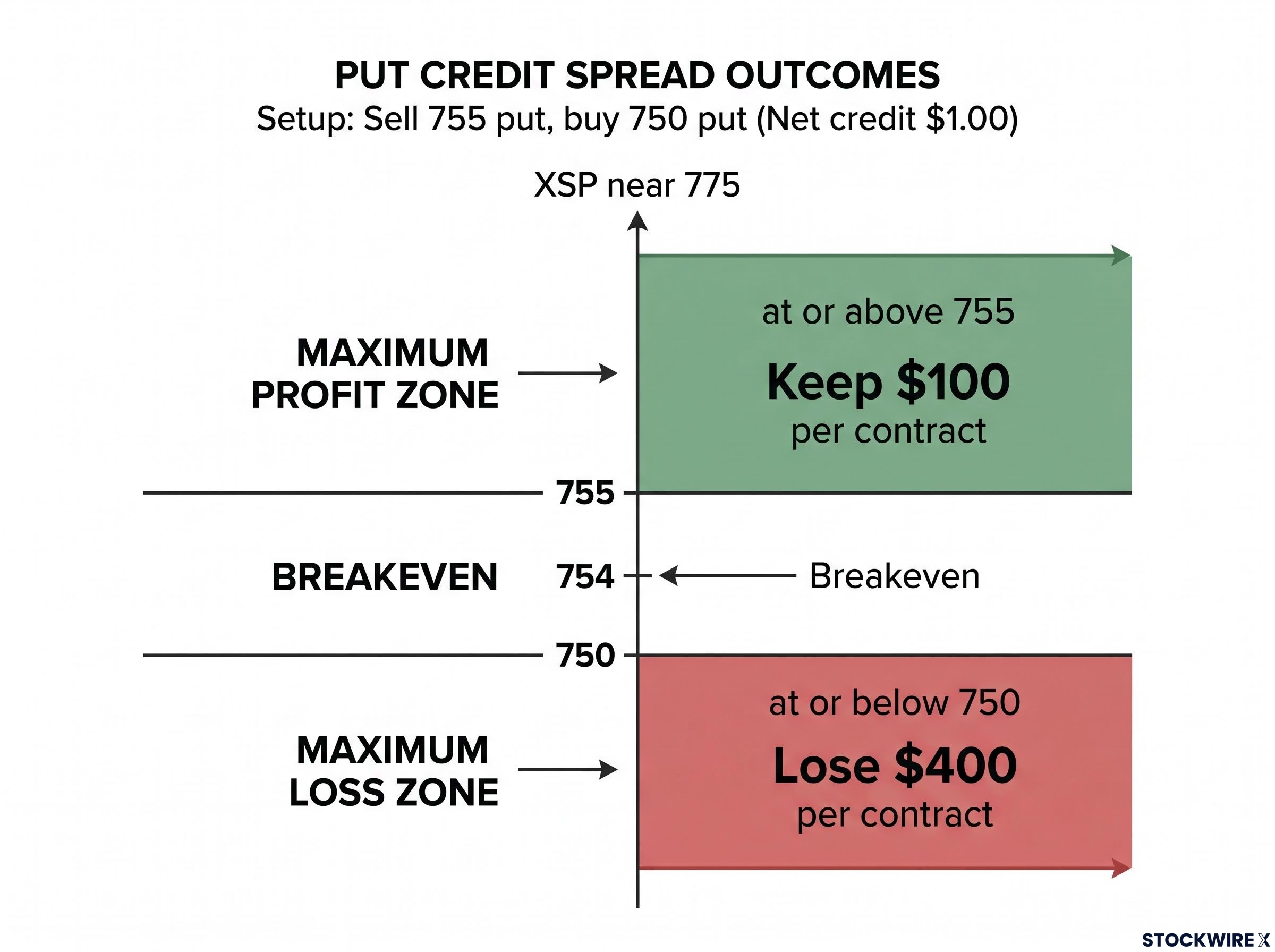
Walk through it with real numbers. With XSP near 775, you sell the 755 put and buy the 750 put in the same expiration, collecting a $1.00 net credit. That is a five-point-wide spread, and every outcome at expiration is now fully defined.
Here are the four states the trade can finish in, from best to worst:
- Maximum profit, XSP closes at or above 755. Both puts expire worthless and you keep the full credit: $100 per contract (net credit $1.00 times the $100 multiplier).
- Partial outcome, XSP closes between 750 and 755. The short put is in the money and the long put is not, producing a partial gain or partial loss depending on where exactly it lands.
- Breakeven, XSP closes at 754. The loss on the short put exactly offsets the credit collected.
- Maximum loss, XSP closes at or below 750. Both puts finish in the money, and you lose the spread width minus the credit: $400 per contract ($5 width minus $1.00 credit, times $100).
The breakeven follows a simple rule worth committing to memory.
Breakeven = short put strike minus net credit received.
That $400 maximum loss is not an abstraction. It is the exact dollar amount that leaves your account if the spread expires at or below the long strike, and you need to see it as a concrete number before you make any sizing decision. Retail traders routinely underestimate the loss side because the structure feels conservative; working through all four outcomes removes that ambiguity.
What this costs in buying power
The buying power a broker sets aside for this trade is anchored to the maximum loss, not the notional value. Per Charles Schwab documentation as of 12 December 2025, the margin on a broad-based index credit spread is the difference in strike prices multiplied by $100 and by the number of contracts, which on this spread comes to $400 per contract.
Tastytrade calculates it the same way for standard accounts, applying the Theoretical Intermarket Margining System (TIMS) for index options in portfolio margin accounts. Whichever broker you use, the actual buying power reduction will appear in the order confirmation before you submit, so you can verify the number against your own math.
Selecting strikes based on thesis, volatility, and probability
Strike selection is where most tutorials quietly fail you. They show how to build the spread but not how to decide where it goes, and the result is traders hunting for the highest credit rather than the soundest placement. The credit is an output of the process, not the input.
Anchor the process to your thesis instead. Work through three ordered steps:
- Define the thesis and its invalidation level. Decide the price level below which your bullish-to-neutral view is simply wrong, for example XSP holding above a meaningful technical support.
- Place the short put strike just below that invalidation level. This puts the strike you are selling at the point where the trade thesis breaks, with the long put further below to define the maximum loss.
- Check the credit against a minimum. A standard guideline is to collect roughly one-third of the spread width. On a $5-wide spread, that means targeting at least $1.67 in credit.
Two platform-displayed metrics tell you how far out of the money the short strike sits: probability of profit and delta. In one live platform walkthrough evaluated at 7-14 days to expiration, the 765/760 strikes showed a 56% probability of profit, a 9 delta, and a $1.47 credit for a maximum loss of roughly $353. The MyATMM tool frames the same idea by placing short strikes just outside the one-standard-deviation band as a probability anchor.
Delta as a strike selection tool does double duty in spread construction: it approximates the probability that a strike expires in the money and quantifies your directional exposure per contract, and both readings shift as expiration approaches, meaning a position that looks conservatively placed at 30 days can behave very differently in its final week.
Volatility changes where this all lands. When the CBOE Volatility Index (VIX) is elevated, premiums inflate, which lets you place strikes further from the money while still collecting acceptable credit.
When VIX is above 20 and IV Rank is above 30, premiums widen and strikes can be placed further from the money without sacrificing credit quality.
The opposite is the trap. In a low-volatility environment, the same out-of-the-money strikes produce thin credit, and the temptation is to move the short strike closer to the money to collect more. That is not strike selection; it is premium chasing, and it materially changes the risk profile by shrinking your margin of safety.
| Condition | Low-VIX environment | Elevated-VIX environment |
|---|---|---|
| Premium available | Thin | Wider |
| Typical OTM distance | Closer to spot | Further from spot |
| Margin of safety | Reduced | Improved |
The one-third guideline gives you a clean filter. If the credit does not clear that threshold at the strikes your thesis demands, conditions do not support the trade today, and not placing the spread is a valid decision in its own right.
Sizing the position without overexposing the account
The same $400 maximum loss means very different things depending on the account behind it. This is where you decide whether your account is actually ready for this position size, before you ever open a platform.
Run the numbers. A $400 loss is 8% of a $5,000 account, 4% of a $10,000 account, and roughly 1.6% of a $25,000 account. The exact same spread is a survivable event on one account and a serious dent on another.
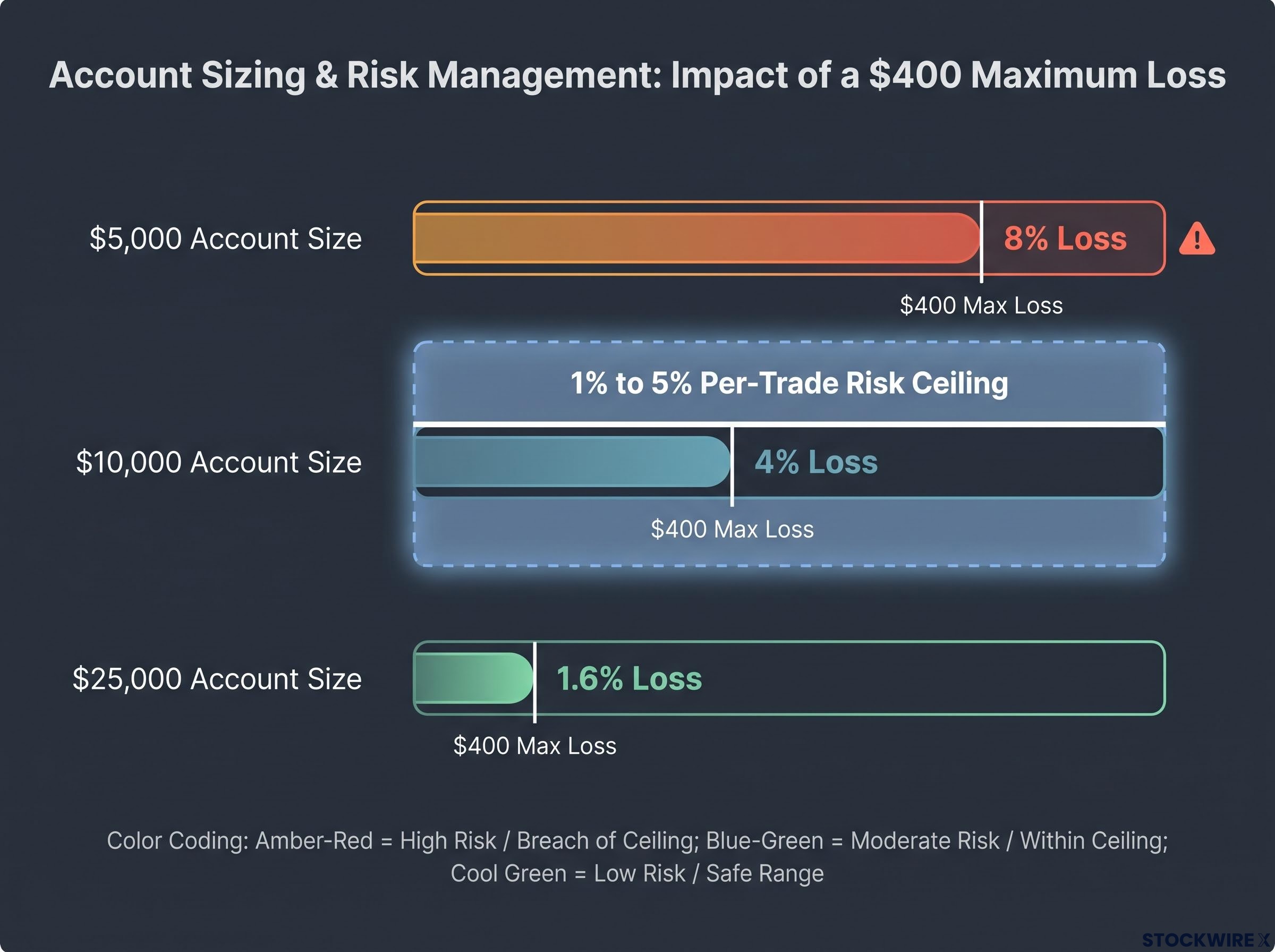
| Metric | $5,000 account | $10,000 account | $25,000 account |
|---|---|---|---|
| Max loss per spread | $400 | $400 | $400 |
| Max loss as % of account | 8% | 4% | 1.6% |
| Spreads before 5% ceiling | Below 1 | 1 | 3 |
Three rules keep the position from overexposing you:
- Per-trade ceiling. Risk no more than 1% to 5% of account equity on any single spread. Treat this as a ceiling, not a target.
- Total exposure ceiling. Keep total short-premium exposure below 30% to 50% of account equity, because index positions are correlated and all move against you together in a sell-off.
- One-contract starting size. For accounts at or below $10,000, where a single spread already approaches or exceeds the 5% ceiling, one contract is the appropriate starting size.
The specific trap to watch is complacency. Because the maximum loss is defined and finite, traders routinely size up beyond what the percentage rules allow, and that is the primary mechanism by which a defined-risk strategy produces outsized account damage.
Tail risk in low-VIX environments is precisely the condition the one-third credit rule is designed to protect against: when premiums are thin and the VIX sits near 14, the structural edge that makes credit spreads work is at its narrowest, and the same calm that compresses credits also suppresses the fear that would otherwise keep traders from sizing up beyond their percentage ceiling.
Picture the consequence concretely. A trader with a $5,000 account who takes maximum loss on two simultaneous put credit spreads has lost 16% of the account in a single event. Getting this section right is what lets you survive a string of losing trades long enough for the probability edge to actually play out.
When to exit: profit targets, stop-losses, and thesis breaks
The exit is decided at order entry, not when the position is already moving against you. Committing to your triggers in a calm state is the whole point, because under live market stress recency bias and emotion pull hardest in exactly the wrong direction.
Lead with the profit target. When the spread can be bought back for half the original credit, close it. On your $1.00 credit spread, that means buying it back at $0.50, locking in $50 per contract while eliminating the remaining open risk entirely.
Set a stop-loss on the same anchor. If the spread value inflates to twice the original credit received, exit regardless of your market opinion. A $1.00 credit spread closed when it reaches $2.00 caps the realised loss near $100 per contract, well before the $400 maximum is reached.
Thesis management sits above both as a separate, prior trigger. If the specific price level that justified the trade fails, reassess the position at that moment rather than inventing new reasons to hold. Here are the three triggers in priority order:
- Thesis break. The invalidation level fails, so the reason for the trade is gone. Reassess immediately.
- 50% profit. The spread can be bought back for half the credit. Take the confirmed partial gain.
- 2x stop-loss. The spread value doubles. Exit and cap the loss.
The 50% profit rule captures a real, confirmed gain while capital is still at risk in the position. Closing at that threshold rather than holding for the full credit is the discipline that separates traders who stay solvent from those who give back every winning trade in one bad expiration.
Managing threatened spreads near expiration
Expiration introduces risks routine exits do not cover. Pin risk appears when XSP closes between your two strikes: the short put finishes in the money while the long put expires worthless, and the defined-risk structure effectively becomes a naked position. On XSP the cash settlement resolves this automatically, but the point is to know whether you are holding through that window deliberately or by default.
A sharp intraday move through the short strike on expiration day can turn a small credit into a near-maximum loss before a manual exit can be executed.
Zero-days-to-expiration (0DTE) spreads amplify this, because a fast move through the short strike can expand a small credit into a near-maximum loss faster than you can react. The practical rule: do not hold a threatened spread into the final hours of expiration unless you have evaluated it and made a conscious decision to stay in.
Putting the process together before the first trade
Every element above collapses into a single sequence you can run before placing any XSP put credit spread. The checklist is not process for its own sake; it is the mechanism by which the decisions you make in a calm, analytical state govern what actually happens once the market is live and emotion is loudest.
Run these five steps in order:
- Define the thesis and invalidation level. Name the price level that proves your view wrong before you touch a strike.
- Select strikes using volatility context and the one-third credit rule. Place the short strike below the invalidation level and confirm the credit clears roughly one-third of the spread width.
- Calculate the max loss and check the sizing ceiling. Verify the dollar loss fits within your 1% to 5% per-trade limit, using the account-size table as your personal anchor.
- Confirm the bid-ask spread before submitting. Check the width against the mid-price so execution does not quietly erode your credit.
- Set both exit triggers at order entry. Lock in your 50% profit target and 2x stop-loss before the position is live.
If the current volatility environment produces credit too thin to clear the one-third threshold at strikes that respect your thesis, the correct response is to wait.
If conditions do not support the trade today, not placing the spread is itself a valid and correct decision.
Starting on XSP is the structural advantage. The smaller notional size means your first trade is a learning trade with proportionate stakes, backed by liquidity deep enough to support retail execution, as the 241,000-contract August ADV confirms. The process is identical when you scale to larger accounts or different instruments later.
For investors exploring other defined-risk ways to generate premium income on a conviction view, our dedicated guide to cash-secured puts walks through how the strategy works, what the downside mirrors, and when implied volatility conditions make it the stronger choice over a credit spread.
This article is for informational purposes only and should not be considered financial advice. Investors should conduct their own research and consult with financial professionals before making investment decisions. Past performance does not guarantee future results, and options trading carries the risk of substantial loss.