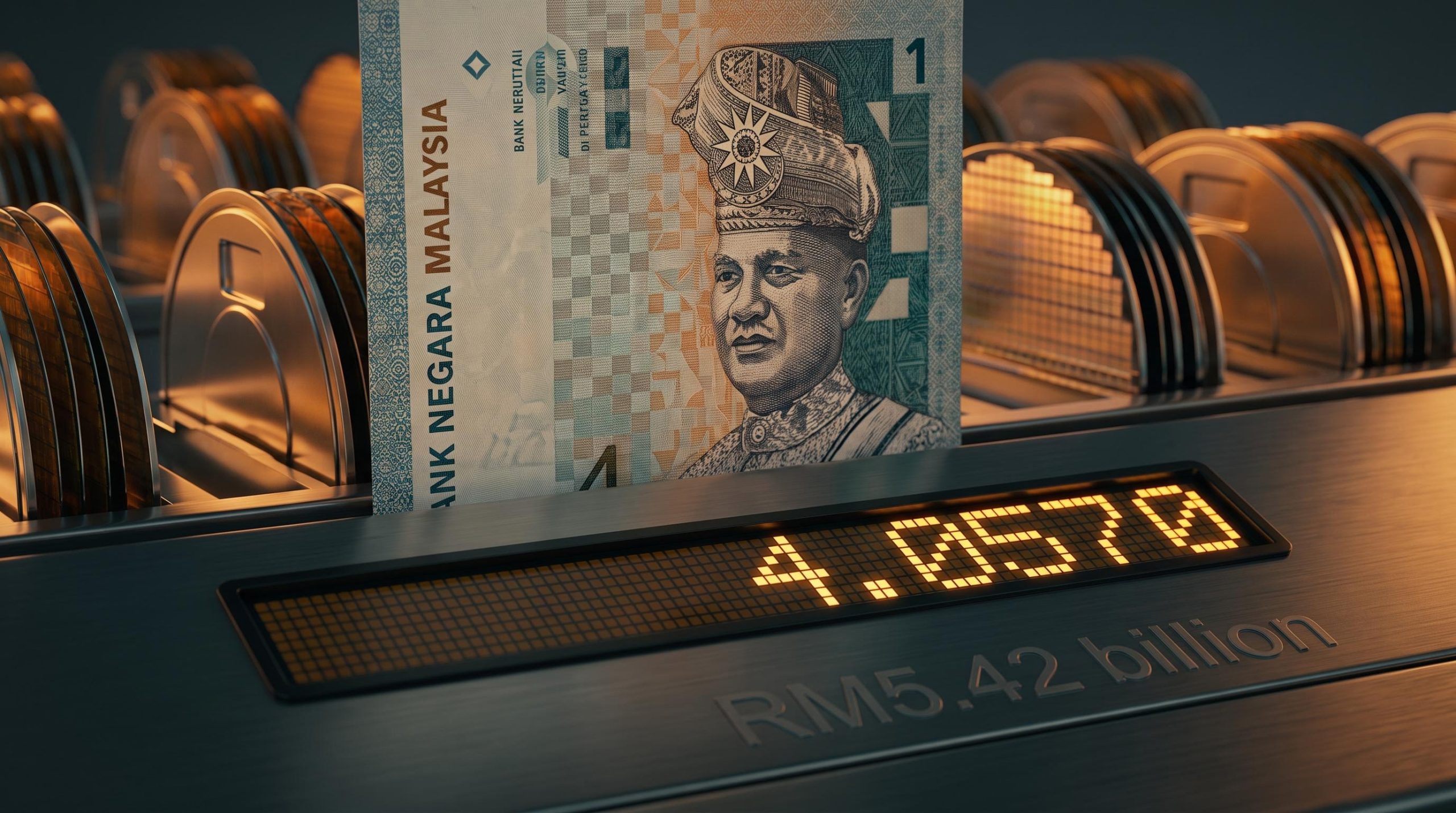
Foreign investors have now pulled a net RM5.42 billion from Malaysian equities so far in 2026, yet the currency sitting at 4.07 per US Dollar may still be leaning too far to the bearish side. The Ringgit’s four-session losing streak looks convincing in isolation. It looks considerably less convincing once the forces driving it are separated from those pushing back.
Three data points landed in close succession this week. A fourth consecutive session of gains for the US Dollar against the Ringgit, a July industrial production print that missed forecasts, and a Bank Negara Malaysia policy meeting that held rates steady for the fourteenth straight month. Each tells a partial story.
Together they sketch a currency under genuine but contained pressure, anchored by a semiconductor export boom that has quietly made Malaysia one of the world’s most AI-exposed economies. Here is what the evidence actually says about the near-term MYR trajectory, and the specific variables that will decide whether the currency stabilises near 4.00 or drifts toward the upper end of analyst forecasts.
Why foreign capital keeps leaving Malaysian equities
The selling is real, it is sustained, and it is accelerating. This is the first thing to establish honestly before anything qualifies it.
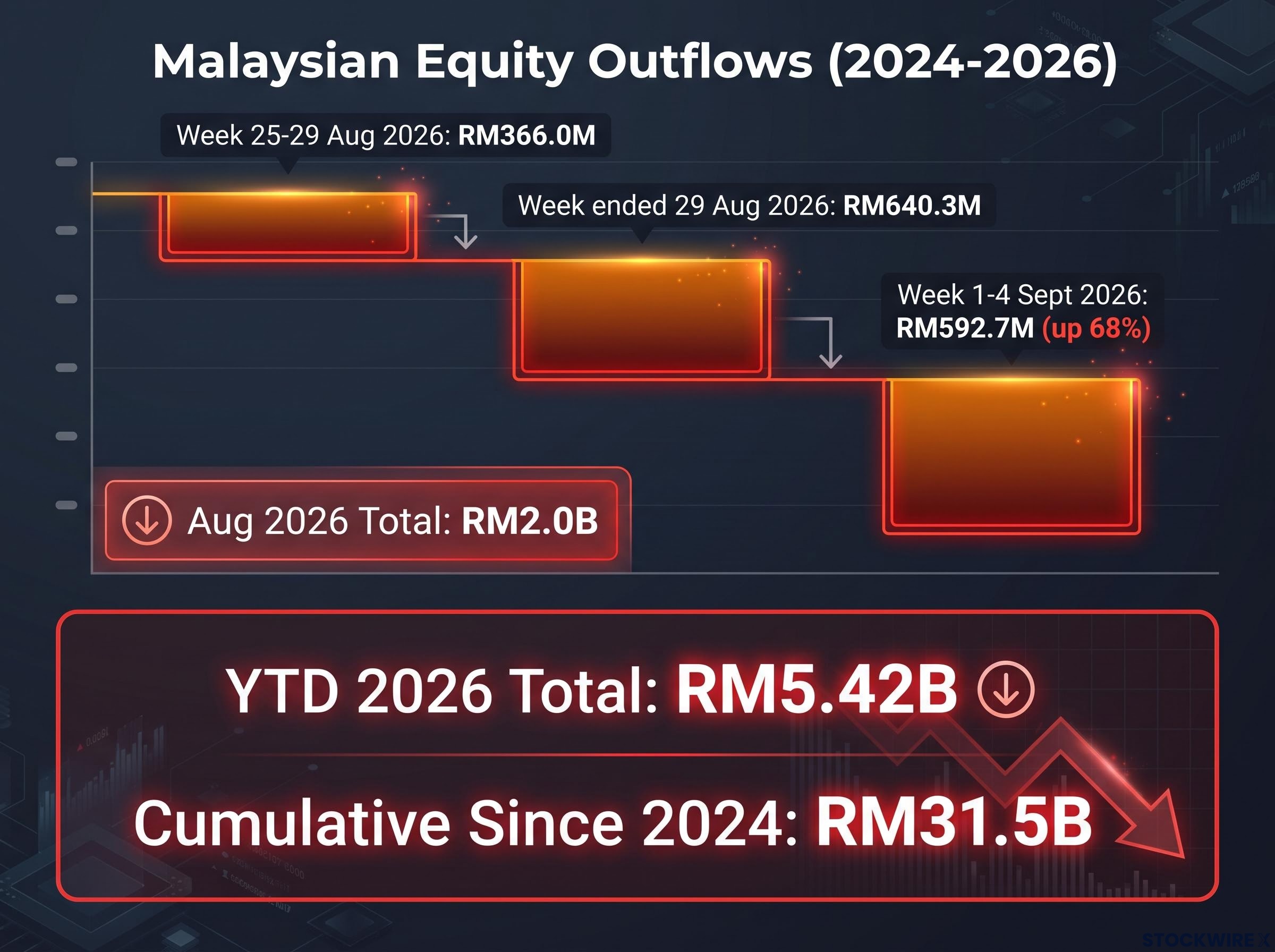
Offshore investors were net sellers of RM592.7 million in Malaysian equities during the shortened trading week of 1-4 September 2026, a 68% jump on the week before. That followed RM640.3 million of outflows in the week ended 29 August and RM366.0 million the week prior. Zoom out and the pattern hardens rather than softens.
Here is the outflow sequence across timeframes:
- Week of 1-4 September 2026: net selling of RM592.7 million (roughly US$120 million), up 68% week-on-week
- Week ended 29 August 2026: net outflows of RM640.3 million
- Week ended 25-29 August 2026: net outflows of RM366.0 million
- August 2026 monthly total: net selling of RM2.0 billion
- Year-to-date cumulative: RM5.42 billion by early September 2026
That is not a single bad week. It is a trend that has been building for the better part of a year, and it maps directly onto the US Dollar’s climb to 4.0570 by 8 September 2026, a daily gain of 0.27%.
Global equity fund flows in 2026 tell a more nuanced story than the Malaysian outflow data alone suggests: nearly $800 billion has entered global equity funds year-to-date as of August 2026, with the majority directed toward Europe, Asia, and emerging markets rather than the US, meaning Malaysia’s selling pressure coexists with a broader emerging-market reallocation that is still net positive at the aggregate level.
How much selling pressure is structurally left
There is a ceiling on this thesis, and it sits in the ownership data.
Cumulative foreign equity outflows since 2024 have reached RM31.5 billion, leaving foreign ownership of Malaysian equities at historically low levels.
That figure changes the read. When foreign investors already hold very little of the market, the pool of potential sellers is not unlimited. The weekly outflow number tells you about the current mood; the ownership floor tells you how far that mood can actually push the currency. For anyone weighing MYR exposure, the second figure is the one that constrains the bearish case.
How the current account offsets the capital account bleed
The reason the Ringgit has not fallen further despite all this selling comes down to a split in Malaysia’s balance of payments. Portfolio capital is leaving through the capital account, but the country continues to run a goods trade surplus, anchored by electrical and electronics (E&E) export strength, that flows in through the current account.
That coexistence, a current account surplus running alongside a capital account deficit, is the core tension driving analyst disagreement over where the currency goes next. One force sells the Ringgit; the other keeps buying it.
When big ASX news breaks, our subscribers know first
What the July industrial production miss actually signals
The headline looked disappointing, and markets reacted to it as such.
Malaysia’s Industrial Production Index (IPI) rose 4.7% year-on-year in July 2026, according to the Department of Statistics Malaysia. That undershot the Bloomberg consensus of 5.6% and the TradingEconomics consensus of 5.4%, and it marked a sharp step down from recent months.
The IPI had grown 8.4% in May 2026, its fastest pace since September 2022, before easing to 6.5% in June.
On a month-on-month basis, output fell 2.0% in July. Read at the headline level, that deceleration looks alarming. The sector breakdown tells a very different story.
| Sector | July 2026 y/y | Notes on trend |
|---|---|---|
| Manufacturing | +6.4% | Productive core still expanding |
| Electricity | +5.0% | Steady, in line with demand |
| Mining | -3.2% | Structural drag from aging oil and gas fields |
| Headline IPI | +4.7% | Below 5.6% Bloomberg consensus |
Almost all of the damage sits in mining. Output there contracted 3.2% year-on-year in July, continuing a run of declines seen through 2026, including 2.0% in February and 6.5% in March. The cause is mostly structural: maturing oil and gas fields weigh on baseline production, and new fields such as Jerun and Kasawari in Sarawak only partly offset the decline. Planned maintenance shutdowns and softer commodity prices compounded the shortfall.
DOSM’s July 2026 IPI release confirms the sector-level divergence at the heart of the headline miss, with the manufacture of computer, electronics and optical products holding up strongly even as mining output dragged the aggregate figure below consensus.
Manufacturing, the part of the industrial economy that actually drives growth, expanded 6.4%. That single figure tells you the headline miss is a poor guide to underlying momentum. The productive heart of the economy is not contracting; one structurally troubled corner is dragging the average down.
That distinction matters for policy. Bank Negara Malaysia is widely expected to treat the July print as sector-specific rather than as a signal to ease. Currency markets and central bank watchers who read the 4.7% headline as broad weakness risk misreading the entire policy setup. The disaggregated picture changes the trade. For the record, August IPI data had not been published as of early September, with its release scheduled for 9 October 2026.
The AI export engine and why it anchors the Ringgit’s floor
Here is the fact that most short-term flow narratives leave out entirely. Malaysia is one of the most AI-exposed economies on the planet, and the numbers behind that claim are startling.
According to the Malaysian Investment Development Authority (MIDA), Malaysia accounts for roughly 13% of global back-end semiconductor assembly, testing, and packaging, and about 7% of global semiconductor trade. This is not a generic technology story. It is a precise position in the part of the chip supply chain that global AI infrastructure depends on.
That positioning has produced an export surge. Consider the progression:
The self-reinforcing dynamic behind global capital flows in 2026 helps explain why Malaysia’s semiconductor positioning attracts structural export demand even as portfolio investors sell equities: dollar strength pulls capital toward US chip stocks, while the same AI investment cycle routes manufacturing revenue back into E&E exporters like Malaysia.
- E&E exports grew 23% year-on-year in Q1 2026, already a strong base.
- That accelerated sharply to 57.1% year-on-year in Q2 2026.
- AI-enabling products grew 42.9% to RM319.05 billion in the January-April 2026 period alone.
- Across a recent measurement window, E&E exports jumped 39.7% to RM382.89 billion, driven by a 61.6% rise in semiconductor exports.
The scale of it reframes the whole currency discussion.
AI-related products now account for roughly 52.4% of Malaysia’s total exports, with integrated circuits alone making up about a quarter.
When more than half of a country’s exports are tied to AI infrastructure, its currency is structurally bolted to the global AI investment cycle in a way most emerging market currencies simply are not. This export engine is the direct counterweight to the capital outflow story. Money leaves through equities; it arrives through chips. For anyone assessing MYR from a macro or positioning angle, this concentration is the single most important structural fact about the currency’s medium-term floor.
Where the competitive threat is real
The optimism needs calibrating, because the advantage is not guaranteed to last. Vietnam and Singapore are competing hard for the same AI manufacturing investment across Southeast Asia.
The specific vulnerability is where Malaysia sits in the chip value chain. Its strength is concentrated in back-end assembly and packaging, the lower-margin end of the process. Front-end chip design and manufacturing is the capability gap. Whether Malaysia can climb into that higher-value work is what determines its long-run positioning, and the current export boom does not settle that question.
Semiconductor cycle dynamics complicate the optimism here: TSMC’s locked-in 2026 capital budget of $52-56 billion and Samsung’s estimated $70-80 billion annual outlay confirm a 2027-2029 supply wave is already in motion, and a capacity glut at that stage could soften the E&E export volumes that currently anchor the Ringgit’s structural floor.
Bank Negara’s steady hand and what it means for depreciation risk
The central bank’s inaction is not inertia. It is a choice, and it caps how far the currency can fall.
Bank Negara Malaysia has held the Overnight Policy Rate (OPR) at 2.75% for 14 consecutive months, its last cut coming in July 2025. The rate was left unchanged at all five Monetary Policy Committee meetings in 2026: 22 January, 5 March, 7 May, 9 July, and 3 September. BNM describes its stance as steady, supportive but prudent, and data-dependent. DBS analysts expect the OPR to stay put for all of 2026, noting the bank shows no urgency to adjust settings and wants to preserve policy ammunition against external shocks.
A central bank with no pressure to cut rates removes one of the classic drivers of currency weakness. That constraint is why the year-end forecast range is narrower on fundamentals than it first appears.
| Institution | Year-End USD/MYR Target | Key Driver Cited |
|---|---|---|
| Loomis Sayles / Deutsche Bank | Toward 3.88 | E&E export resilience, retest of YTD highs |
| BIMB Securities | 3.90 | Domestic macro stability |
| MIDF Research | 3.95 | Fed easing narrowing yield gap |
| MBSB Research | 4.03 | Cautious on global USD strength |
| UOB Global | Around 4.00 | Ringgit viewed as somewhat overbought |
| Mizuho Research | 3.96 (near 4.015 for much of year) | Global risk-off episodes |
Look closely at that spread. The gap between 3.88 and 4.03 is not really a disagreement about Malaysia’s fundamentals. It is a disagreement about global USD conditions and positioning dynamics. On the domestic case for MYR stabilisation, the forecasters are closer to consensus than the range makes them look.
There is one honest caveat that bullish forecasts tend to underweight.
A February 2026 Reuters survey found long, bullish Ringgit bets at a 16-year high.
Crowded positioning like that is a tail risk. It means even a modest adverse shock, a spike in US yields or a global risk-off episode, could trigger a sharp mechanical unwind that has nothing to do with Malaysian fundamentals. That asymmetry belongs in any serious assessment of where the currency can go.
What the evidence actually says about where MYR goes from here
Pull the four threads together and a single view emerges rather than a tie.
Foreign capital is leaving, but from an already historically low ownership base that limits how much further it can push. The July IPI miss was concentrated in structurally declining mining, not the manufacturing core. AI-related products at 52.4% of total exports, with semiconductor exports up 61.6% year-on-year, anchor a structural floor under the currency. And a central bank holding at 2.75% removes the rate-driven trigger for depreciation.
The read that follows is that near-term MYR risk is asymmetric to the upside, meaning weakness beyond current levels, only if global conditions turn materially worse. It is not because domestic fundamentals are deteriorating, because they are not. With USD/MYR at 4.0570 and analyst targets clustering between 3.90 and 4.03, the domestic case points toward stabilisation.
The bearish case strengthens only under specific external conditions:
- Sustained US Dollar strength driven by higher US bond yields
- A Fed delay in rate cuts that keeps the US-Malaysia yield gap wide
- An adverse global risk-off episode that unwinds crowded long-Ringgit positioning
If you are assessing MYR exposure today, the evidence supports a stabilisation view anchored on domestic fundamentals, and it does not support a fundamentals-driven collapse. The real question is not what is happening inside Malaysia. It is what the US Dollar does next.
For investors wanting to model the external scenario in depth, our full explainer on ING’s US dollar forecast examines the five-signal monitoring framework ING uses to track whether the bearish dollar thesis resolves in the 6-12 month window, which is the same timeframe most bullish MYR targets assume.
This article is for informational purposes only and should not be considered financial advice. Investors should conduct their own research and consult with financial professionals before making investment decisions.
Past performance does not guarantee future results. Financial projections are subject to market conditions and various risk factors, and forward-looking forecasts are speculative and subject to change based on market developments.