
You can probably name the ECB’s deposit rate. You might remember roughly when quantitative easing started, and you have almost certainly seen a headline about the Euro sliding against the dollar.
Here is what fewer people can explain: what actually happens inside the Governing Council chamber, why the European Central Bank reaches for asset purchases before it exhausts every rate cut, or how a bond-buying programme run out of Frankfurt ends up weakening the Euro in the first place.
That gap, between headline familiarity and how the institution genuinely functions, is exactly what this piece closes.
The ECB is one of the most consequential institutions in global finance. It sets borrowing costs for an economy of roughly 340 million people and runs a balance sheet that peaked at around €8.8 trillion. What it decides ripples into bond yields, equity valuations, and exchange rates far beyond the Eurozone.
By the time you finish reading, you will have a working model you can apply to any ECB announcement, whether it is a routine rate hold, a fresh round of asset purchases, or a balance-sheet update that barely makes the news.
The mandate behind every decision the ECB makes
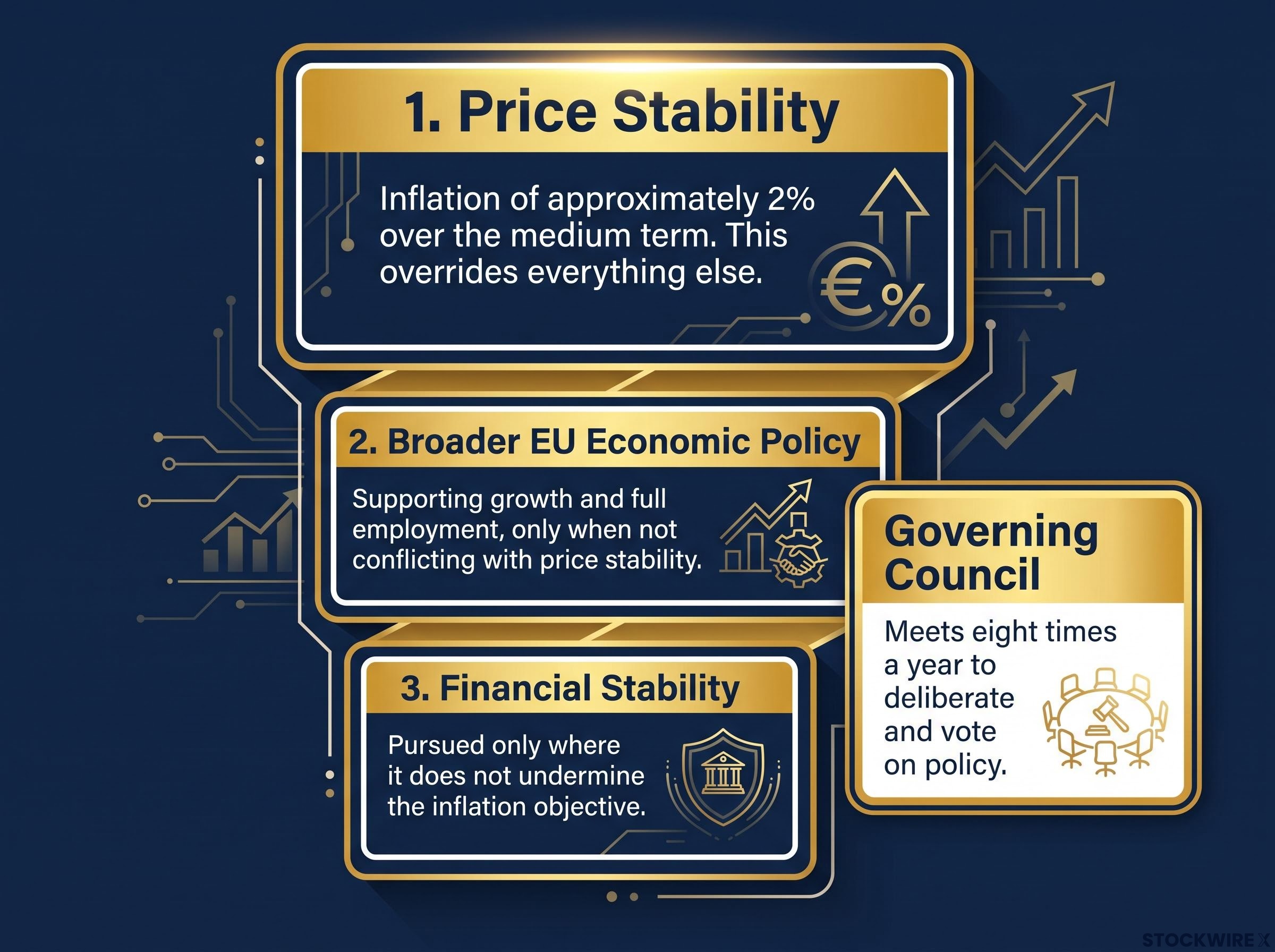
Every tool the ECB reaches for traces back to a single legal obligation. The institution’s primary mandate is price stability, defined in practice as inflation of approximately 2% over the medium term.
This is not a preference or an internal guideline the ECB could quietly revise. It is the constitutional basis for the institution’s existence, which is why understanding it explains almost everything the central bank does.
Decisions are made by the Governing Council, and its composition matters more than most people realise. The Council brings together six permanent members of the Executive Board, including the ECB President, alongside the heads of every Eurozone national central bank.
The ECB Governing Council composition and decision-making structure is formally documented by Eurozone national central banks, each of whose governors sits on the Council alongside the six Executive Board members, giving peripheral economies like Ireland and Portugal equal voting standing with larger members like Germany and France.
This group meets eight times a year to deliberate and vote on policy. That rhythm, eight scheduled meetings, is the structural heartbeat of Eurozone monetary policy.
Why the mandate hierarchy shapes everything
The ECB does have secondary objectives, but they sit firmly below price stability in the pecking order.
- Price stability first: keeping inflation near 2% over the medium term. This overrides everything else.
- Supporting broader EU economic policy (including growth and full employment), but only when doing so does not conflict with the price-stability goal.
- Contributing to financial stability, again pursued only where it does not undermine the inflation objective.
This hierarchy is why the ECB sometimes appears to act against growth or employment instincts. When inflation runs too hot, it is legally required to prioritise bringing it down, even if that squeezes the economy.
Supply-driven inflation complicates the ECB’s mandate in ways the rate corridor alone cannot resolve: when price surges originate from energy disruption rather than excess demand, raising the deposit rate reduces purchasing power without addressing the underlying cause, and the risk of over-tightening into a weak economy grows materially.
For you, this is the foundation for reading any ECB move. Once you know the mandate ranks inflation above all else, you can quickly judge whether a given decision sits within the ECB’s expected behaviour or genuinely breaks from it. That judgement is where sensible interpretation of market reactions begins.
When big ASX news breaks, our subscribers know first
The conventional toolkit: how the ECB uses interest rates
Most coverage talks about “the ECB rate” as though there is only one. There are actually three, and they work as a system.
Together they form a corridor that shapes the cost of money for every bank in the Eurozone. The deposit facility rate sits at the bottom: it is what banks earn on money parked overnight at the ECB, and it acts as the floor.
The main refinancing operations (MRO) rate is the benchmark cost for banks borrowing from the ECB in its regular operations. The marginal lending facility rate sits at the top: it is the emergency overnight borrowing cost, the ceiling of the corridor.
Where those rates sit today reflects a genuine turn in policy. After an easing cycle that dragged the deposit rate down to 2.00% by June 2025, the ECB held steady for the rest of that year, then began hiking again in 2026.
Here is how the corridor has shifted across three key moments.
| Key rate | June 2025 (trough) | June 2026 (hike) | September 2026 (current) |
|---|---|---|---|
| Deposit facility | 2.00% | 2.25% | 2.50% |
| Main refinancing operations | 2.15% | 2.40% | 2.65% |
| Marginal lending facility | 2.40% | 2.65% | 2.90% |
The path between those columns tells its own story. The deposit rate was held at 2.00% across four consecutive meetings in July, September, October, and December 2025, before the ECB resumed hiking with a 25-basis-point increase in June 2026, a hold in July, and another 25-basis-point rise on 10 September 2026.
Notice there is no promise about what comes next. The ECB has deliberately refused to commit to any fixed rate path.
The ECB’s operative guidance is simple to state and demanding to follow: decisions are made meeting by meeting, driven by incoming data rather than a pre-set schedule. No fixed path, no advance commitments.
Why does the corridor matter to you? Because a change to the deposit facility rate instantly reprices the overnight cost of money for every bank in the system. That is why even a 25-basis-point move transmits quickly into lending and saving conditions, and why the deposit rate, not the MRO or lending facility, is the number to watch as the true policy signal.
When rates are not enough: how QE and QT work
There is a point where cutting rates stops working. When the deposit rate is already at or below zero, the ECB cannot ease conditions further through conventional means. That threshold is exactly where quantitative easing enters the picture.
Quantitative easing (QE) is the creation of new money to buy assets, primarily government and corporate bonds, from financial institutions. The ECB has always treated it as a last resort rather than a routine setting, deployed only when rate cuts alone cannot restore price stability.
The clearest example came in January 2015. Three conditions had lined up at once.
- Policy rates were exhausted. The deposit facility was already at or below zero, leaving no room for further conventional cuts.
- Deflation risk was real. Year-on-year Eurozone inflation had fallen below zero, far short of the 2% target.
- Transmission was broken. Fragmentation in the banking system was choking credit flow to stressed member states.
By early 2015, the Eurozone faced falling prices, interest rates with nowhere left to go, and a banking channel too fragmented to pass policy through. Bond purchases were the only route left to anchor inflation expectations.
On 22 January 2015, the ECB announced an expanded Asset Purchase Programme (APP) of €60 billion per month, combining sovereign and private-sector purchases, specifically to bypass those blocked banking channels.
Quantitative easing: the mechanics of money creation
The chain is more mechanical than it sounds. The ECB creates new reserves and uses them to buy bonds from banks.
Those banks now hold cash instead of bonds, which encourages them to lend or invest it elsewhere. As demand for bonds rises and their prices climb, yields across the economy fall, lowering borrowing costs for households and businesses.
That is the whole point: cheaper money flowing through the system when the interest-rate lever has already been pulled as far as it can go.
Quantitative tightening: running the process in reverse
Quantitative tightening (QT) unwinds all of this. Instead of buying new bonds, the ECB simply stops replacing the ones that mature.
As those bonds roll off, reserves drain out of the banking system, and upward pressure on yields builds gradually. Crucially, the ECB is doing this through passive run-off, letting bonds expire, rather than actively selling them into the market, a more aggressive approach it has explicitly ruled out.
The numbers show a balance sheet in steady retreat. From its €8.8 trillion peak in 2022, the Eurosystem balance sheet had fallen to roughly €6.16 trillion by end-May 2026.
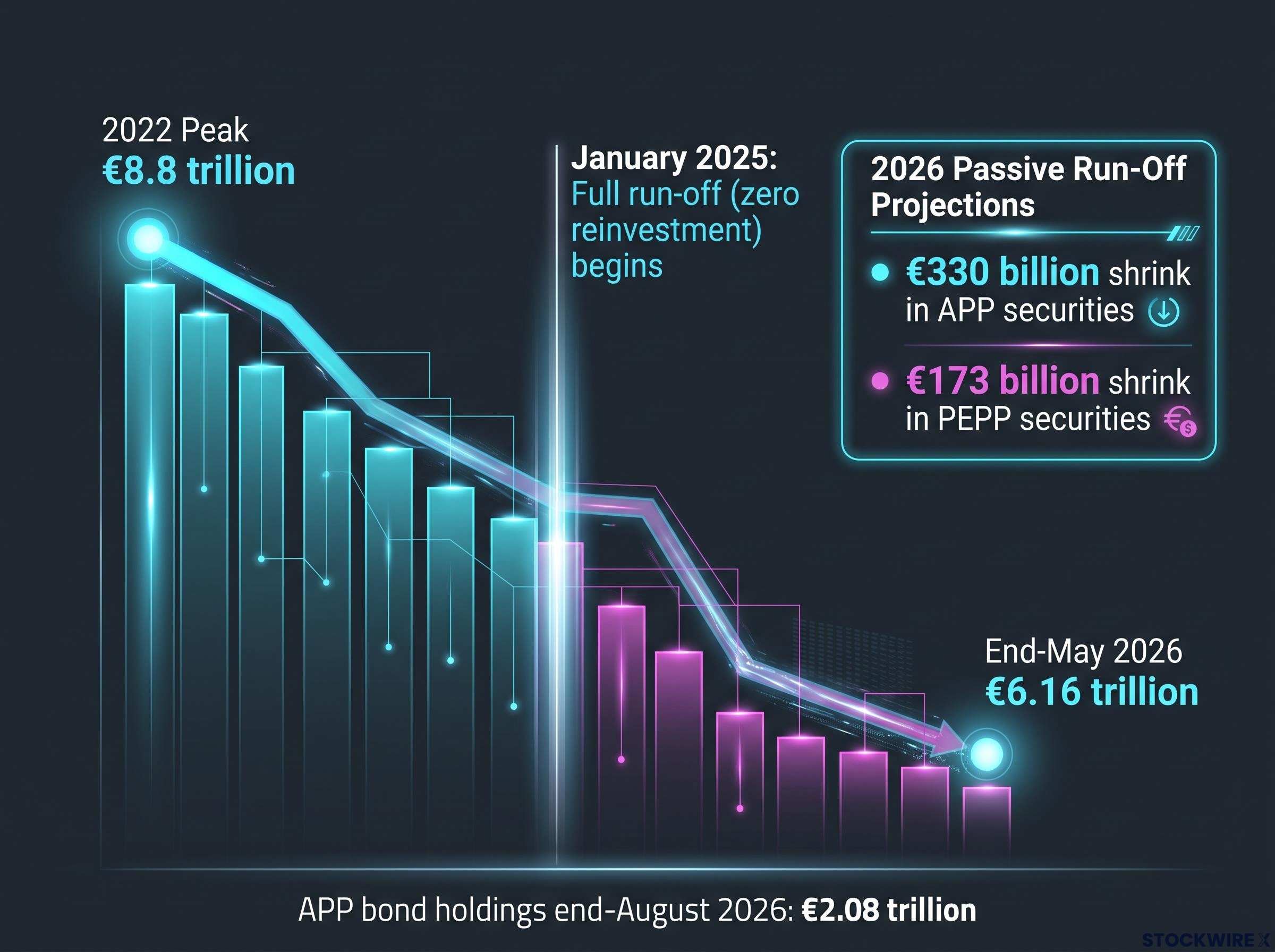
Full run-off, meaning zero reinvestment, began in January 2025 and continues. Across 2026, non-reinvestment is projected to naturally shrink holdings by approximately €330 billion in APP securities and €173 billion in Pandemic Emergency Purchase Programme (PEPP) securities. APP bond holdings alone stood at around €2.08 trillion by end-August 2026.
The passive approach is itself a message. By choosing the slower, less disruptive path, the ECB is signalling how little financial-system stress it is willing to tolerate, and the pace of that reduction is something you can read as a gauge of the Council’s risk appetite. Whether the ECB is easing or tightening, and how forcefully, is essential context for interpreting bond yields, bank funding conditions, and sovereign spreads across the region.
How ECB policy moves the Euro
Here is the part that trips up a lot of readers: how does a bond-purchase programme in Frankfurt end up weakening the Euro against the dollar? The answer runs through three transmission channels.
- Interest-rate differential: Higher ECB rates raise the expected return on Euro-denominated assets, drawing in foreign capital and lifting demand for Euros. Lower rates and QE do the reverse, compressing yields and dulling that relative appeal.
- Portfolio-balance: When QE suppresses domestic bond yields, investors chasing better returns sell Euros to buy foreign assets, directly increasing the supply of Euros in the currency market.
- Liquidity and risk-premium: QE floods domestic markets with liquidity and lowers risk premia on local assets, shifting risk-adjusted returns relative to what is available abroad.
Follow the logic and the direction becomes intuitive. QE and low rates tend to weaken the Euro; higher rates and QT tend to support it. Major QE programmes have generally been associated with single-digit percentage depreciation in EUR/USD, in line with mainstream estimates.
The current environment leans the other way. With the balance sheet declining from its €8.8 trillion peak toward €6.16 trillion, and the deposit rate back up at 2.50% as of September 2026, ECB policy is broadly supportive of the Euro compared with the QE era.
But there is a catch worth internalising.
ECB policy does not move the Euro in a vacuum. What matters is the ECB’s stance relative to other major central banks. Easing in Frankfurt need not weaken the Euro if the US Federal Reserve is easing just as hard.
For anyone holding Euro-denominated assets or analysing European equities, this is the practical takeaway: the gap between ECB and Fed policy is often the single biggest driver of EUR/USD, not the ECB’s absolute rate level on its own. Those currency swings hit international investors directly through returns, and reach exporters, importers, and anyone holding an unhedged European position.
The BTP-Bund spread is one of the less-discussed inputs to euro valuation fundamentals, yet professional traders treat it as a live gauge of fragmentation risk and a direct constraint on how aggressively the ECB can move rates without destabilising the weakest sovereign borrowers in the bloc.
What comes next: AI, the neutral rate, and how structural forces are reshaping ECB policy
The ECB’s traditional inputs, inflation, the output gap, credit growth, are being complicated by something new. A structural investment wave tied to artificial intelligence is starting to enter the central bank’s thinking.
ECB President Christine Lagarde has explicitly framed AI as a structural macroeconomic factor rather than a passing cyclical one, describing it as a second digital revolution. The scale is already visible: survey data in 2026 indicates Euro-area firms plan to allocate around 9% of total investment to AI.
The concern is not just how much is being spent, but how it gets financed. AI is largely long-lived capital, data centres, infrastructure, intangible software, that demands sustained funding over years.
Lagarde has warned that Europe’s heavy reliance on bank credit, rather than deep capital markets, constrains how quickly that investment can be funded. This is why she has tied the ECB’s forward-looking analysis to the push for deeper capital market integration, including the proposed Savings and Investment Union.
Here is how AI could feed into ECB policy over time.
- A higher neutral rate: Sustained capital demand could lift the economy’s equilibrium interest rate, changing what counts as “restrictive” versus “neutral” policy.
- Demand-driven inflation during the transition: If AI raises productivity and incomes, firms and households may spend pre-emptively, adding upward pressure on prices.
- Shifting labour and consumption patterns: Changes to jobs, wealth distribution, and spending behaviour would all feed into how policy transmits through the economy.
The neutral rate debate has moved from an academic concept to a live policy variable: the deposit rate reaching 2.50% in September 2026 represents what ECB Governing Council member Radev publicly identified as the euro area neutral rate, making each subsequent decision a genuinely new structural choice rather than a continuation of the existing hiking cycle.
Lagarde has cast AI as a second digital revolution, a structural force whose financing needs Europe’s bank-heavy system may struggle to meet without deeper, more integrated capital markets.
The ECB is careful not to get ahead of itself. Despite treating AI as structurally important, the Governing Council insists current decisions stay strictly data-dependent, and that AI assumptions are not being baked into today’s policy stance.
For you, the implication is longer-term. If AI does persistently raise the neutral rate, what looks “accommodative” today may look ordinary in three to five years. Anyone anchoring long-run bond or equity assumptions to current rate levels may need to revisit that framework, which puts you ahead of any analysis that treats AI purely as a tech-sector story rather than a live central bank variable.
A durable framework for reading the next ECB announcement
Strip away the detail and the ECB becomes readable through three questions, applied in sequence. The next time a rate decision or balance-sheet update crosses your screen, run through them.
- Check the mandate. Where is the ECB relative to its 2% inflation target? This is the driver behind every decision, so start here.
- Identify the active tool. Is the ECB moving rates, still running QT, or contemplating fresh purchases? With the deposit facility at 2.50%, the balance sheet down to roughly €6.16 trillion and still shrinking through full APP and PEPP run-off, the current tool signals a tightening-to-neutral posture.
- Assess the relative stance. How does the ECB’s position compare with the Fed and other major central banks? That comparison, more than the absolute rate, tells you the likely direction for the Euro.
Grasping how the Federal Reserve works is the necessary complement to any ECB framework, because EUR/USD moves are ultimately relative, and the Fed’s dual mandate structure, FOMC voting composition, and forward guidance conventions all shape the other side of that differential.
Some things remain genuinely uncertain. The neutral rate, the pace of AI adoption, and the speed of European capital market integration will all reshape the policy backdrop in ways no one can forecast with confidence.
That is precisely why this framework beats any fixed rate prediction. The ECB’s own data-dependent, meeting-by-meeting approach, structured around eight meetings a year, means the smartest thing you can carry is not a forecast but a method for interpreting whatever the Governing Council does next.
This article is for informational purposes only and should not be considered financial advice. Investors should conduct their own research and consult with financial professionals before making investment decisions.
Past performance does not guarantee future results. Financial projections and forward-looking statements about the neutral rate and AI-driven investment are speculative, subject to change based on market developments, and should be treated as scenarios rather than certainties.