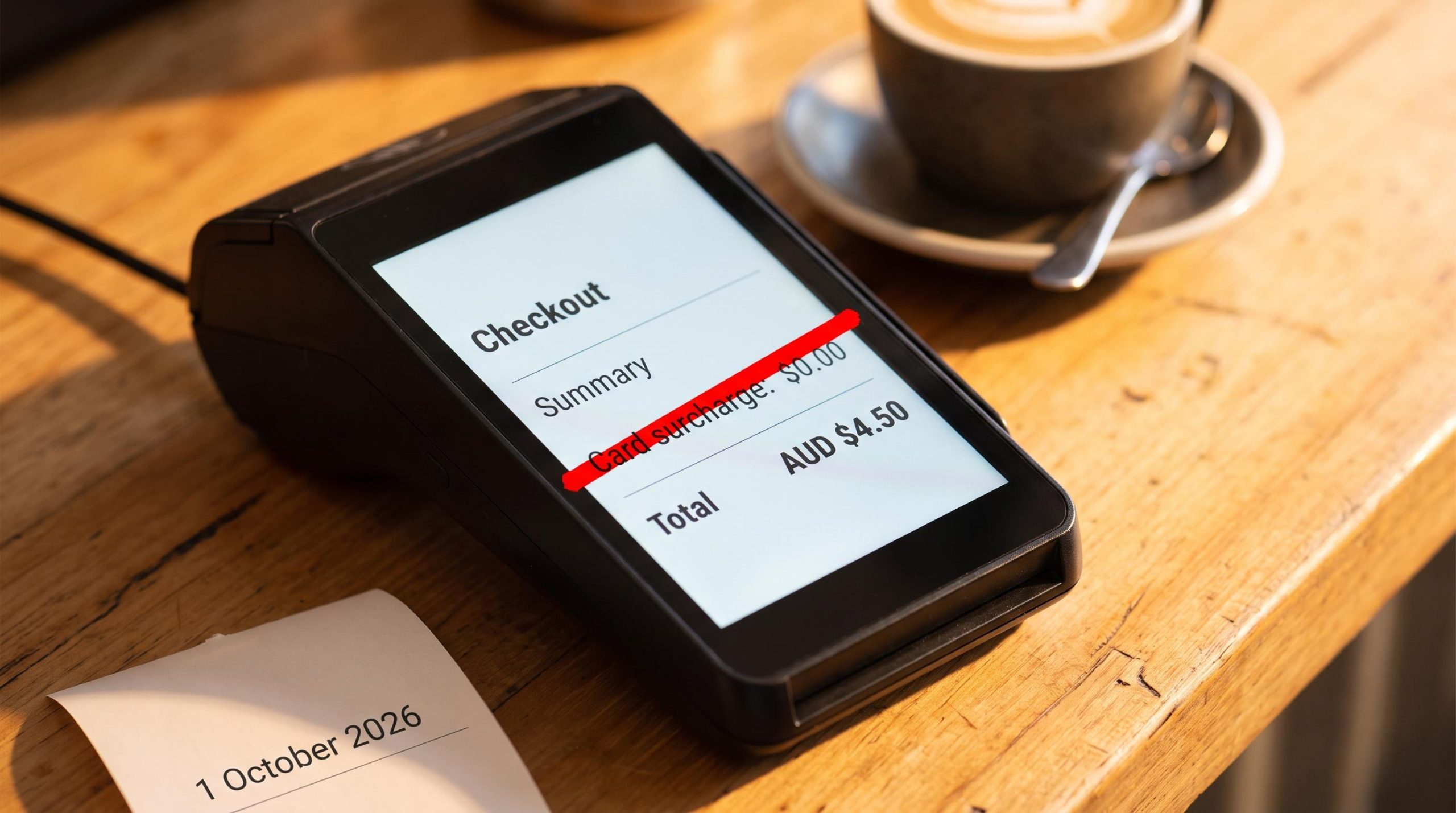
Australians hand over an estimated $1.6 billion in card surcharges every year, that small extra line at the bottom of the receipt or on the payment terminal screen. From 1 October 2026, that line disappears for the vast majority of card payments.
Here is the thing worth understanding up front: this is not a new law. The Reserve Bank of Australia (RBA) lifted its prior prohibition on “no-surcharge” rules for designated card networks on 31 March 2026, which cleared the way for the card networks to enforce their own bans contractually. That means eftpos, Mastercard, Visa, and American Express (voluntarily) will stop merchants from passing card fees on to you as a separate charge.
With the change now roughly three weeks away, this cuts through the noise so you know exactly what disappears on 1 October, what stays perfectly legal, and what to watch for when a cost simply moves rather than vanishes.
What the card surcharge ban actually prohibits from 1 October
The core rule is refreshingly simple. From 1 October 2026, a merchant cannot add a separate charge to your transaction just because you chose to pay with a card.
That applies whether you are tapping in-store or checking out online. The e-commerce checkout screen gets the same treatment as the physical terminal, so the extra percentage some online retailers tack on at the final step goes away too.
The ban covers the networks that together represent the overwhelming majority of cards carried by Australian consumers:
- eftpos
- Mastercard
- Visa
- American Express (voluntarily aligned)
- JCB
- UnionPay
Roughly 16% of Australian businesses currently apply a card surcharge, according to RBA and ACCC figures. The other 84% incorporate card acceptance costs into their base prices alongside other operating expenses such as rent and wages. So for most of the businesses you deal with, nothing changes at all.
Now the part that keeps you alert rather than complacent. A business cannot get around the ban by simply renaming the charge. Any fee that is triggered specifically by a card payment is a card surcharge, regardless of the label printed on the receipt.
The relabelling rule A charge dressed up as an “admin fee” or “handling fee” that applies only when you pay by card is still a card surcharge, and it is prohibited from 1 October 2026. The ACCC has made clear that the payment method a fee targets, not the label attached to it, determines whether it is banned.
This gives you a practical test you can apply at any checkout. Does the charge disappear when you pay cash? If it does, it was a card surcharge, and after 1 October it should not be there. The label on the fee is irrelevant; what matters is the payment method it singles out.
When big ASX news breaks, our subscribers know first
What stays legal after 1 October: the charges that are not going away
Now for the other side of the ledger, because plenty of additional charges survive the change. If you walked away thinking every extra fee vanishes on 1 October, this is where that expectation needs correcting.
The following remain fully legal:
- Weekend and public holiday surcharges at cafes, restaurants, pubs and bars
- Booking fees, service fees, and delivery charges, provided they apply uniformly across all payment methods
- Surcharges on non-card payment methods such as PayPal, buy now pay later (BNPL), BPAY, Diners Club, taxi fares, EFT, and direct debit
- Cash discounts and PayID discounts, as long as the full standard price is displayed just as prominently as the discounted one
The ACCC has confirmed the 1 October changes “only apply to card payment surcharges.” The RBA’s own FAQ frames it the same way: the rules apply only to surcharges “added because a customer pays by card.” Anything charged for a different reason sits outside the ban entirely.
BNPL is worth flagging as its own case. BNPL has been brought within the National Consumer Credit Protection Act since 2025, with ASIC oversight and fee caps on BNPL contracts. But that separate regime does not extend the card surcharge ban to BNPL payments, so a BNPL surcharge remains permitted.
Here is what it means for your Sunday brunch. That weekend surcharge on your receipt is not going anywhere, and it never was tied to how you paid. Understanding this now protects you from the frustration of expecting every fee to vanish and then wondering why one did not.
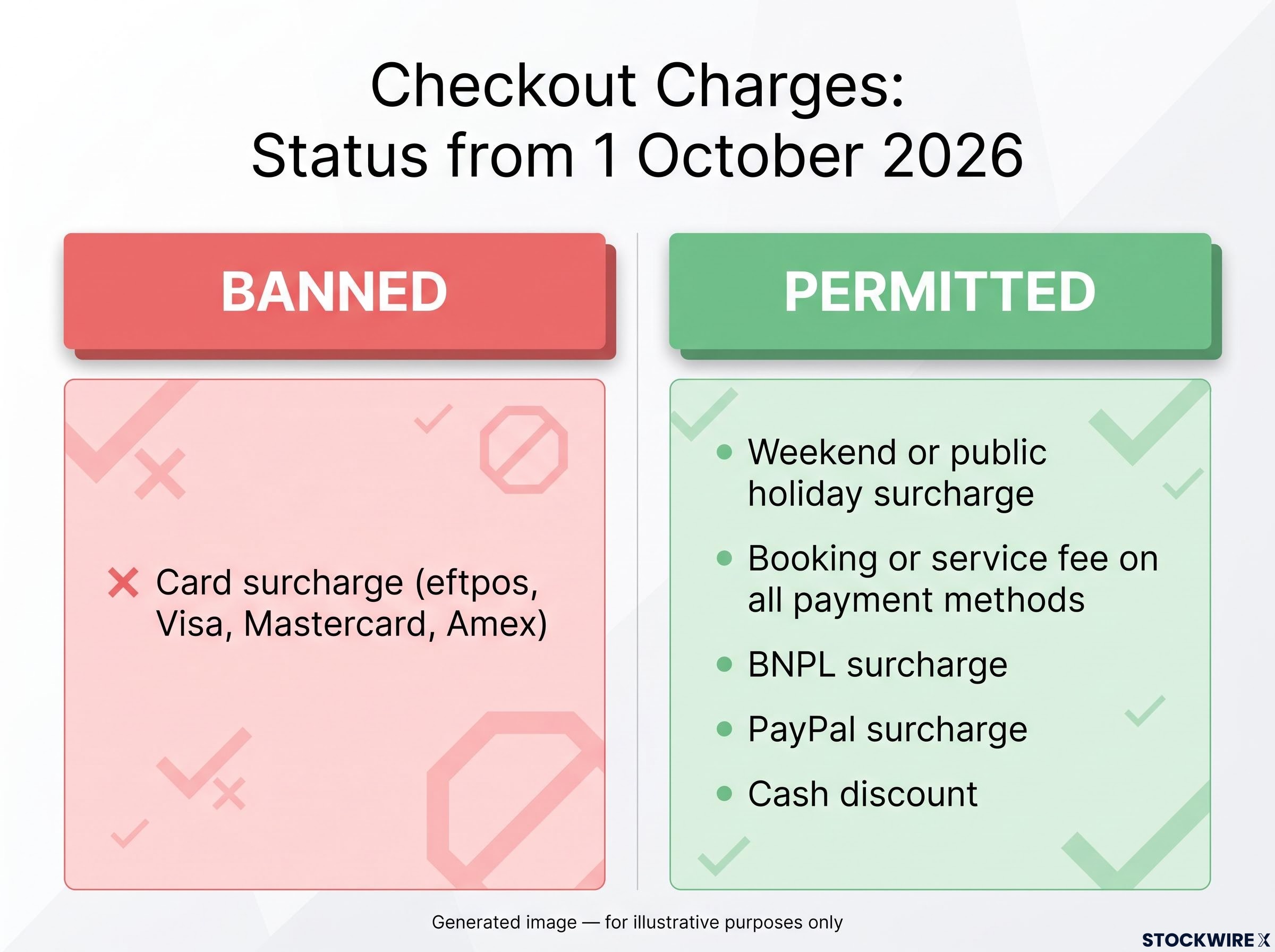
| Charge type | Status after 1 October 2026 |
|---|---|
| Card surcharge (eftpos, Visa, Mastercard, Amex) | Banned |
| Weekend or public holiday surcharge | Permitted |
| Booking or service fee on all payment methods | Permitted |
| BNPL surcharge | Permitted |
| PayPal surcharge | Permitted |
| Cash discount | Permitted |
How interchange fee cuts change the cost equation for businesses
To understand why the RBA felt confident forcing businesses to absorb card costs, you need to look at what happens to those costs on the same date. The ban does not arrive alone.
On 1 October 2026, new interchange fee caps take effect. Interchange fees are the wholesale charges that card networks levy on businesses to process each card payment, and they make up a large share of what a merchant pays to accept cards. Lower caps mean the cost businesses now have to swallow is meaningfully smaller than it was.
The reductions are substantial for the most common card types.
| Card type | Old interchange cap | New cap (from 1 October) |
|---|---|---|
| Consumer credit | 0.8% | 0.3% |
| Debit / prepaid | 10c or 0.2% | 8c or 0.16% (whichever is lower) |
| Commercial card | 0.8% | 0.8% (unchanged) |
The RBA estimates these interchange changes will save Australian businesses in the order of A$900 million a year. That is the arithmetic behind the regulator’s confidence: strip out a chunk of the wholesale cost, and asking businesses to absorb the rest becomes far more reasonable.
There is a genuine catch, and it falls hardest on the smallest operators. According to ACCC figures, businesses processing under $1 million in annual card payments face credit card acceptance costs of 1% to 2%, while businesses processing over $100 million pay just 0.5% to 1%. The burden of absorbing card costs is heaviest exactly where margins are thinnest.
That is why not everyone is celebrating.
The small business warning The Council of Small Business Organisations Australia (COSBOA) cautioned that banning card surcharging “without guaranteed lower fees risks higher costs for small business and consumers.” COSBOA chair Matthew Addison noted that surcharging had been “one of the only ways small businesses can recover these costs.”
The A$900 million figure sounds decisive, but there is a condition attached that matters to any small business owner reading this. Those interchange savings only reach you if your acquirer and payment processor actually pass them through. COSBOA’s warning is essentially a flag that this pass-through is not guaranteed, and that is the difference between a viable reform and a cost shift dressed up as one.
The mandatory fee transparency requirements commencing 1 April 2027 are expected to intensify competition in merchant payment reforms, with payment processors whose pricing models are already structured around cost-plus disclosure better positioned to attract businesses seeking clarity after the surcharge era ends.
Who enforces the ban, and what happens if a business ignores it?
Here is where the mechanism matters, because the answer is not the obvious one. This change was made through contract, not legislation, and that shapes who holds businesses to account.
Enforcement sits with the card networks and payment service providers, through their scheme rules and merchant contracts. It does not sit with the ACCC or the RBA directly. ACCC guidance, updated on 26 August and 31 August 2026, spells it out: “the card networks or payment service providers will be responsible for enforcing these rules, not the ACCC.”
That flows directly from how the reform was built. The RBA lifted its prohibition on no-surcharge rules on 31 March 2026 using its existing powers under the Payment Systems (Regulation) Act. No new primary legislation was required, so there is no single government complaint line dedicated to policing individual card surcharges.
Australia’s approach to financial regulatory enforcement relies on layered institutional accountability: licences, scheme rules, and consumer protection frameworks operating in parallel rather than a single regulator holding all compliance levers, a pattern visible across the payments, banking, and superannuation sectors.
The ACCC has not stepped back entirely. It continues to police excessive surcharging where surcharges remain permitted (on non-card payments), enforce rules against misleading or deceptive pricing, and ensure any permitted surcharge does not exceed the actual cost of acceptance.
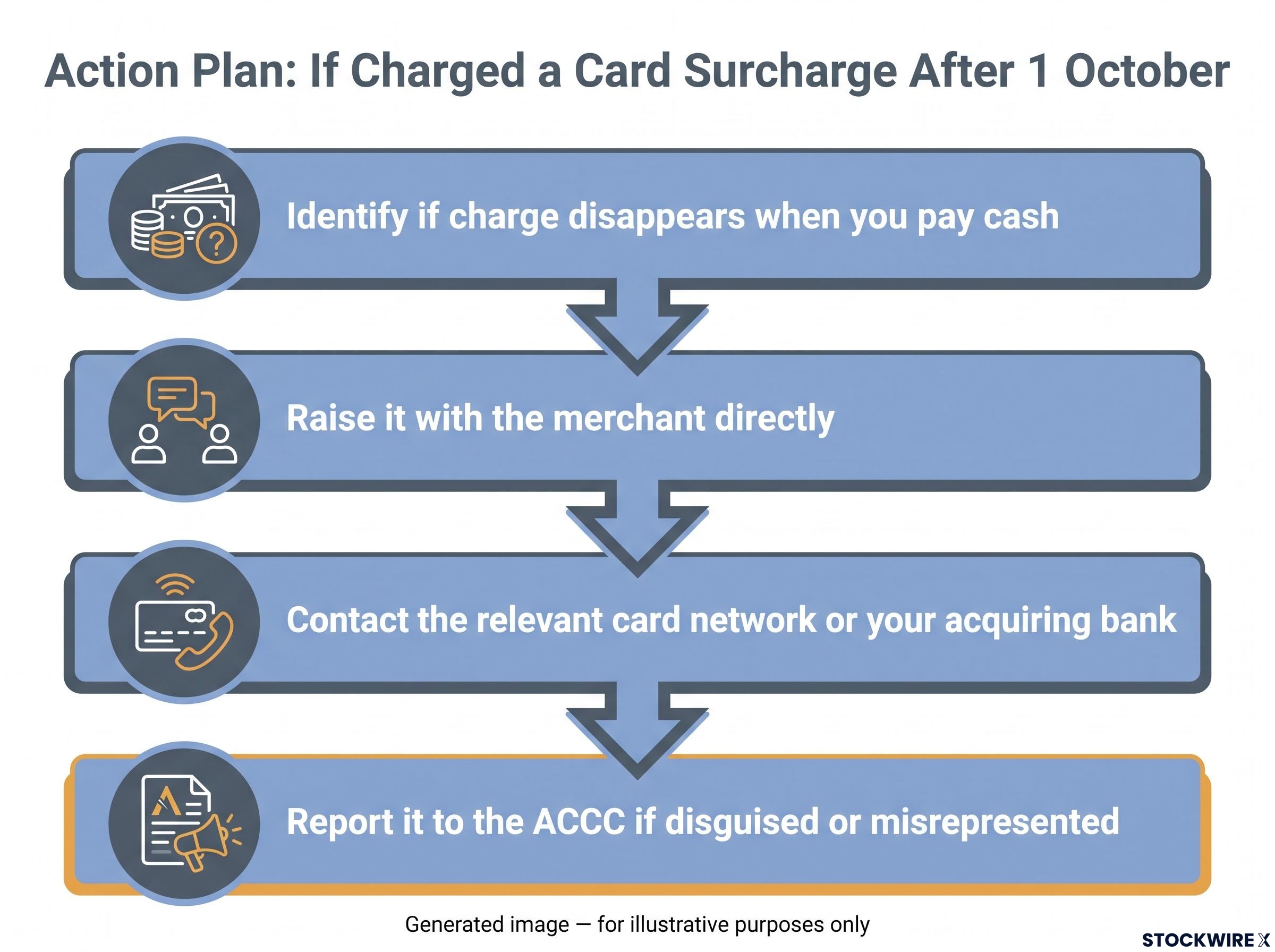
So what should you do if you are charged a card surcharge after 1 October? The escalation path runs through your bank and card network first, and only reaches the ACCC if the charge is disguised or misrepresented.
- Identify whether the charge is card-specific by checking if it disappears when you pay cash.
- Raise it with the merchant directly, as it may simply be an oversight.
- Contact the relevant card network or your acquiring bank if it is not resolved.
- Report it to the ACCC if the charge is disguised or misrepresented as something it is not.
Knowing this before you need it saves you the wasted effort of firing off a complaint to the wrong body. Under the old regime, only 13% of consumers were consistently notified of a surcharge before completing payment, so plenty of people never even saw these charges coming. After 1 October, the more useful reflex is knowing exactly who to call.
What businesses need to do before 1 October
If you run a business that currently surcharges, the compliance list is short but firm. Remove your card surcharge settings by 1 October 2026, reprice your services to fold in card acceptance costs where needed, and review your contracts with acquirers and payment gateways.
The pricing part comes with a rule. The ACCC’s own worked example describes a hair salon charging $60 for a service with a 1% credit card surcharge. From 1 October, the salon can raise its advertised price by $0.60 to reflect the genuine card cost, but no more than that on the basis of the surcharge change.
In other words, only the card-related component can be cited as the reason for a price rise. Attributing a larger increase to the surcharge ban than the card cost actually justifies is subject to ACCC scrutiny, so businesses tempted to pad prices under cover of the reform should expect that to be noticed.
What the real-world checkout looks like after 1 October
Strip away the regulation and picture the actual moment you pay for something. For most everyday card transactions, 1 October delivers a real, visible improvement: the separate surcharge line on your receipt and at the terminal simply disappears.
That is the honest good news, and it is worth stating plainly before the caveats. Since 84% of Australian businesses already build card costs into their prices, this change mostly formalises for the remaining 16% what everyone else already does.
But costs do not vanish from the system. They move. Businesses that were surcharging are expected to lift their advertised prices modestly, reward-heavy credit card users may see trimmed rewards programmes as lower interchange cuts the revenue banks use to fund them, and some hospitality and ticketing operators may lean harder on non-card surcharges.
The overseas experience tells you what “after a ban” actually looks like. When the United Kingdom banned card surcharges in January 2018, explicit surcharges largely disappeared, but booking and admin fees persisted in travel and ticketing, surviving because they applied regardless of how you paid.
Whether businesses absorb card costs or embed them in headline prices matters for embedded price inflation more broadly; at a moment when Australia’s trimmed mean has been rising since mid-2025, even modest across-the-board price adjustments in hospitality and retail add to the cost-of-living picture the RBA is watching.
What CHOICE says Consumer group CHOICE welcomed the change as “a long time coming,” framing it as a win for consumers who have long faced confusing and often high card fees.
Europe offers a sharper caution. The EU Court of Auditors warned in a 2025 report that “hidden surcharges” via higher prices are “not transparent for the consumer and are ultimately likely to lead to an increase in the global surcharge and thus in overall prices.”
Here is what to keep an eye on after 1 October:
- Modest headline price increases at businesses that previously surcharged
- Increased use of weekend or public holiday surcharges in hospitality
- Booking or admin fees appearing in travel and ticketing
- Trimmed credit card rewards programmes
Adjust your expectation from “surcharges vanish” to “surcharges become embedded,” and you are better placed to judge whether an October price rise genuinely reflects card cost absorption or is simply opportunistic. That distinction is the one worth carrying with you.
Three weeks out, a clear-eyed read on what 1 October actually delivers
Strip the reform down to its genuine wins and there are two. The explicit surcharge line at checkout ends for card payments, and interchange fees fall in a way that should lower card acceptance costs for businesses, especially the smaller ones, if acquirers pass those savings through.
There are also two legitimate open questions. Will payment processors fully pass interchange savings to small businesses, and will the grey area of non-card fees in hospitality, travel and ticketing quietly grow to offset some of what consumers gain?
The scale of what is being removed from explicit view is real: roughly $1.8 billion in annual surcharges across the system.
Here is the clean summary to carry forward:
- Removed: card surcharges on eftpos, Visa, Mastercard and Amex
- Unchanged: weekend and public holiday surcharges
- Unchanged: booking and admin fees applied across all payment methods
- Unchanged: PayPal and BNPL surcharges
One date signals the reform is still in motion. Certain foreign-issued card interchange caps do not commence until 1 April 2027, which means the next meaningful checkpoint for judging whether costs have genuinely come down sits roughly six months after 1 October. Watch your receipts through October and November, not to expect a hidden surcharge on every transaction, but to build an accurate picture of what has actually changed in your spending.
For readers wanting to understand the broader regulatory environment shaping Australian payments, our full explainer on how ASIC is regulating financial market innovation covers how tokenised assets and digital payment rails are being brought within Australia’s existing oversight framework.
This article is for informational purposes only and should not be considered financial advice. Investors should conduct their own research and consult with financial professionals before making investment decisions.
—