Most investors assume a stock price is a verdict handed down by the market, dictated by sentiment, momentum, and forces entirely outside a company’s control. Two South Korean semiconductor giants are currently spending roughly $41 billion to prove otherwise.
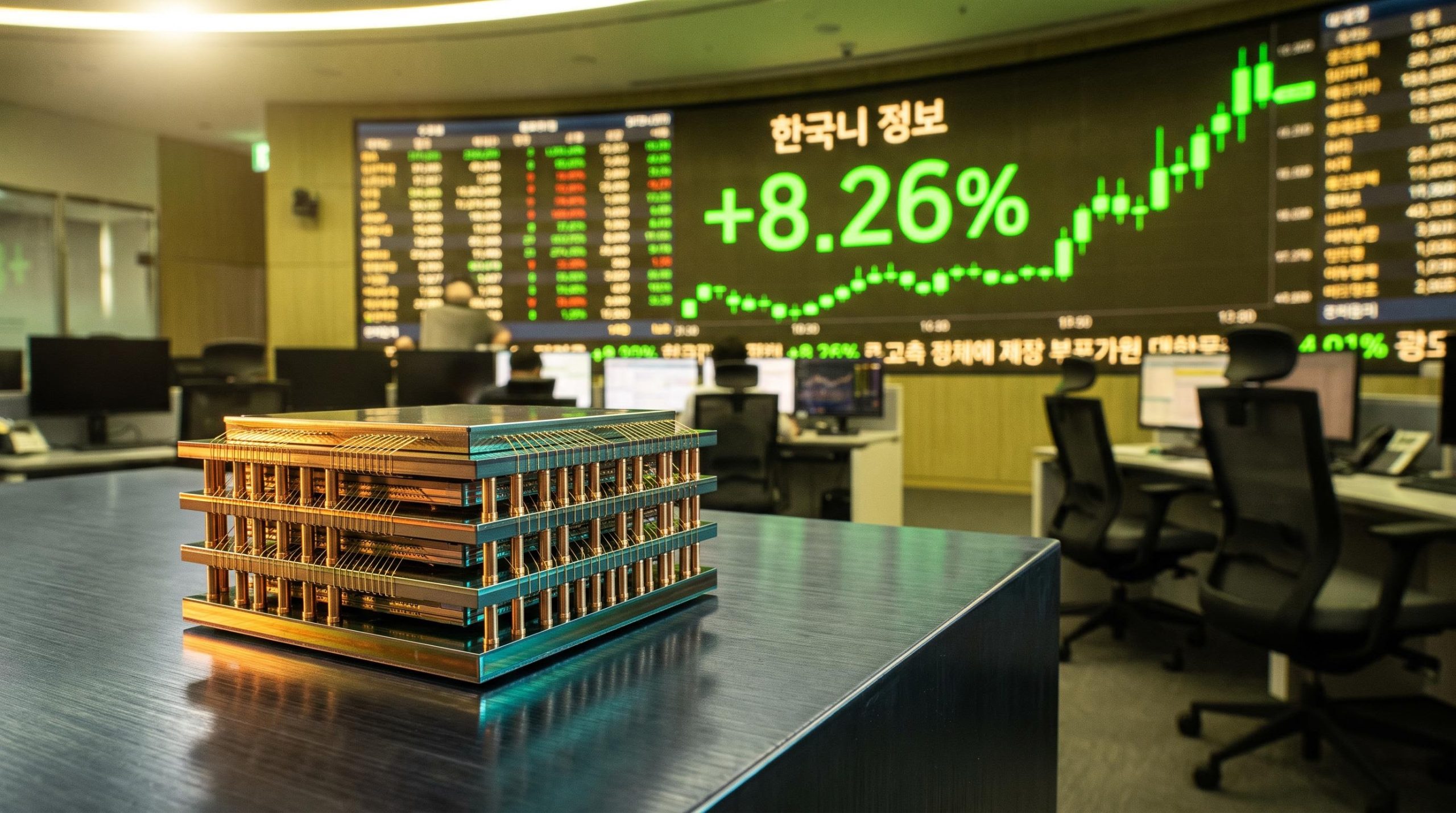
SK Hynix and Samsung Electronics are deploying their cash reserves as a deliberate market-making tool, building a defensive wall under their own share prices that is designed to hold through late November 2026. The backdrop is a jittery semiconductor market where AI-cycle enthusiasm collides with fears of a peak, and where foreign capital has been flowing in and out with unnerving speed.
That is where a share buyback strategy stops being an accounting footnote and becomes a live intervention in how a stock trades day to day.
Here is the framework for reading these massive corporate repurchases: how they build a technical floor under a price, why the two companies are executing wildly different playbooks, and how you can tell the difference between genuine valuation support and routine administrative housekeeping in emerging market tech equities.
How open market repurchases construct a technical floor
Look at the trading screen of a stock with a large active buyback and you notice something odd during a broad market selloff. The stock dips, then stalls. Sell orders keep arriving, but the price refuses to break lower. That resistance is not luck. It is a technical floor, a price level below which corporate buying reliably steps in to absorb whatever the market is selling.
The mechanism is simpler than it looks. A company hires consignment brokers to execute its authorised buying in the open market, and those brokers place standing bids that soak up excess selling pressure. When a session turns thin or volatile and the order book tilts one-sided, the company’s own capital becomes the counterparty of last resort.
Here is how a standing bid absorbs daily volatility in practice:
- The board authorises a fixed sum and share count over a defined window, then appoints brokers to execute.
- The brokers place daily buy orders sized within regulatory limits, active throughout the trading session.
- When selling pressure spikes and the price drops, these standing bids execute, removing shares from the market.
- That absorbed supply prevents the price from falling as far as it otherwise would, dampening the downswing.
- The effect repeats session after session for as long as the programme runs and capital remains.
The academic evidence backs this up. A 2021 study published via the Harvard Law School Forum found that buybacks significantly increase stock liquidity and reduce realised volatility, with managers intensifying repurchases precisely when they expect volatility to rise. TSMC‘s 2024 programme showed the design in its purest form: a fixed price band of NT$598 to NT$1,281 per share, with the company committing to keep buying even if the price fell below the range. That is a quasi-automatic demand backstop written directly into the programme terms.
There is a hard limit to all this, and it is the most important thing to understand. Empirical studies of Vietnamese repurchases between 2008 and 2016 found that the price-stabilising effects hold during the active transaction window but do not persist once the programme ends.
What this tells you about your own positions is precise. A corporate technical floor is not a promise of future gains. It is a mathematically quantifiable dampener on downside risk, and only while the programme is live. Read it as a temporary liquidity buffer, not a permanent repricing of the business.
When big ASX news breaks, our subscribers know first
Divergent execution models in South Korean tech
Two companies, the same headline concept, two almost opposite intentions. SK Hynix is running an aggressive equity-shrinkage campaign. Samsung is running a dividend-leaning defence with buybacks relegated to a supporting role. The gap between them is the whole lesson.
The competitive dynamic underpinning these buybacks intensified in June 2026, when SK Hynix overtook Samsung as South Korea’s most valuable listed company, a milestone driven by its roughly 70% share of the global HBM market and a record 47.2 trillion won operating profit for full-year 2025.
| Metric | SK Hynix | Samsung Electronics | Strategic Purpose |
|---|---|---|---|
| Buyback authorisation | 40.43 trillion won (24.07 million shares) | 15 trillion won (53.29 million shares) | Hynix: shrink float. Samsung: fund staff compensation |
| Programme window | 20 Aug to 19 Nov 2026 | 24 Aug to 21 Nov 2026 | Both expire late November 2026 |
| Fate of shares | Cancelled in full | Held as treasury for equity awards | Cancellation permanently boosts EPS |
| 2026 dividend component | Buyback-led return policy | ~30 trillion won cash dividends | Samsung routes most cash via dividends |
SK Hynix and the equity shrinkage model
SK Hynix’s programme is built to make your slice of the company bigger. It authorised 40.43 trillion won to repurchase 24.07 million common shares, all of which will be cancelled outright. Cancellation is the key word: those shares vanish permanently, so every remaining shareholder’s claim on future AI-era memory profits grows.
As of the first-day report on 20 August 2026, only 1.09 trillion won had been spent, leaving more than 39 trillion won, over 95% of the authorisation, still to be executed. That is a wall of pending demand hanging over the market for months.
Management frames the move around a view that the stock is undervalued, and analysts note the tax efficiency at play; buyback gains can be deferred and taxed as capital gains rather than current income. There is a defensive layer too. A sharp share-price drop had raised fears the AI cycle was peaking, and a cancellation programme this large is a signal to foreign investors that management will not simply hoard cash. The company may go further, with a potential additional Q4 programme of up to 40 trillion won reported. Structurally, this is the Apple-style, valuation-driven equity shrinkage model, familiar from Apple’s $110 billion 2024 authorisation.
Asian semiconductor valuations remained at roughly half the Nasdaq 100 forward multiple as of early May 2026, even as earnings growth forecasts ran nearly three times faster, a discount that makes the valuation-support argument for SK Hynix’s cancellation programme more credible than it would be for a comparably-priced US peer.
Samsung and the dividend defence
Samsung’s approach protects your income, not your share count. Its 15 trillion won buyback of 53.29 million shares is earmarked for employee stock-based compensation, meaning the shares are recycled into staff equity awards rather than cancelled. The float barely moves.
The real return sits in the dividend. Samsung’s 2026 framework targets total shareholder returns of 90 to 110 trillion won, built on a policy of returning 50% of free cash flow, with roughly 30 trillion won flowing through cash dividends and a projected Q4 payout of 9,149 won per share. Its buyback yield is a modest 1.1%.
The governance logic is deliberate. Steady, predictable cash distributions suit long-term domestic institutions and the controlling shareholder group, who may be wary of very large buybacks that complicate control dynamics. Combined, the two firms leave roughly $27 billion of unexecuted buyback capacity in the market.
The contrast tells you exactly what each company is doing. SK Hynix is consolidating your claim on future earnings through permanent cancellation. Samsung is managing dilution and paying you to wait. Not all billion-dollar headlines are the same programme.
The role of the foreign capital pivot in buyback success
A technical floor built by corporate cash can hold a price steady. It cannot, on its own, push a price higher. For that, a stock needs external buyers to return, and the story of these two giants in late 2026 is really a story about foreign capital deciding whether to validate the floor or overwhelm it.
Global semiconductor capital flows in 2026 have been self-reinforcing: the SOXX ETF gained roughly 40% in April alone, and the AI supply chain positioning of South Korea and Taiwan attracted disproportionate institutional allocations compared to every other emerging-market cohort, creating the pool of foreign buyers whose September return amplified the buyback floors.
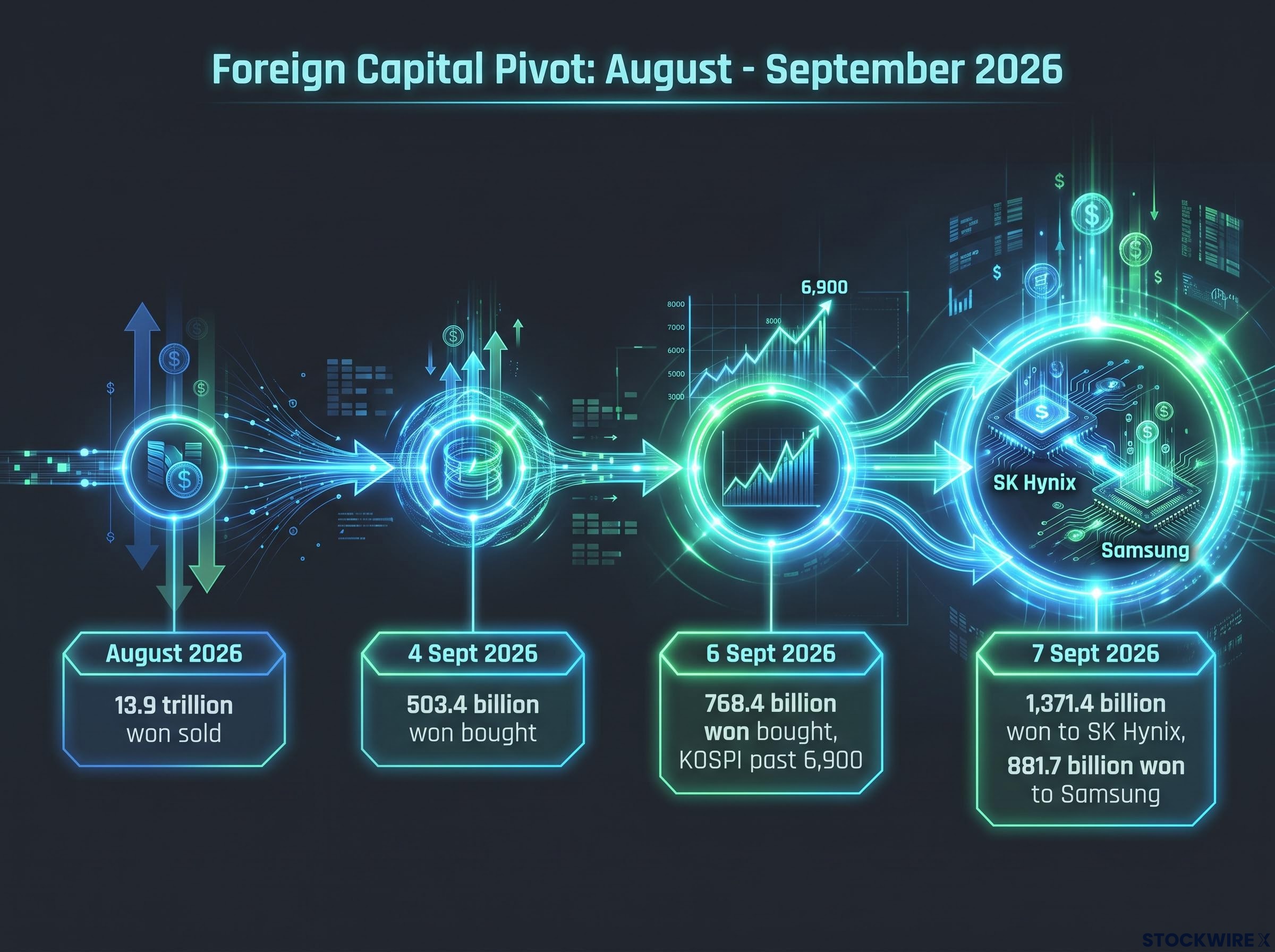
The pressure was severe first. Seoul Economic Daily reported that foreign investors and institutions jointly sold 13.9 trillion won of Korean stocks during August 2026’s selloff, a period that overlapped almost exactly with the start of SK Hynix’s buyback on 20 August. The corporate floor was absorbing a genuine flood of selling.
Then the tide turned in early September. The reversal was sharp and it concentrated exactly where the buybacks were running:
- 4 September 2026: foreign investors net bought 503.4 billion won of KOSPI shares, the first joint buying session in six trading days.
- 6 September 2026: combined foreign and institutional net buying hit 768.4 billion won intraday, pushing the KOSPI up around 3% past the 6,900 level.
- 7 September 2026: foreign buyers piled into large-cap tech, with 1,371.4 billion won flowing into SK Hynix and 881.7 billion won into Samsung.
That rotation matters because Korean tech does not trade in isolation. The Nasdaq 100 and KOSPI 200 have shown greater than 91% price correlation over the prior two years, according to Investing.com data, meaning a return of appetite for US technology tends to drag Korean chip names up with it.
The read you should take is this. Corporate repurchases are at their most potent when they act as a bridge, holding the line until returning institutional confidence arrives to do the heavy lifting. When foreign net flows align with an active buyback, a stock can shift from defence to offence. Watch the daily foreign flow data alongside the programme timelines, because that is where corporate signalling and market conviction meet.
Identifying the limits of engineered price stability
The uncomfortable truth about buybacks is that they can destroy value as easily as protect it. A massive capital return deployed at the wrong moment does not fix a broken business. It simply spends the cash that might have saved it later.
Timing is where the danger lives. Companies have a well-documented habit of buying the most shares when valuations are highest, which is exactly when repurchases deliver the worst return on capital. The Harvard Law School Forum found the pattern is widespread rather than rare.
Buyback timing and price discipline are where the value-creation logic either holds or breaks: Macquarie’s 2026 programme illustrated the inverse case cleanly, deploying capital near the 52-week low and closing the programme once the price had risen 25%, a sequence that maximised the per-share benefit by doing exactly what the academic literature recommends and most companies fail to execute.
Research from the Harvard Law School Forum found that 64% of studied S&P 500 firms exhibited negative buyback effectiveness, meaning their buyback return on investment lagged total shareholder return, often because shares were repurchased at inflated prices.
There is a subtler risk too. Research from Two Sigma found little evidence that buybacks suppress volatility over longer horizons, and noted that average idiosyncratic volatility can actually rise after a repurchase announcement because the company carries more equity leverage afterwards. A buyback can leave a stock jumpier, not calmer, once the programme lapses.
The deepest concern is what a big buyback can hide. Cutting the share count lifts earnings per share even when actual earnings are flat or falling, dressing up stagnation as growth. In a prolonged downturn, a company that exhausts its cash on repurchases can end up over-levered and under-invested, having spent its defensive reserves at prices that later prove unsustainable.
This is why evaluating any repurchase means looking past the headline figure. Ask whether the company is deploying capital wisely at a genuine discount, or engaging in financial engineering to prop up EPS and protect executive compensation. During a sector downturn, that distinction separates a value opportunity from a value trap.
This article is for informational purposes only and should not be considered financial advice. Investors should conduct their own research and consult with financial professionals before making investment decisions. Past performance does not guarantee future results, and financial projections are subject to market conditions and various risk factors.
Navigating the post-November tech landscape
The tension to watch now is between two forces pulling in the same direction. Roughly $27 billion of unexecuted buyback capacity sits waiting in the market, and foreign liquidity has begun rotating back into both names, just as the programmes head toward their late November 2026 expiries.
Two data points deserve your attention. First, the execution rate reports; SK Hynix had spent barely 5% of its authorisation early on, so the pace of the remaining spend will shape how firm the floor stays. Second, any confirmation of the potential additional 40 trillion won SK Hynix Q4 programme, which would extend corporate support well past the current window.
The lasting takeaway is structural. SK Hynix’s cancellations permanently shrink its free float and lift per-share earnings, while Samsung’s dividend-heavy framework locks in a predictable cash yield. These are not temporary gestures. They are reshaping the ownership and income profiles of two of emerging market tech’s most important equities, and understanding which lever each firm is pulling is how you read the next chapter accurately.