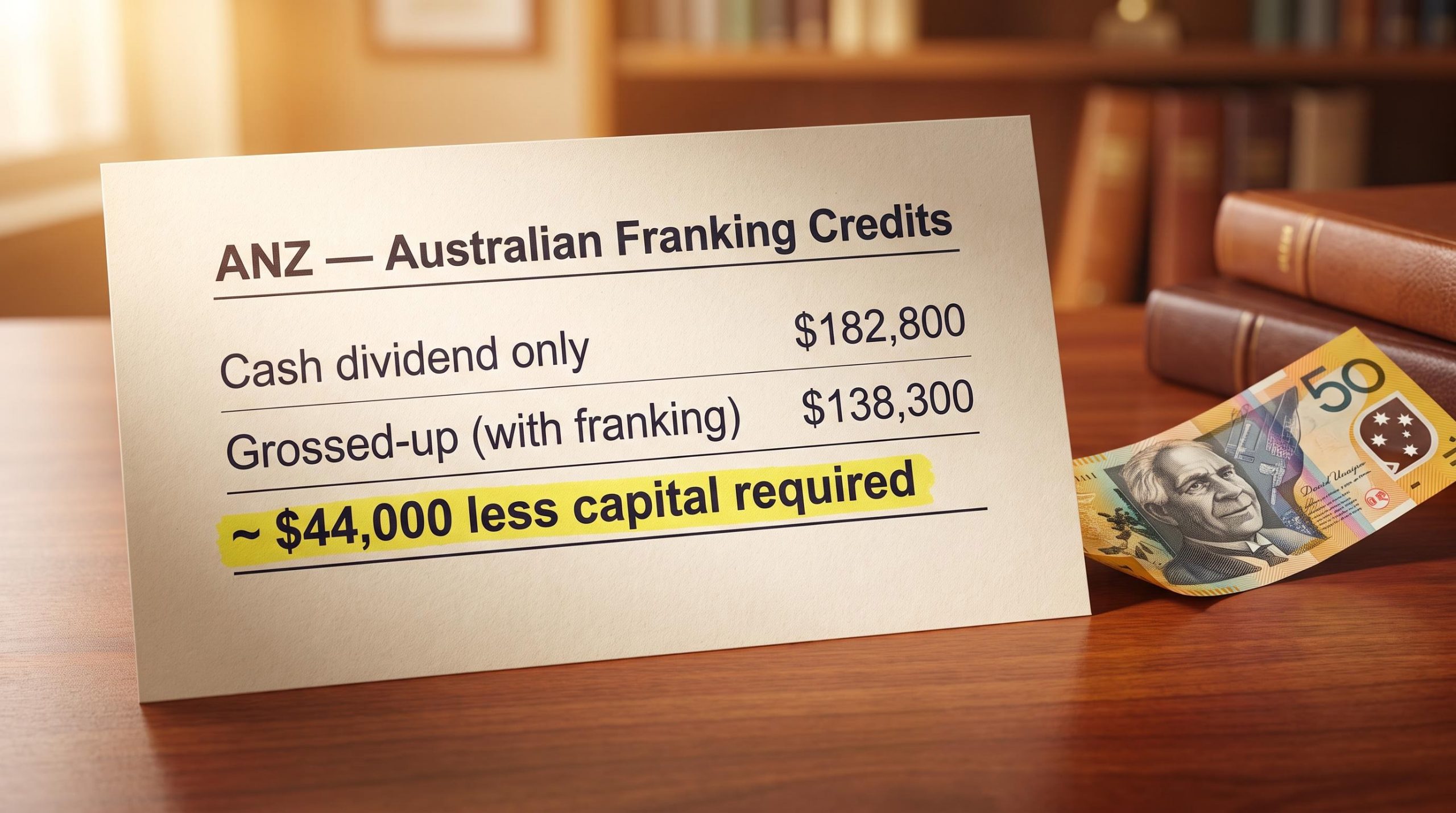
Here is a number most Australian income investors have never actually run. To collect $8,000 a year from ANZ Group Holdings (ASX: ANZ) shares, you need roughly $44,000 less capital than the raw cash dividend suggests, once franking credits are part of the picture.
That gap is not a rounding error or a clever accounting trick. It is a structural feature of how dividends are taxed in this country, and most people simply do not know it exists.
Australian franking credits are one of the most consequential features of the local sharemarket for anyone building dividend income, yet the mechanics are usually flattened into vague talk about “tax benefits.” ANZ works well as the example here because its trailing dividend and share price are real, public, and easy to plug into the same calculation you can run for your own holdings.
By the time you finish reading, you will be able to run the grossed-up dividend calculation yourself. More importantly, you will understand how your own tax situation, especially whether you are in pension phase, decides how much of that headline number you actually keep.
What a franking credit actually is and why it exists
Before the numbers, the logic. Australia’s dividend imputation system exists to solve a specific problem: company profits being taxed twice, once when the company earns them and again when they land in a shareholder’s hands as a dividend.
The system was designed so that profits are effectively taxed once, at the investor’s own marginal tax rate, rather than twice. When a company like ANZ pays tax on its profits at the 30% corporate rate, it attaches a record of that payment to the dividends it distributes. That record is the franking credit.
So a franked dividend has two parts. There is the cash dividend that hits your account, and there is the franking credit, which represents tax the company has already paid to the Australian Taxation Office on your behalf.
The 30% corporate tax rate is the reference point for every franking calculation, and ANZ applies it consistently across all its dividend announcements from 2025 through 2026. To convert a cash dividend into its grossed-up figure, you reverse out that corporate tax.
Here is the formula in plain terms.
The grossed-up dividend formula follows the same 30/70 logic regardless of which ASX stock you are running it on, and a $1,000 fully franked dividend becomes $1,428.57 in total value for an eligible pension-phase investor once the ATO refunds the attached credit in cash.
Grossed-up dividend = Cash dividend divided by (1 minus 0.30)
Working through it is a four-step process.
- Identify the cash dividend per share the company has paid.
- Note the franking percentage attached to it (how much of the dividend carries credits).
- Apply the gross-up: divide the franked portion of the cash dividend by 0.70.
- Add the result back to arrive at the grossed-up dividend figure.
This is where the “one tax, not two” principle matters to you directly. For an eligible Australian investor, the franking credit is not a bonus stacked on top of your cash dividend. It is the mechanism that ensures you, and not the Tax Office, capture the value of tax already paid at the company level.
That distinction changes how you should read every grossed-up yield figure you see quoted. And it holds firm right now: no material changes to the Australian franking credit system were enacted between 2025 and September 2026, so the system operates exactly as described.
When big ASX news breaks, our subscribers know first
The ANZ numbers in full: from 166 cents per share to $44,000 in capital savings
Now watch the numbers build, one step at a time, until the $44,000 figure arrives as a conclusion you have reached yourself.
Start with what ANZ actually pays. Its trailing twelve-month dividend totals 166 cents per share. That comprises two equal instalments: the 83-cent FY2025 final dividend, franked at 70% and paid in December 2025, and the 83-cent FY2026 interim dividend, franked at 75% and paid on 1 July 2026.
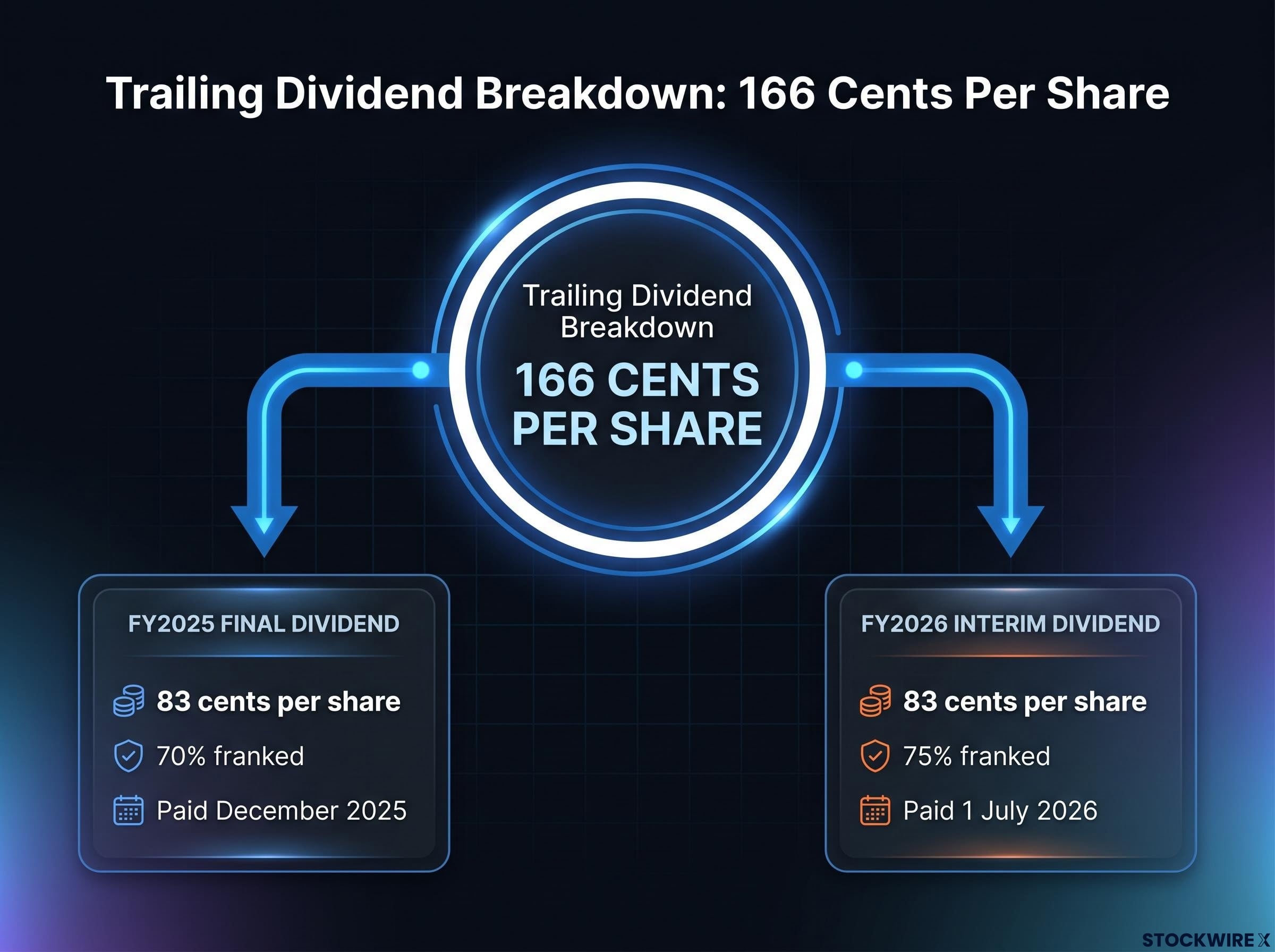
On a share price of around $38, that 166-cent stream gives a cash dividend yield of roughly 4.38%. That is the number most yield screens will show you.
But it is not the number that matters for an eligible investor.
Calculating capital on a cash-dividend-only basis
Ignore franking for a moment and work purely off the cash. The steps look like this.
- Take the income target: $8,000 per year.
- Take the cash dividend per share: $1.66.
- Divide the target by the per-share dividend: $8,000 divided by $1.66 equals approximately 4,820 shares.
- Multiply by the share price: 4,820 shares at $37.93 equals approximately $182,800.
So on a cash-only basis, you need roughly $182,800 of capital tied up in ANZ to pull $8,000 a year.
How the grossed-up dividend changes the share count
Now factor in the credits. With franking sitting at 75% and the corporate tax rate at 30%, the credits attached to each dollar of dividends amount to approximately 32 cents. Factoring those credits in pushes the grossed-up dividend to around $2.19 per share, and pushes the grossed-up yield to around 6%, a figure reported by Motley Fool Australia on 5 May 2026.
Run the same arithmetic against that grossed-up figure.
- Take the income target: $8,000 per year.
- Take the grossed-up dividend per share: $2.19.
- Divide: $8,000 divided by $2.19 equals approximately 3,650 shares.
- Multiply by the share price: 3,650 shares at $37.93 equals approximately $138,300.
The two scenarios sit side by side below.
| Approach | Shares required | Capital required | Annual income target | Yield basis |
|---|---|---|---|---|
| Cash dividend only | ~4,820 | ~$182,800 | $8,000 | ~4.38% |
| Grossed-up (with franking) | ~3,650 | ~$138,300 | $8,000 | ~6% |
The difference is more than $44,000 in capital. Here is what that figure is, and what it is not. It is not a cash refund or a coupon paid to you. It is the amount of invested capital an eligible investor does not need to deploy to reach the same income target, which means that capital stays free for diversification or anything else you choose to do with it.
Why your tax rate is the deciding variable
The 6% grossed-up yield is not a universal promise. Its real value depends entirely on the gap between your own marginal tax rate and the 30% corporate rate, not on the credit itself. That gap is what determines whether the franking credit becomes cash in your pocket or simply a reduction in your tax bill.
Think of it as a spectrum, running from maximum benefit to partial benefit.
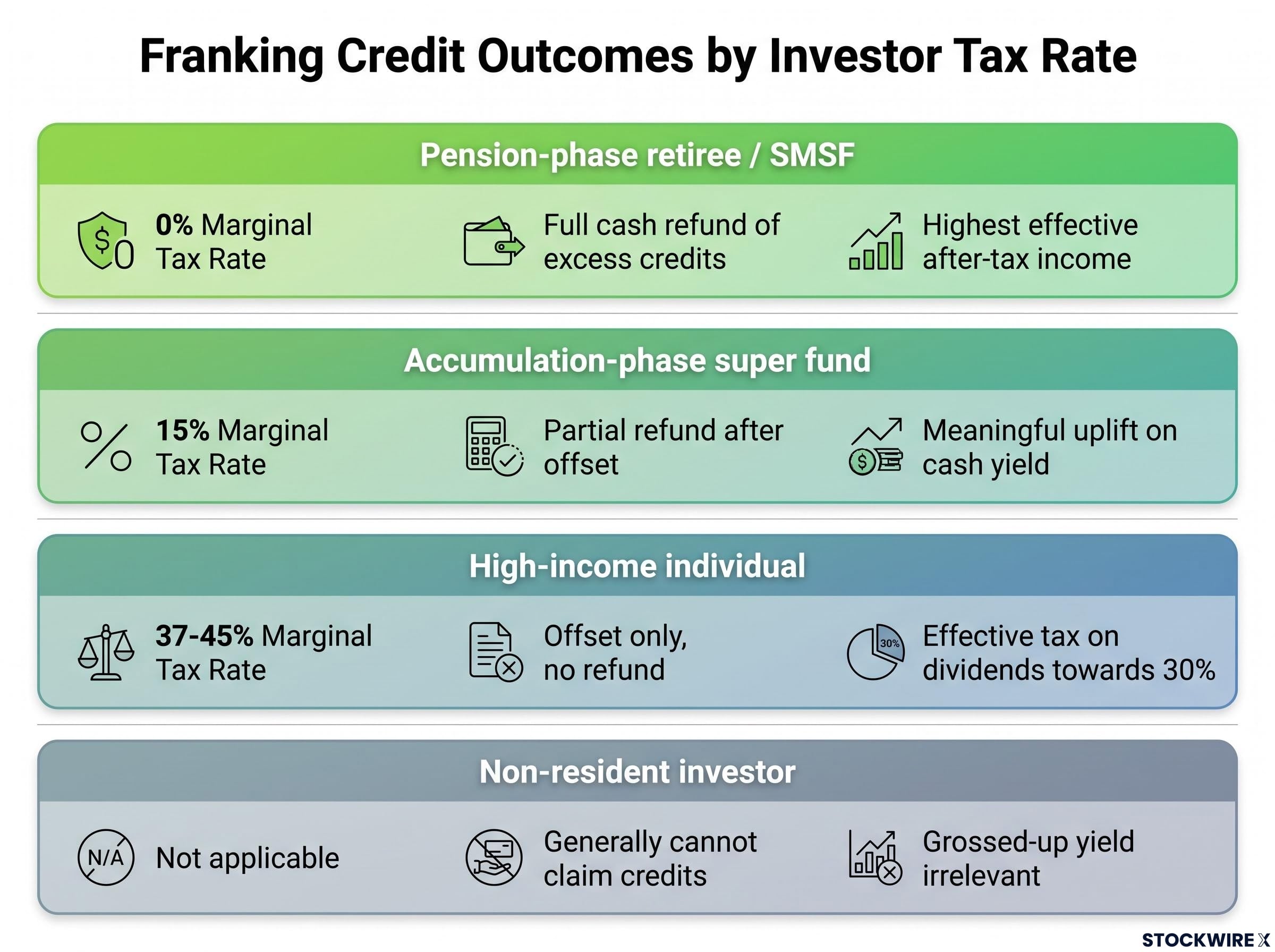
At the top sit pension-phase retirees and self-managed super funds (SMSFs) in pension phase, on a 0% marginal rate. Because they owe no tax on the grossed-up dividend, the franking credits attached to it are refunded to them in cash. A nominal 4-5% cash yield can convert into a materially higher effective after-tax cash flow once those refunds are counted.
In the middle sit accumulation-phase super funds, taxed at 15%. That is still below the 30% corporate rate, so they receive a partial benefit: the credit wipes out their tax on the dividend and refunds the difference.
At the other end sit high-income individuals on marginal rates of 37-45%. Their rate exceeds the company rate, so the franking credit offsets part of what they owe but typically generates no cash refund. It reduces their effective tax rate on dividends towards 30%, and no further.
The contrast is stark when you picture two investors holding identical ANZ parcels. Both receive the same cash dividend, but the pension-phase retiree treats the franking credit as a cash refund while the high earner treats it as a tax offset. Same shares, materially different after-tax outcomes.
The table below maps each investor type to what they actually receive.
| Investor type | Marginal tax rate | Franking credit outcome | Practical income effect |
|---|---|---|---|
| Pension-phase retiree / SMSF | 0% | Full cash refund of excess credits | Highest effective after-tax income |
| Accumulation-phase super fund | 15% | Partial refund after offset | Meaningful uplift on cash yield |
| High-income individual | 37-45% | Offset only, no refund | Effective tax on dividends towards 30% |
| Non-resident investor | Not applicable | Generally cannot claim credits | Grossed-up yield irrelevant |
That last row matters if it applies to you. Non-resident investors generally cannot claim franking credits at all, which makes the grossed-up yield calculation irrelevant to their income planning entirely.
The 45-day holding rule is a qualification step that sits before any of this arithmetic applies: shares must be held at risk around the ex-dividend date for the franking credit to be claimable, with a small shareholder exemption covering investors whose total annual credits fall below $5,000.
The stakes of this structure are made concrete in policy modelling.
A submission to the Australian Parliament in 2025 modelled that an SMSF fully invested in franked shares would effectively face a 30% tax rate on those dividends if credits ceased to be refundable, up from 0% today.
Franking credits in portfolio context: what the ANZ case study reveals about income strategy
The ANZ numbers are useful well beyond ANZ. What you actually have now is a template, not a stock tip.
A replicable framework for any franked dividend stock
Four inputs are all you need to run this calculation for any franked ASX stock.
- Identify the cash dividend yield (dividend per share divided by share price).
- Note the franking percentage attached to the dividend.
- Apply the 30% corporate tax gross-up formula to convert cash into grossed-up dividend.
- Map the result to your own marginal tax rate to see what you actually keep.
Plug in the data for Commonwealth Bank, Westpac or National Australia Bank, and you can compare them on a like-for-like grossed-up basis. The same works for large franked industrials such as Wesfarmers and Telstra, and for select resource companies that pay franked dividends when domestic profits are strong. The framework travels; only the inputs change.
Concentration risk, dividend sustainability, and policy uncertainty
Here is where the productive friction lives. The ANZ calculation is most useful as a way to stress-test income across several holdings, not as a reason to pile into one high-yield bank.
Leaning on a single bank stock for $8,000 a year concentrates several risks in one place.
- Company-specific risk: credit losses, penalties or strategic missteps hit both the dividend and the share price at once.
- Sector risk: major banks are highly exposed to property markets, interest rates and the credit cycle.
- Dividend sustainability risk: a high headline yield can reflect a depressed price and a payout the market expects to be cut.
- Franking credit refundability risk: a change to the rules would reshape the arithmetic for pension-phase investors specifically.
The concentration point is not theoretical. During the COVID-19 shock, bank boards across the sector cut or deferred dividends, and an investor relying on a single bank for income would have felt the full force of it.
The policy risk is the less-discussed one, and it bites pension-phase strategies hardest. If refundable franking credits were removed, the same Parliamentary modelling shows a pension-phase SMSF moving from a 0% effective rate to 30% on its franked dividends. That would fundamentally alter the income maths this whole article is built on.
The practical answer is spread. A basket of franked dividend stocks across sectors, blended with income-oriented listed investment companies (LICs) and ETFs that target franked dividends, keeps the franking benefit while diluting company-specific risk.
Building a resilient ASX dividend income portfolio around franked stocks requires checking ex-dividend dates, monitoring payout ratios, and understanding how dividend reinvestment plans compound income over time, all steps that sit downstream from the grossed-up yield calculation this article covers.
What the $44,000 capital gap tells you about building franked income over time
The grossed-up dividend is not a one-off calculation. It is the lens eligible Australian income investors should use continuously, because it reflects actual after-tax cash flow, including potential refunds, rather than a headline yield that flatters or understates the truth depending on who you are.
Be honest about its limits, though. The grossed-up yield is a tax accounting mechanism, not extra economic value produced from nowhere. Non-residents, high-rate taxpayers and investors with complex tax positions will extract far less from it than a pension-phase retiree will.
The framework also needs maintenance, because the inputs move. ANZ lifted its franking from 70% on the FY2025 final dividend to 75% on the FY2026 interim dividend, driven by improved performance in its Australian business.
That five-percentage-point shift is not trivial. It changes the grossed-up income calculation enough to move the capital needed to hit a target, which means checking franking levels at each result announcement is genuine portfolio maintenance, not a technical afterthought.
For eligible Australian investors, the grossed-up dividend is the correct income-planning metric. The catch is in the word “eligible”, which is defined entirely by your own tax position.
The $44,000 capital gap is the anchor. It has the most power for pension-phase investors, at high franking levels, over large capital bases, and the least for everyone else. Run your own numbers whenever a company’s franking changes.
For readers wanting to see how the grossed-up yield advantage stacks up against current term deposit rates across different income vehicles, our full explainer on building ASX passive income covers direct shares, LICs, and income ETFs in the current rate environment.
This article is for informational purposes only and should not be considered financial advice. Investors should conduct their own research and consult with financial professionals before making investment decisions. Past performance does not guarantee future results. Financial projections are subject to market conditions and various risk factors.
—