Here is a number that should stop most active traders cold: the difference between what you pay to borrow against your portfolio at a standard brokerage and what institutions pay for the same leverage can run to four or even six percentage points a year.
At a 10% to 12% retail margin rate, that gap is not a rounding error. It is a permanent drag on every dollar of leverage you carry, compounding against your returns quarter after quarter.
There is a way retail traders access something close to institutional financing rates using nothing more than four index options contracts. It sits inside the SPX box spread, a structure that turns a set of S&P 500 options into a synthetic fixed-term loan.
The catch is that it comes wrapped in options math, an unusual tax classification, and structural rules that punish mistakes severely.
This explainer breaks down how the synthetic loan actually works, how its implied borrowing rate stacks up against the margin schedules at Schwab, tastytrade, and Interactive Brokers, and why the US tax code treats this financing cost in a way that could make your real borrowing rate lower than the headline number.
Decoding the four-leg synthetic loan structure
A box spread looks intimidating on a trade ticket, but strip away the options language and what remains is a loan with a fixed repayment date.
You build the position by holding four options legs at the same time, all tied to just two strike prices:
- A long (bought) in-the-money call
- A short (sold) out-of-the-money call
- A long (bought) in-the-money put
- A short (sold) out-of-the-money put
That combination does something specific. It locks the value of the position at expiration to the exact distance between the two strikes, no matter where the S&P 500 index actually trades on that day.
This is the part worth sitting with: because the payout is fixed to the strike width, there is no directional bet here. The index can rally, crash, or go nowhere, and your outcome is identical.
That absence of market risk is what lets the structure behave like debt rather than a trade.
The cash flow math behind the expiration date
Picture a box built on strikes 100 points apart in SPX. Because each point is worth $100, that spread settles to a fixed $10,000 cash amount at expiration, an example laid out in Charles Schwab’s own educational material on the strategy.
Now run the loan. If you sell that 100-point box today for $97.50, you receive $9,750 in cash credited to your account immediately.
At expiration, you are obligated to pay back the fixed $10,000.
The $250 difference between what you received and what you repay is your financing cost. That is the entire economics of the trade in one number.
Here is the frame that makes it click: the $9,750 hitting your account today is your loan principal, and the $10,000 you settle at expiration is that principal plus interest. You lock in your exact borrowing cost on the day you open the position, with no floating rate to worry about.
The buying power reduction for a single one-lot box was cited at roughly $135, reflecting how the large cash credit interacts with margin requirements.
One execution rule matters enormously. You must enter all four legs together as a single combo order using limit pricing. Attempting to leg in one contract at a time exposes you to fills at the wrong prices and can leave you holding unintended directional risk before the box is even complete.
Options credit spreads occupy a related corner of the options market, using positive theta to generate daily carry rather than locking in fixed borrowing terms, and their defined-risk architecture shares the same multi-leg combo-order discipline that makes box spread execution unforgiving when legs are entered piecemeal.
When big ASX news breaks, our subscribers know first
The rate arbitrage against standard retail broker margin
Theory is fine, but the case for this structure lives or dies on the actual numbers. So here is what you are really leaking to standard margin.
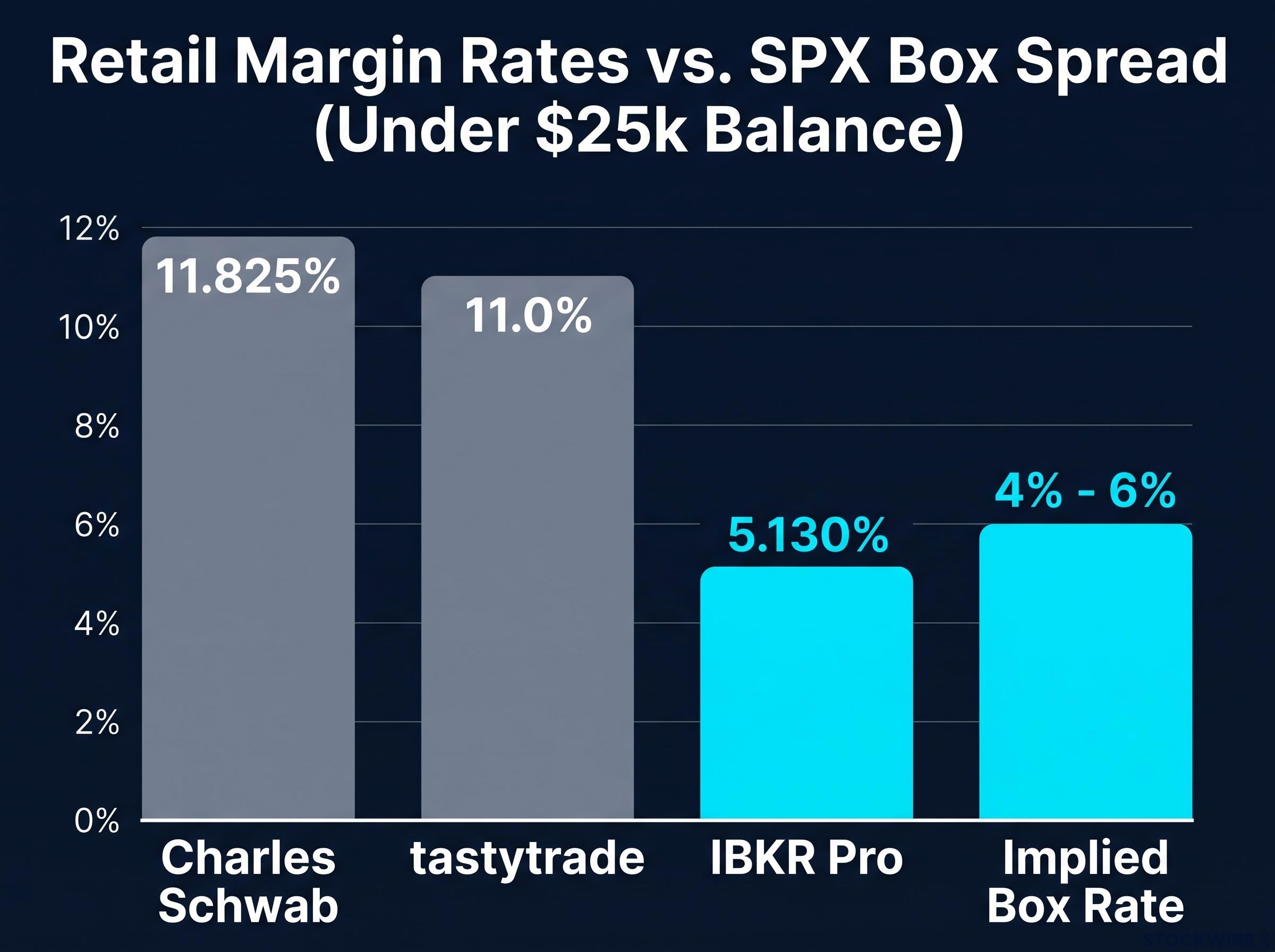
Across box spread executions tracked over 2024 to 2026, implied borrowing rates have generally clustered in the 4% to 6% range annually. A dedicated SPX and EuroStoxx 50 box yield-curve tracker reported an average implied yield of roughly 5.24% across recent executions, and a January 2026 note cited borrowing rates as low as 4.07%.
Now hold that against retail margin schedules.
Charles Schwab set a base margin rate of 10.00% as of its December 2025 schedule, with effective rates reaching 11.825% for the smallest debit balances under $25,000. tastytrade’s tiered rates run from 11% for balances under $25,000 down to 8% at the $1,000,000 level. The one clear outlier is Interactive Brokers, whose Pro schedule ranges from 5.130% on smaller balances to 4.130% for very large ones.
The comparison below puts the four environments side by side across three sample debit tiers.
| Debit Tier | Charles Schwab | tastytrade | IBKR Pro | Implied Box Rate |
|---|---|---|---|---|
| Under $25k | 11.825% | 11.0% | 5.130% | ~4-6% |
| ~$100k | 10.325% | ~8.5% | 4.630% | ~4-6% |
| $1M | ~8.575% | 8.0% | 4.380% | ~4-6% |
The read for you is direct. If you carry a margin balance at a firm like Schwab or tastytrade, you are likely paying a premium of 4 to 6 percentage points above institutional-style borrowing rates, and that premium drains straight out of your annual returns.
A conservative margin strategy typically targets utilisation well below platform-defined ceilings, with practitioners clustering around 10-15% of eligible portfolio value and running a yield-spread calculation that compares after-tax return against after-tax borrowing cost before treating any position as defensible.
The gap narrows sharply if you already trade at Interactive Brokers, where baseline rates sit close to the implied box rate for larger balances. For those traders, the execution complexity may not be worth the marginal saving. But for anyone parked at a firm with double-digit small-balance rates, the arithmetic is hard to ignore.
Navigating the Section 1256 tax treatment trap and benefit
Here is where the strategy stops being simple arithmetic and becomes a question of how the Internal Revenue Service sees your money.
You might assume the cost of borrowing through a box spread counts as margin interest. It does not. Because the position is built from options, the IRS treats your financing cost as trading profit and loss, not an interest expense.
That single distinction changes everything about how the cost is taxed.
SPX options are broad-based index options, which places them under Section 1256 of the tax code. Section 1256 contracts receive a mandatory split on all gains and losses: 60% is treated as long-term capital gain or loss and 40% as short-term, regardless of how long you actually held the position.
IRS Section 1256 in brief Gains and losses on broad-based index options are automatically split 60% long-term and 40% short-term, no matter the holding period. Open positions are also marked to market on 31 December each year, forcing recognition of unrealised gains or losses before the contract expires. Results are reported on IRS Form 6781.
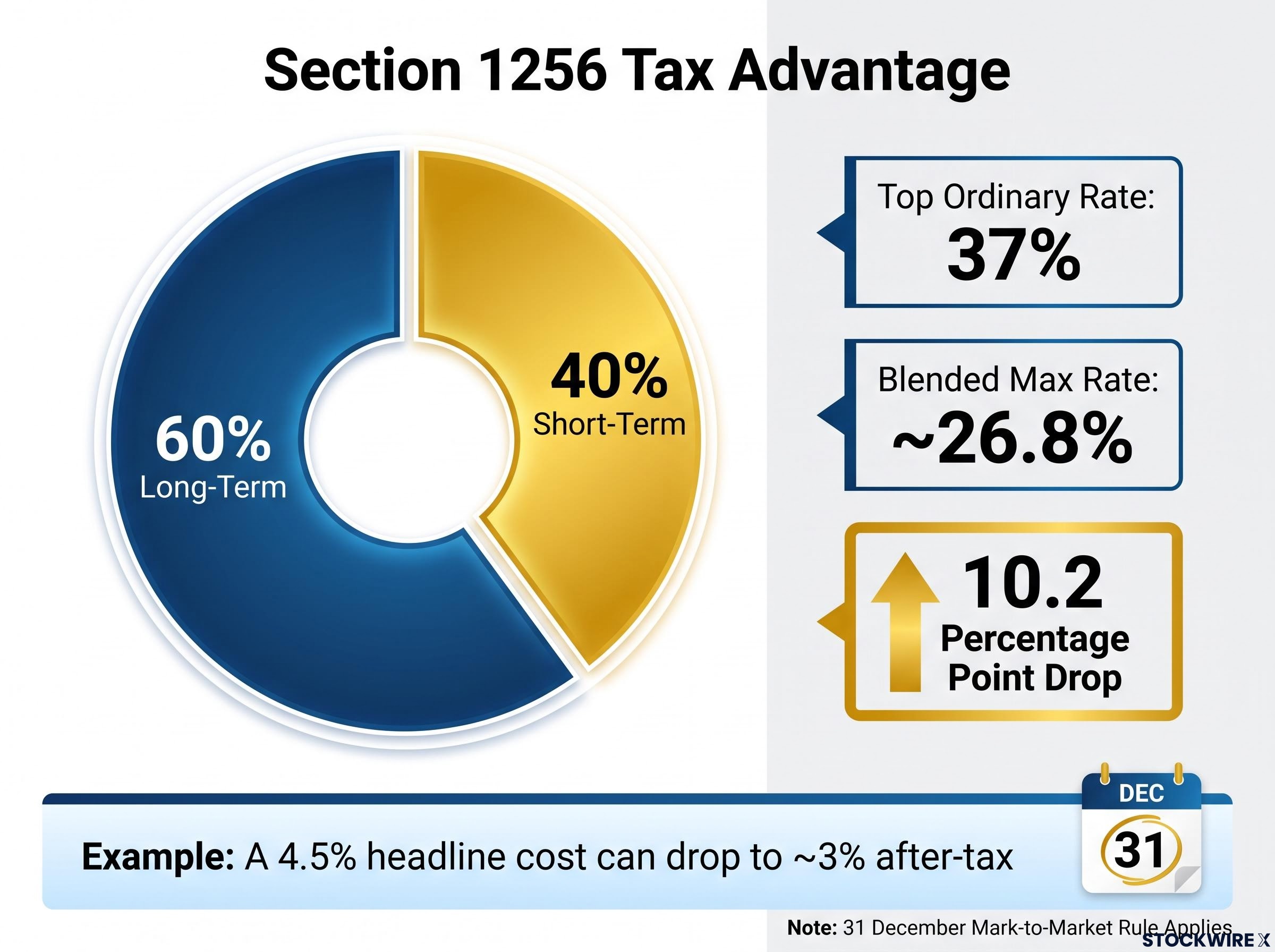
The mark-to-market rule deserves attention. If your box straddles a year-end, the tax code forces you to recognise the position’s gain or loss on 31 December even though the contract has not settled. That can accelerate recognition relative to when the loan actually matures.
Now the benefit. A 2025-2026 tax-planning analysis pegged the blended maximum rate on Section 1256 contracts at roughly 26.8%, around 10.2 percentage points below the top ordinary income rate of 37%.
What this means for your real cost is significant. Because your financing expense flows through as a capital loss with 60/40 character rather than as non-deductible personal margin interest, your true after-tax borrowing cost can land well below the headline rate. One wealth planner estimated that Section 1256 treatment can bring the after-tax cost of a 4.5% box loan closer to 3%, depending on your bracket.
The lesson for your own planning is that you cannot compare a box spread to a traditional loan on a straight rate-to-rate basis. The tax characteristics change the maths entirely.
The lingering Section 1258 recharacterisation risk
There is an unresolved question hanging over all of this. A January 2026 analysis flagged that the tax treatment of box-spread lending remains uncertain, pointing to a debate among practitioners over whether Section 1258, which can recharacterise certain gains as interest income, might apply to these synthetic loans.
If the IRS were to issue guidance reclassifying box-spread profits as interest, it could unwind the 60/40 benefit and potentially require amended returns.
This remains speculative rather than settled law. But it is a live tail risk that sophisticated traders should keep monitoring through 2026, because the entire tax case for the strategy rests on treatment that has not been formally locked down.
The Section 1258 recharacterisation debate sits within a broader landscape of capital gains tax risk that has been actively evolving since Moore v. United States left open the constitutional question of whether unrealised gains can be taxed, a precedent that sophisticated traders are monitoring alongside the box-spread guidance gap.
Why cash settlement and European style are non-negotiable
The structural rules here are not fine print. They are the difference between a working synthetic loan and a catastrophe.
This strategy only functions safely on broad-based indices like the SPX. Attempt it on individual stocks or standard equity ETFs and the whole structure can collapse.
The reason comes down to how the options settle. Consider the contrast:
- SPX options (safe): European-style, meaning they cannot be exercised early. Cash-settled, so no shares ever change hands. All four legs stay a fixed-payoff package through to expiration, as detailed in Cboe educational material on the structure.
- Equity options (dangerous): American-style, meaning short legs can be assigned at any time. Physically settled, creating real share delivery obligations. A single early assignment can shatter the box.
Here is the failure mode made concrete. If you build this on options for a stock like Apple, an early assignment on just one leg instantly breaks your fixed loan structure. The other legs no longer offset it, and you are suddenly holding a large, unintended directional position in the stock, potentially at extreme leverage.
There is a second risk that applies even to a correctly built SPX box: asset-liability mismatch. Cboe’s advisory commentary identifies this as the biggest danger.
The amount you owe on the box is fixed. But the portfolio backing that borrowing is marked to market every day. If your collateral falls in value, you may be forced to post more or face liquidation.
Initial margin requirements typically run around 50% for equities and 60% for ETF portfolios, with maintenance thresholds near 30% to 35% that trigger forced selling. Recognising these rigid boundaries is what protects your account from the margin calls and unintended assignments that can erase years of careful trading.
Margin debt and leverage risk sit at the heart of permanent capital loss scenarios: a 50% portfolio decline demands a 100% gain to recover, and the asset-liability mismatch that Cboe identifies in box spread structures shares the same mathematics that make forced liquidation so destructive when leveraged collateral falls in a correlated drawdown.
Building a capital-efficient portfolio framework
The decision comes down to a straightforward trade-off. Box spreads can lock in fixed borrowing costs several percentage points below standard retail margin, with a tax profile that may lower your real cost further. Against that sits genuine operational complexity: four-leg execution, active roll management at expiry, and the structural risks above.
Account type shapes how well this works for you. Portfolio margin accounts allow more efficient borrowing against the same holdings than standard Regulation T accounts, but they require at least $125,000 in equity at firms like Schwab and carry higher leverage sensitivity.
Before placing a live trade, evaluate two things at your own broker: the quality of its combo-order execution tools, and exactly where you sit on its margin schedule. If you are already at Interactive Brokers, the savings may be thin. If you are parked at a double-digit rate elsewhere, the case strengthens considerably.
This article is for informational purposes only and should not be considered financial advice. Investors should conduct their own research and consult with financial professionals before making investment decisions. Financial projections and tax treatments are subject to market conditions, regulatory developments, and individual circumstances.