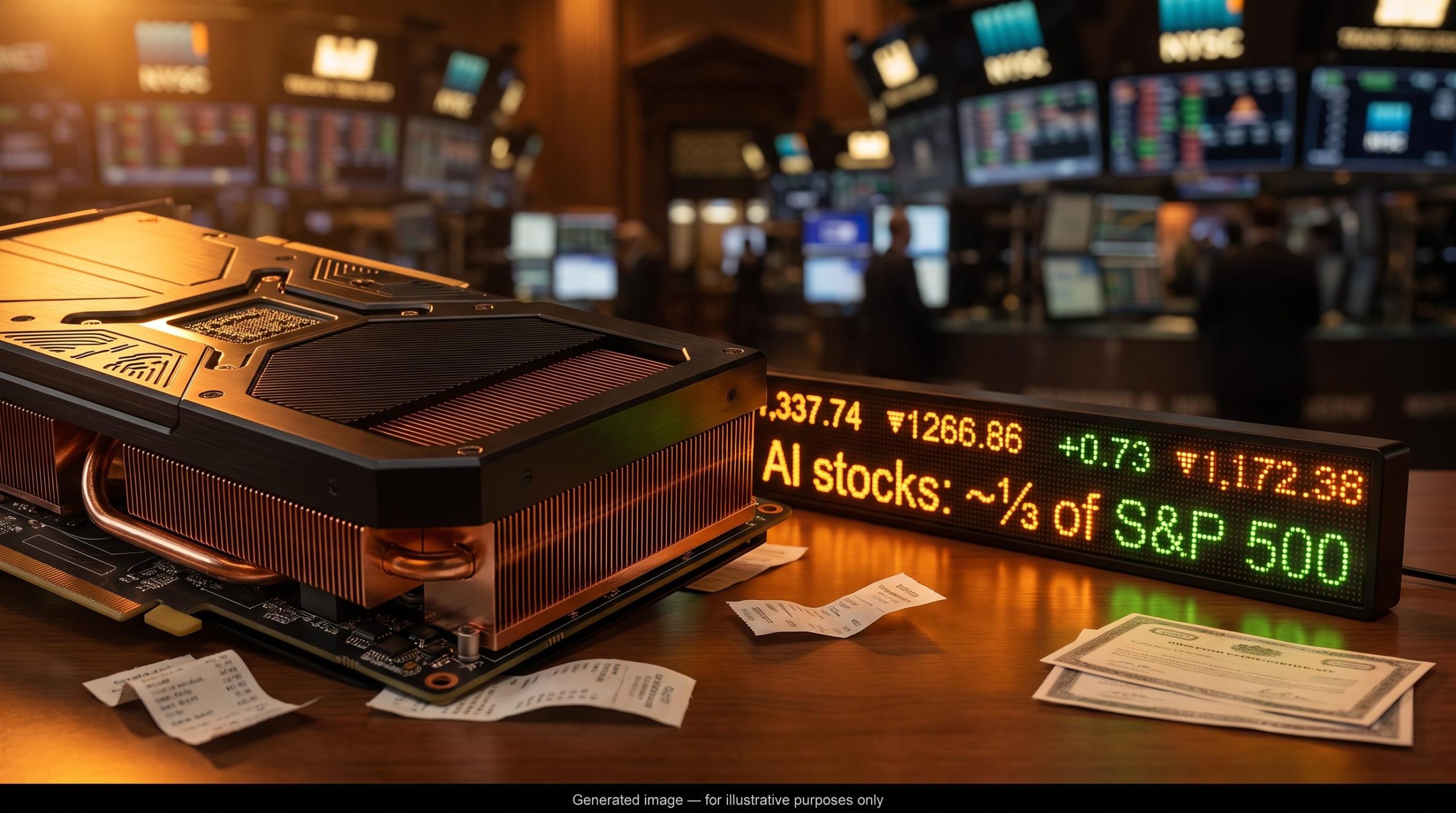
Open your brokerage account, add up everything you own, and you will probably find that roughly one-third of your equity exposure sits in AI and AI-adjacent companies. You never chose that. It accumulated quietly, one automatic index-fund contribution at a time.
That matters more in September 2026 than it would have a few years ago. Margin debt hit a record $1.417 trillion in July, up 38.6% year-over-year, Robinhood margin balances jumped 127% to $21 billion in Q2, and AI stocks now make up roughly one-third of the entire S&P 500 by weight.
Those three facts combine into a structural fragility that passive investors have never really had to think about. A downturn in a handful of names could ripple far beyond the technology sector.
This piece gives you three protective moves that do not require short selling, do not require abandoning equities, and do not require you to predict whether or when a correction arrives. The value is in the structure of the protection, not the guesswork.
How your index fund quietly became a concentrated AI bet
You bought an S&P 500 index fund because you were told it gives you the whole market. For most of investing history, that was broadly true. Today it is only partly true, and the gap between the two is where your hidden risk lives.
The reason comes down to how the index is built. The S&P 500 is market-cap weighted, meaning each company’s share of the index is proportional to its total market value. When a stock rises, its weight grows, and the fund automatically holds more of it. There is no committee deciding this is wise. It happens mechanically, so passive funds accumulate whatever has already gone up the most.
When “the whole market” is not actually the whole market
The result is an index that tracks price performance, not economic breadth. The S&P 500 that once mirrored the broad American economy now leans heavily on a small cluster of companies that happened to climb fastest.
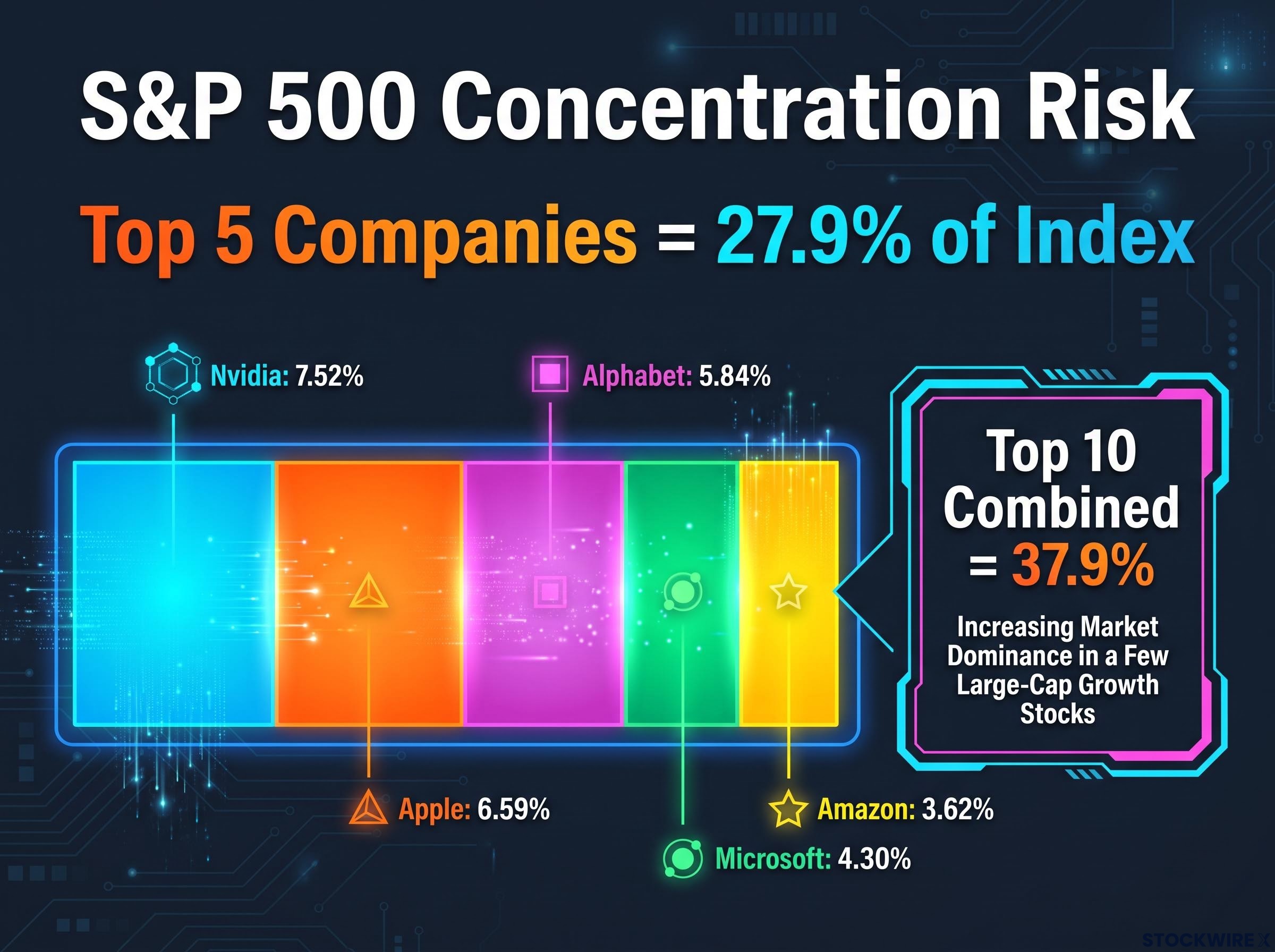
Consider the current concentration. The top five constituents alone account for 27.9% of the entire index.
| Company | S&P 500 Weight | Primary Exposure |
|---|---|---|
| Nvidia | 7.52% | AI chips and data centre hardware |
| Apple | 6.59% | Consumer hardware, AI integration |
| Alphabet | 5.84% | AI models, cloud, search |
| Microsoft | 4.30% | AI cloud, enterprise software |
| Amazon | 3.62% | Cloud infrastructure, AI services |
The top 10 combined reach 37.9%, and AI-related equities together make up roughly one-third of the index. This level of concentration has surpassed the peaks seen during the dot-com era, which makes it a historically unusual condition rather than routine market cycling.
This is not a routine market cycle. The current market concentration record surpasses even the dot-com peak, with five companies controlling roughly 30% of total U.S. equity market capitalisation, a threshold that has no historical precedent in modern index data.
Here is what that means for you. A bad quarter for four or five companies can materially dent your retirement balance no matter how well every other sector performs. Your “diversified” fund is, at these weights, a concentrated wager.
The problem compounds if you also hold individual tech names. This is the double-exposure trap, and it defines a lot of retail portfolios:
- You own Nvidia or Microsoft directly for the growth story.
- You also own an S&P 500 or Nasdaq fund for diversification.
- That fund already holds a heavy dose of the exact same names.
- Your effective bet on those companies is far larger than your account balance suggests.
Michael Burry warned back in 2022 that passive inflows into the largest market-cap stocks can artificially support elevated valuations, effectively reinforcing themselves. That is not a crash prediction. It is a description of the machinery you are now part of.
The history is worth remembering. Among tech firms that lost half their value in the 2000-2003 crash, fewer than 20% ever regained their prior highs, and those that did took roughly seven years to get there.
When big ASX news breaks, our subscribers know first
Why a sharp AI selloff would not stay contained to AI stocks
If AI stocks fell hard, you might assume the damage stops there. It would not, and the reason is leverage. Borrowed money links assets that otherwise have nothing to do with each other.
Start with how leverage builds. In calm markets, brokers keep margin requirements low, so investors borrow freely to buy more. Everything feels stable, so the borrowing feels safe.
Then prices fall, and the sequence turns:
- A calm market lets investors take on heavy leverage.
- A price decline erodes the equity backing those borrowed positions.
- The broker issues a margin call, demanding more collateral.
- Investors who cannot pay are forced to sell into a falling market.
- That forced selling drives prices lower still.
- New margin calls trigger across unrelated positions, and the cycle repeats.
A forced-selling feedback loop is structurally different from an ordinary correction because it is mechanical rather than discretionary: when collateral values fall, brokers trigger calls, and the resulting liquidations compress prices further regardless of any underlying fundamental case for the sold assets.
The last step is the dangerous one. To meet a call, a leveraged investor sells whatever they can, including bonds, international shares, and holdings that had nothing to do with AI. That is how sector stress becomes market stress.
The Bank for International Settlements has emphasised that margin requirements are highly procyclical: low when markets are calm, and sharply higher exactly when falling prices force investors to sell.
The record debt figures behind today’s fragility
The abstract risk becomes concrete when you look at the numbers. FINRA reported margin debt at $1.417 trillion in July 2026, up from $1.023 trillion in July 2025, a 38.6% year-over-year rise.
The FINRA margin statistics data, updated monthly by the regulator, confirms the scale of borrowing behind today’s equity market, with aggregate debit balances tracing the full arc of leverage growth since the pandemic recovery began.
The retail picture is more striking. Robinhood margin balances reached $21 billion in Q2 2026, a 127% jump from a year earlier. That tells you leverage is not confined to institutions; everyday investors are stacked with borrowed money too.
There is a legitimate counterpoint worth knowing. As of May 2026, margin debt sat at roughly 2.2% of total market capitalisation, below the peaks of prior cycles. In relative terms, the system is not at a historical extreme.
The growth rate is the concern. Historically, when annual margin debt growth has exceeded roughly 40%, markets have become far more susceptible to severe corrections. The current pace of borrowing sits close to that threshold.
For scale, the tech sector fell roughly 33% in 2022, and that unwound without the leverage backdrop you have today. The margin figures tell you an AI selloff would not be a contained event. It could activate a forced-selling chain that pulls down your bonds, your international funds, and assets you never associated with AI at all.
Reading the warning signs before the market reads them for you
You do not need to forecast the macro economy to see stress building. You need a short watchlist, and the best early-warning candidates are companies called NeoClouds.
NeoClouds are smaller cloud-computing firms that rent out AI hardware. Their business model depends on two things holding at once: customer contracts that keep expanding, and uninterrupted access to debt financing to keep building. Remove either, and the model strains fast.
The financial pressure is already visible in their books. Look at what servicing their debt now costs.
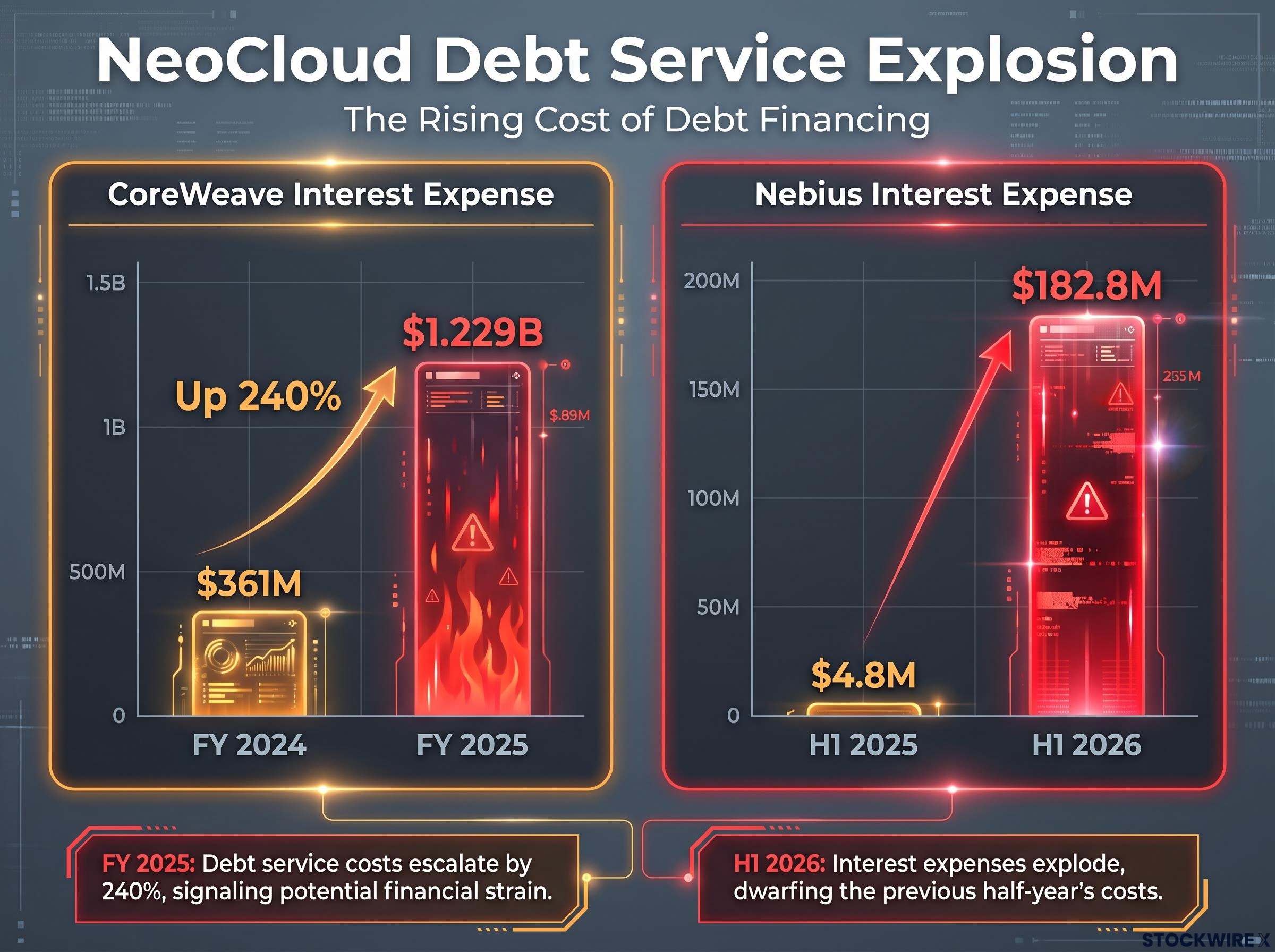
| Company | Period | Interest Expense | Year-over-Year Change |
|---|---|---|---|
| CoreWeave | FY 2025 | $1.229B | Up 240% from $361M in FY 2024 |
| CoreWeave | Q2 2026 | $640M | Quarterly interest expense |
| Nebius | H1 2026 | $182.8M | Up from $4.8M in H1 2025 |
Nebius went from $4.8 million in interest expense in the first half of 2025 to $182.8 million a year later. Michael Burry has flagged Nebius specifically as showing characteristics typical of a speculative expansion nearing its peak.
These companies are your canary. Watch three signals, and you get a read on whether the broader AI thesis is straining before the wider market reacts:
- Excess or underutilised computing capacity, which signals customer demand has stalled and the valuation justification is weakening.
- Inability to secure new lending, which signals lenders are losing confidence in repayment and a credit freeze may follow.
- Rapid escalation in interest costs, which pushes debt servicing to levels these smaller firms cannot sustain.
None of this proves a crash is coming. The bull case is genuine, and you should hold it alongside the warnings:
- AI-exposed companies are projected to deliver roughly 38.5% EPS growth for 2026-2027, against 11.9% for non-AI sectors.
- Leading mega-cap AI names trade at forward price-to-earnings multiples of 30-40x, which many analysts view as reasonable given those growth rates.
- BlackRock notes that current AI spending is funded largely by corporate profits and strong balance sheets, not speculative debt.
The read for you is this. Financial stress is already documented at the most leveraged edge of the AI ecosystem, and tracking that edge is a practical way to see trouble forming early, without needing a macroeconomics degree.
Three moves that protect your portfolio without requiring a crystal ball
Before the strategies, one thing to rule out: do not try to short the market. Burry endured three years of pressure while waiting for the 2008 collapse to arrive. Even a correct call can destroy a portfolio if the timing is wrong, and shorting a high-momentum market is a timing bet you are unlikely to win.
Here is what actually works, in priority order:
- Measure your true exposure. Add up every holding, individual stocks and index funds together, and calculate your real AI and tech weighting. This is the single most useful thing you can do this week, because most investors have never stress-tested their combined sector exposure and are shocked by the number.
- Rebalance with new money, not by selling winners. Direct fresh contributions toward international equities, value stocks, or defensive sectors. This dilutes your concentration over time without triggering capital gains tax on positions you already hold.
- Shift part of your passive allocation to equal-weight or minimum-volatility funds. These structures spread holdings more evenly instead of letting a handful of giants dominate, which structurally reduces single-name risk without requiring you to pick stocks.
Equal-weight ETF structures assign every constituent the same allocation and rebalance quarterly, which mechanically trims outperformers and tops up underperformers; that discipline is exactly what the rebalancing move in this article is attempting to replicate without switching funds entirely.
Alongside those three, add defensive ballast for downside protection against a tech-led drawdown:
- Bonds
- Cash
- Utilities
- Consumer staples
- Healthcare
As a general principle, consider capping any single thematic or sector bet at a modest slice of your total portfolio. The exact figure depends on your risk tolerance and time horizon, so there is no universal number, but the discipline of setting a ceiling is what matters.
The point of all this is not to flee equities. It is to avoid the specific combination of concentration and leverage that turned ordinary downturns into multi-year recovery crises for investors who could not afford to wait, like the roughly seven years it took recovering dot-com names to regain their highs.
Over any rolling 20-year period in U.S. market history, the stock market has never produced a negative total return.
That is why these moves are risk management, not retreat. They work whether a correction hits next month or never, because they trim unnecessary concentration while keeping you fully invested in equity growth.
This article is for informational purposes only and should not be considered financial advice. Investors should conduct their own research and consult with financial professionals before making investment decisions. Past performance does not guarantee future results, and financial projections are subject to market conditions and various risk factors.
What concentration risk actually demands from a long-term investor
The article has surfaced two genuine uncertainties, and you cannot resolve either from where you sit. AI stocks may be priced for a future that never fully arrives, or they may be fairly valued for a productivity wave that justifies the concentration. Both cases have serious backing.
Earnings concentration risk adds a forward-looking dimension to the structural weight argument: roughly half of the S&P 500’s recent earnings outperformance has come from non-recurring items that will not repeat, meaning the valuation case for the index’s heaviest constituents depends partly on a base effect that is already fading.
That is exactly why the strategies in the previous section are useful. They do not ask you to pick a side. Reducing fragility through diluted concentration and defensive ballast lowers your downside risk without cutting your exposure to growth, which means you win either way the debate resolves.
So the real question is not whether an AI crash is coming. It is whether your current allocation reflects a decision you actually made, or years of passive drift that quietly stacked risk you never signed up for.
Some investors will look at that 38.5% projected EPS growth for AI names and choose to hold their concentration on purpose. That is a legitimate call. The problem is holding it by accident. And the 2.2% margin-debt-to-market-cap ratio suggests the risk is real but not yet at a terminal level, which supports a calibrated response rather than a panicked one.
Your next action is concrete. Open your brokerage, aggregate your holdings, calculate your effective AI and tech weighting, and decide whether that number reflects a deliberate choice or accumulated inertia.
Then watch three data categories in the months ahead:
- The next FINRA margin debt reading
- NeoCloud capacity utilisation reports
- Mega-cap earnings revisions
Those three will tell you, in real time, whether the fragility is easing or building.
—