ANZ just posted a 14% half-year profit jump, and its Common Equity Tier 1 (CET1) capital ratio climbed to 12.51% by August 2026. On those numbers alone, the dividend looks secure and the bank looks strong.
The harder question is what those headline figures are not telling you.
Underneath the profit growth sits a $1 billion capital add-on from the Australian Prudential Regulation Authority (APRA) that has not been lifted, a Suncorp Bank integration that is only 57% complete with roughly 1.2 million customers still to migrate, a fresh NZ$125 million class action provision, and a valuation that leaves almost no margin for error.
For income investors weighing a real position in ANZ, the financial results are the starting point of the analysis, not the answer.
This piece works through the four variables that actually determine whether ANZ is worth holding at current prices: what the profit numbers mean in context, what the regulatory situation costs in real terms, how serious the integration risk is, and whether the valuation leaves room for those risks to materialise. By the time you finish, you will have a clear framework for making that call.
What the profit numbers actually mean for dividend security
Start with the strength, because it is real. ANZ’s cash profit for the half-year to 31 March 2026 came in at $3.78 billion, up 14% on the preceding half when significant items are stripped out. That is earnings growth, not an accounting flourish.
The efficiency story backs it up. The cost-to-income ratio improved to 49.4% from 54.6%, and cash return on tangible equity rose 161 basis points to 11.6%. When a bank pulls its cost ratio below the halfway mark, that is operational leverage, not just a good revenue quarter doing the work.
Then the momentum starts to narrow. The third-quarter trading update in August 2026 showed cash profit of $1.90 billion, a rise of just 1% on the first-half quarterly average. Net interest margin, the gap between what the bank earns on loans and pays on deposits, edged up a single basis point to 1.54%.
That deceleration matters when you are pricing a sustained dividend. A 14% half-year jump that moderates to a 1% quarterly rise tells you part of the earlier result reflected one-off efficiency gains rather than a permanently higher earnings run-rate. You should not treat the half-year growth rate as the base case for the years ahead.
| Metric | Half-year (to 31 Mar 2026) | Q3 update (Aug 2026) |
|---|---|---|
| Cash profit | $3.78B (up 14%) | $1.90B (up 1%) |
| CET1 capital ratio | 12.39% | 12.51% |
| Net interest margin | n/a | 1.54% |
| Cost-to-income ratio | 49.4% | n/a |
| Cash return on tangible equity | 11.6% | n/a |
Where the profit does clearly help is capital. A CET1 ratio strengthening from 12.39% to 12.51% gives management enough headroom that it did not need a discounted dividend reinvestment plan, and reported disclosures indicate the bank neutralised the interim reinvestment through on-market share purchases rather than issuing new stock. That protects existing shareholders from dilution, which is a genuine positive for anyone already holding.
CET1 progression: 12.39% to 12.51% The capital buffer is improving, but even this trend sits inside a constraint. A portion of ANZ’s risk-weighted assets is inflated by a regulatory overlay that peers do not carry, which is where the analysis has to go next.
When big ASX news breaks, our subscribers know first
The $1 billion APRA overlay and what a court-enforceable undertaking actually costs
This one did not arrive as a headline. It escalated.
APRA first lifted ANZ’s operational risk capital add-on to $750 million in August 2024, a signal that the regulator was unsatisfied with the bank’s handling of non-financial risk. That is risk management covering conduct, culture, and operational failures rather than credit or market losses.
APRA stress testing confirmed in May 2026 that Australian banks can absorb severe multi-variable shocks, including elevated funding costs and major cyber disruptions, but the regulator’s own assessment flags that imported risks from geopolitical transmission channels operate through channels that capital buffers alone cannot neutralise.
Then it hardened. On 3 April 2025, APRA raised the add-on to $1 billion and accepted a court-enforceable undertaking (CEU), a formal legal commitment the bank must meet to fix specific governance and risk-culture failings. A CEU is not a routine compliance note. It is one of the strongest tools a prudential regulator has short of licence action, and it signals a loss of confidence that the bank has to earn back.
APRA’s court-enforceable undertaking for ANZ, formalised on 3 April 2025, sets out the specific governance and risk-culture obligations the bank must satisfy before regulators will consider lifting the overlay, and it carries the weight of a legal commitment rather than an administrative directive.
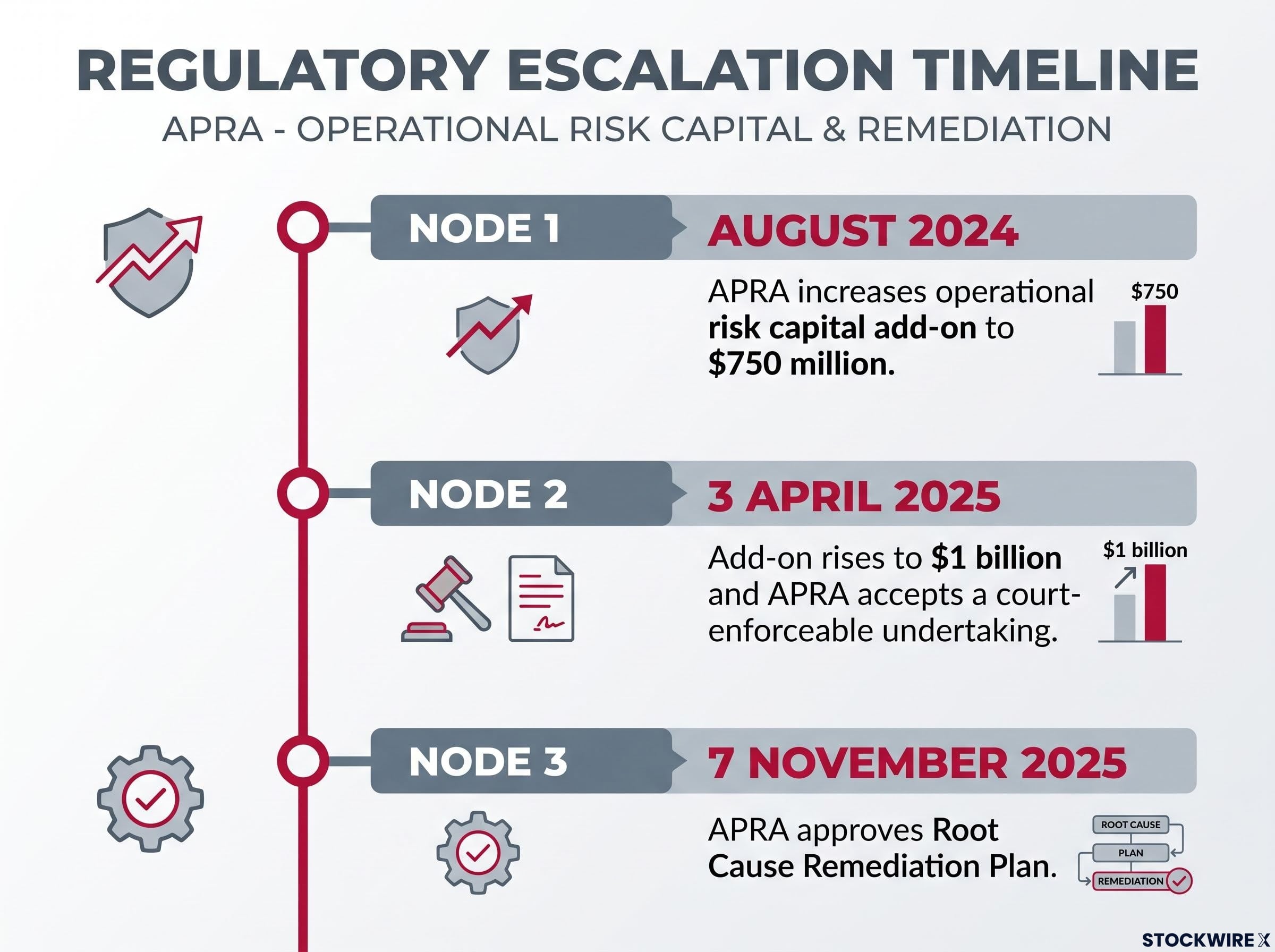
The escalation ran in three clear steps:
- August 2024: APRA increases ANZ’s operational risk capital add-on to $750 million.
- 3 April 2025: The add-on rises to $1 billion and APRA accepts a court-enforceable undertaking on non-financial risk and culture.
- 7 November 2025: APRA approves ANZ’s Root Cause Remediation Plan under the CEU, genuine progress that stops short of lifting the overlay.
The mechanical cost sits in the capital maths. Research indicates the $1 billion requirement is applied as a $12.5 billion operational risk risk-weighted asset overlay. That inflated asset base ties up capital that ANZ could otherwise direct toward lending growth, buybacks, or dividend enhancement, and it applies to ANZ while peers such as NAB and Westpac operate without an equivalent penalty.
How long might this last? The most instructive precedent is Westpac’s own CEU, initiated in December 2020, where APRA did not confirm the obligations had been met until October 2025. That is a five-year remediation cycle for a comparable major bank.
Applied to ANZ, that timeline is the read you should take. Even with the remediation plan approved, the Westpac precedent suggests you should not price in a lifted overlay before 2027 at the earliest, and until it lifts, ANZ carries a structural capital handicap its rivals do not.
The NZ$125 million class action: a separate legal risk to price in
Alongside the regulatory overhang, ANZ recorded a NZ$125 million provision in the third quarter of 2026 tied to a class action in New Zealand. This is a distinct risk from the APRA matter: litigation rather than prudential regulation, with a different resolution path and a different uncertainty profile.
The key point for pricing is that a provision is a floor, not a ceiling. Setting money aside does not guarantee it will be the final figure, so treat this as an open legal exposure rather than a settled cost.
Suncorp Bank integration: how to read “57% complete”
At face value, 57% complete reads as reassuring progress. Read it more carefully and the picture inverts, because the remaining 43% is where the harder risk lives.
The overall figure hides an uneven split. The unified customer front-end, the part customers actually touch, is only 45% complete, having climbed from 24% at the end of June 2026. In other words, the most customer-exposed and churn-sensitive work is the least advanced part of the whole programme.
| Milestone | End-March 2026 | End-June 2026 |
|---|---|---|
| Overall integration | 34% | 45% |
| Customer front-end | 13% | 24% |
The pivotal number is the migration of roughly 1.2 million Suncorp Bank customers, targeted for June 2027. This is the moment where acquisition value is either captured or destroyed, because customer attrition during migration, not the back-office plumbing, is the mechanism that erodes the revenue case behind the deal.
Do the arithmetic on the timeline. A 45% complete front-end with a June 2027 deadline means ANZ has to accelerate the most sensitive stretch of the integration over roughly the next nine months. Any material customer loss in that window feeds directly into weaker retail revenue, which is precisely the growth the Suncorp purchase was meant to deliver.
Three risk categories sit live at this stage of any bank integration:
- Technology migration failure: system cutovers that corrupt data, drop functionality, or lock customers out.
- Staff disengagement: key Suncorp employees leaving before their knowledge and relationships transfer.
- Customer churn: account holders switching banks rather than tolerating disruption during migration.
There is a real positive in the result too. Reported disclosures indicate ANZ has delivered around 73% of its targeted cost synergies, and that early cost extraction helps explain the cost-to-income improvement in the half-year figures. The savings are landing. The revenue-protecting half of the thesis is the part still in front of the bank.
For a holder, the takeaway is that the integration is not simply a one-off cost and distraction. It is the vehicle through which management is betting it can grow the retail franchise, and if the migration stumbles, the long-term earnings trajectory that supports the dividend weakens with it.
Valuation at 19x earnings: what the price is already assuming
A price-to-earnings (P/E) ratio, the share price divided by earnings per share, is not just a number. It is a statement about what the market believes has to go right.
ANZ’s P/E sits in a premium band. Estimates range from roughly 17.1x (Simply Wall St, June 2026) to around 18.9x (Wealth Quest Lab, July 2026), with the original source flagging a figure above 19x. Whatever the exact reading, this is not a multiple that reflects caution. It implies confidence in both a clean regulatory resolution and a successful integration, which makes those two risks the very conditions under which today’s price is justified.
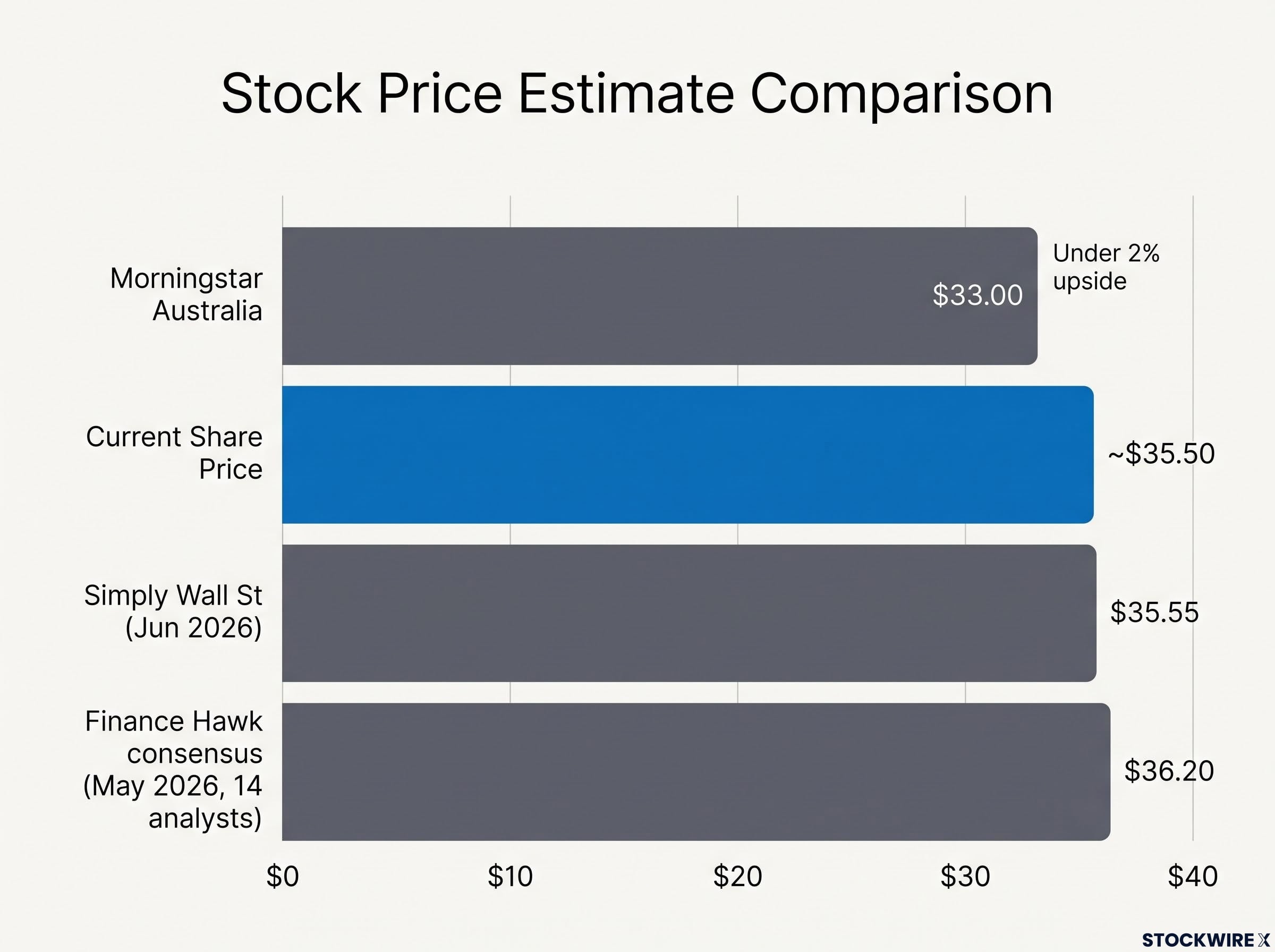
The consensus picture confirms how little cushion is built in. Finance Hawk noted a 14-analyst consensus 12-month target of about $36.20 against a share price near $35.50, which is under 2% of capital upside. Read plainly, that means anyone buying at these levels is buying ANZ for the dividend yield, not for share price appreciation.
| Source | Fair value / target | Stance at reference price |
|---|---|---|
| Morningstar Australia | $33.00 | Overvalued above this mark |
| Simply Wall St (Jun 2026) | $35.55 | ~7% overvalued (P/E 17.1x) |
| Finance Hawk consensus (May 2026) | $36.20 | Under 2% upside (14 analysts) |
| Wealth Quest Lab (Jul 2026) | P/E 18.9x on ~$37.50 | Moderate upside only |
Notice where the independent estimates cluster. Morningstar’s fair value of $33.00 and Simply Wall St’s $35.55 both sit at or below the reference share price, meaning the stock is trading at or above most independent measures of fair value, not beneath them.
There is a credible bull case worth stating. Yahoo Finance analysis argued a P/E around 18.2x against a “fair ratio” of 21x leaves room for a re-rating if execution improves, and Morgan Stanley’s “Equal-weight” rating holds out the possibility of outperformance balanced against valuation limits. If the overlay lifts and the migration lands cleanly, the multiple could expand.
Here is the read that matters for you.
The concept of margin of safety, the discount to estimated intrinsic value that compensates for business uncertainty, is precisely what ANZ’s current valuation leaves thin; when independent fair value estimates cluster at or below the share price, the cushion that absorbs execution failures on the overlay or migration is largely absent.
14% profit growth, less than 2% consensus capital upside. When the consensus upside is under 2% and multiple independent fair value estimates sit at or below the current price, the valuation is not pricing in the risks in this article. It is pricing in the scenario where those risks resolve cleanly. That is the assumption you make when you buy at current levels.
Making the call: what ANZ’s risk profile means for portfolio sizing
None of this is a bear case. ANZ’s financial position is genuinely solid: profit is growing, the cost structure is improving, the CET1 ratio of 12.51% sits comfortably above APRA’s minimum, and the third-quarter individual credit impairment charge was just $65 million, around three basis points annualised. The dividend is not at imminent risk.
The problem is not quality. It is price against risk. The overhangs are real, yet the valuation is set as though they will resolve cleanly, so an investor who concentrates heavily in ANZ is effectively making an implicit bet that regulatory remediation and flawless integration both land on schedule.
Here is what you are accepting when you buy at current levels:
- The $1 billion APRA overlay remains active and unremediated.
- The customer front-end of the Suncorp integration is only 45% complete.
- The NZ$125 million New Zealand class action provision is open, and a provision is a floor, not a ceiling.
- The valuation premium leaves under 2% of consensus capital upside.
There is also a structural point most income investors overlook. Research from Ausbil in 2025 found that the top seven ASX companies paid over half of all dividends in 2024, with banks alone accounting for roughly 30% of the total. If you hold a diversified Australian income portfolio, you are already carrying significant ANZ-correlated sector risk before you buy a single share directly.
The income case for ANZ also depends on how franking credits on bank shares interact with the investor’s tax position; for pension-phase SMSF members, the grossed-up yield can be materially higher than the headline cash figure, which affects how much weight dividend sustainability carries relative to capital upside in any position decision.
A sensible position size for an uncertain risk profile
This is not a forecast of dividend cuts. It is a recognition that the valuation premium and the active risks make a large, concentrated ANZ holding imprudent when the margin for error is this thin.
For an income investor, the more useful principle is to spread income exposure across three or four high-yield positions rather than lean heavily on one bank. ANZ can reasonably sit among them; it should not dominate them.
This article is for informational purposes only and should not be considered financial advice. Investors should conduct their own research and consult with financial professionals before making investment decisions. Past performance does not guarantee future results, and these statements are speculative and subject to change based on market developments and company performance.
The ANZ case in September 2026: solid foundations, real constraints, thin upside
Pull the four threads together and the picture is calibrated rather than simple. ANZ’s balance sheet is strong, the risks are real and active, and the valuation reflects optimism rather than caution.
Two conditions would validate today’s price. The APRA overlay would need to lift within roughly 18 months, and the Suncorp customer migration would need to complete without material attrition. Meet both, and the current multiple is defensible.
Imported financial system risks, including geopolitical transmission through wholesale funding costs and offshore private credit stress, represent a category of exposure that sits above individual bank capital ratios and affects ANZ alongside its peers, regardless of how cleanly any single remediation programme resolves.
The thesis weakens if either slips. Regulatory remediation could drag, as the five-year Westpac precedent warns, or the migration could stumble during the sensitive nine-month window ahead. Neither outcome is priced in.
That is the tension in two numbers: 14% profit growth makes the case for ANZ, and less than 2% consensus capital upside makes the case for caution.
For an income investor in September 2026, the income case is defensible but the capital case is weak. ANZ can play a role in a diversified income portfolio, but position sizing and entry timing matter more than usual when the margin for error is this narrow.