

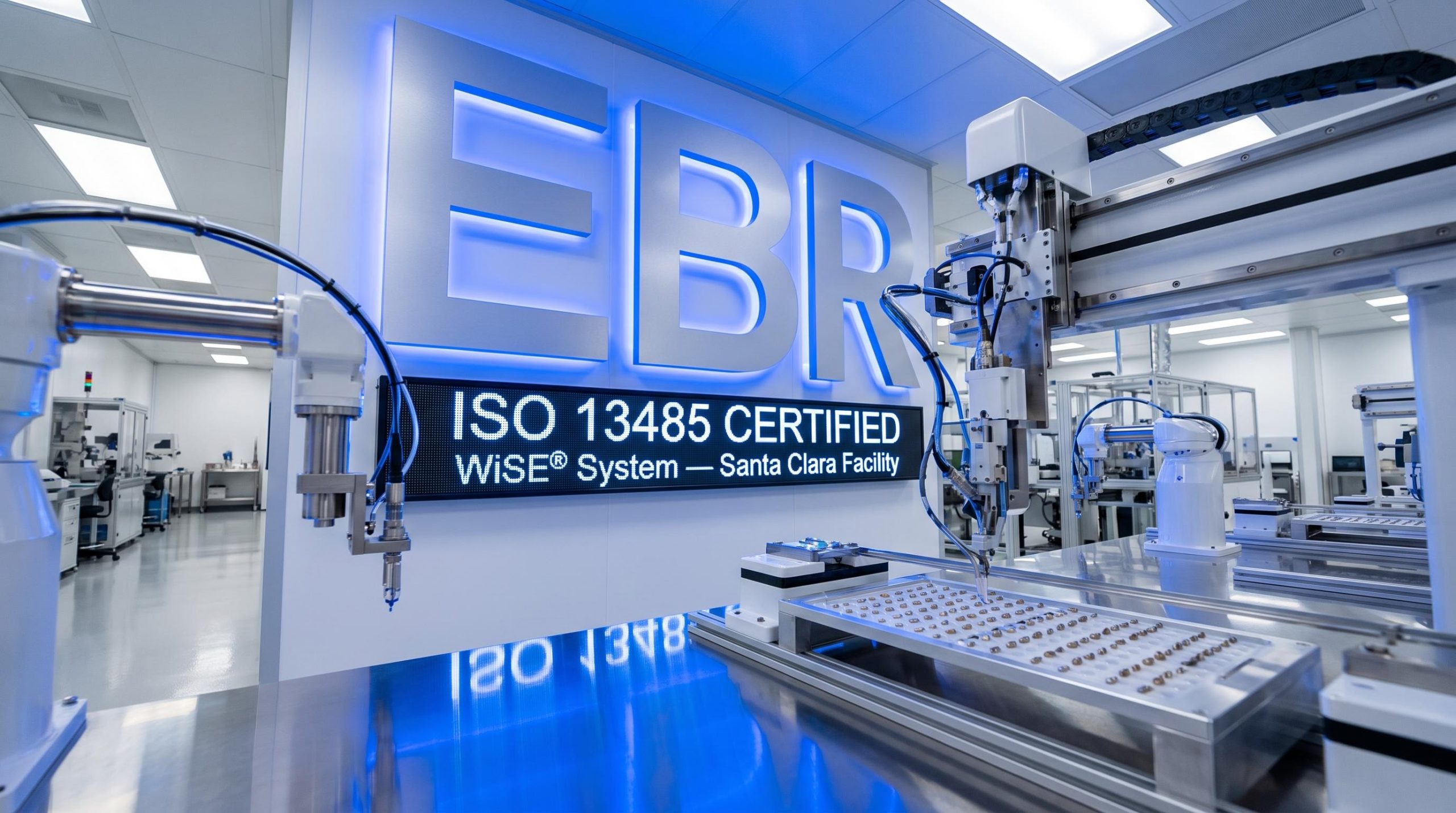
EBR Systems’ new Santa Clara facility secures ISO 13485 certification
EBR Systems, developer of the world’s only wireless cardiac pacing device for heart failure, has achieved ISO 13485 certification for its new Santa Clara, California manufacturing facility following assessment by global standards and certification body the British Standards Institution (BSI). The milestone supports the Company’s transition to an expanded manufacturing footprint with substantially higher capacity for the continued U.S. commercial rollout of the WiSE® System.
The certification arrives as EBR installs additional equipment designed to shift production from manual to automated assembly, a change expected to lift output significantly once regulatory clearance is obtained. Key details from the announcement include:
-
ISO 13485 certification achieved via BSI assessment
-
New manufacturing equipment installed to support the transition from manual to automated assembly
-
Production capacity of the WiSE System expected to increase by approximately 500%
-
FDA Pre-Approval Inspection scheduled for September 2026
-
Anticipated FDA approval of the new facility by year end
For investors, the certification represents a quality and operational milestone that de-risks EBR’s capacity expansion and directly underpins the commercial scale-up strategy in the United States.
When big ASX news breaks, our subscribers know first
What the certification unlocks for WiSE production
ISO 13485 is the internationally recognised quality management standard for medical device manufacturing. Achieving it signals that the expanded Santa Clara facility meets the rigorous documentation, process control and traceability requirements demanded of medical device producers, a prerequisite for scaling manufacturing at a commercial level.
EBR continues to install additional manufacturing equipment into the new facility, including new automated assembly machinery. The transition from a smaller manual operation to a larger, more scalable automated platform is central to the Company’s plans to reduce cost, improve yield and expand production volumes.
Once FDA approval is received, the transition from manual to automated assembly of the WiSE System will be initiated, with production capacity expected to increase by approximately 500%. This uplift is designed to support growing commercial demand for the device without creating a manufacturing bottleneck.
The commercial momentum underpinning that constraint is real: EBR reported doubling implant volumes in Q1 2026, completing 41 WiSE cases and generating preliminary revenue of US$2.25 million to US$2.36 million in the quarter, more than double the prior quarter’s case count.
John McCutcheon, President & Chief Executive Officer, EBR Systems
“Achieving ISO certification for our new Santa Clara facility is an important milestone in EBR’s manufacturing scale-up strategy. The certification, together with the move-in of additional manufacturing equipment including new, automated assembly machinery, supports our transition to a larger, more scalable manufacturing platform. This expanded capability is an important part of EBR’s broader commercial execution strategy as we continue the U.S. commercial rollout of the WiSE System.”
Understanding WiSE, the world’s only wireless cardiac pacing device
For readers less familiar with the technology, the WiSE System is the underlying reason the manufacturing scale-up carries such weight. It is a first-in-class device addressing a long-standing challenge in cardiac care.
-
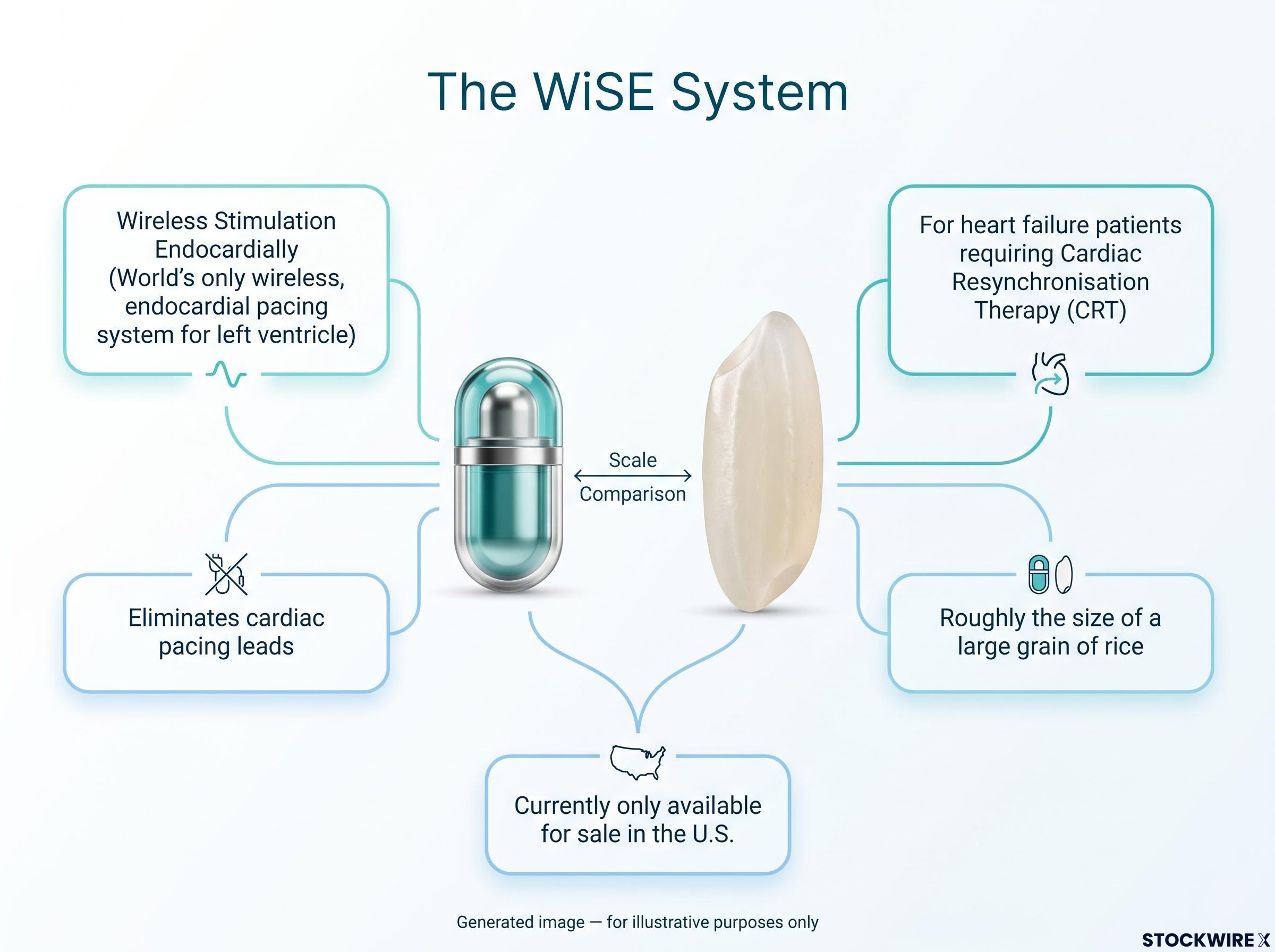
WiSE stands for Wireless Stimulation Endocardially, and is described by EBR as the world’s only wireless, endocardial (inside the heart) pacing system in clinical use for stimulating the heart’s left ventricle.
-
The technology was developed to eliminate the need for cardiac pacing leads, historically the major source of complications, effectiveness and reliability issues in cardiac rhythm disease management.
-
The initial product is designed for heart failure patients requiring Cardiac Resynchronisation Therapy (CRT), a treatment that helps the heart’s chambers beat in a more coordinated rhythm.
-
The cardiac implant is roughly the size of a large grain of rice.
-
WiSE is an investigational device in most markets and is currently only available for sale in the U.S.
The differentiated clinical position of the device means manufacturing capacity is the key factor governing EBR’s ability to capture commercial demand. Expanding that capacity addresses the constraint directly.
Path to FDA approval and commercial scale-up
The near-term catalyst is the FDA Pre-Approval Inspection of the new facility, which is expected to be completed in September 2026. Following completion of the inspection and any remediation of potential observations, EBR expects the facility to be approved by the FDA by year end.
It is important to note that the automated assembly transition and the approximately 500% capacity uplift are only initiated after FDA approval is received. The timeline below reflects management expectations rather than certainties.
| Milestone | Status | Expected Timing | Investor Impact |
|---|---|---|---|
| ISO 13485 certification | Achieved | September 2026 | Quality milestone secured |
| FDA Pre-Approval Inspection | Scheduled | September 2026 | Near-term catalyst |
| FDA facility approval | Anticipated | By year end 2026 | Unlocks automated production |
| Automated assembly transition | Post-approval | Following FDA approval | ~500% capacity uplift |
Why this matters for the investment case
Manufacturing capacity has been a defining constraint on the pace of commercial rollout. The ISO 13485 certification, combined with the installed automated equipment and the pending FDA approval, sets out a defined pathway to scaling production to meet U.S. commercial demand for a first-in-class device.
The WiSE commercial rollout reached 117 cumulative implants by the end of Q2 2026, with more than half of EBR’s 30 activated hospital accounts completing three or more procedures, a pattern suggesting repeat adoption rather than isolated trials.
The anticipated 500% capacity increase positions EBR to service growing demand without a bottleneck, provided the regulatory steps are completed as expected. The Company has also framed the expansion around cost reduction and yield improvement, factors that could support its longer-term margin and profitability trajectory.
The forward-looking elements remain subject to the FDA process. The September 2026 inspection and anticipated year-end approval are stated by management as expectations, not guaranteed outcomes, and the capacity uplift depends on those approvals being obtained.
Don’t Miss the Next Healthcare Breakthrough
Big News Blast delivers FREE breaking ASX healthcare news straight to your inbox within minutes of release, with in-depth analysis already done. Over 20,000 active subscribers rely on it to stay ahead of market-moving announcements. Click the “Free Alerts” button at StockWire X to get the next big healthcare update the moment it breaks.