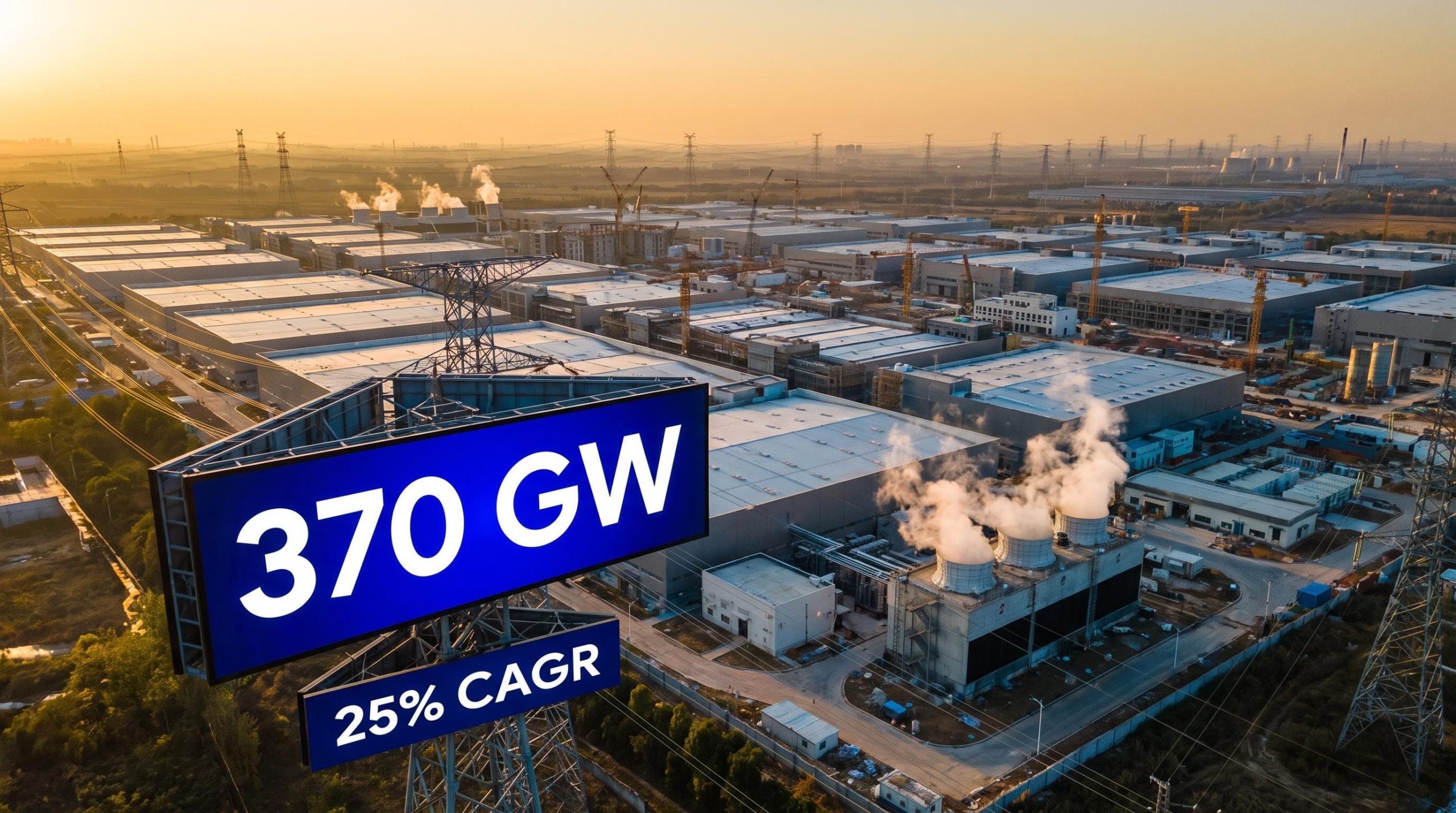
Citi has just overhauled its global data center model, more than tripling its 2031 IT load projection to 370 gigawatts of AI-driven capacity. For the first time, China sits inside the numbers.
The revision, published in September 2026, follows stronger-than-expected AI token consumption, faster chip sales momentum, and the emergence of agentic AI workloads as a structurally different demand category. The decision to include China is a signal in itself. Citi had previously left the market out to keep conviction on non-China opportunities, and bringing it back inside reflects a changed view: no serious global infrastructure thesis can credibly ignore the world’s second-largest economy.
Here is what Citi’s revised figures actually say, why the demand drivers behind them are proving more durable than earlier models assumed, and what the supply constraints now visible across the US mean for anyone tracking the buildout timeline.
Citi’s numbers: from 121 gigawatts today to 370 by 2031
Start with the headline. Citi now projects global data center IT load to climb from 121 GW in 2026 to 370 GW by 2031, a 25% compound annual growth rate (CAGR), which is the average yearly rate of increase.
Citi’s revised model: 370 GW of global data center IT load by 2031, growing at a 25% CAGR.
The figure alone is striking, but the more telling number is how much Citi has moved. Two years ago the bank was working from a very different frame.
The Goldman Sachs forecast revision published in July 2026 reached a similar conclusion through a different lens, nearly doubling its 2030 global capacity estimate to 217 GW and projecting $6 trillion in supportable capital expenditure, a figure grounded in confirmed hyperscaler spending rather than speculative demand assumptions.
| Estimate date | Geography scope | CAGR | IT load target |
|---|---|---|---|
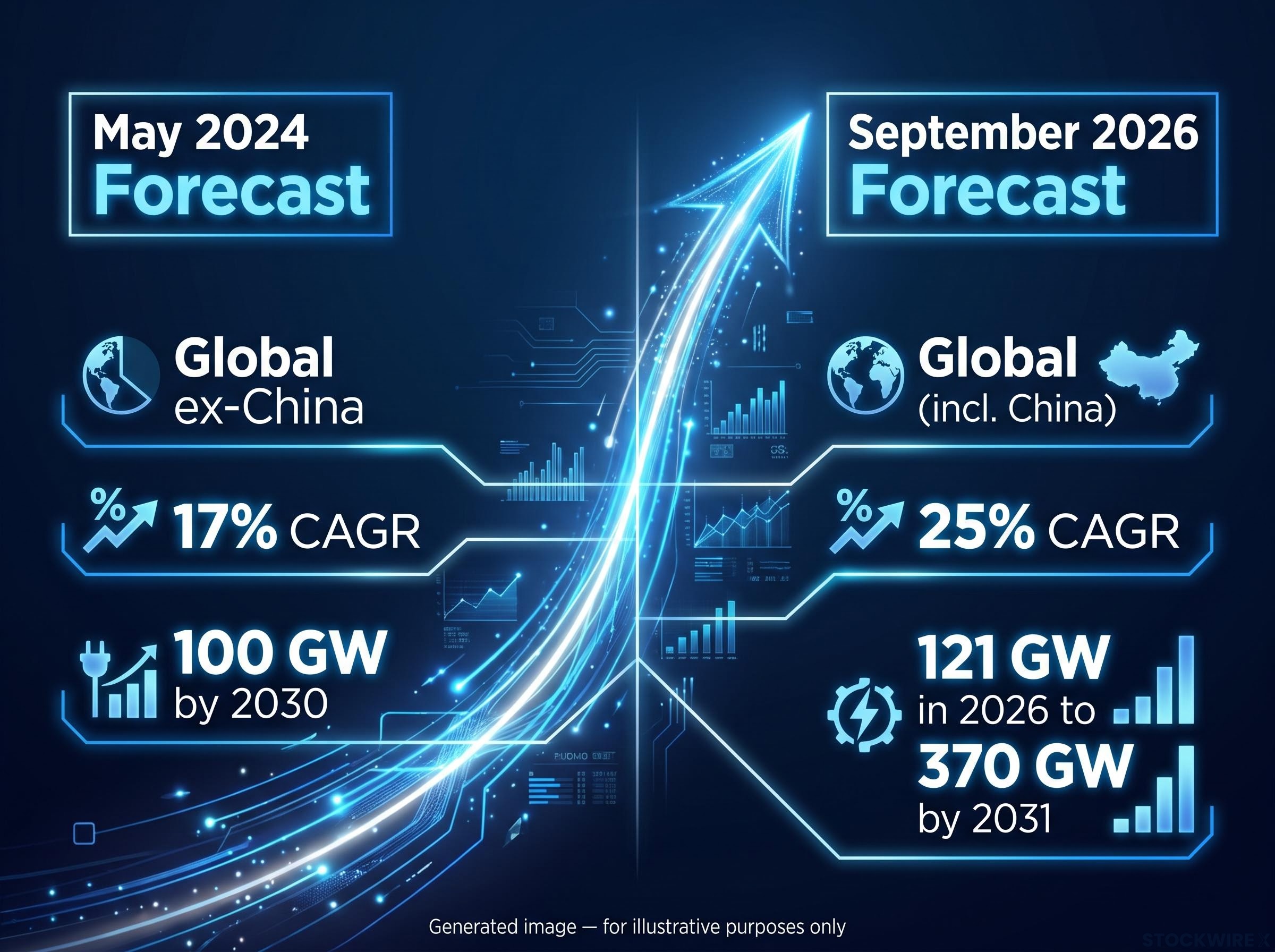
| May 2024 | Global ex-China | 17% | 100 GW by 2030 |
| September 2026 | Global (incl. China) | 25% | 370 GW by 2031 |
The jump from a 17% CAGR on an ex-China basis to 25% on a global basis is the story underneath the story. In roughly two years, Citi has lifted its growth assumption by around 800 basis points and added an entire geography it had previously chosen to exclude.
Underneath the CAGR, the model assumes annual absorption of IT load accelerating from 35 GW in 2026 to 60 GW in 2031. Bookings are forecast at 35 GW in 2026 and 40 GW in 2027, both of which Citi describes as materially above its own prior estimates.
For investors, that pace of revision matters more than the endpoint. When a major bank raises its growth rate and its geographic scope in the same update, it is telling you the demand curve is running ahead of the frameworks analysts were using to measure it. That has compounding read-through for supply chains, hyperscaler capex, and valuations across the entire buildout stack.
When big ASX news breaks, our subscribers know first
What is driving the upgrade: tokens, chips, and agentic workloads
So what changed to justify a revision this large? Citi points to three demand drivers, and they are not interchangeable. They stack.
- AI token consumption growth: Enterprises are running far more AI queries than earlier models assumed, and each query consumes compute.
- Chip sales momentum: Faster-than-expected server and processor sales are pulling forward the hardware layer of the buildout.
- Agentic AI workloads: Autonomous AI agents consume compute at a scale that traditional generative AI never approached.
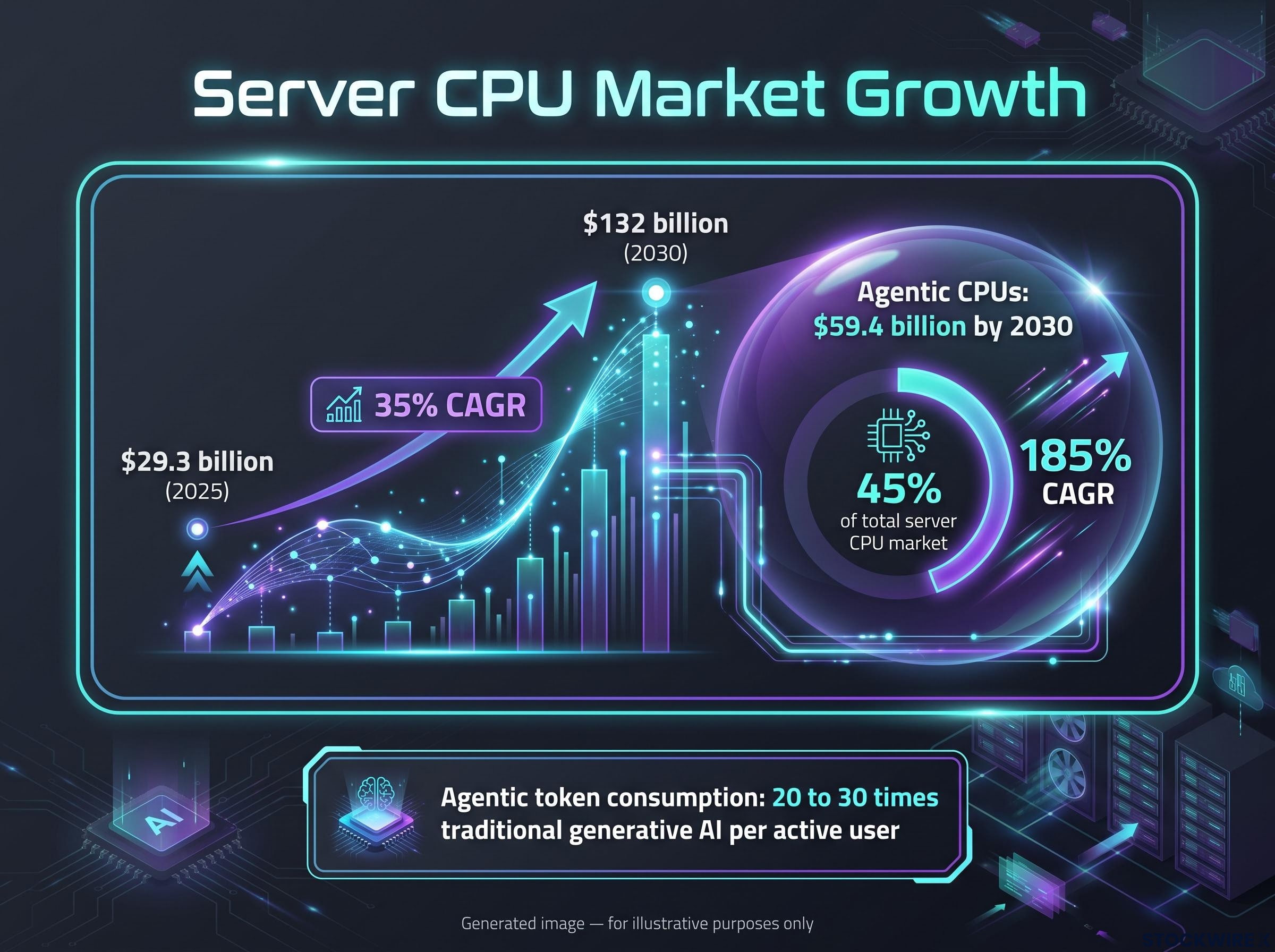
The chip layer gives the clearest read on how fast this is moving. Citi forecasts the server CPU market growing from $29.3 billion in 2025 to $132 billion by 2030, a 35% CAGR. Within that total, one sub-segment stands apart.
Why agentic AI hits infrastructure harder than generative AI did
Agentic CPUs, the processors built for autonomous AI agents, are forecast by Citi to grow at a 185% CAGR, reaching $59.4 billion by 2030 and capturing roughly 45% of the total server CPU market. That growth rate is not a note about a niche product line. It is a proxy for how fundamentally different agentic infrastructure is from what data centers were designed around.
The difference sits in orchestration. A traditional generative query is one prompt and one response. An agentic prompt can trigger hundreds of downstream actions without a human in the loop, each one consuming context and compute.
That multiplication is severe. Citi and industry practitioners put token consumption for agentic workloads at 20 to 30 times that of traditional generative AI, per active user.
AMD’s Q1 2026 earnings provided the clearest market-side confirmation of the same trend, with agentic AI hardware investment driving the company to double its server CPU market growth forecast to 35% annually and post 57% year-over-year data centre revenue growth, numbers that align closely with Citi’s 185% CAGR projection for agentic CPU processors.
There is a storage dimension too. Agents must query, write, and retrieve context across multi-turn sessions running at once, which demands fast, persistent, low-latency storage that legacy enterprise systems were never built to provide.
For investors weighing duration risk in infrastructure positions, this distinction is the point. Agentic workloads are a step-change in per-user compute intensity, not a linear extension of the AI adoption curve already in motion. That is why Citi treats enterprise adoption and agentic expansion as structural drivers rather than cyclical ones.
The supply side is not keeping pace
Demand is only half the equation, and the other half is where the buildout gets difficult. Citi’s own numbers describe a delivery curve that is anything but smooth.
The bank estimates AI compute demand will require 55 GW of new power capacity by 2030, translating to roughly $2.8 trillion in incremental spending.
Citi estimates roughly $2.8 trillion in incremental spending will be needed to deliver 55 GW of new power capacity by 2030.
The problem is timing. Annual data center demand is projected at 14.5 GW in 2026, rising to an average of around 20 GW per year through 2030, but utility and regulator approvals are not moving at that speed. The gap between what developers need and what grids can connect has become a genuine bottleneck.
The power constraint Citi is describing has developed into what grid analysts now characterise as a structural grid crisis, with IEA projections placing combined data centre, AI, and crypto electricity consumption above 1,000 TWh by 2026 and hyperscalers increasingly bypassing utility queues through direct nuclear supply agreements and long-duration power purchase contracts.
Two of the largest US power markets have now stepped in directly.
| State | Date of action | Scope | Key threshold | Current status |
|---|---|---|---|---|
| New York | 14 July 2026 | Moratorium on new large data centers | 20 MW peak demand or above | Pause up to one year, pending impact statement |
| Texas | 3 August 2026 | Statewide approval freeze and audit | New grid connections held | ERCOT Batch Zero review suspended |
New York’s Executive Order No. 62 directs the state to hold discretionary permit applications while it studies cumulative grid, water, and community impacts. Texas went further procedurally, with regulators weighing a rise in the nonrefundable portion of interconnection deposits from 20% to as high as 80% to discourage speculative projects.
These are not isolated political events. They signal that the buildout is now outrunning the permitting, utility, and community frameworks meant to govern it, which compresses the pipeline of shovel-ready supply.
For investors, that scarcity is reshaping the map. Projects that have already cleared approvals and secured energy allocations are commanding a growing premium as permitted supply becomes scarcer, while hyperscalers are pushing pre-leasing commitments out through the 2028 to 2030 window to guarantee capacity before anticipated demand arrives. When the states creating the most friction are also the most strategically important, the constraint has outsized weight on near-term delivery.
Hyperscaler commitments versus the overbuild question
The capital being committed to close that supply gap is extraordinary. Goldman Sachs estimates that Meta, Microsoft, Amazon, and Alphabet will spend a combined $5.3 trillion on capex over 2025 to 2030, while Morgan Stanley put total hyperscaler capex at roughly $300 billion in 2025 alone.
The hyperscaler capex trajectory that underpins these commitments has been moving faster than most mid-2025 models assumed, with Amazon, Microsoft, Alphabet, and Meta collectively spending $130 billion in Q1 2026 alone and full-year 2026 combined guidance reaching approximately $725 billion before Citi published its revised forecast.
- Microsoft: roughly $64.6 billion in FY25 (about 45% year-on-year growth), with FY26 guidance above $80 billion.
- Amazon (AWS): AWS-related capex surpassed $105 billion in 2025.
- Alphabet (Google): committed $75 billion specifically for calendar year 2025.
- Meta: guided to $70-72 billion for 2025, its highest capex year to date.
That is the committed-capital narrative. The harder question is whether it will all be absorbed.
Is the build ahead of the demand?
According to a 2026 Mizuho report, Microsoft CEO Satya Nadella suggested the industry was broadly headed toward an “overbuild.” When the head of the world’s largest cloud platform reaches for that word, it says something about how even apex operators are assessing near-term risk internally.
Ares Management has voiced a parallel concern, warning that the flood of capital entering the space raises real overcapacity risk if enterprise workload demand slows or fails to fill the infrastructure being built.
The scale sharpens the point. New installations are being designed as campus-style AI factories requiring 1 to 5 GW of capacity, with rack density now exceeding 200 kW per rack, roughly double the 2016 baseline.
For investors in data center REITs, infrastructure operators, and chip supply chains, treat Nadella’s language as a signal about absorption timing, not a reason to abandon the long-run demand thesis. The 370 GW projection is a 2031 endpoint; the $5.3 trillion is a multi-year spending commitment. The risk lives in the path between them, and that path runs through enterprise adoption timelines no model has yet resolved.
Past performance does not guarantee future results. Financial projections are subject to market conditions and various risk factors. These statements are speculative and subject to change based on market developments and company performance.
What the 370 gigawatt target means for the buildout from here
Two forces are pulling against each other. On one side sits a validated demand thesis: 370 GW, a 25% CAGR, and China now inside the numbers. On the other sits a constrained near-term supply environment of regulatory moratoria, power approval gridlock, and pre-leasing already stretching into 2028 to 2030.
The demand side gains conviction from an unexpected source. A separate, non-Citi forecast project named “Europe2031” independently arrives at roughly the same 370 GW endpoint by 2031 using a different methodology. Two frameworks converging on the same figure strengthens the structural case, even as the near-term friction persists.
For investors with a shorter horizon than 2031, the path is the trade. Three variables will determine whether the timeline holds:
- Regulatory resolution pace: How quickly New York, Texas, and other key markets move from freeze to workable approval frameworks.
- Agentic adoption curve: Whether enterprises deploy autonomous AI workloads fast enough to fill the compute being built.
- Hyperscaler capex discipline: Whether operators distinguish committed capacity from speculative capacity as the overbuild debate sharpens.
Knowing where the buildout is headed by 2031 is useful context. Knowing what keeps the timeline intact is what actually informs a position.
This article is for informational purposes only and should not be considered financial advice. Investors should conduct their own research and consult with financial professionals before making investment decisions.