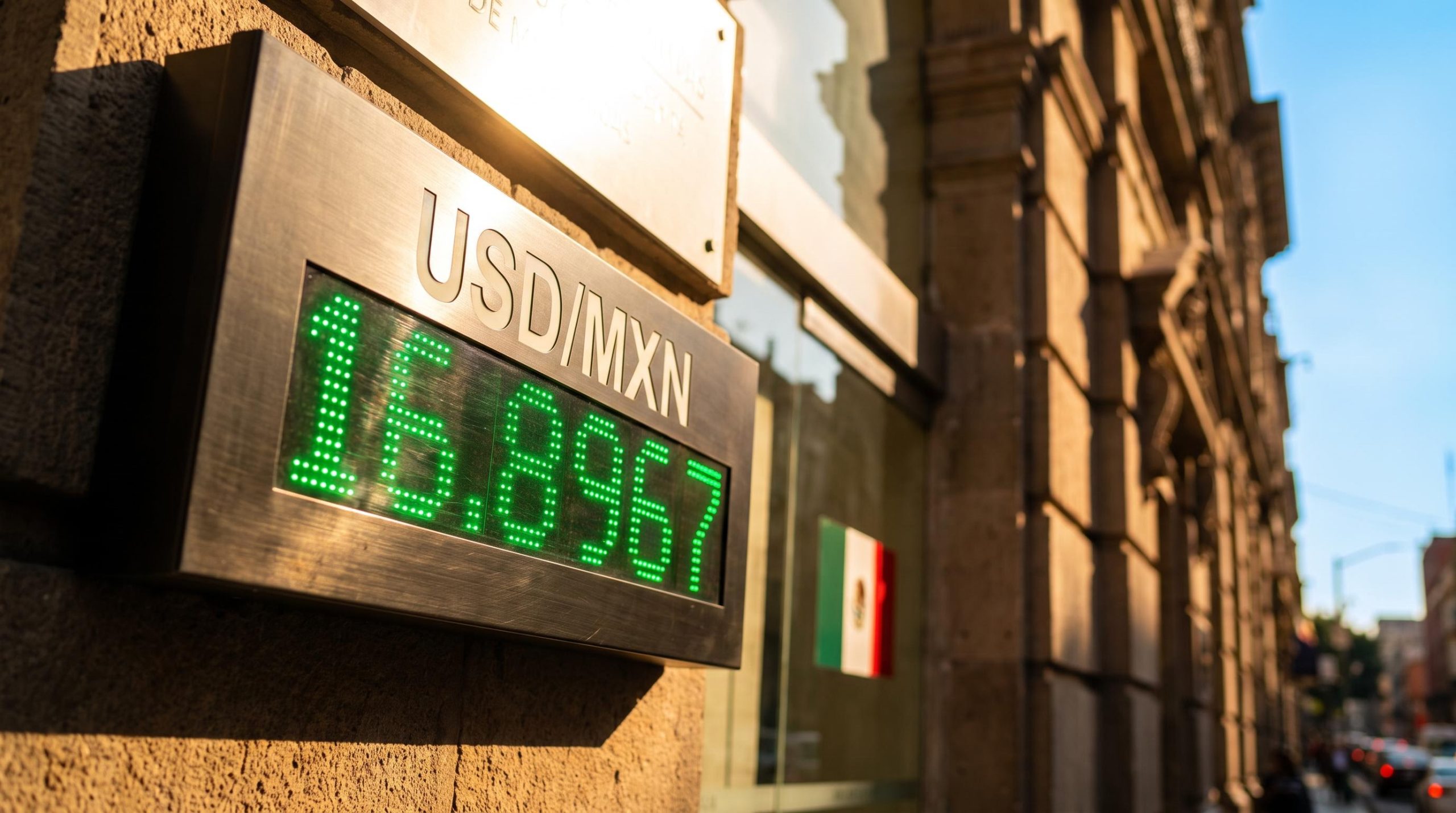
The Mexican peso pushed below a level it has not held all cycle. On 4 September 2026, USD/MXN closed at 16.8967, according to Investing.com, confirming the pair below the psychologically watched 17.00 mark for the first time in the current trade-negotiation window. The question for anyone tracking the peso as a barometer of North American trade risk is simple: what shifted to pull it here, and now.
The timing is not incidental. Mexican Economy Minister Marcelo Ebrard met U.S. Commerce Secretary Howard Lutnick on 2 September 2026 in Chapel Hill, North Carolina, on the sidelines of the G20 innovation ministerial, with tariffs on autos and steel at the centre of the conversation.
That meeting sits inside a larger story. The USMCA framework governing the entire Mexico-US trade relationship is moving through its most consequential restructuring in years, having shifted to an annual-review regime after Washington declined to extend it in July. These are the active variables, not background noise.
This piece gives you the full picture behind the move: the confirmed price data, the diplomatic event that coincided with it, and the renegotiation dynamics that will decide whether the peso holds these levels or hands them back. The goal is to leave you knowing what to watch, not just what happened.
Peso confirms sub-17.00 territory as diplomatic calendar turns active
Start with the data, because the data is unusually consistent. Across the 1-4 September window, four independent platforms placed USD/MXN below 17.00 on both an intraday and closing basis, and they moved in the same direction rather than pointing in different ones.
Investing.com’s table for 4 September 2026 shows a closing price of 16.8967, with an intraday high of 16.9150 and a low of 16.8948. MTFX Group’s sequential daily rates tell the same story in slow motion: 16.9916 on 1 September, 16.9728 on 2 September, 16.9216 on 3 September, and near 16.89 by 4 September.
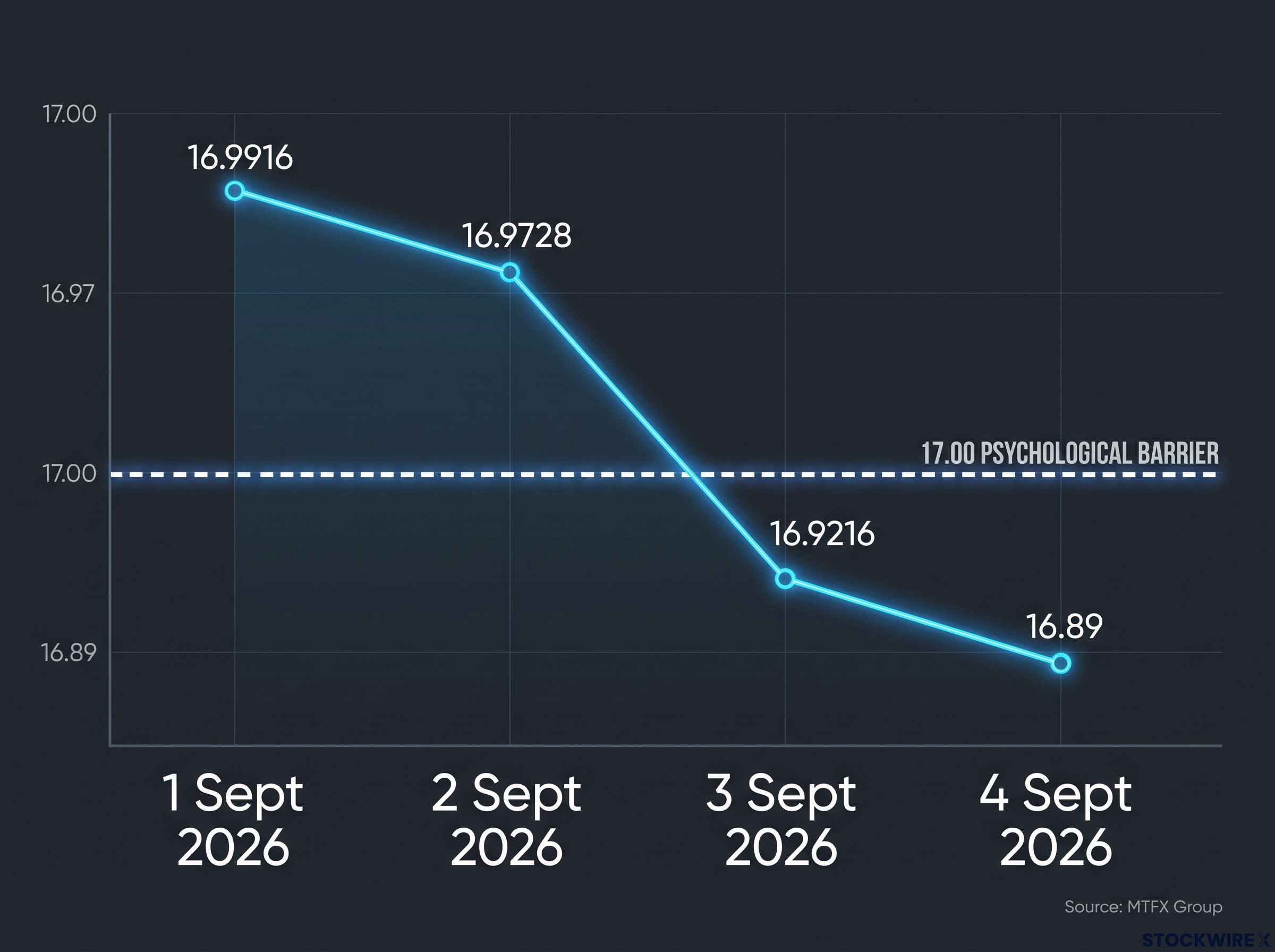
| Date | Rate (MXN per USD) | Source |
|---|---|---|
| 1 September 2026 | 16.9916 | MTFX Group |
| 2 September 2026 | 16.9728 | MTFX Group |
| 3 September 2026 | 16.9216 | MTFX Group |
| 4 September 2026 | approx. 16.89 | MTFX Group |
TradingEconomics logged the pair at 16.9803 on 3 September, up 0.04% from the prior session. The Wall Street Journal, using Tullett Prebon data, recorded a 1-day range of 16.9398-17.0218 on 1 September and quoted the pair at 16.9611 at 11:04 a.m. EDT, confirming sub-17 intraday trading.
Anchor data point USD/MXN closed at 16.8967 on 4 September 2026 (Investing.com), the clearest confirmation of the pair below 17.00 in the current cycle.
One dataset diverges. LiveRates.io reported daily fixes of 17.0009 and 17.0008 for 1-2 September, clustered just above the line, but it stands alone against the more granular multi-platform readings and does not override them.
Here is why that consistency matters to you. A single thin-liquidity spike can be dismissed as noise. A directional move confirmed across four independent sources is repositioning, and 17.00 has long acted as a short-term anchor for this pair. Breaking below it is a signal about how markets are pricing the trade process, not a rounding quirk.
The sub-17.00 close sits at the intersection of several distinct Mexican peso drivers operating simultaneously: the Banxico-Fed rate differential, nearshoring FDI flows, and global risk-off positioning, each pulling at different speeds and over different time horizons.
What Ebrard and Lutnick actually discussed in Chapel Hill
The market signal is one thing. What was actually said at the table is another, and you should judge the second before assuming it drove the first.
The confirmed details are these. On 2 September 2026, Ebrard sat down with Lutnick in Chapel Hill, North Carolina, on the sidelines of the G20 innovation ministers’ meeting. Reuters characterised U.S. tariffs on cars and steel as a key source of friction, and those tariffs headed the agenda.
The confirmed agenda points were:
- U.S. tariffs on autos and steel, the central friction point in the bilateral relationship
- Broader bilateral trade issues across the commercial agenda
- North American regional technological development and innovation cooperation
Mexico’s economy ministry framed the discussion as spanning both tariff resolution and regional technology. President Claudia Sheinbaum went further, using her daily morning press conference to state publicly that Ebrard was in the United States seeking agreements on auto and steel tariffs, a signal of how high the administration ranks tariff relief within its diplomatic posture.
One honest caveat matters here. No on-the-record commentary from named FX strategists explicitly ties the Chapel Hill meeting to the sub-17.00 move in the sources reviewed. The causal link is intuitive, but it is not formally corroborated, and you should hold it as inference rather than fact.
What the agenda does tell you is stark. Autos and steel are the highest-stakes industrial sectors in the entire relationship, and they remain unresolved. That means any peso strength built on the optimism of this meeting is contingent on what happens next at the negotiating table, not on the meeting itself. A productive-looking engagement that leaves the hard questions for later rounds is not the same as a settlement.
USMCA’s new annual-review reality and what it means for the peso
Pull the lens back further and the Chapel Hill meeting looks like a single frame in a much longer reel. The peso’s sub-17.00 move and the September bilateral both sit inside a renegotiation arc that could run for a decade, and the direction of that arc carries real downside risk to current levels.
The structural facts are settled. On 1 July 2026, the United States formally declined to extend USMCA after its six-year review, activating the sunset clause and shifting the pact to an annual-review regime. According to a White & Case legal analysis, the agreement stays fully operational but now faces a potential expiry of 1 July 2036 unless the three countries agree to renew it with changes.
The USMCA annual-review mechanism confirmed that the agreement remains fully operational through a potential expiry of 1 July 2036, with each successive review year creating a discrete window for the parties to extend, amend, or allow the pact to lapse.
The Chapel Hill meeting is not an isolated event; it is the latest step in a sustained sequence. There have been at least three bilateral rounds with Mexico since January 2026, led by U.S. Trade Representative Jamieson Greer and Ebrard.
| Date | Event | Significance |
|---|---|---|
| 28 January 2026 | Greer-Ebrard agree to formal USMCA reform talks | Opens the six-year joint review |
| Week of 25 May 2026 | Formal bilateral negotiations launched in Mexico City | Rules of origin, critical minerals on the table |
| 1 July 2026 | U.S. declines to extend USMCA | Sunset clause activated; annual reviews begin |
| Week of 20 July 2026 | Third bilateral round with Mexico | Greer calls Mexico’s approach “pragmatic” |
| 22 July 2026 | Separate U.S. tracks with Canada and Mexico confirmed | Trilateral framework fragmenting into bilaterals |
| 2 September 2026 | Ebrard-Lutnick meeting, Chapel Hill | Autos and steel tariffs central |
Three structural risks complicate the peso’s current strength. The first is tariff persistence.
Key risk signal In April 2026, USTR Greer told Mexican business leaders that Trump-era tariffs were “here to stay,” signalling that significant tariff burdens would persist regardless of the broader USMCA outcome.
The second is Canada. Ottawa had offered no concessions as of 15 July 2026, and by 22 July 2026 Washington was running parallel bilateral tracks with Canada and Mexico separately, eroding the trilateral character of the pact.
The pattern of tariff pause dynamics visible in the US-Canada track, where a deadline is deferred without a signed agreement, offers a direct precedent for how autos and steel tariff relief in the Mexico bilateral might materialise: as a sequenced negotiation with interim pauses rather than a clean resolution.
The third is the review structure itself. Rules of origin, auto and steel tariffs, critical minerals cooperation, and worker protections all remain under negotiation, and there is no settled endpoint through to 2036.
Here is what that means for you. The annual-review regime turns every successive review into a fresh risk event for the peso. Traders pricing in a resolution on the strength of September’s diplomatic momentum may be running ahead of what the timeline can actually deliver, because sustained engagement is not the same as concrete outcomes on tariffs and rules of origin.
What the peso’s next move depends on
The sub-17.00 level is a reading, not a resting place. Whether the peso consolidates here, extends the move, or hands it back comes down to a handful of specific developments, and they are worth watching individually.
The variables that matter most:
- Concrete tariff relief on autos and steel. This is the highest-stakes item and the clearest test of whether Chapel Hill produced substance or atmosphere.
- Progress on rules of origin within the USMCA bilateral rounds, one of the core terms still unresolved.
- Canada’s posture. Ottawa’s holdout and the parallel bilateral tracks remain an unresolved complication for the trilateral structure.
- The next negotiation round. The July and September sequence points to a rough four-to-six-week cadence, making the next round the nearest-term catalyst.
Tone offers a modest positive. Greer described Mexico’s approach as “pragmatic” in July 2026, one data point suggesting the bilateral track is functional. But the absence of on-the-record strategist commentary linking the FX move to the diplomacy means the market’s read of each upcoming signal will carry elevated weight, and each annual review through to the 2036 expiry horizon is now a recurring event that could drive appreciation or a sharp reversal.
The nearshoring FDI thesis underpinning the structural case for peso appreciation is one of the most consequential variables in the multi-year USMCA renegotiation: prolonged uncertainty over rules of origin and tariff resolution risks redirecting investment decisions that would otherwise flow into Mexican manufacturing capacity.
For you, tracking the peso as a trade-sentiment proxy, the takeaway is a map rather than a verdict: the sub-17.00 level marks where expectations currently sit inside a negotiation with years left to run, and its durability depends on outcomes, not engagement.
This article is for informational purposes only and should not be considered financial advice. Investors should conduct their own research and consult with financial professionals before making investment decisions. Past performance does not guarantee future results. Financial projections are subject to market conditions and various risk factors.