Citi has named its best stocks to own heading into 2027, and the list runs from data center REITs to regulated utilities to AMD. That spread tells a story: the bank sees the next phase of artificial intelligence as an infrastructure buildout, not a pure software play.
The list landed on 4 September 2026, at a moment when a real decision faces investors. Do you want AI infrastructure exposure in your portfolio, and if so, through which entry point?
Citi’s answer arrives with hyperscaler capital spending at historic levels and enterprise inference demand returning after a soft patch. The bank’s sector-by-sector view gives investors a structured way to think through where the money flows next.
What follows is a sector-by-sector breakdown of Citi’s reasoning, so you can judge whether each thesis holds for your own view of AI’s trajectory.
Why Citi sees data center REITs as the most direct bet on the AI buildout
Citi’s case for data center REITs, real estate investment trusts that own and lease out the buildings where servers live, is not really about renting floor space. It is about platform monetisation.
The bank frames Equinix as an interconnection hub rather than a landlord, a place where enterprises plug into multiple cloud providers and generative AI services at once. Citi has cited Equinix’s fully managed service for Nvidia AI as evidence of growth prospects the market underappreciates. Interconnection fees, managed AI services, and multi-cloud connectivity are the revenue streams that matter here, not square footage.
The price target history tells you how that conviction has moved. In June 2025 Citi trimmed its Equinix target to $950 from $990, still a Buy, but reflecting a softer near-term view even as it argued for multi-year margin expansion. Then enterprise inference demand, the computing needed to actually run AI models rather than train them, started coming back.
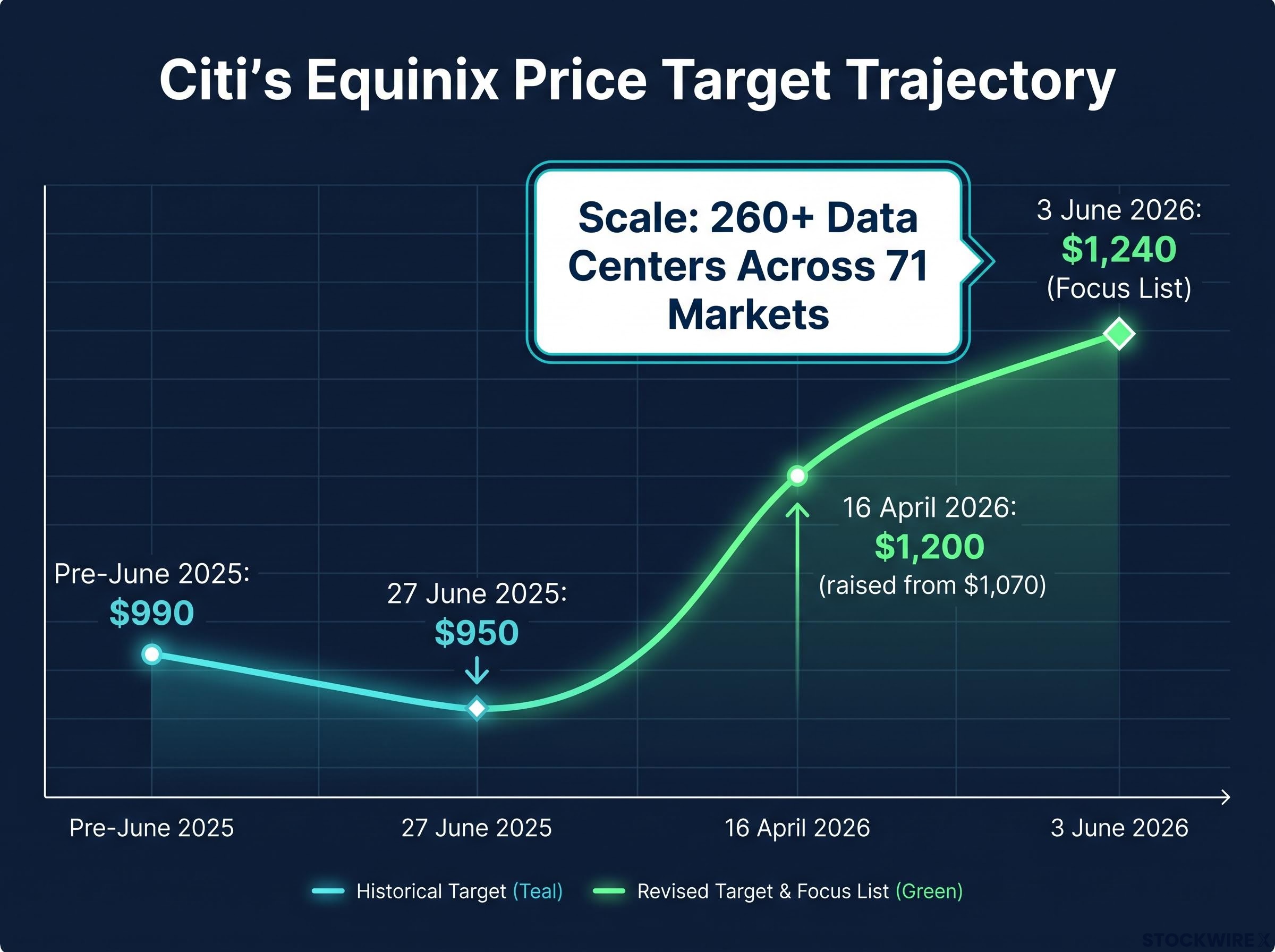
| Date | Price Target | Change vs. Prior | Cited Catalyst |
|---|---|---|---|
| Pre-June 2025 | $990 | Baseline | Core recurring revenue view |
| 27 June 2025 | $950 | Trimmed | Softer near-term, multi-year margin case |
| 16 April 2026 | $1,200 | Raised from $1,070 | Enterprise inference demand recovery |
| 3 June 2026 | $1,240 | Raised, Focus List add | High-conviction endorsement |
Citi analyst Michael Rollins raised the target to $1,200 in April 2026, citing that inference recovery directly. By June 2026, Equinix had earned a place on Citi’s Focus List at $1,240.
That trajectory tells you something specific: Citi’s conviction dipped when enterprise demand softened in mid-2025, then rebuilt sharply as inference workloads returned. The investment case here is sensitive to the pace of enterprise AI adoption, not just hyperscaler cheque-writing. Equinix now operates over 260 data centers across 71 markets, according to US News & World Report, so the scale to absorb that demand is already in place.
Power availability, cooling density, and grid interconnection queues represent the binding constraints on AI deployment that historically determine where durable compounding value concentrates in a technology buildout cycle, a dynamic that helps explain why Citi’s highest-conviction call lands in data center infrastructure rather than software.
The three infrastructure names sit at different points on the risk curve:
- Equinix: the interconnection premium, the only name on Citi’s full list with a public price target and its highest-conviction call.
- Digital Realty: the volume-and-scale complement, high-density campuses feeding hyperscaler demand.
- TeraWulf: the higher-risk, higher-leverage play on the same infrastructure theme, with no public target disclosed.
Digital Realty and TeraWulf: the supporting cast in Citi’s infrastructure basket
Digital Realty serves as the large-campus, high-density complement to Equinix’s colocation and interconnection model. Citi’s supporting data point is telling: roughly 50% of Digital Realty’s first-quarter bookings were likely AI-related, and about 50% of its sales pipeline was tied to anticipated AI workloads, per a Citi note from June 2024. That is structural demand showing up in the order book, not a speculative bet on future adoption.
TeraWulf brings a different profile entirely. It is smaller, more heavily leveraged, and carries no public Citi price target. For readers thinking about position sizing, that absence matters. Its inclusion signals thematic exposure to the buildout, not the defensible, target-backed conviction Citi has published for Equinix.
When big ASX news breaks, our subscribers know first
The power grid angle: why Citi includes two regulated utilities on an AI stock list
Utilities on an AI stock list can look out of place until you trace the mechanism. Every AI data center needs large, always-on baseload power, the steady supply that runs around the clock. And every new megawatt of AI load requires fresh generation and transmission investment that flows straight through a regulated utility’s rate base.
The link is direct: AI data centers demand reliable, continuous power, and utilities earn regulated returns on the new capital they deploy to supply it. That capital spending is what converts AI demand into utility earnings.
Citi named two utilities in its 4 September 2026 list, and they express the same demand in different ways:
- NextEra Energy: growth-oriented. Primary revenue driver is renewable generation and transmission development. Its AI exposure comes through incremental power demand for its wind, solar, and transmission pipeline. Risk profile skews toward development and interconnection timing.
- FirstEnergy: income-oriented. Primary revenue driver is regulated grid operation across a multi-state transmission footprint. Its AI exposure comes through transmission upgrades and interconnection investment as AI loads seek reliable connections. Risk profile skews toward regulatory rate-case outcomes.
Be clear about what Citi has actually disclosed here. There are no public price targets or ratings for either name. Their inclusion is a qualitative endorsement, not a published Buy with a defended number.
That distinction changes how you should read them. Citi’s decision to put utilities on an AI list signals the bank believes AI power demand is durable enough to justify regulated-return equity exposure. Without published targets, though, treat these as thematic endorsements rather than high-conviction calls you can size against a number.
The risks are specific to the sector, too. Regulatory approval of rate-base expansion is never guaranteed, and regulators may resist rapid AI-linked spending if they fear retail ratepayers end up subsidising tech firms. Long grid interconnection queues, the waiting lists for new projects to connect to the network, can also delay when that revenue actually arrives.
Grid interconnection delays are not a temporary administrative backlog but a structural constraint on AI deployment timelines, with the IEA projecting data centre electricity consumption above 1,000 TWh by 2026 and regulated utilities facing multi-year queues before new AI-linked capacity reaches their rate base.
For an investor, the appeal is different from pure tech. Utilities offer lower volatility and dividend income alongside AI demand exposure. The question of portfolio fit comes down to which profile you want: NextEra’s growth tilt or FirstEnergy’s income steadiness.
Semiconductors and the hardware stack: what Citi’s AMD and Celestica picks reveal about the AI supply chain
Citi’s semiconductor picks sit at two different rungs of the same ladder. AMD designs the chips. Celestica assembles the servers those chips go into. Naming both is a bet that AI server demand stays strong enough to lift the whole supply chain, not just the marquee names.
AMD competes with Nvidia in the accelerator market, offering data-center GPUs and high-performance CPUs for both AI training and inference workloads. Citi remains constructive on the name, viewing AI hardware demand as structurally supportive through 2027. No public Citi price target is available, so the stance is confirmed as positive without a defended number attached.
IDC AI infrastructure hardware forecasts project more than $1 trillion in cumulative spending by 2029, with AI infrastructure accounting for over 45% of total AI outlays, figures that contextualise why hyperscaler capital budgets remain at historic levels heading into 2027.
For investors uncomfortable with Nvidia’s valuation, AMD offers a second-mover route into AI data-center silicon with meaningful revenue exposure. Here is a side-by-side of the two hardware names:
- AMD: market role is chip designer. AI exposure comes through GPU and CPU sales for training and inference. Valuation visibility is high, given heavy public coverage. Primary risk is competitive pressure from Nvidia and demand timing.
- Celestica: market role is hardware assembler. AI exposure comes through building AI servers for hyperscalers. Valuation visibility is low, with far less public coverage. Primary risk is order-volume cyclicality tied directly to hyperscaler capex.
Celestica: the overlooked assembler in Citi’s AI supply chain thesis
Celestica runs an electronics manufacturing services (EMS) business, meaning it builds hardware on contract for other companies rather than selling products under its own brand. In this case, that hardware is AI servers destined for hyperscalers.
The logic is direct. As hyperscalers ramp their AI server deployments, Celestica’s order volumes climb with them. That downstream position is Citi’s core thesis for the name. It is less glamorous than a chip designer, more directly tied to actual order flow, and less covered by analysts, which can mean less competition for any upside.
There is a shared caveat across both names. Semiconductor and EMS businesses carry cyclical risk. If hyperscalers front-load their capital spending and then decelerate, revenue growth for AMD and Celestica could compress even if the long-run AI trend stays intact.
That is what pairing a chip designer with an assembler really tells you. Citi is betting the entire AI hardware build cycle runs hot through 2027, which raises the stakes if capex timing shifts earlier than expected.
Megacap platforms and software: where Citi sees AI monetisation at scale
The infrastructure names are where AI capital gets spent. The megacap platforms are where it converts into high-margin recurring revenue. That is the shift in register Citi’s list makes when it reaches Amazon, Alphabet, Meta, Microsoft, and Oracle.
The internet platforms sit on both sides of the AI trade at once. They are hyperscalers funding the buildout, and they are sellers of AI services to enterprises and consumers.
Amazon, Alphabet, and Meta are dual-sided bets: buyers of AI infrastructure and sellers of AI services simultaneously. They spend on the buildout and monetise it in the same motion.
The software layer works through a different mechanism. Microsoft and Oracle command premium pricing on AI-enhanced products, Microsoft through its productivity suite and Oracle through database and cloud offerings positioned for AI workloads. Neocloud providers, cloud platforms built specifically to serve AI workloads, are cited alongside them as further beneficiaries.
| Company | Sector | AI Exposure Mechanism | Citi Stance |
|---|---|---|---|
| Amazon | Internet platform | Cloud infrastructure plus AI services | Positive, no public target |
| Alphabet | Internet platform | Cloud plus AI platform monetisation | Positive, no public target |
| Meta | Internet platform | AI-driven advertising and automation | Positive, no public target |
| Microsoft | Software | AI-enhanced productivity suite | Favoured, no public target |
| Oracle | Software | Database and cloud for AI workloads | Favoured, no public target |
Note the last column. Citi’s view here is constructive across the board, but no public price targets are available for any of these names, which limits your ability to assess implied upside against current prices.
There is a harder truth in this cluster. These are the most widely owned, most widely covered names on the entire list. Citi’s positive view is the consensus view, not a contrarian call.
That reframes the decision for you. The question is not whether to own Amazon or Microsoft; most US equity investors already do, through passive or active funds. The question is whether to overweight them intentionally on an AI monetisation thesis, and that requires a view on how much of the AI revenue story is already priced in.
The AI software revenue timeline matters when evaluating whether Microsoft and Oracle’s current valuations have already priced the thesis: Goldman Sachs analyst Gabriela Borges has dated meaningful software revenue outperformance to 2027, identifying only two companies producing quantified additive AI revenue evidence rather than qualitative disclosure.
What Citi’s full list tells you, and what it does not
Step back from the individual names and the architecture of the list becomes the interesting object. Citi named 12 stocks across five sectors, plus neocloud providers as a category, and it did not crown a single winner.
The full basket runs Equinix, Digital Realty, and TeraWulf in data centers; NextEra and FirstEnergy in utilities; AMD and Celestica in semiconductors; Amazon, Alphabet, and Meta in internet platforms; and Microsoft and Oracle in software. That five-sector span is itself an analytical stance. Citi is not betting on one company; it is mapping the entire value chain from infrastructure to monetisation, an argument about the breadth and duration of the buildout rather than any single stock.
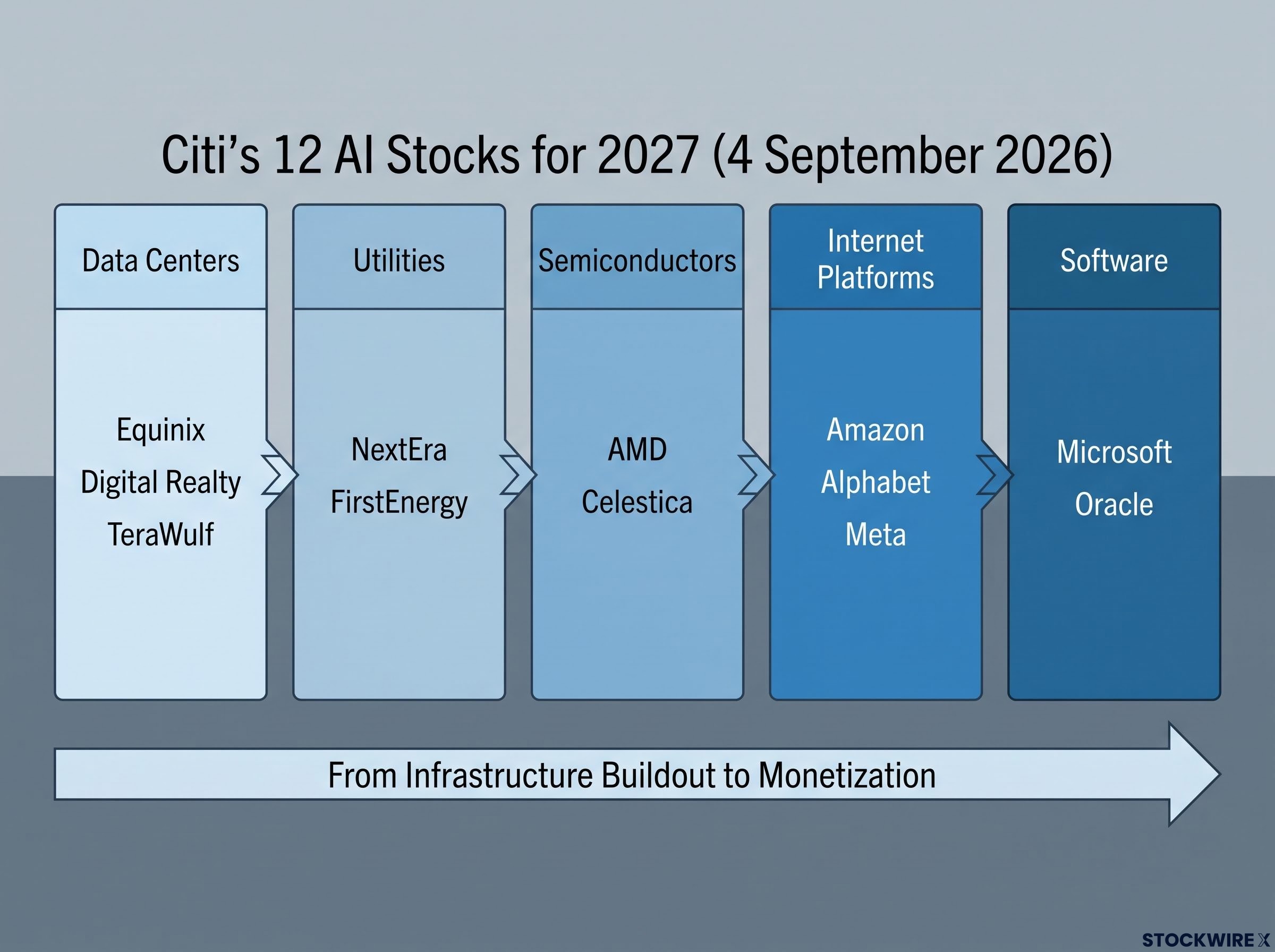
The structural limitation for a retail investor is blunt. Public price targets exist for exactly one name, Equinix at $1,240. Every other stock carries a qualitative endorsement with no published upside figure, which means you cannot evaluate their risk-reward using Citi’s own numbers.
The risks that apply across the basket are worth holding together:
- Demand pull-forward: hyperscalers may front-load AI capex, slowing growth in later years.
- Priced-in valuations: the megacap names are consensus longs, leaving little margin for error.
- Regulatory risk: utilities face rate-case and interconnection uncertainty.
- Energy and margin pressure: rising power and equipment costs can compress margins even as revenue grows.
- Interconnection queue delays: long grid waiting lists can push out revenue realisation.
Read Citi’s list as a sector map, not a stock-picker’s scorecard. The only detailed, publicly defended call is in data center infrastructure. Everything else is directional.
That distinction is the actionable takeaway. The list is most useful for investors weighing infrastructure-adjacent names, REITs, utilities, and Celestica, where the AI thesis is less priced in than in megacap tech, and where Citi’s view is genuinely differentiated rather than consensus.
For investors wanting a structured approach to sizing positions across the hardware, cloud, and software layers that Citi’s list spans, our comprehensive walkthrough of AI infrastructure stock allocation covers the 50/40/10 framework US financial advisors are applying to growth portfolios with AI exposure.
This article is for informational purposes only and should not be considered financial advice. Investors should conduct their own research and consult with financial professionals before making investment decisions. Past performance does not guarantee future results, and financial projections are subject to market conditions and various risk factors.