Every investor eventually hits the same uncomfortable fork in the road. You can chase the exciting growth stocks that promise huge returns, knowing a single earnings miss could send them tumbling. Or you can hunt for cheap value plays, only to discover that “cheap” sometimes just means “a business quietly falling apart.”
It is a genuine dilemma, and picking the wrong side at the wrong moment in the cycle can quietly erode years of returns.
By 2026, a growing number of Australian investors have stopped treating this as a binary choice. They want the earnings expansion that growth offers without paying a reckless price for it, and they want valuation discipline without walking into a value trap.
That middle ground has a name, and increasingly it comes packaged as a ready-made fund on the ASX.
This guide gives you a clear, practical framework for deciding whether a blended factor strategy belongs in your portfolio. You will see exactly how the approach works, and you will meet two live ASX-listed funds that put it into practice right now.
The educational foundation: bridging the growth and value divide
For decades, investors have been sorted into two camps that rarely mix.
Growth investors back companies with fast-rising revenue and earnings, betting that strong compounding will reward shareholders over time. The catch is that market enthusiasm can push valuations far beyond what the underlying numbers justify. When that happens, even a genuinely excellent business can fall hard the moment it fails to meet inflated expectations.
Those who favour value pursue a different philosophy entirely, screening for shares whose market price sits below what their underlying fundamentals suggest they are worth. Their nightmare is the value trap: a company whose stock appears attractively priced only because its profits are eroding, its cost structure is worsening, or its ability to fend off rivals has quietly deteriorated.
A value trap occurs when a stock’s low price reflects genuine business deterioration rather than temporary mispricing; screening metrics like P/B below 1.5 and free cash flow yield above 5% are the standard tools investors use to separate the two, though no single ratio is sufficient on its own.
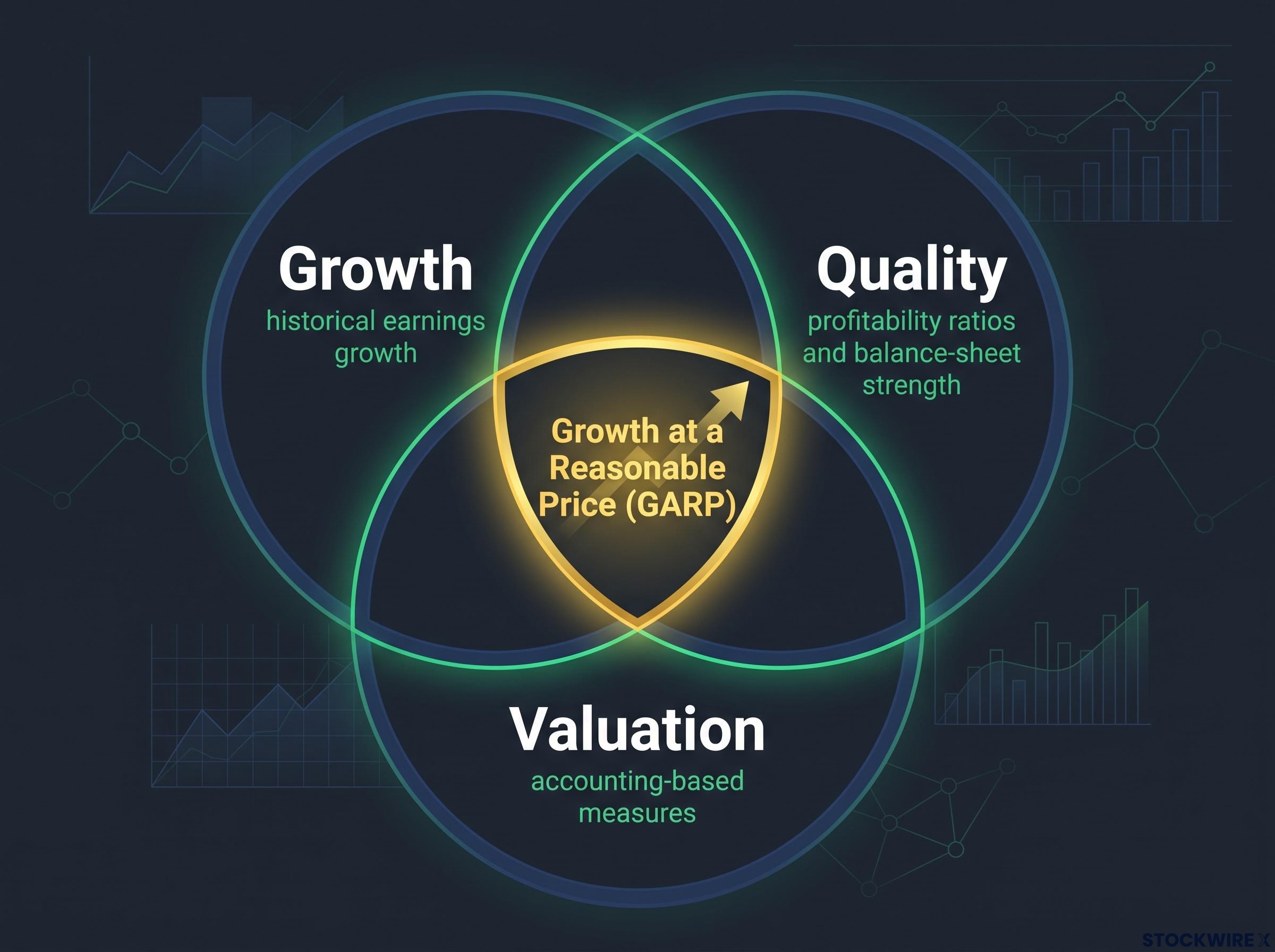
Growth at a Reasonable Price, known as GARP, is built to resolve this exact tension. Rather than swinging between styles, it blends three investment characteristics into one rules-based framework: growth, quality, and valuation. It looks for businesses whose growth prospects are backed by solid fundamentals and whose share price still makes sense.
The clever part is how the quality filters do the cleaning. A pure growth screen can load you up with expensive, low-profit “story” stocks. A pure value screen can hand you a portfolio of heavily indebted, low-quality companies. GARP uses profitability and balance-sheet strength measures to strip out both extremes, leaving something closer to good businesses at fair prices.
Here is what each of the three screening pillars actually measures:
- Growth: historical earnings growth, identifying companies with a track record of expanding profits rather than just promises.
- Quality: profitability ratios and balance-sheet strength, which filter out speculative names and highly leveraged businesses.
- Valuation: accounting-based measures that keep the entry price sensible rather than paying any amount for growth.
This blended design draws on decades of multi-factor research, including the work of Fama and French, which showed that combining factors with low correlation to each other tends to smooth returns over time. Different factors shine in different conditions: value often recovers after drawdowns, quality tends to hold up in downturns, and growth leads in strong bull markets.
For you, that is the whole point. Blending these metrics means you do not have to perfectly time the rotation between growth and value cycles, which protects your capital from the extreme, style-specific drawdowns that punish investors who bet everything on one camp.
When big ASX news breaks, our subscribers know first
Inside the ASX options: evaluating global and domestic exposures
Theory is useful, but you can now buy this exact methodology off the shelf. Two Global X funds bring GARP to the ASX, and they take very different approaches to the same idea.
The Global X S&P World ex Australia GARP ETF (ASX:GARP) is the more established of the pair. It launched on 24 September 2024 and tracks the S&P World Ex-Australia GARP Index, selecting roughly 250 companies from developed markets outside Australia after applying the growth, quality, and valuation screens. It charges a management fee of 0.30% p.a.
Its scale has grown meaningfully. From around $70 million in mid-2025, the fund reached approximately $127 million to $145 million by August 2026, depending on the reporting snapshot. That kind of asset base generally supports tighter trading and deeper liquidity.
The Global X S&P Australia GARP ETF (ASX:GRPA) is the newer, more concentrated sibling. It launched on 30 September 2025 and tracks the S&P/ASX 200 GARP Index, selecting exactly 50 local companies described as demonstrating consistent fundamental growth, reasonable valuations, and strong earnings power. Its fee is slightly lower at 0.25% p.a.
The contrast in scale is stark. As of mid-2026, GRPA held only around $2 million in assets, a fraction of its global counterpart.
| Ticker | Focus area | Holdings count | Management fee | Estimated 2026 AUM |
|---|---|---|---|---|
| ASX:GARP | Developed markets ex-Australia | ~250 companies | 0.30% p.a. | $127M-$145M |
| ASX:GRPA | S&P/ASX 200 (domestic) | 50 companies | 0.25% p.a. | ~$2M |
That gap in assets under management is not just trivia. It tells you the domestic fund is still building its liquidity profile, so you need to watch the bid-ask spread carefully when you place a trade. Buying a thinly traded ETF at the wrong moment can quietly cost you more than the fee ever will.
Index construction methodology
Both indexes are administered by S&P Dow Jones Indices, which publishes the rules governing how growth, quality, and valuation factors are defined, scaled, and combined.
That matters because both ETFs are passive index trackers, not actively managed funds. There is no portfolio manager making discretionary calls on which stocks to buy. The rules do the selecting, which removes human bias from the process but also means the methodology itself becomes the thing you are trusting.
Rules-based screening applies consistent, quantitative filters to a broad investment universe, removing human bias from stock selection; the same quality criteria that GARP uses to strip out speculative names, return on equity, earnings stability, and low debt, also underpin dedicated quality ETFs like QLTY and AQLT trading on the ASX.
Understanding the structural risks and limitations
No screening framework is a silver bullet, and GARP carries trade-offs you should understand before committing capital.
The first is its reliance on backward-looking data. GARP screens lean heavily on historical earnings, profitability ratios, and accounting-based measures. Those numbers describe what a business has already done, not what it might become.
Academic and practitioner research repeatedly warns that backward-looking screens can miss structural market shifts, such as technological disruption or regulatory change, and may exclude emerging winners whose fundamentals have not yet shown up in reported financials.
This is why a company investing aggressively for future growth, and reporting temporarily depressed earnings as a result, can be screened out entirely, even if it later turns out to be a big winner.
The second risk is cyclical underperformance. Factor research from MSCI and AQR documents that value and quality tilts often lag during periods when speculative growth, momentum, or thematic stocks dominate returns. Because GARP deliberately excludes companies without current earnings, you must accept that your portfolio will likely trail the broader market during intense, hype-driven tech or thematic rallies.
That is not a flaw in the strategy. It is the direct consequence of its discipline. Knowing this in advance is what stops you from abandoning the approach at precisely the wrong moment.
The cost of concentration
The domestic fund carries a specific structural risk worth isolating.
By selecting only 50 companies from the S&P/ASX 200, the index creates significant tracking error against the standard benchmark. Your returns will diverge, sometimes meaningfully, from the broad ASX 200.
Concentrated portfolios like this can also cluster in sectors with strong current fundamentals, such as healthcare, financials, or consumer names, which increases your exposure to sector-specific shocks. This divergence is intentional. The whole reason to own a GARP fund is to get something different from the market average, and tracking error is the price of that difference, not a defect to be surprised by.
Sector concentration risk inside a 50-stock domestic fund is not visible from a single holdings snapshot; because the ASX 200 already overweights financials and materials, a GARP screen favouring companies with strong current fundamentals can inadvertently double your exposure to the same sectors already dominant in your core index ETF.
Integrating multi-factor ETFs into an Australian portfolio
So where do these funds actually fit? For most investors, the answer is not as a foundation.
The cleanest way to think about it is the core-satellite model. Your core is broad, cheap, market-matching exposure that does the heavy lifting. Satellites are smaller, deliberate tilts layered on top to enhance returns or express a view. GARP and GRPA are far better suited to that satellite role than to anchoring an entire portfolio.
Cost is a big reason why. These funds charge 0.25% to 0.30% p.a., which is competitive within the smart beta category but well above the sub-0.10% p.a. fees on plain-vanilla broad-market index ETFs. Research houses including Morningstar consistently find that lower fees are among the strongest predictors of better net returns, which is exactly why the expensive factor tilt belongs in a smaller allocation.
Tax is the other consideration, and it is easy to overlook. Multi-factor strategies refresh their screens regularly, so they tend to have higher portfolio turnover than cap-weighted index funds. Higher turnover generates more realised capital gains inside the fund, which means you should factor in potential annual tax drag when holding these assets in a taxable account outside your superannuation. Both funds distribute semi-annually, so those distributions land twice a year.
Here is a practical sequence for sizing a satellite allocation:
- Assess your core holdings first. Confirm you already have broad, low-cost market exposure doing the foundational work before adding any tilt.
- Determine your tilt size. Decide what proportion of your portfolio you are comfortable allocating to a strategy that will sometimes underperform the market for extended stretches.
- Review liquidity before trading. For the smaller domestic fund especially, check trading volume and bid-ask spreads so execution costs do not eat into your returns.
- Calculate the fee drag. Compare the higher management fee against your core holdings and be honest about whether the expected factor benefit justifies the extra cost.
Work through those four steps and you turn a vague interest in factor investing into a deliberate, sized decision. That is the difference between owning a satellite on purpose and accidentally over-concentrating your risk.
For investors who want a structured walkthrough of how to build the core before adding any satellite tilt, our dedicated guide to ETF portfolio construction covers asset allocation frameworks, cap-weighting concentration risks, and the fee arithmetic that determines long-run net returns.
This article is for informational purposes only and should not be considered financial advice. Investors should conduct their own research and consult with financial professionals before making investment decisions. Past performance does not guarantee future results, and financial outcomes are subject to market conditions and various risk factors.
Strategic next steps for factor allocation
Combining quality, growth, and valuation into one rules-based framework offers a disciplined alternative to the emotional stock picking that trips up so many investors. It will not win every year, and that is by design.
As you move through the rest of 2026, the honest truth about multi-factor investing is that its success depends almost entirely on your conviction and patience through inevitable style cycles. The strategy works for those who stay the course, not for those who bail at the first stretch of underperformance.
Now is a good moment to look hard at your own equity exposure. Are you unknowingly loaded up with extreme growth risk, or quietly holding a few decaying value traps?
Use the core-satellite framework and the four-step sizing checklist above to decide whether a targeted GARP allocation could bring those extremes back into balance. The tools are in your hands. The decision, as always, is yours.
—