India’s rupee is trading near 94.5 against the dollar while the central bank sits on record foreign exchange reserves of US$729.33 billion. On paper, that combination reads like a currency under firm control. The structural trajectory tells a different story: USD/INR is still drifting upward, and the machinery holding the line is about to wind down.
That tension is the whole story. The Reserve Bank of India (RBI) has engineered a genuine stabilisation through a targeted deposit programme, yet the underlying pull toward a weaker rupee has not been reversed, only softened.
Timing sharpens the point. The special FCNR(B) swap window closes to new deposits on 30 September 2026, which means the inflow phase is nearly complete and the question shifts from how much the RBI can raise to what happens once the tap closes. What follows here maps the mechanics of the programme, the structural outlook for the rupee, and the contested rate question, so the balance of risks becomes clear as the window shuts.
How the FCNR(B) swap window assembled US$136 billion in four months
Start with the deposit itself. A Foreign Currency Non-Resident (Bank), or FCNR(B), deposit is a term deposit that non-resident Indians (NRIs) hold in a foreign currency rather than rupees. The bank repays principal and interest in that same currency at maturity, so the depositor carries no rupee risk at all.
Now add the swap layer. Under the special window launched on 8 June 2026, authorised dealer banks raise fresh FCNR(B) deposits, then swap the foreign currency with the RBI at a concessional rate. The bank’s foreign liability becomes a rupee liability, and the RBI takes on the future dollar obligation.
That is the mechanical difference from conventional intervention. Instead of selling dollars out of reserves on the spot market, the RBI is effectively renting stable foreign funding from the Indian diaspora and absorbing the hedge.
The programme’s key parameters are worth laying out plainly:
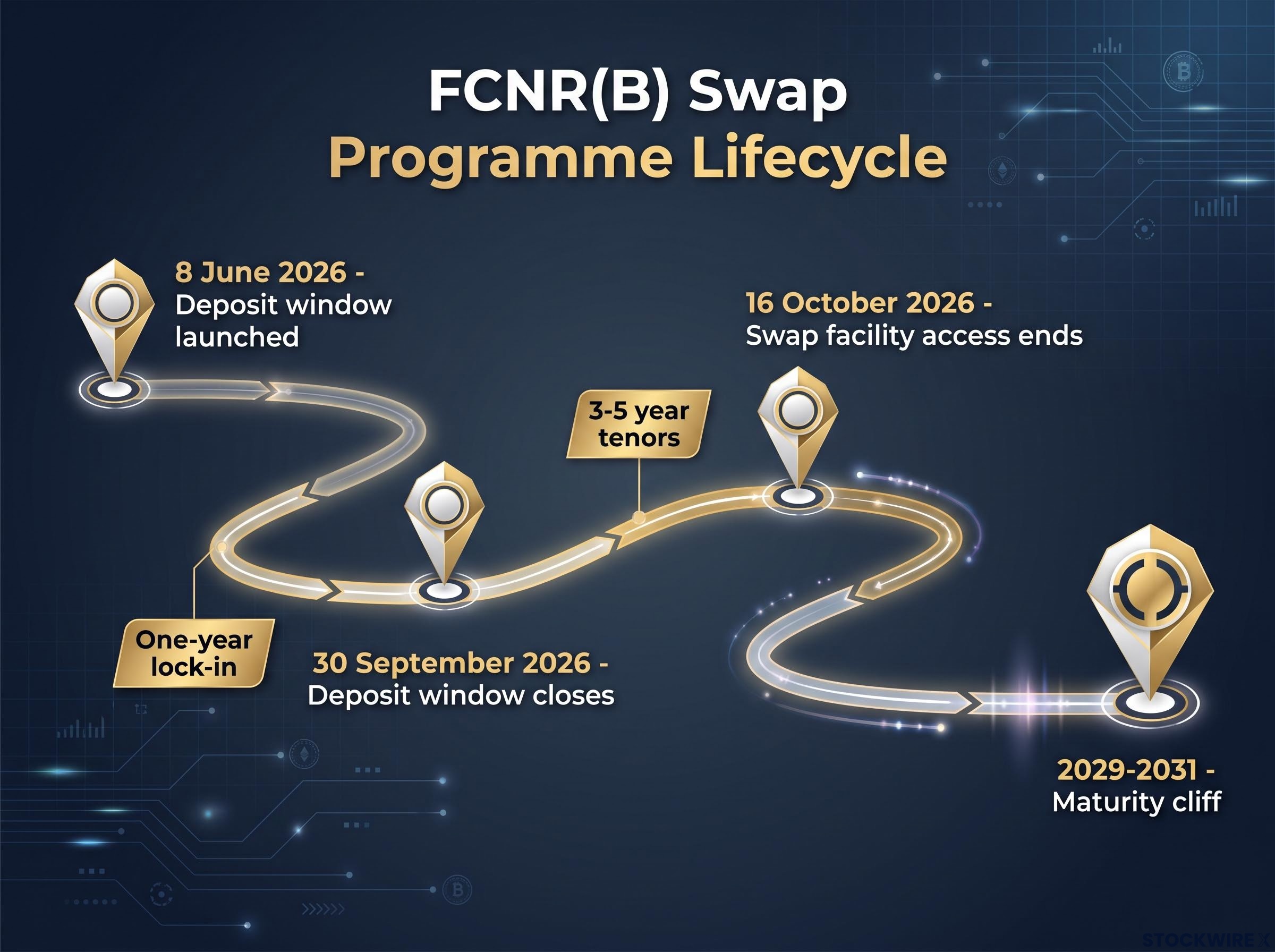
- Deposit window launched 8 June 2026, open until 30 September 2026
- Swap facility accessible until 16 October 2026
- Tenors of 3-5 years on the underlying deposits
- A one-year lock-in, with RBI swaps non-cancellable once executed
- The swap facility offered exclusively in US dollars, even though deposits can be raised in multiple convertible currencies
Assemble those parts and the scale of the response makes sense. Through 31 August 2026, provisional data shows total inflows under the broader special swap window reached US$136.38 billion, with FCNR(B) deposits alone contributing US$127.23 billion.
The RBI provisional data on FCNR(B) inflows, released 2 September 2026, confirms total inflows of US$136.38 billion through the special swap window, with FCNR(B) deposits accounting for US$127.23 billion of that figure.
| Inflow source | Amount | Share of total |
|---|---|---|
| FCNR(B) deposits | US$127.23 billion | ~93% |
| OFCB and ECB | US$9.15 billion | ~7% |
MUFG on the uptake Analyst Michael Wan at MUFG noted that these dollar inflows considerably surpassed initial market expectations, with cumulative FCNR(B)-linked flows clearing the US$130 billion mark by the end of August.
The pace of that uptake tells you something. NRI depositors committed capital quickly, which signals both attractive yield terms and a trust premium the diaspora placed on the programme’s design. For anyone weighing near-term rupee volatility, the stickiness matters more than the headline: 3-5 year tenors with a one-year lock-in mean this capital cannot reverse overnight.
When big ASX news breaks, our subscribers know first
The risks the RBI absorbed to make the programme work
The immediate payoff is real. At US$729.33 billion for the week ending 21 August 2026, India’s reserves stand at an all-time high, and MUFG judges that the risk of a severe, abrupt rupee selloff has now meaningfully diminished.
The optimistic anchor MUFG’s assessment is that the intervention has equipped the monetary authorities with substantial firepower, reducing the tail risk of a disorderly depreciation.
That firepower came at a price, and the price sits on the RBI’s own balance sheet. Because it took the other side of the swap, the central bank now carries obligations that will arrive on a schedule.
Three structural risks beneath the headline reserve figure
The first is depreciation liability. By assuming the dollar obligation on the swap, the RBI pays the difference if the rupee falls sharply between the deposit date and maturity. The stronger the dollar becomes over the next few years, the larger that settlement grows.
The second is the maturity cliff. Mobilising tens of billions in 3-5 year deposits within a few months concentrates large reverse flows at predictable future dates. When those deposits mature in 2029-2031, the RBI will need active reserve management to prevent a sudden drain.
The third is precedent. Analysts point to Turkey’s FX-protected deposit scheme (KKM), introduced in late 2021, as a structural caution rather than a forecast. That programme stabilised the lira in the short term but, according to those analysts, became a fiscal burden reported to have exceeded 1.6% of GDP over 2021-2024, illustrating how large FX-linked schemes can prove difficult to unwind.
None of this dismisses the programme’s success. It does tell you that the intervention has a deferred cost, and that cost is denominated in rupees-per-dollar at whatever rate prevails when the deposits mature.
IMF constraints on currency intervention set a broader institutional context for how central banks can deploy reserves: Japan’s episode-count framework and India’s own history of IMF scrutiny over sustained targeting illustrate that the volume of reserves matters less than the institutional legitimacy of the intervention mechanism, a distinction relevant to assessing how freely the RBI can deploy its US$729.33 billion cushion.
For anyone holding multi-year exposure to Indian assets or INR-denominated instruments, the maturity cliff is not abstract. It is a known future pressure point on the very reserves that provide comfort today.
Where USD/INR is headed and what the market is not pricing
USD/INR sat at roughly 94.54 on 4 September 2026, following a close of 94.485 on 31 August 2026. Active intervention and record reserves are keeping downside moves capped, but the medium-term direction is set by structural forces: India’s growth-driven import demand and global dollar conditions.
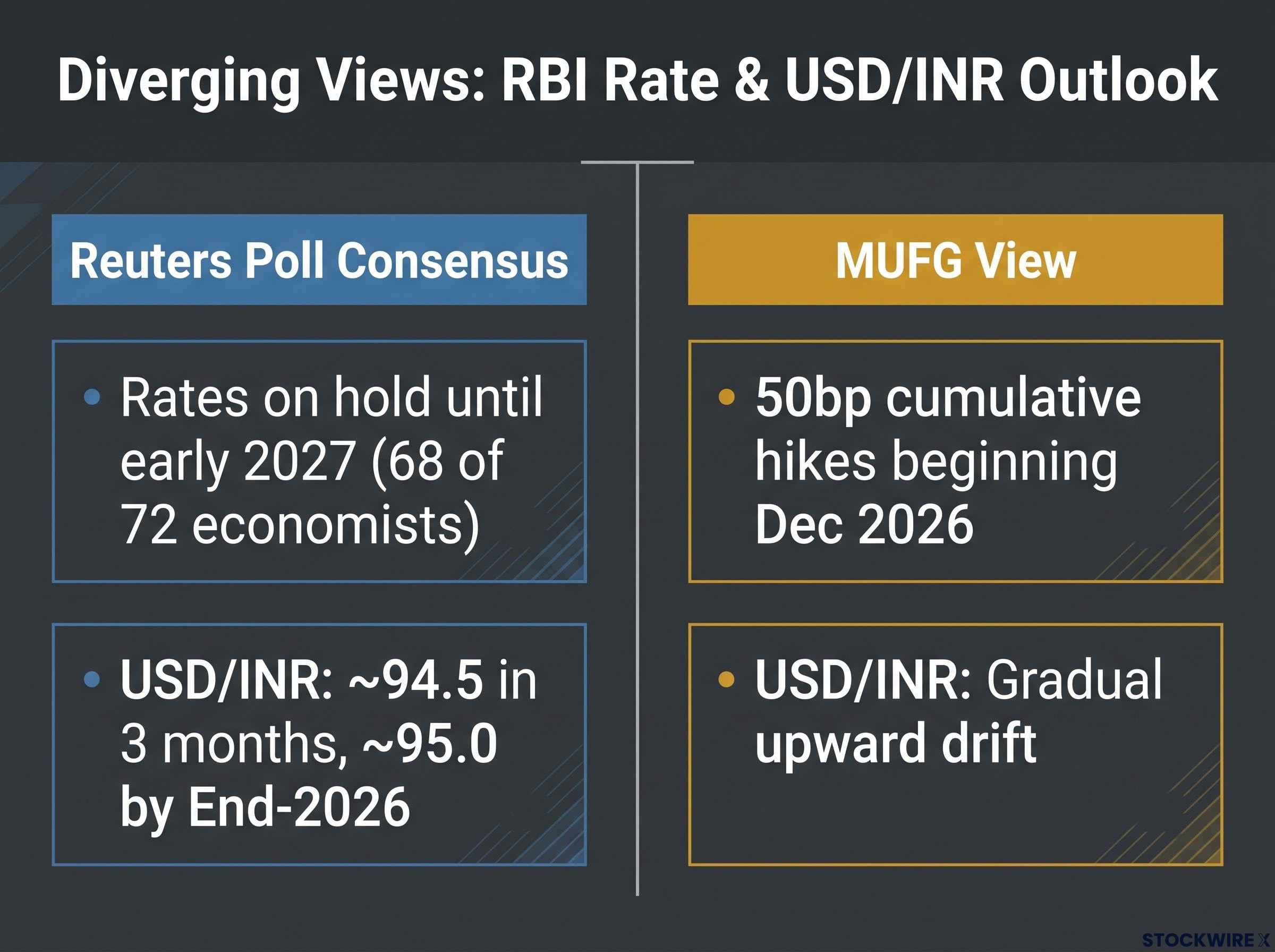
Reuters polling points to gradual drift as the baseline. Strategists projected USD/INR around 94.5 in three months and 95.0 by end-December 2026.
The consensus anchor Reuters polling placed USD/INR near 94.5 over a three-month horizon and 95.0 by the end of December 2026, framing a slow managed slide rather than a break.
MUFG’s view runs in the same direction, just softer on severity. The bank expects gradual upward drift in USD/INR over a longer horizon, with the FCNR(B) programme reducing the depth of depreciation without reversing its direction.
| Forecast source | 3-month USD/INR | End-2026 USD/INR |
|---|---|---|
| Reuters poll | ~94.5 | ~95.0 |
| MUFG | Gradual upward drift (no point forecast) | Gradual upward drift (no point forecast) |
Valuation adds a wrinkle. Some domestic strategists estimated earlier in the year that the rupee was roughly 5% undervalued, while the IMF’s External Sector Report is reported to have assessed India’s external position as moderately stronger than fundamentals imply, advising that FX intervention be limited to genuinely destabilising risk events.
So the consensus and MUFG are not really at odds. Both see the rupee drifting weaker over time, and the FCNR(B) programme has narrowed the range of that drift rather than reversed it. Stability and gradual depreciation coexist in the current framework.
The dollar index trajectory matters directly for USD/INR: the DXY reached a 13-month peak of 101.8 in late June 2026 after shedding roughly 9-10% across 2025, and Morningstar’s model flagged the index as approximately 15% overvalued at mid-year, which implies the external pressure on the rupee could ease if the cyclical dollar premium compresses on any Fed pivot.
For anyone pricing INR exposure into portfolio decisions, the read is straightforward: the tail risk of a disorderly move has been compressed, but the baseline direction stands. Hedging costs and return assumptions should reflect a slow, managed drift, not a sharp dislocation.
The rate debate: why MUFG expects 50bp in hikes the market is not pricing
The consensus is close to unanimous. At its 3-5 August 2026 meeting, the RBI’s Monetary Policy Committee (MPC) unanimously held the repo rate at 5.25% for the fifth consecutive meeting, with the Standing Deposit Facility at 5.00% and both the Marginal Standing Facility and Bank Rate at 5.50%.
The consensus hold In the August Reuters poll, 68 of 72 economists forecast that the RBI would keep rates on hold at least until early 2027.
The RBI’s posture reinforces that. It has held a neutral stance, cut its FY27 inflation projection to 5.0%, and projected real GDP growth at 6.7%, while consistently preferring FX-specific tools over rate hikes to address rupee weakness.
What would need to be true for MUFG to be right
MUFG breaks from the pack with a specific call: a cumulative 50 basis points of hikes beginning at the December 2026 meeting. Its catalysts, in order of specificity, are:
- Inflation dynamics linked to adverse weather events
- Solid credit expansion
- Robust GDP growth
- Supportive fiscal policy
For that scenario to materialise, several conditions would need to align. Weather-driven price pressure would have to translate into sustained CPI running above the RBI’s revised 5.0% projection rather than fading as a one-off.
Credit growth would need to outpace the RBI’s comfort zone enough to shift the committee toward pre-emptive tightening. And external conditions, global dollar dynamics and oil prices among them, would need to stay contained, so the MPC’s attention stays on domestic overheating rather than defending the currency.
This remains a minority view. But the catalysts MUFG cites are independently observable, which gives the call analytical standing even against a near-unanimous consensus.
The forecaster split on RBI hikes is wider than the MUFG-versus-consensus framing suggests: UOB reversed its no-change call in September 2026 and joined BofA Securities in projecting a cumulative 50bp tightening cycle from December, while Citi, DBS, and Union Bank of India maintained a prolonged hold, with the October 5-7 MPC meeting identified as the real inflection point.
The gap matters for positioning. If MUFG is right, the current pricing of Indian rate instruments and the rupee’s forward curve are both wrong at the same time. A 50bp surprise tightening cycle would be a meaningful repricing event for Indian fixed income and could put an additional floor under the rupee, which is why anyone holding Indian bonds or rate derivatives should treat it as a live tail scenario rather than a fringe idea.
What the window closing in September changes, and what it does not
The value of the programme lies in separating what is durable from what is temporary. On 30 September 2026 the deposit window closes and, on 16 October 2026, the swap facility follows. From those dates, no new FCNR(B) flows will supplement reserves.
What changes after September 30
- No fresh inflows arrive to top up the reserve cushion
- The RBI’s swap facility access ends on 16 October 2026
- Any new external shock will test existing reserves rather than being offset by new programme flows
What remains in place after September 30
- The US$127.23 billion in FCNR(B) deposits stays locked under 3-5 year tenors and a one-year lock-in
- The reserve cushion is real capital, not a paper figure
- Reverse flows remain concentrated in 2029-2031, a known future date, not an imminent one
Two uncertainties stay live. The first is whether inflation and credit dynamics justify MUFG’s December tightening call. The second is whether the 2029-2031 maturity cliff will require a successor intervention to avoid a disorderly unwind.
So “window closes” should not read as “stability ends”. The capital is locked, the reserves are genuine, and the RBI retains substantial intervention capacity. What changes is that fresh shocks will now be absorbed by the existing cushion rather than new inflows.
The takeaway for near-term decisions is a reasonably clear stability window, with the structural upward drift in USD/INR toward roughly 95.0 by end-2026 still the baseline. The rate question is the single variable most capable of shifting that trajectory, which makes the December MPC meeting the natural review point for anyone holding INR-denominated assets, forward hedges, or Indian fixed income.
EM local-currency bond positioning has become a live question precisely because the rupee’s managed drift creates the kind of stable-but-softening FX environment where carry yield and gradual appreciation can compound: EM local-currency bonds returned roughly 19% in 2025 per the J.P. Morgan GBI-EM index, attracting $11.4 billion in Q1 2026 flows, and India’s trajectory fits the profile of markets benefiting from that reallocation.
This article is for informational purposes only and should not be considered financial advice. Investors should conduct their own research and consult with financial professionals before making investment decisions. Past performance does not guarantee future results, and financial projections are subject to market conditions and various risk factors. Forward-looking forecasts cited here are speculative and subject to change based on market developments.