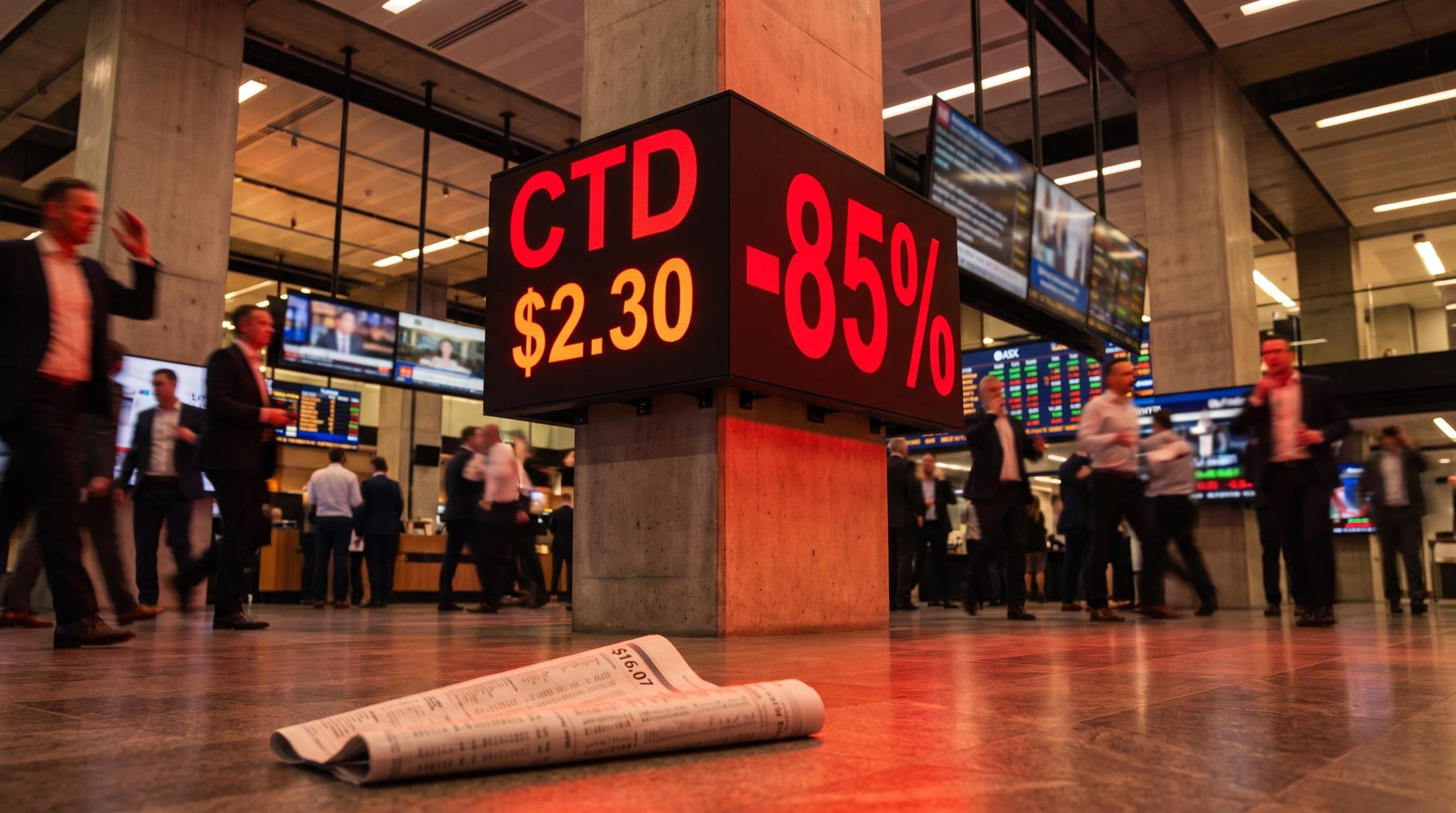
Corporate Travel Management shareholders woke up today to a stark new reality: roughly 85% of their capital wiped out the moment the stock finally started trading again.
The blue chip travel name that once changed hands at around $16 returned to the ASX today as a fraction of its former self.
That resumption on 3 September 2026 ends a trading suspension that had stretched beyond 12 months, triggered by a colossal United Kingdom overcharging scandal and a cascade of accounting control failures. For a full year, holders could only watch and wait.
Today is the first moment of genuine price discovery since the freeze, and the market has delivered a brutal verdict.
Here is a clear picture of how the billing failures unfolded, what the active ASIC investigation means for the company’s future, and how to weigh the risks that still sit inside this stock before deciding it has found a floor.
The brutal arithmetic of a 12-month trading freeze
The numbers tell a story of value that vanished while nobody could act on it.
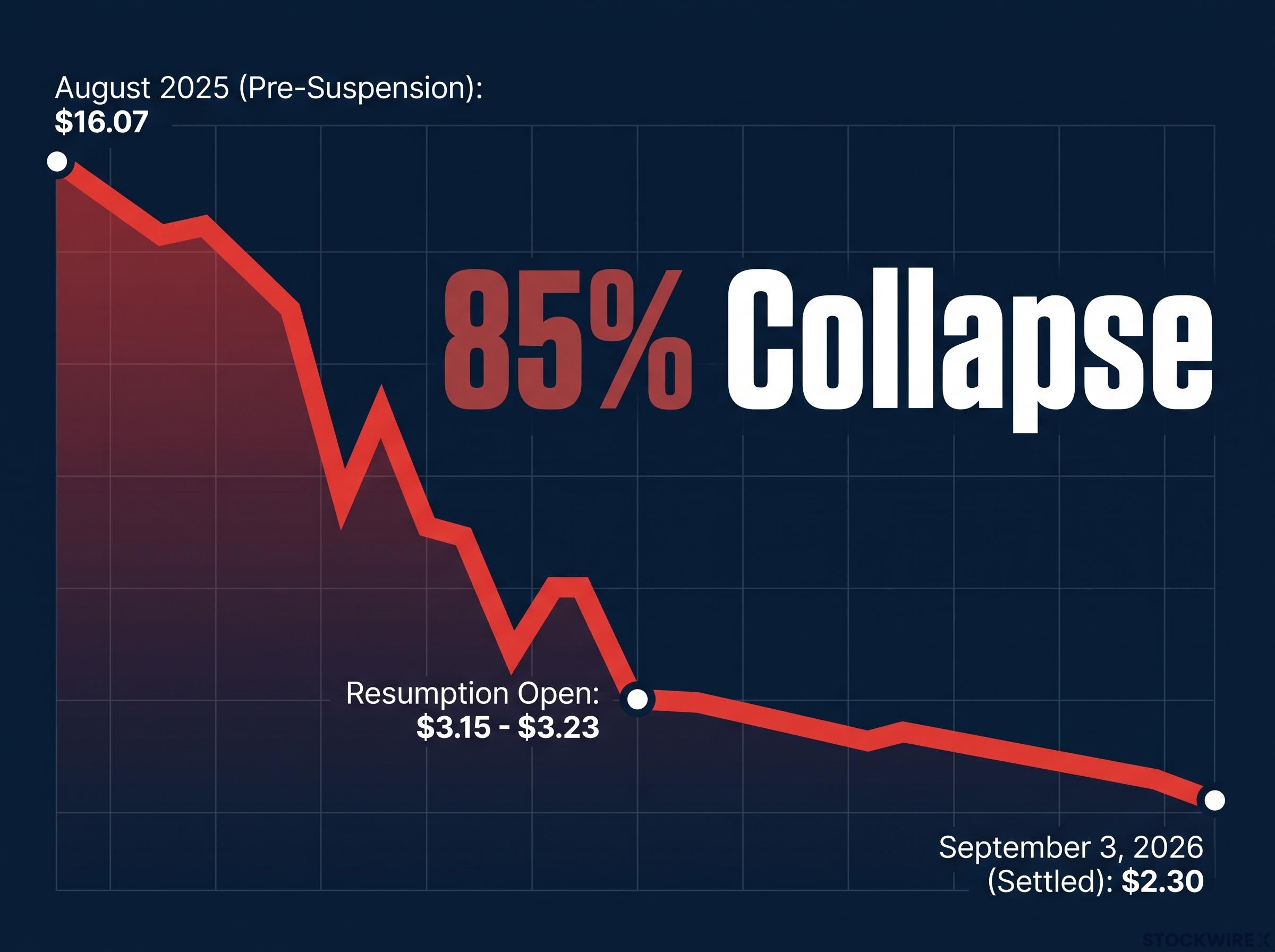
Corporate Travel Management closed at approximately $16.07 in August 2025, just before the suspension took hold. When trade resumed today, the stock opened in a range of roughly $3.15 to $3.23 and then sold off further through the session, settling near $2.30.
That is a collapse of around 85% from the pre-suspension level.
The catalyst for the unfreezing was mundane by comparison to the drama around it: the company lodged its audited FY26 results with the ASX on 1-2 September 2026, satisfying the reporting requirement that had kept it frozen. Once those accounts were in, the exchange allowed trading to restart.
Here is what that gap between $16 and $2.30 actually shows you. The travel business kept booking billions in transactions throughout the suspension, yet its market value cratered. The destruction was driven almost entirely by lost trust and broken governance, not by a collapse in underlying revenue. Valuation, it turns out, is as much about confidence as it is about cash flow.
The harder lesson sits with the shareholders themselves. For more than a year, they were locked in, unable to sell a single share while the crisis played out. That is the hidden trap of an ASX suspension: when a governance shock hits a frozen stock, you have no exit until the exchange decides to reopen the door.
Stop-loss limitations become most acute in exactly the scenario Corporate Travel Management shareholders experienced: once a stock is suspended, existing stop orders are frozen and cannot execute, leaving holders with no mechanical protection against the gap-down that occurs when trading resumes at a price far below the level at which the order was set.
Navigating the ASX suspension timeline
The path from normal trading to today’s reopening was a slow tightening of the screws.
The ASX imposed a trading halt on 22 August 2025, followed by a full suspension from quotation on 26 August 2025 after auditors discovered an accounting error that stopped the company releasing its FY25 annual report on time.
By 18 April 2026, the exchange had classified Corporate Travel Management as a “long-term suspended entity” and set hard deadlines: lodge the oldest outstanding report by 29 August 2026, and meet all requirements to resume trading by 26 August 2027. The company scraped in on the first deadline with days to spare, which is what made today possible.
The ASX Listing Rules and Guidance Notes set out the precise conditions under which a long-term suspended entity must meet reporting deadlines to have quotation reinstated, which is the framework Corporate Travel Management navigated when lodging its audited FY26 results just ahead of the 29 August 2026 deadline.
When big ASX news breaks, our subscribers know first
How systemic control failures inflated the books
Shift the lens from shock to structure, because the collapse did not come from bad luck. It came from a business that kept the money it was supposed to give back.
At the heart of the scandal was a breakdown in refund reconciliation. When flights or services were cancelled, the refunds Corporate Travel Management received were not systematically passed back to clients. Instead they were retained and booked as revenue.
That is a failure of the most elementary kind of financial control, and it went undetected for at least three financial years across FY23 to FY25 before Deloitte, the incoming auditor, flagged it.
The problem then metastasised in the United Kingdom. The company admitted that £77.6 million in UK revenue booked between FY23 and FY25 would need to be reversed or refunded. A forensic review by KPMG identified a further £45.4 million from concluded contracts as an area of concern, pushing the total estimated overbilling of the British government into a range of £118 million to £128 million, or roughly $220 million to $240 million.
Investigations by ABC News detailed exactly how the overcharging worked in practice:
- Double billing within the same month
- Invoicing for more rooms than a hotel actually contained
- Charging for “exclusive use” of hotels that were not being treated as exclusive
- Billing for services with no supporting hotel contract or invoice
- A disputed side agreement, later alleged to be fake, under which the company would keep £22 million and refund £28 million of contested amounts
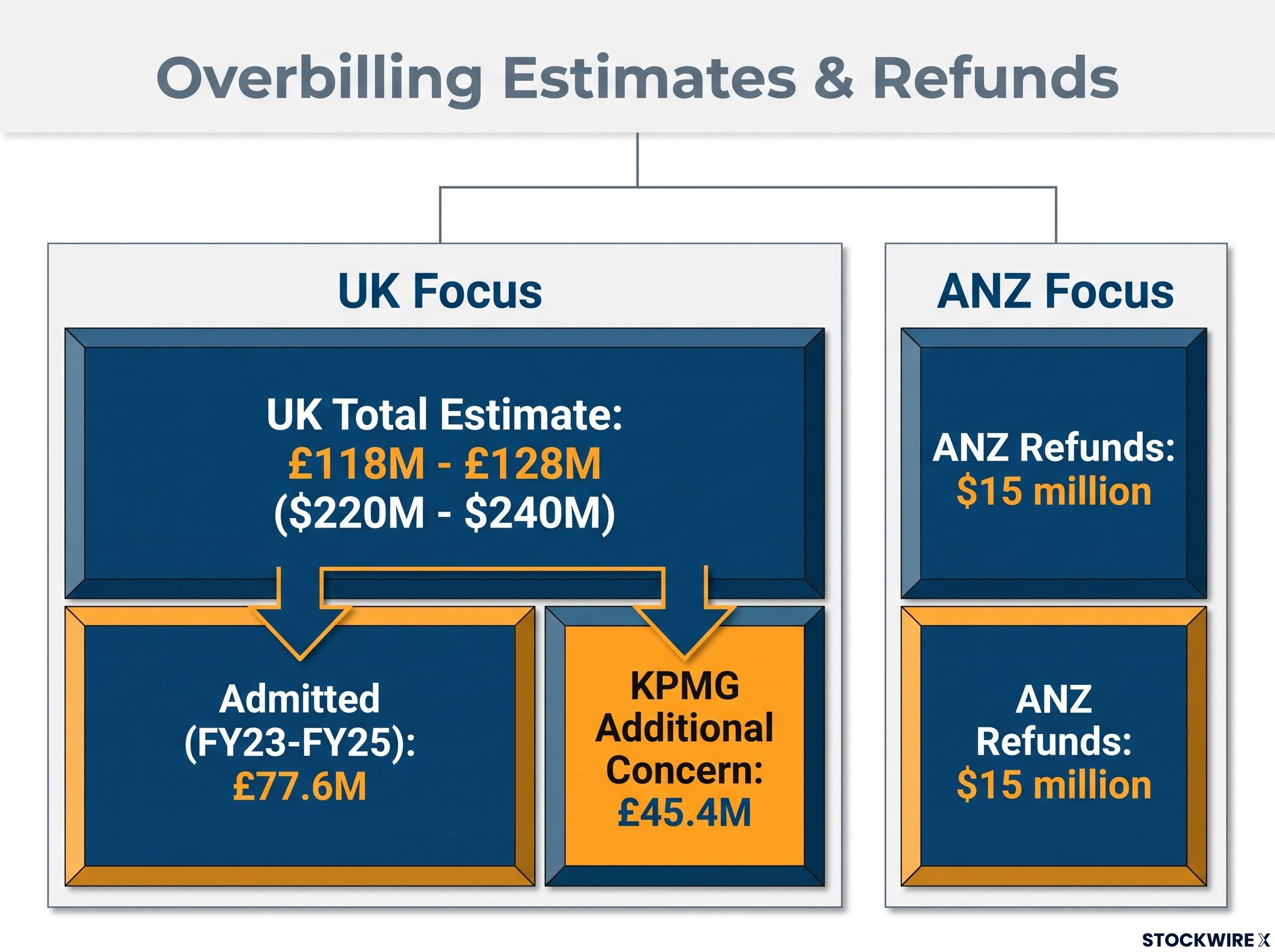
The rot was not confined to the UK. The company also failed for years to pass on supplier margins and rebates to local clients, and is now refunding approximately $15 million to Australian and New Zealand customers.
An internal governance review laid bare how this happened. It found the company had lacked a rigorous internal audit function and had pursued a strategy that was overly financially focused, with almost every area of governance scoring two or lower on a five-point scale.
Board oversight failures of the kind documented in the Corporate Travel Management governance review, where internal audit was described as lacking rigour and virtually every governance measure scored below two on a five-point scale, are structurally predictable when directors lack the independence or technical capacity to interrogate management on financial controls.
What that tells you is simple and worth carrying into any holding you own. This was a business that chased revenue growth and contract wins while letting basic controls wither. When you see aggressive top-line ambition paired with a thin governance function, that combination is the red flag, not the growth itself.
The regulatory and contractual threats still active
Trading again does not mean the danger has passed. Several serious threats remain live, and they sit on top of a share price that has already fallen hard.
The most significant is the corporate regulator. ASIC maintains an open investigation covering possible breaches of directors’ duties, continuous disclosure failures tied to the missed FY25 accounts, and the quality of prior audit work by PwC, following whistleblower allegations that the firm overlooked persistent problems.
ASIC deputy chair Sarah Court confirmed the probe at a Senate hearing on 29 May 2026.
Court told the hearing that the company’s accounts were “well overdue” and that enforcement action remained under active consideration. ASIC has refused any further extensions and left civil or administrative action firmly on the table.
Director duty breaches carrying personal penalties and disqualification orders have become a consistent feature of ASIC’s post-scandal enforcement playbook, with the Noumi proceedings confirming that passive reliance on a finance team does not shield a chief executive from personal liability once misstatements are established.
The risks fall into three categories investors should track:
- ASIC enforcement: An open investigation into directors’ duties, disclosure, and audit quality, with penalties still possible.
- Government contract renewals: Sensitive UK Home Office contracts covering asylum accommodation and quarantine hotels sit at the centre of the scandal, and both British and Australian agencies have ordered reviews, raising the risk of contract loss or exclusion from future tenders.
- Outstanding remediation payouts: Roughly 22% of the refund program remained unresolved as of the FY26 reporting date, with tens of millions of pounds still to be paid.
There is partial relief on one front. The company has struck a repayment deal with the UK Home Office to settle overcharging on quarantine hotel and asylum accommodation contracts, including the Bibby Stockholm barge.
But the execution of those payments is ongoing, and the UK government has pledged that all taxpayer money owed will be recovered, which leaves room for further claims beyond the agreed framework.
Put plainly, you should treat this stock as carrying a heavy legal and regulatory overhang. The depressed price you see today does not necessarily mark the fundamental bottom, because the outcomes of these open matters are still unknown.
Finding the baseline business beneath the scandal
Strip away the scandal for a moment and a real, functioning business is still there. That is worth understanding, because it is the reason the company survived the suspension at all rather than collapsing into it.
The FY26 results that finally freed the stock showed a return to profit. Revenue and other income reached $669.9 million, up 4%, while underlying EBITDA (earnings before interest, tax, depreciation and amortisation, a measure of operating profitability) climbed 36% to $113.6 million.
Net profit after tax came in at $17.7 million, a sharp reversal from the $348.5 million net loss booked in FY25.
That prior loss was driven almost entirely by goodwill impairments of approximately $357.7 million, a one-off writedown of the value of past acquisitions. The FY26 figures represent the financial reset after that reckoning.
| Metric | FY26 | FY25 |
|---|---|---|
| Revenue and other income | $669.9M | $643.4M |
| Underlying EBITDA | $113.6M | $83.6M |
| NPAT | $17.7M | -$348.5M |
| Basic EPS | $0.127 | -$2.453 |
There were pockets of genuine operational strength too. ANZ revenue rose 6% to $181.4 million, and Europe delivered a turnaround with revenue up 34% to $113.7 million. An audit of the Whole-of-Australian-Government travel arrangements found no evidence of widespread overcharging and noted robust program controls.
What the return to statutory profit tells you is that a viable travel management engine still runs underneath the accounting chaos. The question for any investor is whether that engine is worth more than the liability overhang sitting on top of it.
Navigating the long tail of governance recovery
The structural damage to shareholder trust will not repair in a single reporting cycle. ASX precedents such as iSignthis and Star Entertainment Group show that companies emerging from accounting-related suspensions typically wear prolonged valuation discounts before confidence returns.
It is also worth remembering that the audited FY26 results carry a qualification, meaning the financial picture is not yet entirely clean.
Before treating this stock as stabilised, watch for two concrete signals: the formal closure of the ASIC investigation, and the final completion of the UK Home Office refund program. Until both land, the governance discount is likely to persist.
The governance discount that follows a major disclosure failure is not simply a sentiment effect; research into newly listed and recently restructured companies shows that an early credibility miss revises investor beliefs about management quality across the entire forward earnings horizon, not just the period in which the failure occurred.
This article is for informational purposes only and should not be considered financial advice. Investors should conduct their own research and consult with financial professionals before making investment decisions. Past performance does not guarantee future results, and forward-looking statements are subject to market conditions and various risk factors.