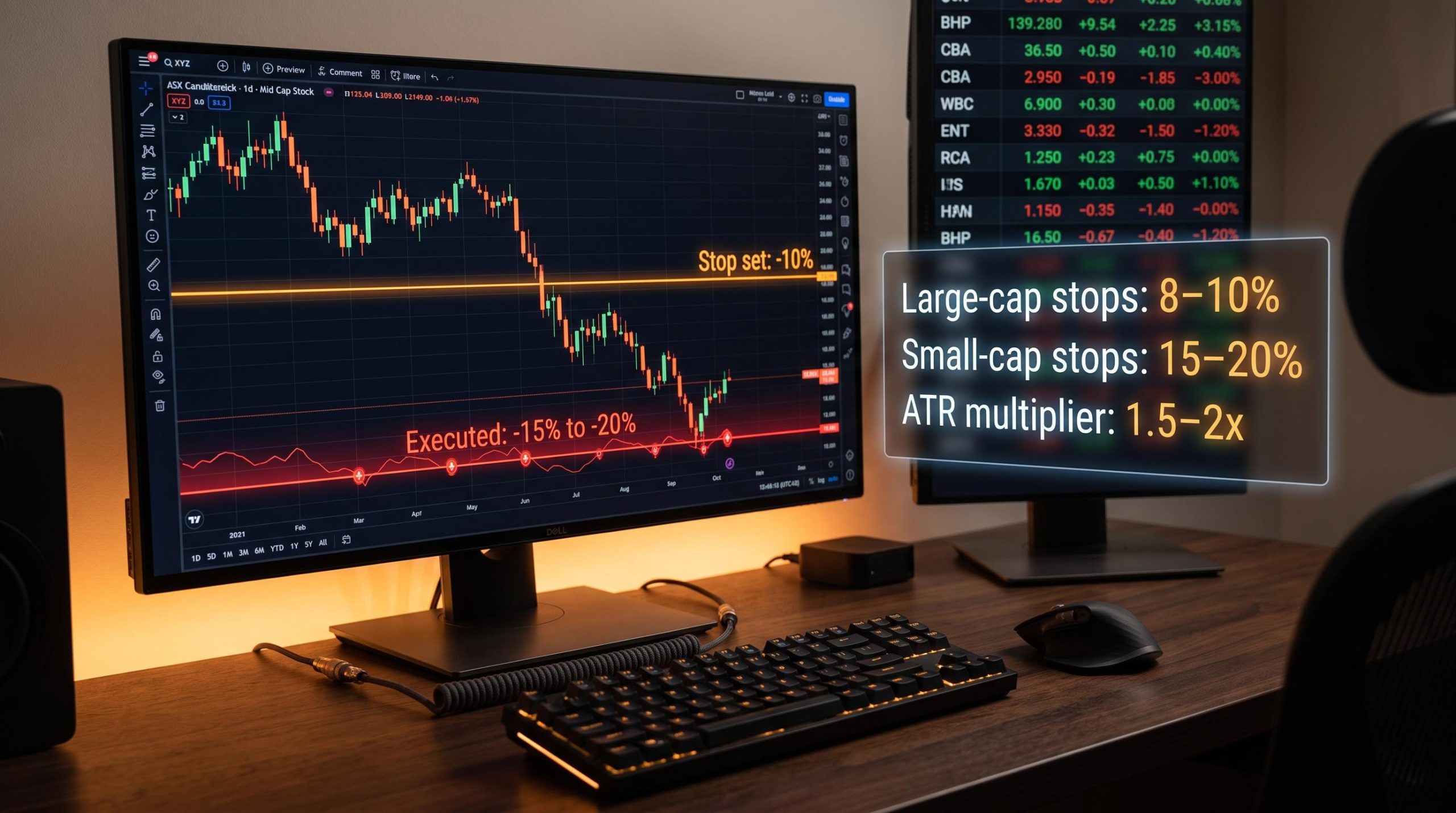
Most ASX investors know stop-loss orders exist. Far fewer understand that, in certain market conditions, these orders can execute at a price significantly worse than the level that was set.
Stop-loss orders are one of the most widely used risk-management tools available to retail investors on the ASX, yet the gap between how they are expected to work and how they actually behave in fast-moving or illiquid markets is consequential. Understanding that gap before relying on one in your portfolio is the difference between a tool that performs as intended and one that provides false confidence.
This guide covers the mechanics of how stop-loss orders work on the ASX, the three main variants and when each is appropriate, how to select a trigger level based on stock volatility, and the specific conditions that can cause a stop-loss to underdeliver. Here is a practical framework for deciding whether, how, and where to use these orders in your own portfolio.
What a stop-loss order actually does (and what it does not do)
A stop-loss order is a standing instruction your broker holds in reserve, waiting for the stock price to reach or breach a level you nominated in advance. You specify both the price threshold and an expiry period when you place it, and from that point the order requires no further action from you.
Here is the detail that changes everything: once triggered, a standard stop-loss becomes a market order. That means it fills at whatever price the market offers next, which may be meaningfully different from the threshold you set.
ASX order execution mechanics, including how the pre-open auction resolves at a randomised moment and how bid-ask spreads widen on lower-volume securities, directly shape what price a triggered stop-loss market order actually receives in the opening session.
The three-step sequence works like this:
- You place the order, which sits dormant with your broker at the nominated trigger price
- The stock’s price reaches or passes through the trigger level
- The order activates as a market sell order and executes at the next available price
The distinction between “I have set a stop at $X” and “I will sell at $X” is the single most important thing you need to internalise before placing one of these orders. Misreading it shapes every subsequent decision about where you set the level, which order type you choose, and how much protection you actually have.
If your trigger price is never reached during the expiry period you selected at placement, the order simply lapses. No trade occurs.
When big ASX news breaks, our subscribers know first
The three types of stop orders available to ASX investors
Choosing an order type is actually a decision about what you fear more: a bad price or no execution at all. Each variant handles that trade-off differently.
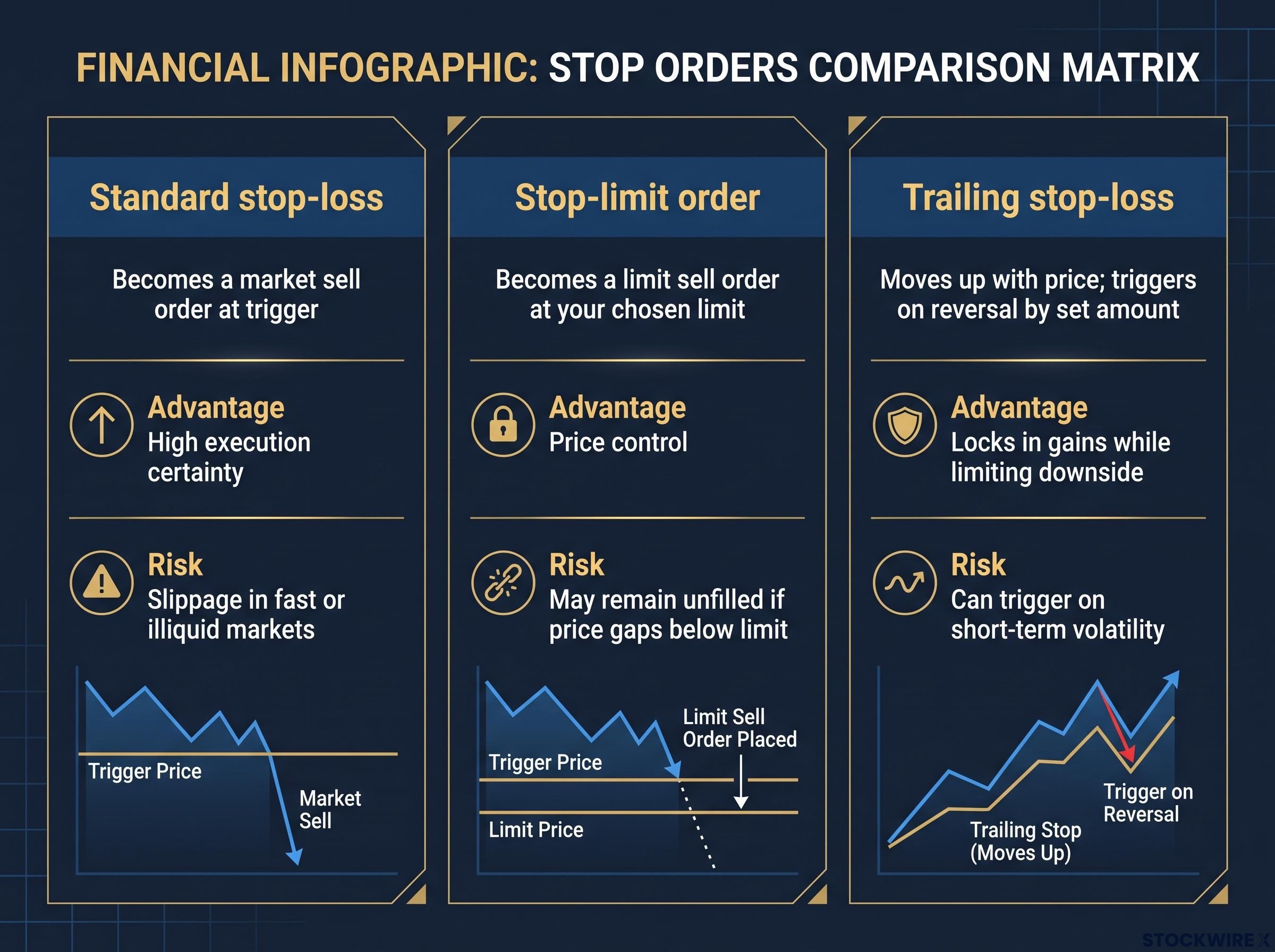
A standard stop-loss switches to a market order as soon as the trigger price is reached. It puts getting you out of the position first. You will almost certainly sell, but the price you receive may differ from the trigger, particularly in fast or illiquid conditions.
A stop-limit order converts into a limit order at a separately specified price. You set both a trigger and a minimum acceptable sale price. This gives you price control but sacrifices execution certainty. If the stock gaps below your limit price without trading at it, the order may remain unfilled entirely.
A trailing stop-loss moves the stop level upward automatically as the stock price rises. When the price reverses by your nominated percentage or dollar amount from its peak, the trailing stop triggers. It is designed to protect accumulated gains, but it requires careful calibration to avoid triggering on short-term noise.
| Order Type | How It Triggers | Main Advantage | Key Risk |
|---|---|---|---|
| Standard stop-loss | Becomes a market sell order at trigger | High execution certainty | Slippage in fast or illiquid markets |
| Stop-limit order | Becomes a limit sell order at your chosen limit | Price control | May remain unfilled if price gaps below limit |
| Trailing stop-loss | Moves up with price; triggers on reversal by set amount | Locks in gains while limiting downside | Can trigger on short-term volatility |
Stop-limit execution risk: If the market falls sharply through your limit price without a trade occurring at or above it, your order stays unfilled. You remain holding the falling stock. The exact scenario where you most need protection is the scenario where a stop-limit is most likely to fail.
For most retail ASX investors holding mainstream shares, the standard stop-loss is the appropriate default because execution certainty matters more than the price difference in most real scenarios. For investors holding thinly traded small-caps where slippage could be severe, that calculation changes, and a stop-limit deserves serious consideration despite its own risks.
Calibrating your stop-loss trigger level for ASX stocks
No single percentage works for every stock. The right stop-loss level reflects the stock’s normal volatility, not an arbitrary number pulled from a rule of thumb applied blindly.
Here are the practical heuristic ranges retail traders commonly use:
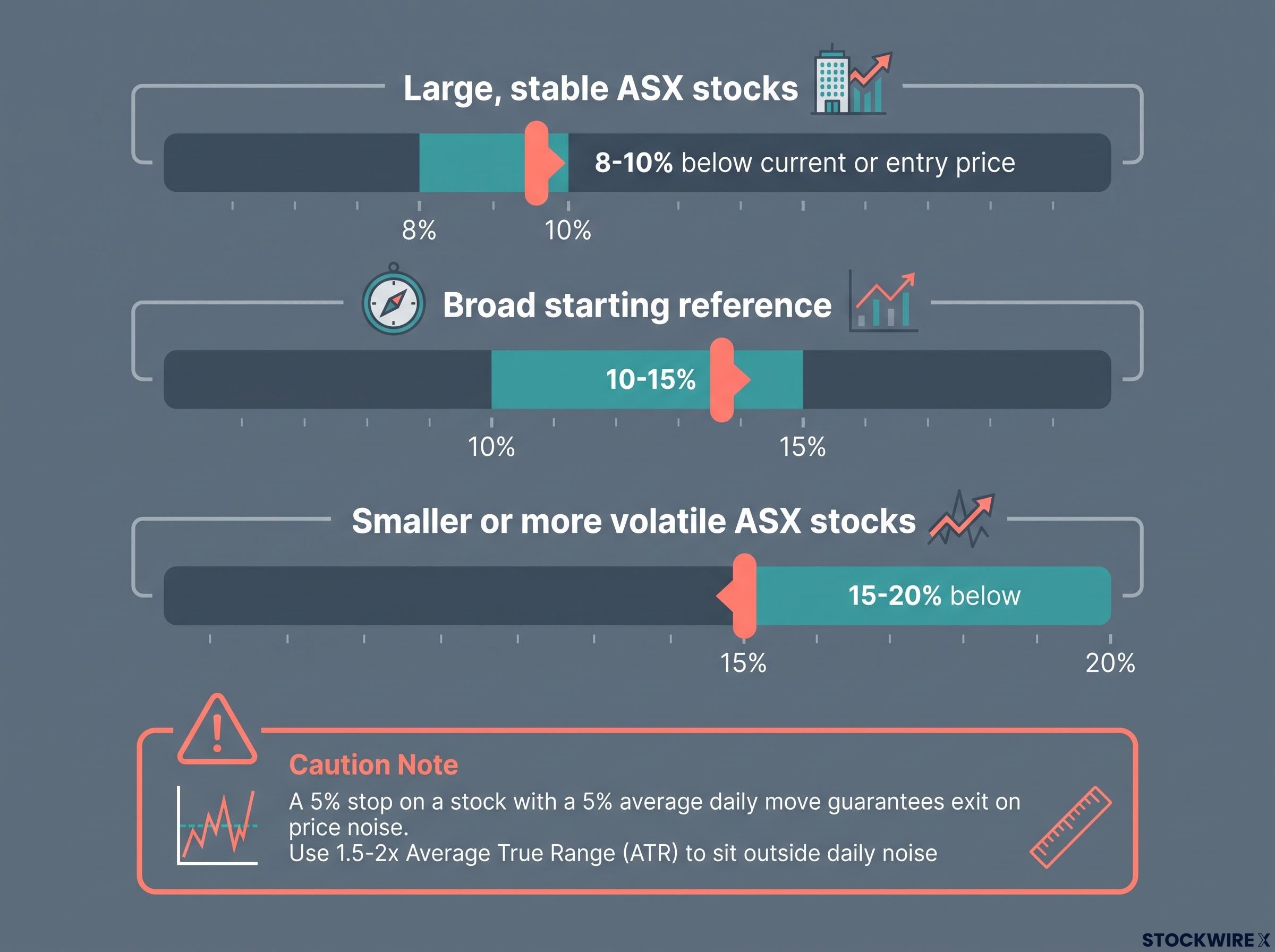
- Large, stable ASX stocks: approximately 8-10% below current or entry price, since these stocks tend to move in narrower daily ranges that keep routine fluctuations well within that buffer
- Smaller or more volatile ASX stocks: approximately 15-20% below, to allow room for the wider daily swings these stocks routinely produce without triggering an unintended exit
- Broad starting reference: approximately 10-15%, adjusted up or down based on the individual stock’s characteristics
Setting a level that is too narrow invites exits driven by normal intraday noise rather than any genuine change in the stock’s outlook, and locking in a loss on a position that then rebounds is a costly way to learn that lesson. Too broadly, it may fail to provide meaningful protection when genuinely needed.
The core principle is this: if you hold a volatile small-cap ASX stock with a 5% average daily move and you set a 5% stop, you are not managing risk. You are guaranteeing a near-immediate exit on normal price noise. The stop is working against you rather than for you.
Using ATR for more precise placement
Average true range (ATR) measures the average daily price movement of a stock over a set period. It tells you how much a stock typically moves in a single session, giving you a data-driven baseline for where normal volatility ends and a genuine trend change begins.
Placing a stop beyond 1.5-2x the ATR helps ensure your trigger sits outside normal daily noise rather than inside it. ATR data is available on most ASX charting platforms and broker tools, making this a practical step you can take before placing any order.
Charles Schwab’s ATR explainer describes the indicator as specifically designed to account for overnight gaps and unusually large single-session moves, making it a more reliable volatility baseline for stop placement than simple percentage rules.
The real risks that can cause a stop-loss to underperform
Understanding how stop-losses can break down is what separates investors who use these orders effectively from those who discover the limitations only after an adverse event. Here are the four failure modes to anticipate, ordered by relevance for ASX retail investors:
- Slippage in fast or illiquid markets. Once a stop activates, it becomes a market order that fills wherever demand exists. During a sharp, illiquid sell-off, available buyers may be at prices well below your trigger. A stop set 10% below entry can execute at 15-20% below in these conditions.
Small-cap illiquidity on the ASX is the direct driver of the widest slippage scenarios, where thin order books mean that a triggered stop-loss market order can exhaust available buyers well before finding a price close to the original trigger level.
- Gap-down openings from overnight news. When price-sensitive announcements land while the ASX is closed, the stock can open the following morning well beneath your nominated stop level. The order fills at the opening price rather than anywhere near your original threshold. This is not an edge case.
- Premature triggering from market noise. When a stop sits too close to the current price, ordinary intraday swings are enough to activate it. This reflects a placement error rather than anything the market did wrong. The stock may recover quickly once you have already been sold out.
- Stop-limit non-execution. When a stop-limit order is in place and the price falls through your nominated limit in a single move without printing a trade at or above it, the order simply does not fill. You remain exposed to the continuing decline at the moment you most needed to exit.
Gap-down risk for ASX investors: Price-moving news frequently originates from US and European markets outside local trading hours. A stop-loss level that looks protective at close of trade can become irrelevant before the market reopens the following morning. For investors with any exposure to globally connected stocks or sectors, this is a regular feature of the market calendar, not a theoretical footnote.
Broker implementation also matters here. Some brokers use last-traded price to trigger stops; others factor in bid/ask spreads or exchange-specific rules. Two different brokers can produce materially different outcomes on the same stop, on the same stock, on the same day.
What stop-loss orders cannot replace
Stop-loss orders act on individual positions. They do not address portfolio-wide risks, and treating them as a portfolio-level safety net is one of the most common errors retail investors make.
Consider this: if you hold five correlated ASX resource stocks, all with stop-losses in place, you have not diversified your risk. When a sector-wide shock hits, all five stops may trigger at once. The stops have not protected the portfolio. They have simply automated the timing of the loss crystallisation.
It is also worth distinguishing stop-losses from other automated tools that are frequently conflated:
- Stop-loss orders: conditional on a price trigger; designed to exit positions and limit downside
- Good-till-date (GTD) orders: an expiry setting for standard buy or sell orders that keeps them open until a chosen date rather than closing at day’s end; no trigger price is involved and they serve an entirely different function
- Auto-invest features: built for scheduled, recurring accumulation into positions; they operate at the opposite end of the strategic spectrum from tools designed to exit a falling holding
Position sizing, diversification, and asset allocation remain the foundational layer of risk management. Stop-losses sit on top of that foundation as a supplementary, position-level tool. A portfolio-level stress event, such as a broad market crash, can trigger multiple stops simultaneously. In that scenario, how you sized and diversified your positions matters far more than where you placed your stops.
Position sizing discipline, including capping individual holdings at a fixed percentage of total portfolio value, is what determines how much damage a single triggered stop-loss can actually do; a correctly sized position limits the loss even when slippage pushes the fill price significantly below the trigger.
Checking your broker’s setup before you rely on a stop-loss
Before placing a stop-loss order in a live portfolio, verify how your specific broker implements the feature. Platform-level differences are the last mile of stop-loss effectiveness, and they vary meaningfully across Australian retail brokerages.
Two investors using different brokers can place stops at the same trigger price on the same stock and have materially different outcomes in a fast-moving market, purely because of how their respective platforms define a trigger event.
Here are five specific questions to answer using your broker’s documentation or support team before relying on a stop-loss order:
- How does your broker define the trigger event: last-traded price, bid/ask spread, or another mechanism?
- Does your broker support conditional stop orders for all ASX instruments, including ETFs and less-liquid securities?
- Is a trailing stop option available on your specific platform?
- What are the expiry rules and maximum duration for stop orders?
- Are there minimum price distance requirements between the current price and your stop level?
Your platform’s documentation or support team is the authoritative source for these answers. No general guide can substitute for broker-specific verification.
Using stop-loss orders as part of a considered risk strategy
Stop-loss orders are a useful, limited, implementation-dependent tool. They earn their place in your portfolio when you understand them fully and apply them deliberately, not when you set a default percentage and forget about it.
The core trade-offs to hold in mind:
- Execution certainty vs. price control (standard stop-loss vs. stop-limit)
- Protection vs. noise tolerance (tight stops vs. wide stops)
The practical framework comes down to three steps:
- Calibrate the trigger level to the stock’s actual volatility, not to an arbitrary percentage
- Select the appropriate order type based on the stock’s liquidity and your priority (execution certainty or price control)
- Verify your broker’s specific implementation before placing the order
A stop-loss that was calibrated correctly at placement but never reviewed can become either a noise trigger or a false safety net as a stock’s volatility profile changes over time. Review your stop levels periodically as conditions evolve, not as a one-time setup.
Stop-loss orders can reduce capital loss risk, but they cannot eliminate it, particularly in gap-down or illiquid conditions. The investors who use them most effectively are those who treat them as one layer within a broader risk strategy, not the strategy itself.
An ASX risk management backtest across 100 random-entry simulations over 20 years demonstrated that a hard 10% stop-loss paired with a 5% per-trade position cap produced a positive total return without any stock selection skill, illustrating precisely why mechanical rules outperform discretionary judgement under stress.
This information is general in nature and does not constitute financial advice. Past performance is not a reliable indicator of future results. Consider seeking advice from a licensed financial adviser before making investment decisions.