Wipro has renewed its multi-year Digital Workplace Services contract with ABB, adding endpoint security operations and AIOps capabilities to a global engagement that spans more than 100 countries and underpins the daily operations of one of the world’s largest industrial automation companies.
The renewal, announced on 1 September 2026, lands as the largest IT services players scramble to defend and expand their biggest accounts by proving they can deliver AI execution rather than headcount.
For ABB, the decision signals a deepening bet on AI-run workplace infrastructure as a core operational layer, not a pilot. For Wipro, it is evidence that its proprietary AI platform strategy is holding ground against pointed competition from HCLTech and Infosys.
This piece unpacks what actually changed in the scope of the deal, how Wipro’s platform stack is being deployed at ABB, what the competitive fight around these contracts looks like, and what the renewal means for investors watching Wipro’s AI-led growth thesis.
What changed: the expanded scope of Wipro’s ABB renewal
The headline is not that the contract continues. It is what got bolted onto it.
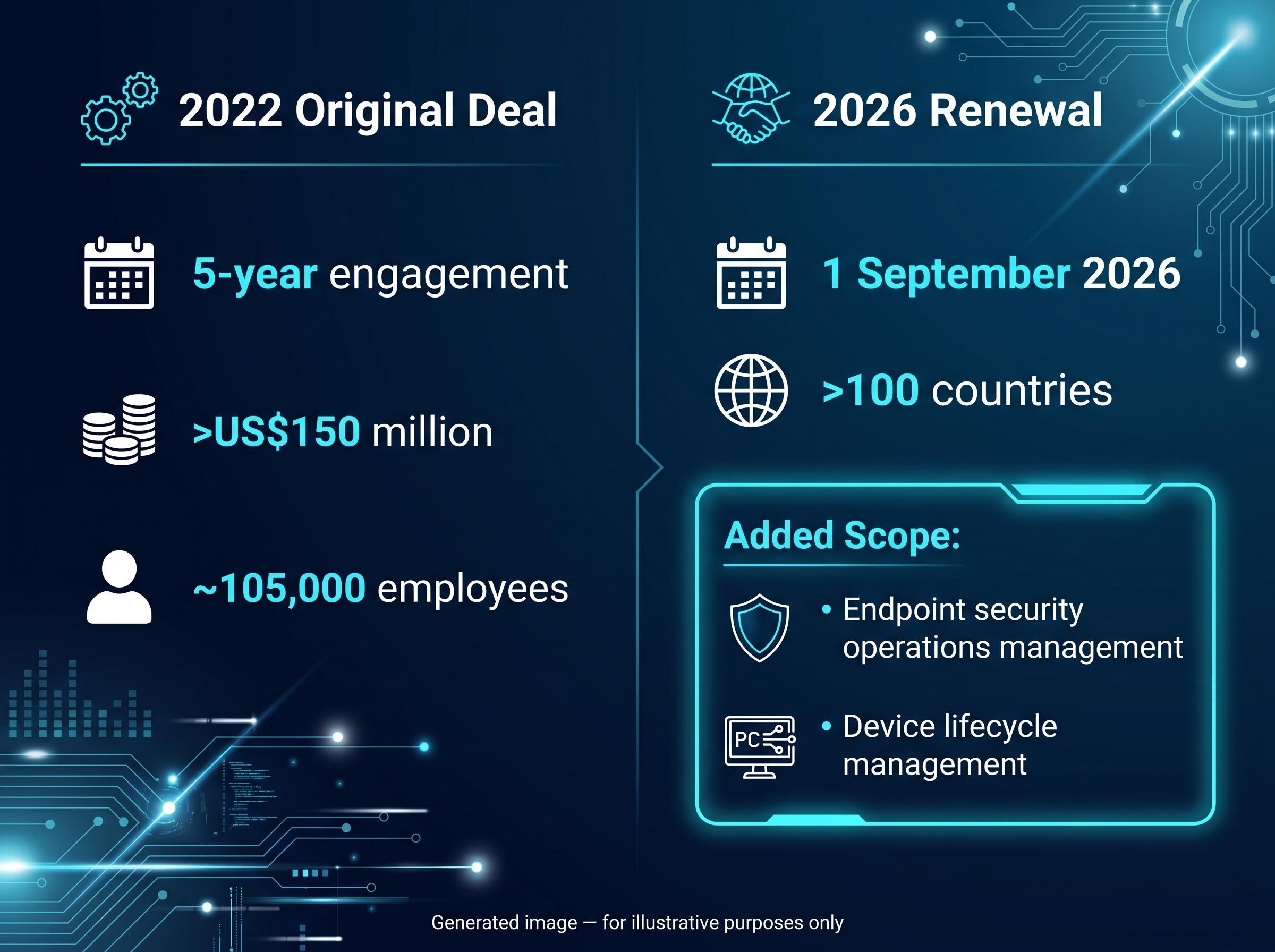
Wipro and ABB have worked together on digital workplace services since 2022, when the two companies signed what multiple industry reports describe as a five-year engagement. Those same reports peg the original deal at more than US$150 million covering roughly 105,000 employees, though neither figure has been independently confirmed and Wipro has not disclosed a new value or term length for the 2026 renewal.
What the company has confirmed is the scope expansion, and that is where the news sits. The renewed contract now folds in two service lines that were not central to the original arrangement:
- Endpoint security operations management, using AI/ML-driven analytics, extended detection and response (XDR), and zero-trust principles to protect devices across ABB’s estate
- Device lifecycle management, including secure erasure and end-of-life handling for industrial PCs deployed in harsh factory and field environments
Endpoint security here means protecting individual devices, laptops, industrial PCs, connected terminals, as entry points for cyber threats. XDR refers to a system that pulls threat signals from across those devices into a single detection and response layer. Zero-trust is the principle that no device or user is automatically trusted, even inside the network.
The CISA Zero Trust Maturity Model establishes the federal benchmark for how organisations should implement zero-trust principles across device, network, and identity layers, providing the authoritative framework that enterprise deployments like ABB’s endpoint security expansion are measured against.
The read for the reader is straightforward. ABB is treating device-level cyber risk as part of its workplace services contract rather than a separate security procurement, which reflects how large industrial enterprises are consolidating IT management and security management under a single vendor.
The expansion into AI-driven endpoint security reflects a structural shift in enterprise threat environments, where Palo Alto Networks’ internal AI scan compressed five to seven years of conventional vulnerability discovery into six weeks, setting a new baseline for how quickly device-level exposure can be identified and exploited across an industrial estate like ABB’s.
That consolidation is what makes this a growth event rather than a static renewal. Wipro is expanding its revenue surface inside an account it already holds, and for investors, that distinction matters: retaining a client protects revenue, but widening the scope of what you deliver is how you grow it.
When big ASX news breaks, our subscribers know first
The AI platform stack powering the ABB engagement
Peel back the announcement and the interesting part is the machinery underneath it. Wipro is not selling ABB more people. It is selling a platform layer designed to take humans out of routine IT resolution.
That layer is branded Wipro Intelligence, the company’s unified suite of AI platforms, and it is operationalised through a set of named components that each do a specific job for ABB.
- Wipro Intelligence: the overarching AI platform suite underpinning the engagement
- WINGS: Wipro’s AI-powered delivery platform that runs the operational side of the contract
- AI Live Workspace: the framework that delivers the day-to-day workplace experience to ABB employees
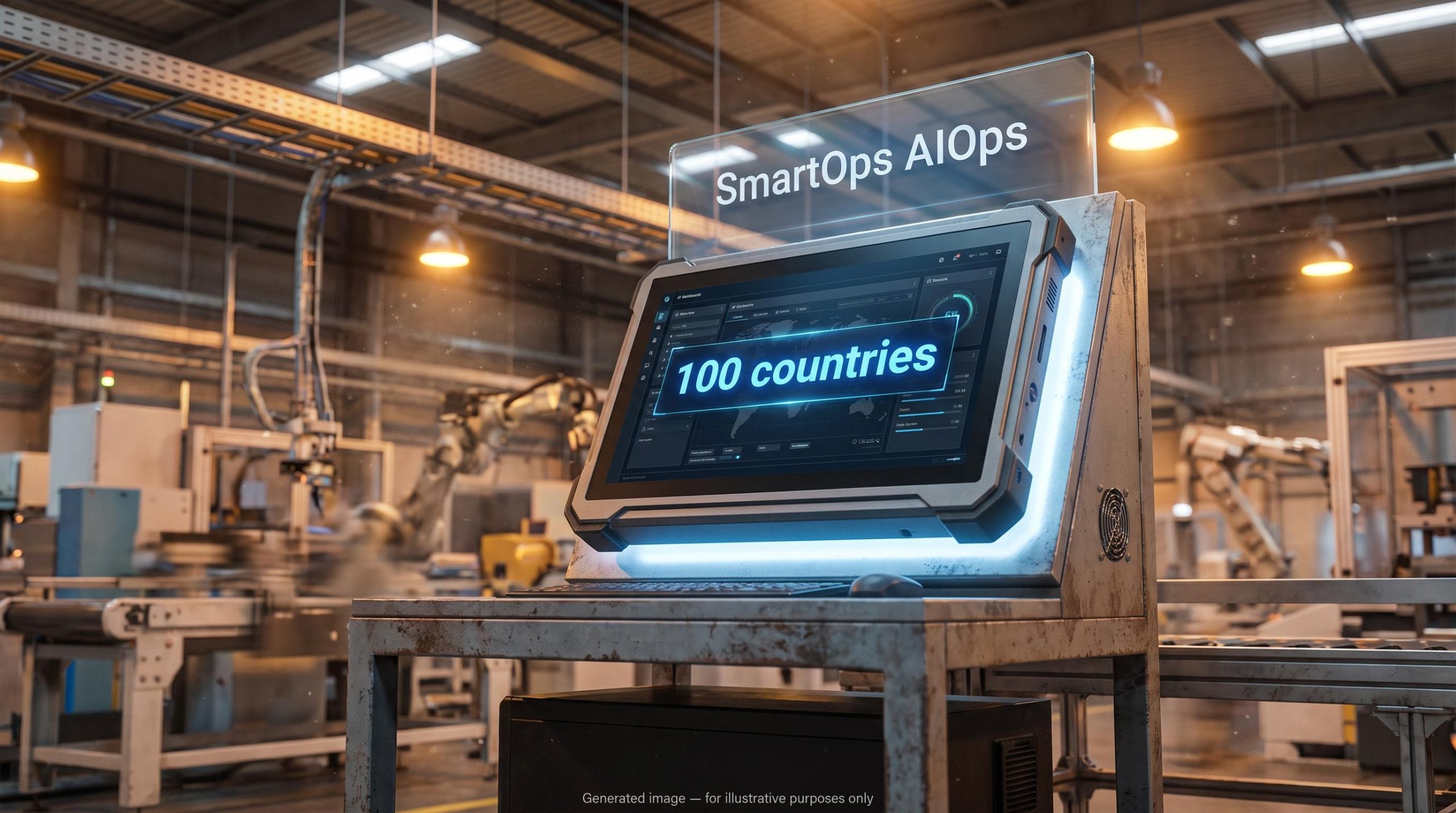
- SmartOps: Wipro’s AIOps capability, meaning AI applied to IT operations to predict, detect, and fix issues automatically
SmartOps is the piece that carries the strategic weight, because it is tied directly to the operating model ABB says it wants.
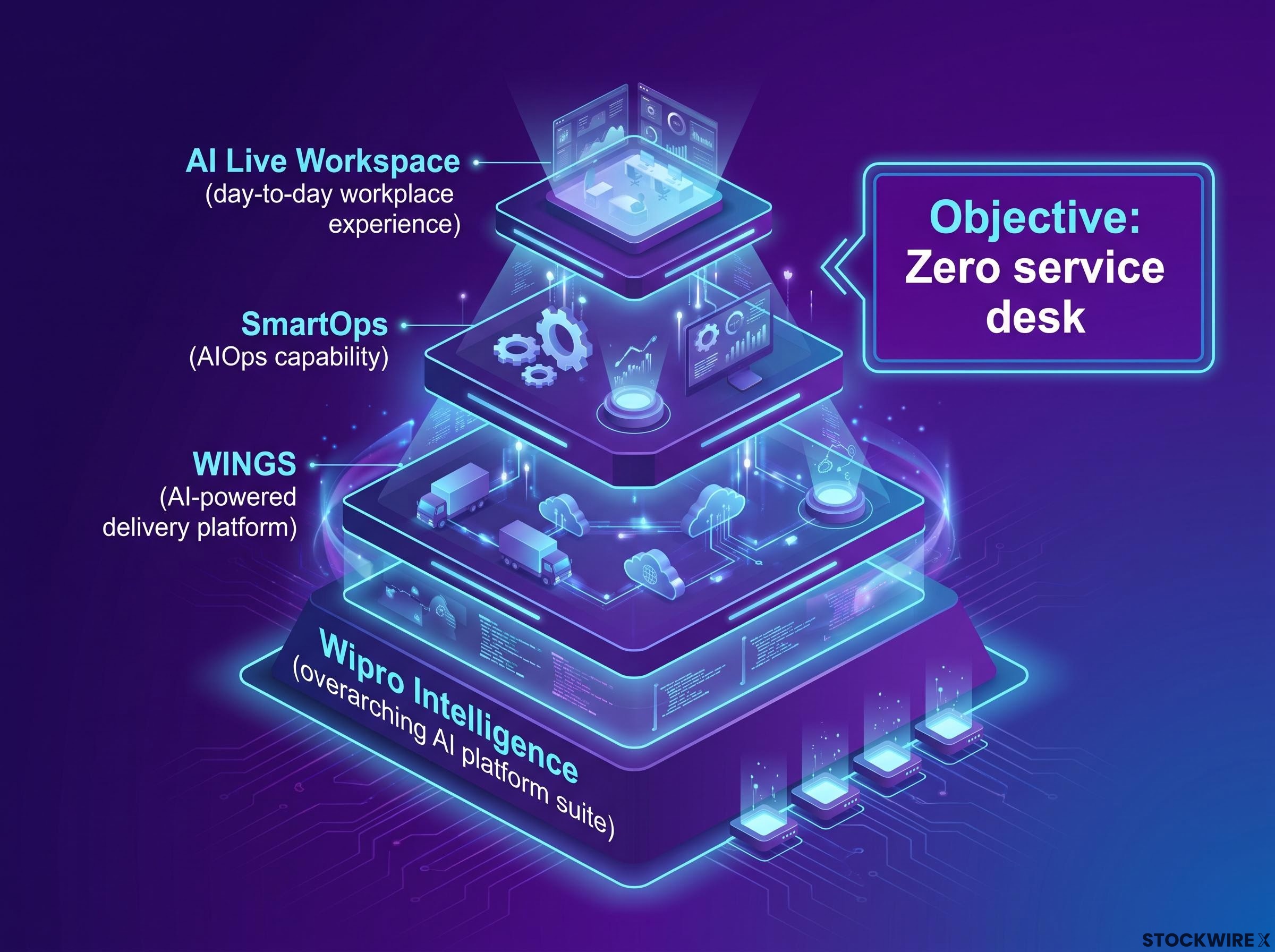
The objective: a “zero service desk” model Wipro’s stated aim for ABB is a workplace where AI resolves issues before a human ticket is ever raised, moving the company toward what both parties describe as a “zero service desk” operating model.
On top of that infrastructure sits the user-facing delivery layer: GenAI-powered self-service tools, virtual agents that handle employee requests, automated remediation that fixes common faults without human intervention, and AI-assisted dispatch that routes the problems that do need a person to the right one faster. Telemetry and usage data feed the endpoint oversight, so device health and security are monitored continuously rather than reactively.
The “zero service desk” framing tells you exactly what is being sold. For ABB, it is a margin proposition: fewer human-mediated resolutions mean lower operating cost per employee. For Wipro, it is a stickiness play, because once a client’s workplace runs on your proprietary platform, unwinding it becomes expensive and disruptive.
That is why the architecture matters to investors and not just IT buyers. Proprietary AI platforms are the mechanism by which services companies are trying to defend margins and build switching costs in an era when their largest accounts are openly contested.
Proprietary AI platforms create switching costs that are structurally similar to ecosystem ownership in software, where the durable variable is not the technology layer itself but the depth of embedding in customer workflows, which is precisely the logic behind Wipro’s push to run ABB’s workplace on WINGS and SmartOps rather than commodity tooling.
How this deal fits the competitive battle for industrial AI contracts
Wipro is not defending ABB in a vacuum. The market for large AI-led workplace contracts has turned into a genuine contest, and the clearest evidence is what happened to a comparable industrial account.
HCLTech secured a US$1.14 billion, 5.5-year deal with a Fortune Global 50 company, widely reported to be Mercedes-Benz, to build an AI-driven operating model across digital workplace and network infrastructure. The detail that should catch an investor’s eye is that the win displaced an existing Infosys engagement. Incumbency, in other words, no longer guarantees safety in this segment.
Infosys, for its part, is running the same playbook elsewhere. The company has announced expanded multi-year, AI-led managed services deals with GlobalFoundries and Metsä Group, both anchored on its proprietary Topaz Fabric platform to automate IT operations, workplace services, and IT/OT support.
The table below shows how these engagements line up.
| Vendor | Client | Deal Value | Duration | Key AI Capability |
|---|---|---|---|---|
| Wipro | ABB | Not disclosed | Multi-year | Wipro Intelligence, SmartOps AIOps, endpoint security |
| HCLTech | Mercedes-Benz (reported) | US$1.14B | 5.5 years | AI-driven workplace and network operating model |
| Infosys | GlobalFoundries, Metsä Group | Not disclosed | Multi-year | Topaz Fabric platform automation |
For historical contrast, an older-generation benchmark, the roughly US$3.2 billion, eight-year Infosys-Daimler contract, included AI-enhanced workplace elements, but treated AI as an add-on to a traditional deal rather than the core delivery mechanism. The current wave is different: contract scope and value are now tied explicitly to autonomous, AI-run operations.
The competitive axis has shifted accordingly. Cost and headcount no longer win these contests. Demonstrated AI execution and platform depth do, which is exactly why the expanded scope of the ABB renewal reads as a signal rather than paperwork.
The HCLTech displacement of Infosys at a comparable industrial account tells you the takeaway. Wipro’s ABB relationship is not safe simply because it is the incumbent, so the deepened scope of this renewal is a defensive move as much as a growth one. For investors benchmarking the Indian IT majors against each other, the pattern is clear: the market is rewarding whoever can prove AI-led outcome delivery, and this renewal keeps Wipro in that contest rather than watching it from the sidelines.
What the renewal signals for Wipro’s AI-led growth thesis
Move from the deal to the numbers behind it, and the significance sharpens. Wipro is leaning on large-deal momentum and account expansion precisely because its top line and margins have little slack.
In Q1 FY27 (the quarter ended 30 June 2026), Wipro’s IT Services operating margin moderated to 16.0%. Revenue from operations reached ₹24,478.6 crore, a 10.6% year-on-year rise, with segment revenue reported at US$2.6145 billion, though the segment figure is unverified. This is a company where account expansion is doing real work, not decoration.
There is momentum to point to. Large deal bookings in Q2 FY26 reportedly reached US$2,853 million, up 90.5% year-on-year in constant currency, and market analysts have projected a revenue, EBIT, and PAT CAGR of 7.8%, 8.9%, and 8.0% for FY26-FY29E as Wipro transitions toward what analysts describe as a “services-as-software” model. Both figures are unverified and should be read as indicative rather than confirmed.
The strategy is not without a genuine risk, and it is worth naming plainly. As Wipro pushes clients onto Wipro Intelligence, WINGS, and SmartOps, analysts from PCG, Kosmoy, and Viviscape have flagged the downside of proprietary AI platform dependency:
- Vendor lock-in: heavy reliance on a provider’s AI gateway can make it costly and complex to switch or run a multi-cloud strategy
- Governance fragmentation: proprietary orchestration layers can splinter how AI is governed across an enterprise
- Data sovereignty and portability: clients may struggle to move their data and models out, prompting analysts to recommend contractual portability guarantees
There is also a technical overhang worth flagging: Wipro’s reported removal from the Nifty 50 index may create selling pressure unrelated to fundamentals, though this too is unverified.
The margin moderation to 16.0% tells you where Wipro sits in this cycle. The AI platform strategy is still in its investment phase, not its harvest phase, which means the ABB renewal matters more as a retention and expansion signal than as an immediate earnings catalyst.
The gap between AI platform investment and measurable financial return is a live tension across the sector, with Goldman Sachs projecting hyperscaler capex at $755-$800 billion in 2026 while a significant portion of that spending has yet to demonstrate corresponding margin expansion, a dynamic that applies equally to IT services vendors running front-loaded platform buildouts like Wipro’s.
The number to watch is whether these AI-intensive, automated contracts start converting into margin accretion in FY28 and FY29. The ABB renewal is one data point in a pattern that will take several reporting cycles to confirm or unravel.
Defending ABB while chasing the next deal
Strip the announcement down and two things are confirmed. Wipro’s proprietary AI platform strategy is holding and expanding a major industrial account, and endpoint security has emerged as a live growth vector inside workplace services contracts rather than a separate line item.
What is not yet confirmed is the part investors actually care about. Whether AI-intensive delivery can lift margins at the contract level remains an open question, because the platform and tooling investments are front-loaded while the efficiency gains accrue slowly over multi-year engagements.
That tension is structural, not temporary. The convergence of IT and operational technology in industrial enterprises, what Gartner frames as an evolution toward autonomous operations, means contracts like the ABB engagement tend to widen in scope over time. IDC has observed that successful industrial AI programmes have moved from experimentation to KPI-driven initiatives focused on asset uptime and safety, which is precisely the direction this deal points.
The durability of AI services business models is under scrutiny across the sector, with open-source model commoditisation compressing the pricing assumptions that underpin long-duration platform contracts, raising a structural question for any IT vendor whose margin recovery depends on clients remaining committed to a proprietary delivery stack over multi-year engagements.
IDC’s AI-driven manufacturing research has documented the shift from experimental AI deployments to KPI-driven programmes focused on asset uptime and operational safety, the same trajectory the ABB engagement is designed to support at scale.
For Wipro, that expanding scope is either an opportunity to deepen wallet share or a complexity risk if delivery quality fails to scale alongside it.
So watch three things over the coming cycles: Wipro’s operating margin trajectory across FY27 and FY28, large deal bookings in the manufacturing and industrial verticals, and any new clients or expansions at the ABB tier of engagement. Those indicators, tracked together, will tell you whether the AI services growth thesis is producing measurable returns or simply producing deals.
This article is for informational purposes only and should not be considered financial advice. Investors should conduct their own research and consult with financial professionals before making investment decisions. Past performance does not guarantee future results, and financial projections are subject to market conditions and various risk factors.