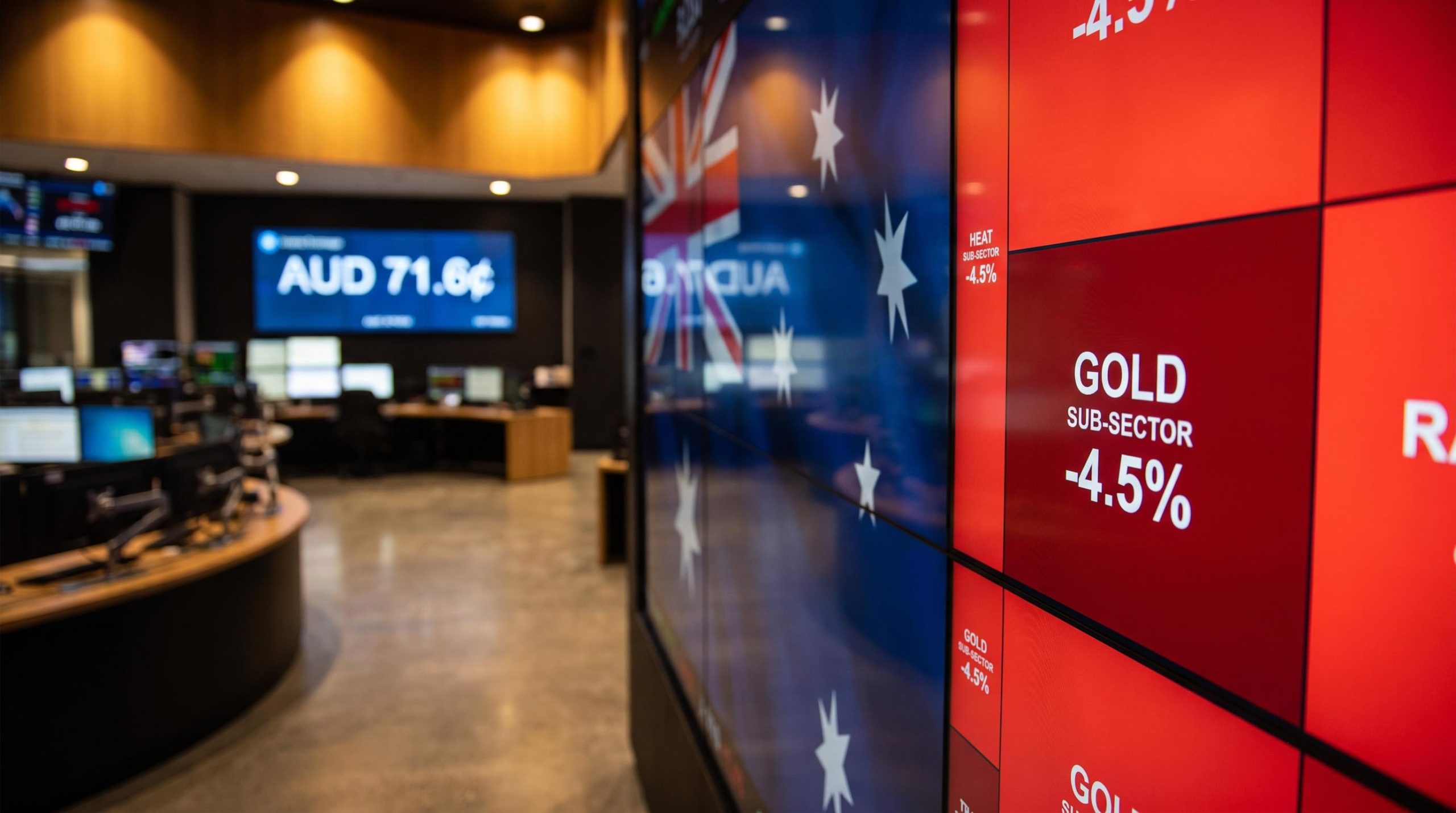
The ASX closed August 31 marginally lower, but that daily wobble obscures the bigger number: five consecutive months of gains, with August itself delivering a rise of more than 1% despite a session that saw miners shed over 2%.
The session’s story is one of divergence. Financials climbed while materials fell sharply, gold stocks bore the brunt of a hawkish Federal Reserve signal out of Jackson Hole, and individual company results produced some of the day’s sharpest moves in either direction. The Australian dollar softened to around 71.6 US cents, consistent with rising US rate expectations weighing on risk sentiment.
Here is a clear picture of what drove each major move today, which macro signal is now the dominant force heading into September, and which stock stories are worth following into the next session.
Financials hold the line as miners drag the index to a flat finish
The ASX closed at approximately 9,076 points, down roughly 0.18% on the session. On its own, that number reads as a quiet, directionless day. It was anything but.
The session’s clearest split was between the financial and materials sectors. Financials gained a little over 1%, supplying steady upward pressure throughout the day, while materials shed more than 2% and functioned as the single heaviest drag on the headline number. Technology also weakened, losing 1.4%, confirming that selling pressure was not confined to resources alone.
- Financials: up slightly more than 1%
- Materials: down more than 2%
- Technology: down 1.4%
Five consecutive monthly gains: August rounded out as the ASX’s fifth month in a row of positive returns, with the index adding more than 1% over the period in spite of the weak final session.
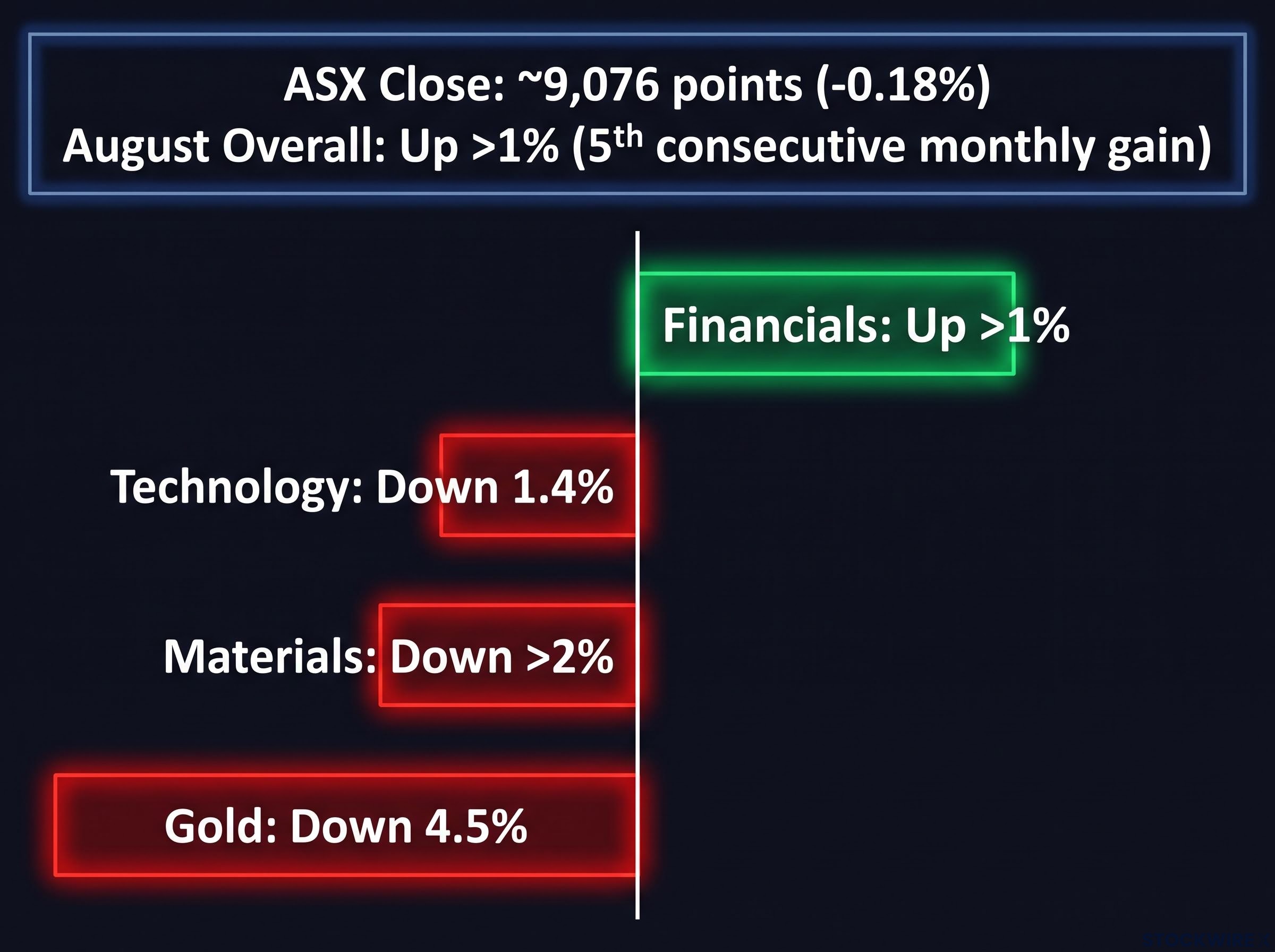
That financials-versus-materials split tells you the session’s flat headline number is not a signal of broad indecision. Two dominant sectors were pulling in opposite directions with genuine conviction, and the index simply netted out near zero. The daily close did not undermine the monthly achievement, but the rotation underneath it is the detail that matters heading into September.
ASX sector rotation between financials and materials has been one of the defining structural features of 2026, reflecting a broader shift away from rate-cut positioning toward identifying sectors with genuine earnings resilience as the RBA held rates above target-band inflation projections extending through end-2027.
When big ASX news breaks, our subscribers know first
Earnings results and recovery plays produce the session’s standout individual moves
Beneath the index-level tug-of-war, individual stocks moved sharply on company-specific catalysts. The spread of outcomes tells a story of its own.
Pexa Group surged approximately 9.5%, clawing back ground after touching an all-time low the previous Friday. That historic trough had come in the wake of a company forecast that weaker conditions in the property market would drag on both revenue and profit margins. The scale of today’s recovery implies a portion of investors concluded the initial selloff went too far.
Michael Hill gained roughly 7%, reaching its strongest price since May. The jewellery retailer’s full-year results included record sales and a material lift in earnings, while early FY27 trading data also came in encouragingly. The element that drew particular attention, however, was the reinstatement of the dividend after a two-year absence: 2 cents per share, scheduled for payment on 22 September.
Monash IVF added close to 4% even as its results revealed a meaningful profit decline, attributed to softer domestic appetite for fertility treatments. The share price gain reflected investor focus on a pickup in treatment volumes through the second half of the year and a constructive forward outlook. That reaction tells you the market is actively discriminating on narrative quality rather than simply following the index direction.
Across the August results season, forward guidance has been the primary price driver, with algorithmic and institutional flows capable of producing single-session moves of 10-15% in high-beta sectors when management commentary surprises in either direction, a dynamic visible in Monash IVF’s gain despite a reported profit decline.
Liontown continued its recovery trajectory, landing among the day’s top ten performers. The lithium producer had sustained losses exceeding 40% in July, making any sustained bounce a story worth tracking.
| Stock | Move | Catalyst | Context |
|---|---|---|---|
| Pexa Group | Up ~9.5% | Rebound from all-time low | Prior Friday’s low followed property market warning |
| Michael Hill | Up ~7% | Record sales, first dividend in two years | Highest level since May |
| Monash IVF | Up ~4% | Improving second-half volumes, positive outlook | Profit fell on weaker domestic demand |
| Liontown | Top-10 gainer | Continued recovery momentum | Down more than 40% in July |
| BHP | Declined | Materials sector weakness | All-time highs reached last Wednesday |
| Silex Systems | Pulled back | Normalisation after sector-driven surge | Up 61.5% the prior week on nuclear enthusiasm |
Stocks that retreated: BHP and Silex give back recent gains
BHP pulled the index lower, a notable contrast given the stock had set all-time highs just last Wednesday. The decline reflected the broad 2% retreat across the materials sector rather than any company-specific news, with the heavyweight carried down alongside its peers.
Silex Systems gave back some ground following a remarkable 61.5% advance over the prior week, a run fuelled by enthusiasm for nuclear and uranium-related names. The session’s move looks like profit-taking after an exceptional short-term run rather than any shift in the underlying investment case.
How rising US rate expectations hit the gold sector on August 31
Federal Reserve Chair Jerome Powell delivered hawkish remarks at the Jackson Hole Symposium, and the gold sector absorbed the full force of the repricing that followed.
Fed rate signalling has been reshaping asset class pricing throughout 2026, with the June dot plot revision to a 3.8% year-end rate already compressing valuations for long-duration and non-yielding assets before Powell’s Jackson Hole remarks added a further hawkish layer.
Market pricing shifted to assign roughly a 60% chance of the Fed lifting rates at its September meeting, with that gathering expected in the month’s third week. That shift in expectations hit gold through a well-understood mechanism: rising US interest rates increase the opportunity cost of holding gold, which is a non-yielding asset. When bonds and cash offer higher returns, capital rotates away from gold, putting downward pressure on both the metal’s price and the share prices of gold producers.
Implied odds of a September Fed rate hike reached around 60% following Powell’s Jackson Hole address, reflecting a notable repricing of near-term US monetary policy expectations.
The transmission was immediate. Gold producers sold off sharply, with the sub-sector losing around 4.5% to become the day’s worst-performing corner of the market. Sterling gains for the US dollar also weighed on the Australian currency, which eased to approximately 71.6 US cents as rate-driven capital flows favoured the greenback.
The cause-and-effect chain ran in one direction:
- Powell’s hawkish Jackson Hole signal
- Rising implied odds of a September rate hike
- Higher opportunity cost for holding non-yielding assets
- Gold price pressure
- Gold stock selloff, with the sub-sector down 4.5%
For Australian investors with exposure to gold stocks or AUD-denominated assets, this macro signal is the most important carry-forward from today’s session. It shapes currency sentiment, risk appetite, and the relative attractiveness of yield-bearing versus non-yielding assets heading into September. The gold sub-sector still appreciated meaningfully across August as a whole, but the monthly trend and the daily reversal are now pulling in opposite directions.
What to watch heading into September
September opens with a busy calendar. Here are the specific items that matter for the next session:
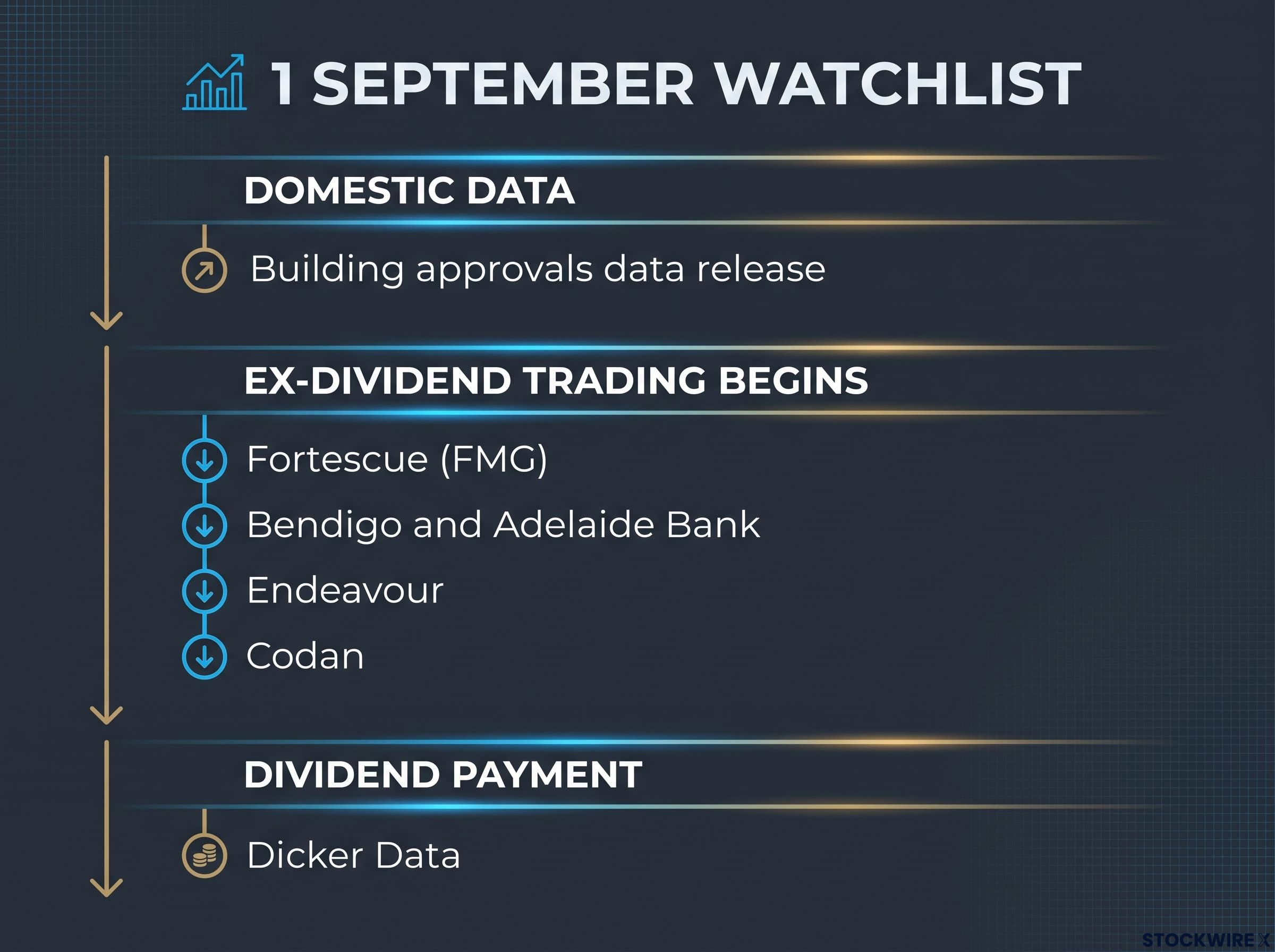
- Building approvals data is due for release on Tuesday 1 September, an immediate domestic economic catalyst with potential to influence sentiment.
- Ex-dividend trading begins for a cluster of companies on 1 September, among them Fortescue (FMG), Bendigo and Adelaide Bank, Endeavour, and Codan. The mechanical share price adjustment creates a headwind for those specific stocks that should not be confused with genuine selling pressure.
- Dicker Data will make its dividend payment to shareholders on 1 September.
That cluster of ex-dividend names creates a mechanical headwind that investors in those specific stocks should factor in separately from any broader market direction signal.
Wall Street’s own final August session concluded on 31 August US time, with the monthly result to be reviewed in forthcoming analysis.
Star Entertainment result: what the numbers say and why they conflict
Star Entertainment released its full-year financial results today, and the qualitative picture is consistent across sources: ongoing challenges and regulatory pressures remain the defining narrative.
However, the specific numbers are in dispute. One set of figures in the original coverage pointed to a net loss of $37 million alongside a flat share price close. Subsequent analysis indicated a statutory net loss after tax of approximately $307.3 million for the year to 30 June 2026, with the share price falling around 4% on the day. Until the discrepancy is resolved, the qualitative read is more reliable than any single figure: Star’s operating environment remains difficult, and regulatory headwinds persist.
Five months up, but September brings its own tests
Five consecutive monthly gains is a meaningful run. The index added more than 1% through August, extending the streak even as gold stocks shed 4.5% and the materials sector fell more than 2% on the final day. The monthly achievement is real.
The carry-forward risk is equally specific. Markets entered September pricing roughly a 60% probability of a Fed rate hike, a level that was far from baked in when August began. How that implied probability moves across the first weeks of September will be critical in determining whether the rotation visible in today’s session, with financials advancing and materials and gold retreating, solidifies into a durable theme or proves to be a one-day story.
The variables to monitor:
- Fed rate decision: expected during the third week of September, with market pricing currently assigning around 60% odds of a hike
- Domestic economic data: building approvals on 1 September as the first test
- Gold price direction: the sub-sector’s monthly gain is now being tested by the daily reversal
The streak has earned its acknowledgement. September will test whether it earns a sixth month.
FY27 index momentum had already built a strong foundation before August’s final session: the ASX 200 gained 3.3% in the first seven weeks of the financial year, driven by a 17% healthcare surge from nine-year sector lows and an 8% technology rally, meaning August’s monthly gain extended a run that had already outpaced all of FY26.
This article is for informational purposes only and should not be considered financial advice. Investors should conduct their own research and consult with financial professionals before making investment decisions.