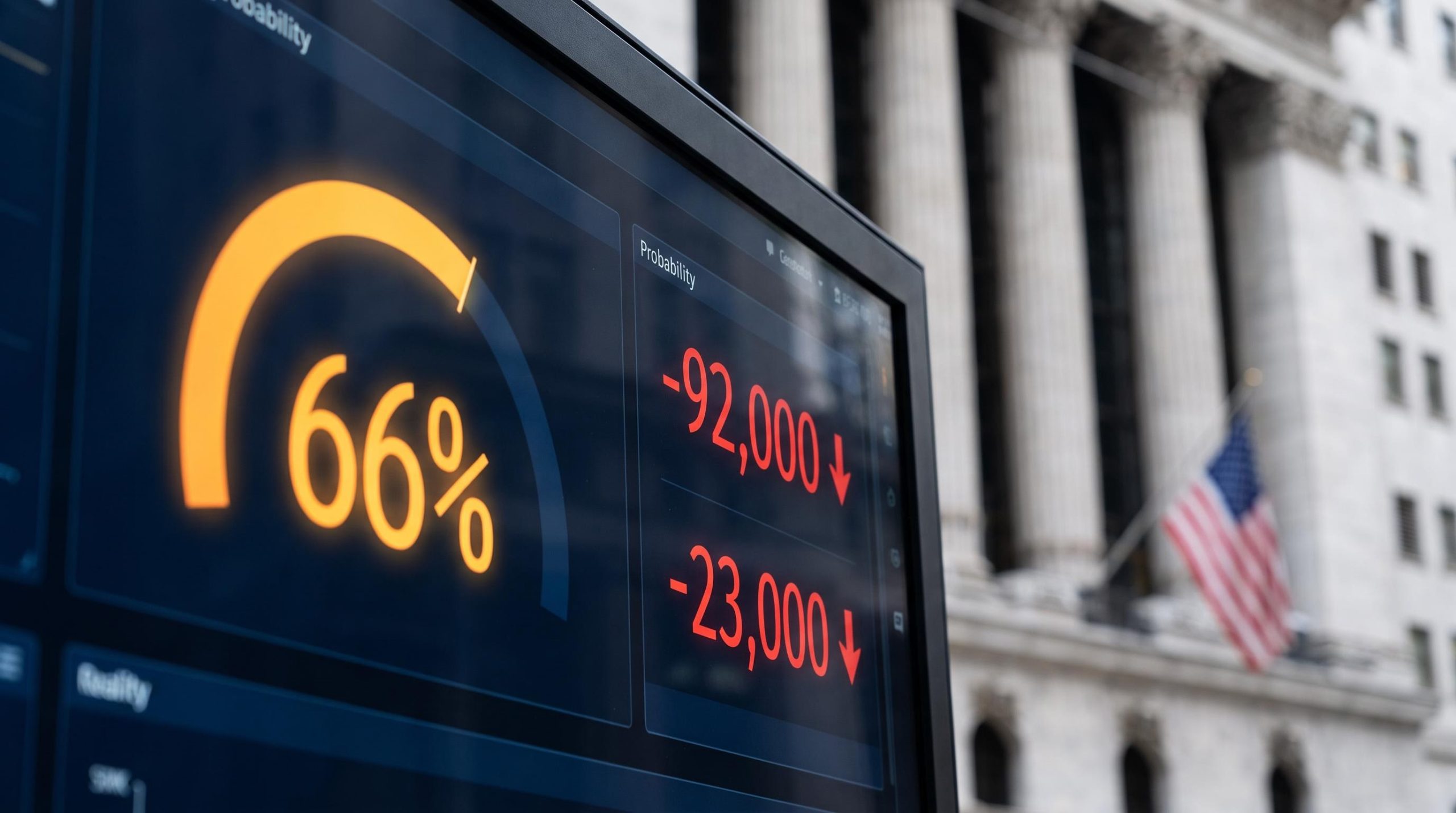
Forward markets are pricing roughly a 66% probability of a Federal Reserve rate hike in September 2026. The most recent nonfarm payrolls print came in negative. Regional manufacturing indices are sitting at multi-year contraction lows. Incoming data is consistently undershooting consensus by margins that are hard to dismiss as noise.
That disconnect is not a market inefficiency waiting to be corrected. It is a structural phenomenon with a coherent explanation, rooted in institutional behaviour, asymmetric risk management, and a narrative that has become self-sustaining. Understanding why the gap exists is more useful than simply noting that it does.
Here is the framework for interpreting Fed signals against hard data: a specific set of indicators to watch, a map of the internal power dynamics that actually drive FOMC decisions, and an analytical test for whether the hawkish consensus is defensible or running on inertia.
What the data is actually saying right now
Start with February 2026. Nonfarm payrolls fell by 92,000 against a consensus expectation of roughly +59,000 to +63,000. The unemployment rate rose to 4.4%. That was a miss of more than 150,000 jobs against the midpoint of consensus, the kind of deviation that typically forces a rethink.
Then came July 2026. Payrolls declined by 23,000, with the unemployment rate at 4.1%. Two consecutive prints that badly missed expectations, with the most recent one outright negative.
The labour market is not the only signal flashing. The Chicago Business Barometer registered 47.1 in July 2025 before falling further to 41.5 in August 2025, against a consensus estimate of 57.
The gap between the Chicago PMI reading and consensus expectations ranked among the most extreme divergences ever recorded for that series.
The Kansas City Fed manufacturing index came in at -3 versus an expectation of +10. These are not borderline readings. They are decisively contractionary.
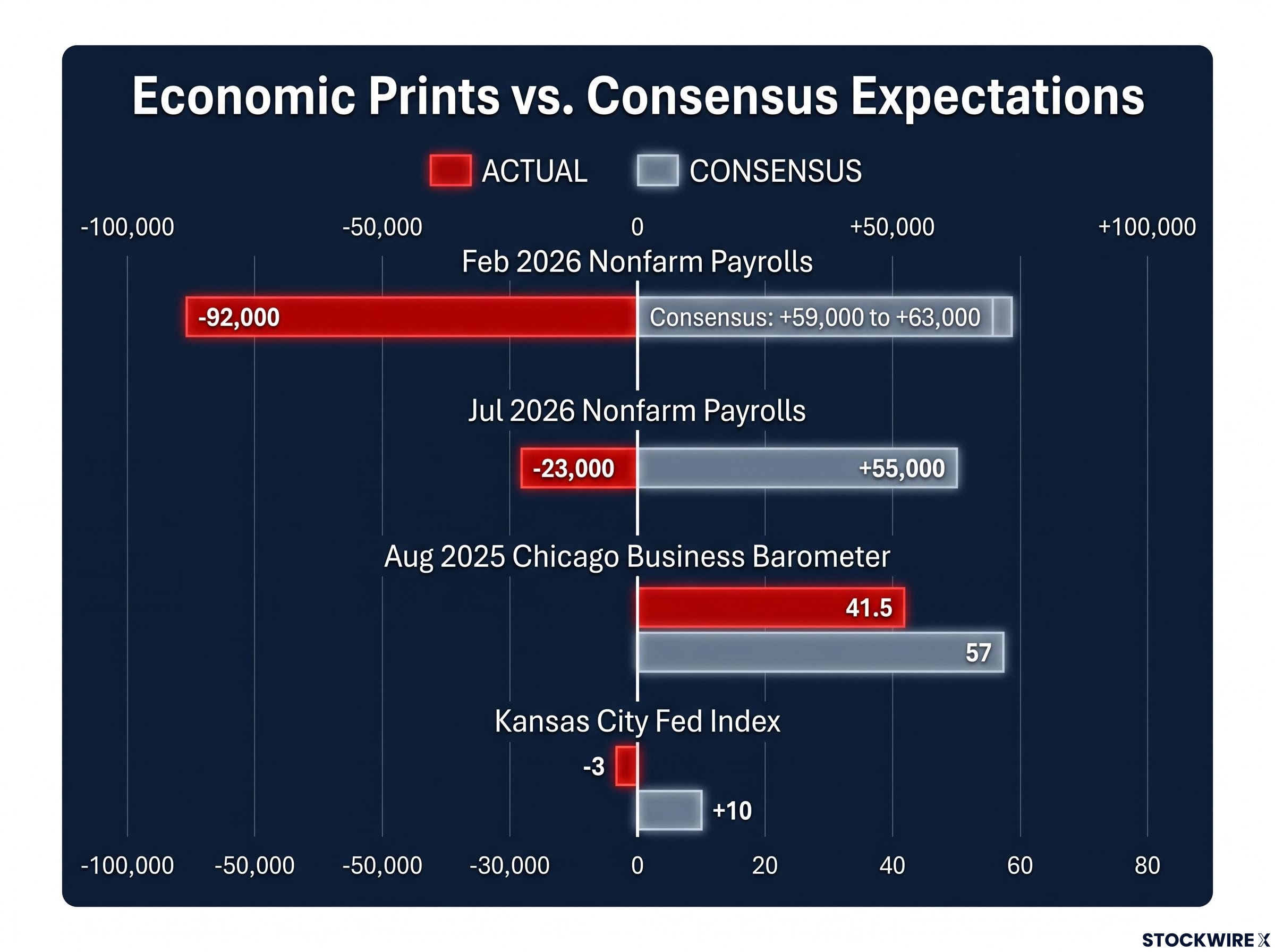
| Indicator | Actual Reading | Consensus Estimate |
|---|---|---|
| Nonfarm Payrolls (Feb 2026) | -92,000 | +59,000 to +63,000 |
| Nonfarm Payrolls (Jul 2026) | -23,000 | +55,000 |
| Chicago Business Barometer (Aug 2025) | 41.5 | 57 |
| Kansas City Fed Index | -3 | +10 |
The next payroll release carries a consensus forecast of 55,000, arriving on the heels of back-to-back shortfalls in which the most recent result turned outright negative. The consecutive misses and the scale of the deviations from consensus tell you this is not statistical noise. The data has a direction, and that direction is not consistent with an economy that needs further restraint applied.
Beyond the headline print, NFP internals such as average hourly earnings, prior-month revisions, and labour force participation are where the actual policy signal sits; markets frequently reprice sharply on wages data even when the jobs number lands near consensus.
If you accept that the data is genuinely soft, the persistence of hawkish pricing becomes the puzzle that needs explaining.
When big ASX news breaks, our subscribers know first
Why hawkish pricing persists when the data turns soft
The explanation starts with scar tissue. The Fed characterised post-pandemic inflation as “transitory” in 2021-22, held too long, and then had to execute the most aggressive tightening cycle in a generation to restore credibility. Markets absorbed that lesson. The institutional aversion to being perceived as prematurely dovish is now baked into how both the Fed and traders price risk.
That credibility constraint feeds into an asymmetric loss function. A mild recession that anchors inflation is politically and institutionally survivable. A renewed inflation spike after declaring victory is not. The Fed and markets both understand this asymmetry, and it rationally skews pricing toward over-tightening even when the marginal data no longer supports it.
Then there is communication inertia. After months of hawkish guidance, the Fed faces reputational and signalling costs if it pivots quickly. Officials tend to shift language gradually, moving from “additional hikes likely” to “data-dependent” to “policy is sufficiently restrictive,” before changing the actual rate. Markets price this slow-moving communication process, not just the latest data print. At Jackson Hole, the Fed Chair struck a hawkish tone on the same day that downward payroll revisions landed, pointing firmly in the opposite direction.
Forward guidance removal under Warsh means the slow language migration the article describes, from ‘additional hikes likely’ toward ‘data-dependent,’ no longer serves as the reliable leading indicator it once was; each data release now carries full pricing weight without a Fed-provided interpretive buffer.
The employment mandate underweighting reinforces this. Although the Fed’s formal dual mandate gives equal weight to employment and inflation, markets have effectively reduced this to a single-mandate framework since the post-pandemic spike. With unemployment still near historically normal levels, the labour side is treated as acceptable collateral damage.
These five mechanisms form what macro analyst Jared Dillian characterises as an “inflation mind virus,” an organising narrative that becomes self-sustaining independent of incoming data:
- Credibility scar tissue: The 2021-22 “transitory” mistake created lasting institutional aversion to perceived dovishness
- Asymmetric loss function: Renewed inflation is more career-threatening than a mild recession, skewing behaviour toward over-tightening
- Communication inertia: Fed language migrates slowly; rate changes trail rhetoric shifts by months
- Employment mandate underweighting: Labour softening is treated as acceptable until it becomes politically salient
- Positioning feedback loop: Rate-sensitive strategies calibrated to “higher for longer” rationalise incoming softness as noise
When the narrative becomes its own evidence
The positioning feedback loop operates at the market structure level, not the policy-setting level, and it deserves separate attention. Hawkish expectations support hawkish Fed rhetoric, which anchors hawkish expectations, which reinforces hawkish positioning. Rate-sensitive strategies, carry trades, and certain macro funds are calibrated to the prevailing narrative. Incremental data softness gets rationalised as noise to avoid costly whipsaws.
This creates a self-reinforcing cycle that can persist until an external data shock breaks it. The Fed’s public rhetoric, in other words, is a lagging indicator. The larger the gap between what officials are saying and what the data shows, the sharper the eventual repricing when the two have to converge.
What the dual mandate reveals and when a policy shift becomes unavoidable
The Fed’s formal dual mandate, the legal obligation to pursue both maximum employment and price stability, is the latent structural break point in this analysis.
The Fed’s dual mandate framework, as restated in the FOMC’s 2025 strategy document, assigns equal statutory weight to maximum employment and price stability, making the current effective treatment of labour weakness as acceptable collateral damage a deliberate interpretive choice rather than a legal necessity.
Current conditions allow the Fed to maintain its hawkish posture. The unemployment rate peaked at 4.4% in February 2026 and sits at 4.1% now. That is soft but not politically salient. The Fed can plausibly characterise the labour market as “cooling from an unsustainably tight level” rather than genuinely weak.
The mandate balance shifts when job losses become sizable and persistent enough to generate clear political and media pressure. At that inflection point, the employment mandate reasserts itself not as a theoretical constraint but as a practical one, and the repricing from a one-mandate (inflation-first) regime to a genuine dual-mandate regime is likely to be abrupt rather than gradual.
The specific conditions that would make continued hiking analytically indefensible can be expressed as a three-condition trigger:
- Weak payrolls: A third consecutive soft or negative employment print, pushing unemployment higher, would make it analytically untenable to dismiss labour weakness as statistical noise. The consensus forecast of 55,000 for the upcoming release follows two substantial misses, with the most recent print landing in negative territory.
- Sustained PMI contraction: With Chicago already at 41.5 and Kansas City at -3, the next threshold is national ISM joining regional indicators below 50 for several consecutive months, undermining the “resilient demand” narrative.
- In-line or softer inflation: CPI and PPI releases are scheduled for the days following Jackson Hole. If these come in at or below consensus, the core justification for further tightening, ongoing inflation risk, loses force.
Weak payrolls combined with contracting PMIs combined with benign inflation is a combination that is hard to reconcile analytically with continued hiking. The rate decision expected within weeks of these releases makes this alignment especially consequential.
What this means for you is that you now have a concrete watch-list: three data prints that, if they align, would force a policy repricing and create a sharp move in rate expectations, the yield curve, and risk assets broadly.
Fed internal dynamics and what the dissenter map reveals
The analytical lens shifts here from data and market pricing to the institution itself. Within the Federal Open Market Committee (FOMC), the body responsible for setting interest rates, effective policy direction is determined by the alignment of Jerome Powell, John Williams, and Christopher Waller, whose collective stance shapes committee outcomes regardless of dissenting votes.
Voting in opposition are Beth Hammock, Neel Kashkari, and Lorie Logan. Having three members dissent simultaneously is without precedent in the committee’s modern history, making the current configuration historically notable.
The vote split dynamics behind the July 2026 nine-to-three division, characterised as the most internally divided committee in close to a decade, provide the historical baseline against which the current three-dissenter configuration should be evaluated.
| FOMC Figure | Role / Characterisation |
|---|---|
| Jerome Powell | Core bloc; effective policy direction setter |
| John Williams | Core bloc; effective policy direction setter |
| Christopher Waller | Core bloc; effective policy direction setter |
| Beth Hammock | Dissenter; former Goldman Sachs, characterised as politically motivated |
| Neel Kashkari | Dissenter; previously advocated negative rates, now favours very high rates |
| Lorie Logan | Dissenter |
Worsh’s credibility deficit as a policy wildcard
Before his appointment, Kevin Worsh devoted substantial effort to publicly attacking the Federal Reserve’s conduct and decisions. That history limits his internal political capital in ways that matter for policy direction. Despite the hawkish tone delivered at Jackson Hole, this credibility deficit may constrain his ability to drive consensus within the institution, creating a potential gap between his public hawkishness and his actual capacity to move the committee.
According to reports, Warsh and Treasury Secretary Scott Bessent shared a flight to Asheville for the G20 summit, pointing to a degree of coordination between the two on policy direction. That external alignment does not necessarily translate into internal institutional leverage.
Understanding the internal power map tells you that the public FOMC narrative can be more fragile than it appears. A core bloc of three determines the actual direction, and a credibility-constrained Chair means the institutional consensus may be harder to maintain than a unified hawkish front suggests.
What this disconnect means before the next decision window closes
The asymmetric risk-reward setup is a product of everything laid out above, not a standalone observation.
The fiscal dominance constraint, rooted in federal debt reaching roughly 122% of GDP, structurally limits how far a credibility-focused Fed can tighten before debt servicing costs force a political reckoning, adding a ceiling to the ‘higher for longer’ scenario that hawkish pricing implies.
The upside from being positioned for the consensus hike is limited: roughly 66% probability is already priced. The downside from a surprise hold or dovish shift is potentially large because so much hawkishness is embedded in current positioning. Both Millius Speedback, head of global macro at Tasty Live, and Dillian have noted that odds of roughly 2-to-1 against a hike represent a meaningful risk-reward opportunity for those looking to position on that outcome.
Approximately 66% hike probability is already priced into rate futures. If the triple-condition trigger fires, the repricing potential is asymmetric: the market has little room to move higher on confirmation but significant room to reprice lower on a surprise hold.
The framework converts into four monitoring priorities you can apply over the coming weeks:
- Labour data: Track NFP, unemployment rate, and participation rate for signs that the employment mandate is transitioning from latent to binding.
- PMIs and ISM: Watch for national ISM joining regional indicators below 50, which would distinguish a shallow soft patch from outright demand weakness.
- Inflation surprise indices: Monitor CPI and PPI relative to consensus to assess whether the inflation-credibility story remains analytically defensible.
- Fed rhetoric as a lagging indicator: Track the specific language migration from “additional hikes likely” toward “data-dependent,” which historically precedes actual rate changes by weeks to months.
The inflation mind virus framework explains why the disconnect persists. The triple-condition trigger identifies when it is most likely to break. The internal power map tells you where to look for early signals that the consensus is cracking. Together, they give you a way to assess whether that 66% probability is an opportunity or a trap, rather than simply a number to accept.
This article is for informational purposes only and should not be considered financial advice. Investors should conduct their own research and consult with financial professionals before making investment decisions. Forward-looking statements about Federal Reserve policy are speculative and subject to change based on economic developments and incoming data.