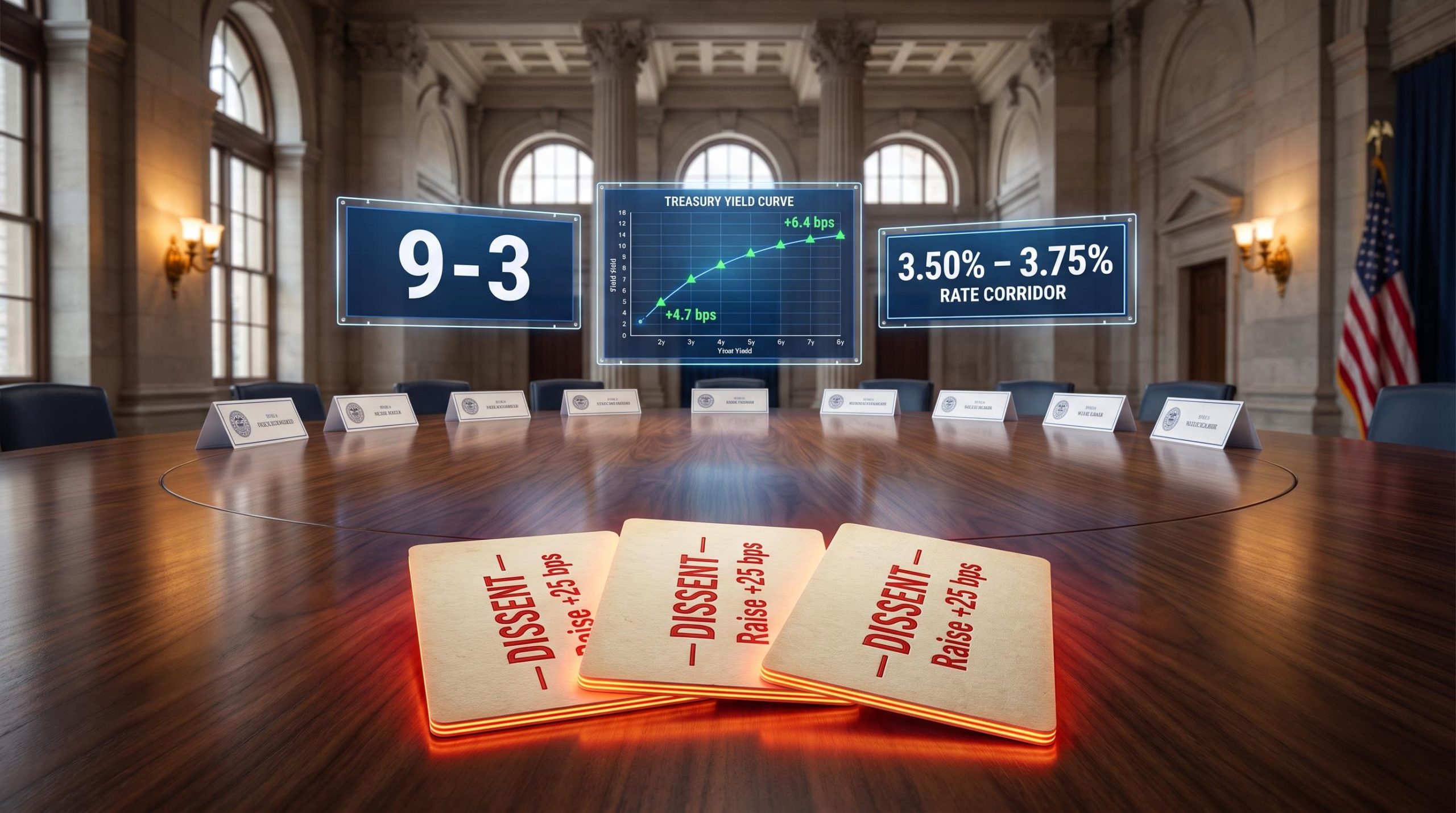
Three Federal Reserve officials voted to raise interest rates at the most recent FOMC meeting. The Fed held rates steady anyway, and most headlines moved on.
That is precisely the wrong response.
The headline rate decision tells you what the committee agreed on. The vote split tells you how close the committee is to changing its mind. For investors trying to anticipate where rates are heading, the dissent count is often the more actionable signal, yet it is almost universally underread by retail market participants.
Here is how FOMC dissenting votes work, what the direction and size of a split communicate about the Fed’s internal debate, and how to translate that signal into a clearer picture of rate trajectory, bond market positioning, and currency exposure. This is the layer of Fed communication most investors skip, and the one worth understanding.
How the FOMC vote actually works
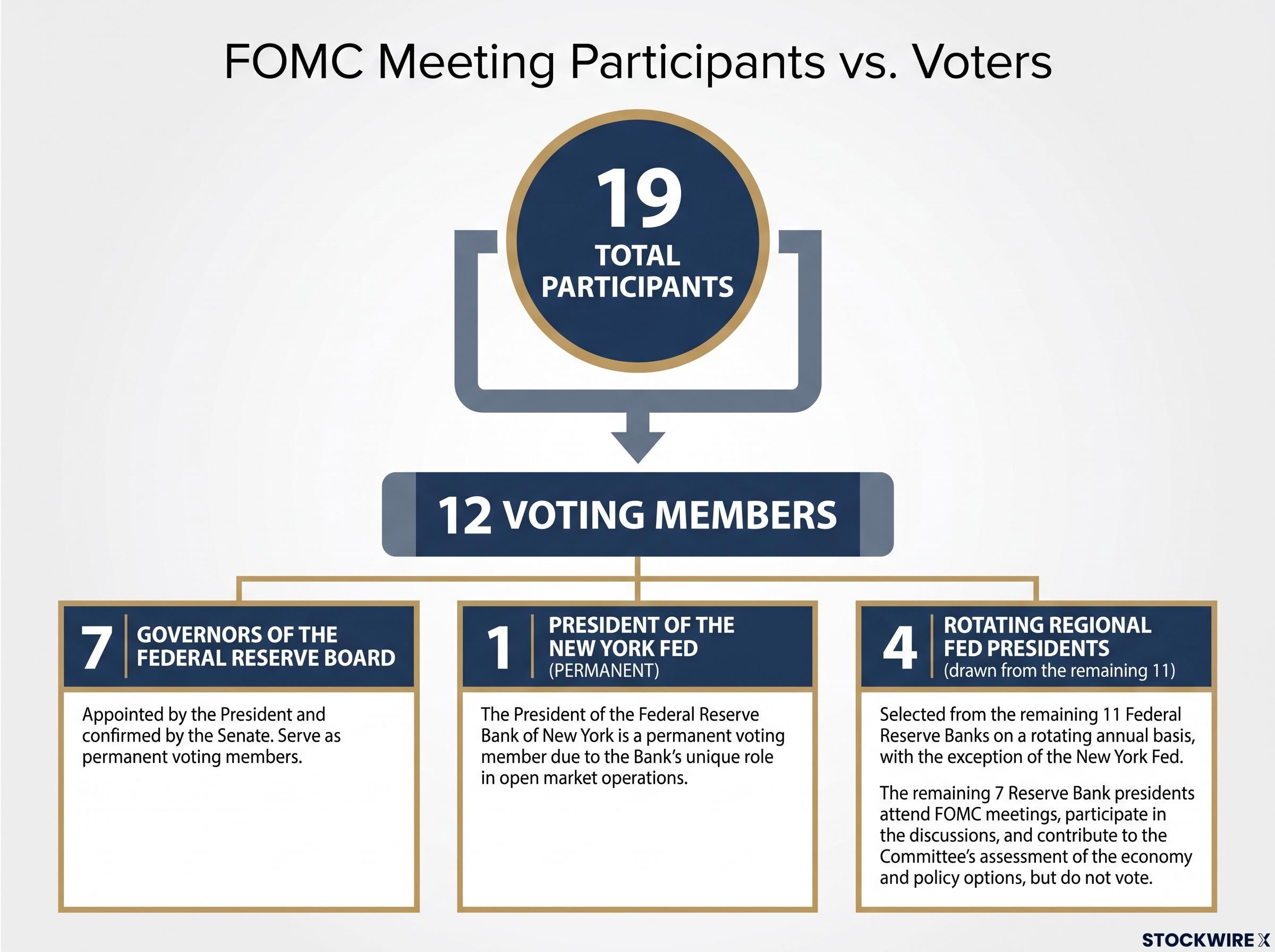
The Federal Open Market Committee (FOMC) is the Federal Reserve’s main policy-setting body for interest rates. It meets eight times a year, and at each meeting, 12 members cast a formal vote on whether to raise, lower, or hold the federal funds rate.
The FOMC voting structure, with seven permanent Board governors, a fixed New York Fed seat, and four rotating regional presidents, means no incoming chair can unilaterally redirect policy, a structural constraint that explains why the July 2026 dissenters could hold formal minority positions without triggering an immediate reversal of the majority view.
Those 12 voters are drawn from three groups:
- 7 Governors of the Federal Reserve Board, all of whom vote at every meeting
- The president of the New York Fed, who holds a permanent voting seat
- 4 rotating regional Fed presidents, drawn from the remaining 11 regional banks on a yearly rotation
Beyond the 12 voters, 19 total participants contribute to the discussion, submit economic projections, and shape the debate. But only 12 cast a binding vote.
When a voting member disagrees with the majority decision, they cast a formal dissent. Their name and the reason for their disagreement are recorded in the post-meeting statement and minutes. The Fed strongly favours consensus and typically presents a unified front, particularly under political scrutiny. Most formal dissents historically come from regional bank presidents rather than Governors, which makes episodes involving multiple Governor dissents particularly notable.
That context matters. When you see a 9-3 vote, you are not looking at routine friction. You are looking at a quarter of the decision-making body concluding that the current policy is already wrong.
Hard dissents versus soft disagreement
Not all disagreement shows up in the vote tally. A “hard” dissent is a formal NO vote, recorded by name in the statement and minutes. A “soft” dissent is subtler: a dot plot projection well away from the median, or a speech signalling discomfort without a formal vote.
Researchers have even developed machine-learning models to detect “hidden dissent” in meeting transcripts, measuring strong opposition that never becomes a recorded vote. The formal dissent count, in other words, is only the visible portion of a broader spectrum of internal disagreement.
When big ASX news breaks, our subscribers know first
Hawkish or dovish: why the direction of a dissent matters more than the count
You now know how to read the count. The next layer is direction, and it is the variable that determines whether the signal points toward tightening or easing.
A hawkish dissent means the member preferred tighter policy: a higher rate than the majority chose, or opposition to a cut. A dovish dissent means the opposite: the member preferred easier policy, a lower rate, or opposition to a hike.
When all dissenters lean the same direction, the signal is unambiguous. A unified minority tells you exactly which way the internal pressure is pulling. A 9-3 hawkish split on a hold decision, for example, means three voters already believe rates should be higher. A 9-3 dovish split on the same hold decision means three voters believe rates should already be lower. Same tally, completely opposite implications.
When dissenters appear on both sides simultaneously, one wanting tighter policy and another wanting looser, the signal shifts. That configuration tells you the committee is deeply divided on the outlook itself, not simply debating the pace of movement in one direction.
A San Francisco Fed study decomposing district-president dissents from 1990 to 2017 classified each dissent as favouring looser versus tighter policy, and the pattern is clear: clusters of same-direction dissents tend to appear at turning points in the rate cycle, when the committee is close to changing course. Research also shows dissent frequency increases when uncertainty about the economic outlook is high.
San Francisco Fed research on district voting patterns spanning 1990-2017 confirms that same-direction dissent clusters tend to appear near cyclical turning points, when the committee is closest to reversing its prevailing rate stance.
For you as an investor, the direction of the dissent is the first filter. Before adjusting any portfolio assumption after an FOMC meeting, identifying whether the dissenters wanted more tightening or more easing is the analytical step that tells you which pressure is building.
| Attribute | Hawkish dissent | Dovish dissent |
|---|---|---|
| Definition | Member preferred a higher rate or opposed a cut | Member preferred a lower rate or opposed a hike |
| Policy direction signal | Rate path likely tilted higher than headline decision suggests | Rate path likely tilted lower than headline decision suggests |
| Likely bond market implication | Short and intermediate yields rise as hike probability increases | Short and intermediate yields fall as cut probability increases |
| Likely USD implication | Dollar gains support as rate differential widens versus other currencies | Dollar weakens as rate differential compresses |
July 2026 hawkish split in practice: how a divided committee signals the next move
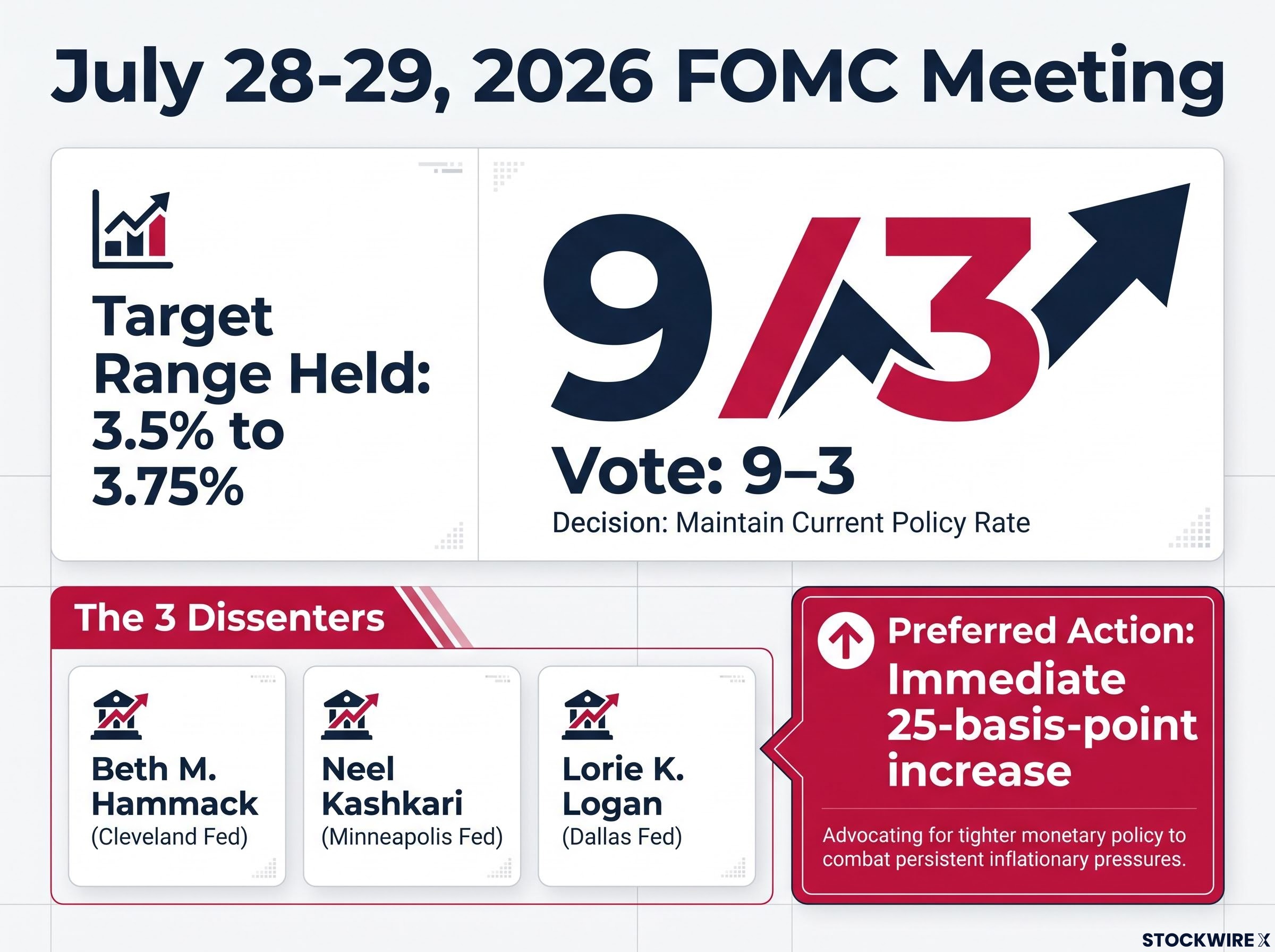
On 28-29 July 2026, the FOMC held the target range for the federal funds rate unchanged at 3.5% to 3.75%. The vote was 9-3.
The three dissenters were all regional Fed presidents:
- Beth M. Hammack, Cleveland Fed
- Neel Kashkari, Minneapolis Fed
- Lorie K. Logan, Dallas Fed
All three formally preferred the same action: an immediate 25-basis-point increase.
“Preferred to raise the target range for the federal funds rate by one-quarter percentage point at this meeting.”
That language, recorded in the official post-meeting statement, is the dissent in its sharpest form. Three named voters, all pulling in the same tightening direction, after an extended stretch with very few formal NO votes. Multiple commentators characterised it as the most hawkish FOMC vote the committee had seen in close to a decade, with several observers noting the Fed had not appeared so internally divided in over ten years.
Placing the July statement alongside the prior meeting’s June statement revealed how little the text itself had changed: apart from minor wording adjustments and the new paragraph at the foot of the document identifying the three dissenters, the two documents were substantively the same. In that sense, the vote tally carried considerably more fresh information than the statement language did.
Markets responded accordingly. A September rate hike was immediately described as “live” even though the committee had just chosen to wait. The threshold for that next move was lower than the headline hold implied, because one quarter of the voting committee had already concluded that the current stance was insufficient.
If you read only the rate outcome that day, you saw a hold. If you read the vote composition, you saw a committee where the debate over the next move had already been decided by three of its members, and the remaining question was whether incoming data would bring more voters to their side.
For investors who want the full analytical treatment of what each dissenter argued and which swing voters to watch heading into September, our deep-dive into the July 2026 dissenting votes examines Kashkari’s stagflation parallel and why Governor Waller’s next communication is the most consequential signal to monitor.
What bond and currency markets do with dissent information
The interpretive layer is one thing. The mechanical layer, how dissent information moves prices, is where it connects to your portfolio.
US Treasury yields respond most directly to changes in expected future short-term rates. When hawkish dissents appear on a hold decision, short-maturity yields (the 2-year, for instance) reprice most immediately as the market assigns greater probability to a near-term hike. Intermediate maturities (the 5-year to 10-year range, sometimes called the “belly” of the curve) adjust if traders believe the higher rate path will persist beyond just the next meeting. Long maturities (20-year and 30-year) tend to move less, because they are anchored more to long-run neutral rate expectations than to the next few meetings.
US Treasury yields respond most directly to changes in expected future short-term rates, and the mechanics of why bond yields move inversely to price, and how auctions continuously reprice them, determine how fast and far each maturity segment adjusts when the Fed signals a shift.
Following the July 2026 meeting, the pattern was visible in the data:
| Maturity | Curve segment | Approximate move (basis points) |
|---|---|---|
| 2-year | Short end | +4.7 |
| 5-year | Belly | Belly underperformed slightly |
| 7-year | Belly | +6.4 |
| 30-year | Long end | Smaller relative move |
The belly underperforming the short end is not random. It reflects the market pricing a higher rate path over the medium term, not just the next meeting. That is exactly what a unified hawkish minority signals when three voters believe the current stance is already behind.
The currency mechanism follows the same logic. Hawkish dissents that push the expected US rate path higher widen the interest rate differential versus other major central banks, giving the dollar support. Dovish dissents compress that differential and tend to weaken the dollar.
Following the July meeting, the USD picture was mixed but directionally consistent:
- The US Dollar Index traded in a narrow range just under 105.00 in the session leading up to the Wednesday CPI release
- The USD gained approximately 0.21% against the Swiss franc, registering its best performance across major pairs on the day
- The USD declined roughly 0.13% against the Canadian dollar, its weakest major-pair performance
Market participants do not react to the dissent in isolation. They are simultaneously evaluating incoming macro data, upcoming CPI and jobs releases, and speeches from the dissenters themselves to judge whether the minority view is gaining traction. For you as an investor with bond fund exposure or international equity positions, these are not abstract mechanics: a few basis points of yield movement translate directly into net asset value changes, and dollar strength or weakness shifts the relative return of any unhedged foreign position you hold.
Three misconceptions that distort how retail investors read dissent headlines
If you follow FOMC meetings, you have probably carried at least one of these assumptions. Each is reasonable on the surface and worth correcting.
- “Dissent means the Fed is dysfunctional.” It does not. Deliberative disagreement is a feature of the process, not a breakdown. Fed officials themselves have noted that dissent highlights diversity of views and helps counter groupthink. The Bank of England routinely publishes significant vote splits, and these are considered healthy for accountability. A 9-3 vote tells you the debate is live, not that the institution is fractured.
- “The dissenting side always wins eventually.” Research suggests otherwise. One study finds that dissenting FOMC members are actually less likely to see their preferred policy adopted in subsequent meetings and may experience reduced influence after opposing the majority. Dissents signal pressure on the current stance, but they do not guarantee the minority view becomes policy. The direction of the dissent tells you where the debate is pulling; it does not tell you who wins.
- “You should reposition your portfolio immediately on a dissent headline.” By the time the statement hits the tape, professional traders have already priced in the new information. For most retail investors, the value of dissent is contextual and strategic rather than tactical. It helps you understand whether the Fed is closer to changing course and whether your fixed-income or currency exposure is aligned with that evolving outlook. It is an input to your rate-cycle assessment, not a trigger for same-day action, and understanding that distinction protects you from reactive decisions that professional markets have already made before you see the news.
A practical framework for using dissent signals in portfolio monitoring
The concept-building is done. Here is a structured, repeatable process you can apply at each of the Fed’s eight annual meetings.
- Record the count and direction. How many dissenters were there, and were they all hawkish, all dovish, or split? A 9-3 hawkish split on a hold is a fundamentally different signal from a 9-3 dovish split on the same hold.
- Follow the dissenters’ public speeches and interviews. In the days after the meeting, dissenters usually explain their reasoning publicly, offering insight into which data points (inflation, labour market, financial conditions) they believe the majority is underestimating.
- Track whether dissent grows, shrinks, or reverses across meetings. A widening dissent over several consecutive meetings is a strong signal that a policy change is approaching. A one-off dissent that disappears at the next meeting suggests the minority view failed to gain traction.
- Cross-reference with major data releases. Compare CPI, PCE, nonfarm payrolls, and GDP surprises against the dissenters’ stated arguments. When data consistently supports the minority view, market pricing often migrates toward it. The July 2026 case illustrates this precisely: the CPI release the Wednesday after the meeting was anticipated to come in below June’s reading, which would have reduced the credibility of the hawkish minority’s position.
- Align your fixed-income and currency exposure with the evolving rate path. This is where the framework becomes actionable in your portfolio.
If dissents and macro data consistently point to higher-for-longer rates, shorter-duration bonds and dollar-denominated assets tend to be more resilient. If they point toward earlier easing, longer-duration bonds and selected non-USD exposures may benefit.
This framework treats dissent as one informational input within a broader macro monitoring process, not as a standalone trading signal. If you apply it consistently, the next FOMC meeting you follow becomes a structured information-gathering event rather than a headline to react to.
For readers wanting to understand how the annual meeting calendar itself could change under Chair Warsh, our dedicated guide to FOMC meeting frequency examines how a reduction from eight to six meetings would concentrate policy risk into fewer windows and elevate the market impact of each CPI and payrolls release between sessions.
Reading the committee’s internal debate, not just its decisions
The rate decision tells you what the Fed agreed on. The vote split tells you how close the committee is to changing its mind. For forward-looking investors, the latter is the more actionable signal.
The July 2026 meeting is the clearest recent proof. A unanimous hold would have signalled stability. The 9-3 split signalled that the policy debate was live, that September was a genuine possibility, and that bond and currency markets were right to reprice accordingly. The difference between those two readings is the difference between passive headline consumption and active committee interpretation.
Each FOMC meeting’s vote composition is publicly available and free to read. The names, the count, the stated reasons for dissent are all in the post-meeting statement. The institutional knowledge gap between retail and professional investors on this topic is smaller than it appears. The only thing required is knowing what to look for, and now you do.
This article is for informational purposes only and should not be considered financial advice. Investors should conduct their own research and consult with financial professionals before making investment decisions.