Despite weaker local currencies and bonds across Poland, South Africa, and Turkey, equity allocators have not been deterred. In most market environments, softening FX and bond underperformance would act as a deterrent to equity exposure in the same geography. Here, the opposite is true: sustained buying has continued across all three markets, with the momentum building in the weeks leading up to the July Federal Reserve meeting and showing no sign of reversing.
The concentration is striking. According to proprietary flow data cited by Geoff Yu at BNY, all three markets appeared among the five most heavily bought equity destinations worldwide in the week that coincided with the U.S. Treasury buyback announcement. This is not a diffuse emerging market rally. It is selective, concentrated, and it does not look like the familiar dollar-weakness-drives-everything trade.
Here is a breakdown of three separate investment theses that happen to share a geographic region and a common macro facilitator, why the currency and bond divergence is a feature rather than a warning sign, and what the pattern reveals about how sophisticated allocators actually approach EMEA emerging market equities right now.
The macro conditions making this trade possible right now
Softening U.S. real yields have reduced the opportunity cost of holding higher-risk, higher-yielding equities. When the return on U.S. Treasuries compresses, the dividend streams and earnings growth available in emerging market equities become relatively more attractive. That much is straightforward.
What matters is that this macro backdrop is a facilitator, not the driver. It makes the trade easier to justify on a risk-adjusted basis, but it does not explain why capital is flowing specifically into Warsaw, Johannesburg, and Istanbul rather than into São Paulo or Mumbai.
The explanation sits at the equity level. All three markets share a set of characteristics that appeal to allocators seeking yield uplift beyond fixed income:
- Meaningful dividend yields from large-cap banks and resource companies with established payout histories
- Multi-year earnings visibility across sectors including banking, defence, energy transition, and financial services
- Equity duration that rewards patient capital: these are not speculative, early-stage markets but mature listed companies whose cash flows can be modelled over several years
BNY flow data cited by Geoff Yu showed that Poland, South Africa, and Turkey each featured among the five most actively bought equity markets in the world during the week of the U.S. Treasury buyback announcement.
The currency and bond divergence is the detail that sharpens the picture. If this were a generic emerging market beta trade, you would expect to see currencies strengthening and local bond spreads tightening alongside equity inflows. Neither is happening. That tells you this is not passive exposure. These are deliberate, stock-specific allocations where investors are consciously absorbing FX risk as part of the position.
Understanding the facilitator helps you calibrate durability. If U.S. real yields reverse sharply upward, this tailwind weakens, even if each country-level thesis remains intact.
The U.S. real yield trajectory is the single external variable with the most direct bearing on this trade’s durability; the mechanical relationship between compressing real yields and the relative attractiveness of higher-yielding equity positions in emerging markets means any reversal in that trend would reduce the macro tailwind even if each country-level thesis remained structurally intact.
When big ASX news breaks, our subscribers know first
Poland: the EU funds unlock, defence spending, and bank earnings combination
Poland’s equity case rests on three reinforcing pillars arriving simultaneously. Any one of them would draw attention. Together they create a thesis with structural depth that separates it from the broader “Eastern Europe” shorthand.
EU infrastructure spending and the defence premium
The Tusk coalition’s arrival in government has unlocked previously frozen EU funds. Large allocations to infrastructure, green energy, and regional development are creating multi-year revenue pipelines for construction, industrial, and utilities names listed in Warsaw. This is not a one-quarter stimulus. It is a capital expenditure cycle with a political mandate behind it.
Layered on top is the defence and logistics premium. Poland’s proximity to Ukraine and elevated NATO spending commitments are driving sustained investment in defence, transport, and logistics infrastructure. This is a secular spending impulse, not a cyclical one, and Warsaw-listed companies positioned in these sectors are direct beneficiaries.
The risk to watch is political. EU-Poland relations have historically been strained over judiciary and media independence issues, and a reversal on reform progress could disrupt the capital flow.
European equity positioning provides a useful reference point for the Poland thesis: while Barclays upgraded European equities in July 2026 and institutional investors remain structurally underweight across the continent, Poland’s EU-anchored reform story and defence spending cycle offer a more concentrated entry point into the same fiscal expansion dynamic than broad European index exposure delivers.
Why Polish banks are attracting equity capital
Polish banks have benefited from elevated policy rates, which have supported strong net interest income. Even if margins compress as rates eventually ease, the current dividend distribution capacity is attractive relative to what developed-market bank yields offer.
Key factors drawing institutional equity capital into Polish banks:
- Net interest income remains elevated under current policy rate settings
- Dividend capacity is well-supported by current earnings levels
- EU membership provides a governance and regulatory floor that reduces non-economic risk
- Capital market infrastructure is mature and familiar to global institutions
For you, Poland represents the most institutionally approachable case in this group. The EU legal framework functions as a governance floor, which means the equity thesis does not depend on taking a directional view on political tail risk to the same degree as Turkey or South Africa.
South Africa: GNU optionality, resource leverage, and the rand-hedge structure
South Africa’s case does not require optimism. It requires only the absence of the worst outcomes.
The Government of National Unity (GNU) represents a “less bad than feared” political outcome, and that distinction is doing most of the analytical work in the South African equity thesis.
The ANC losing its outright majority and entering a coalition with the Democratic Alliance and smaller parties has reduced the probability of more radical, market-unfriendly policy outcomes. Markets price the direction of change, not the absolute level of governance quality. The GNU does not solve South Africa’s structural problems, but it softens tail risks enough to bring allocators back to the table.
South African equities offer liquid exposure to platinum group metals, gold, and battery and energy-transition metals through established, dividend-paying companies with global operations. These are names institutional investors are comfortable underwriting because the earnings, cost structures, and capital allocation histories are well-documented.
The more structurally interesting feature is the rand-hedge equity layer. Companies like Naspers and Prosus, along with various dual-listed multinationals, earn revenues in hard currency but are priced in rand. For foreign investors, this means accessing South African equity flows without needing a directional view on the rand itself.
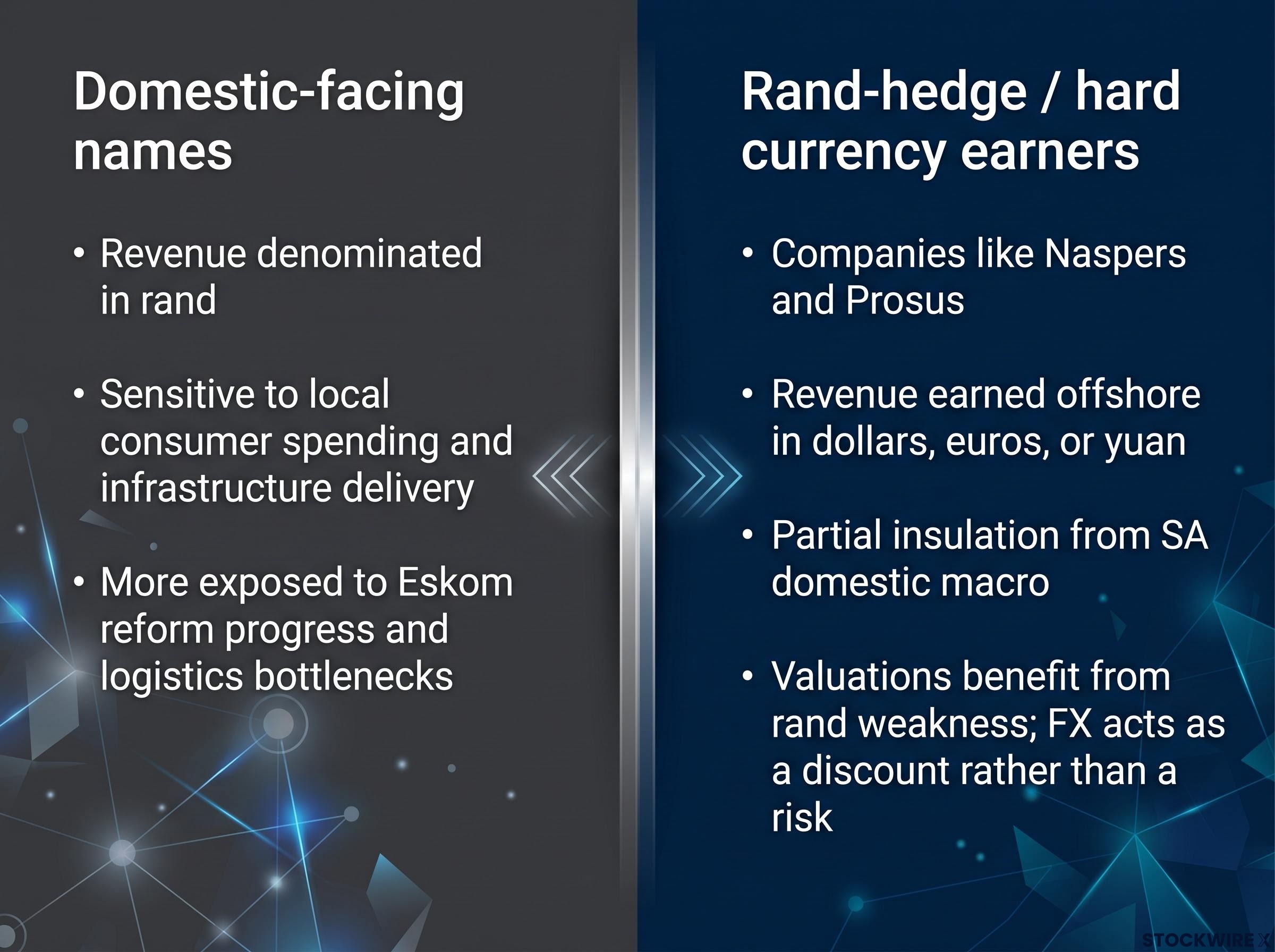
| Domestic-facing names | Rand-hedge / hard currency earners |
|---|---|
| Revenue denominated in rand; sensitive to local consumer spending and infrastructure delivery | Revenue earned offshore in dollars, euros, or yuan; partial insulation from SA domestic macro |
| More exposed to Eskom reform progress and logistics bottlenecks | Valuations benefit from rand weakness; FX acts as a discount rather than a risk |
Current equity flows do not require a rand rally to be valid. They are consistent with investors exploiting cheap valuations in hard-currency earners while treating the weak rand and persistent risk premium as an entry point rather than a barrier.
Risks remain real. GNU coalition stability is not guaranteed, Eskom and logistics reform could stall, and fiscal pressures persist. But the marginal change in expected outcomes is what unlocked these flows, not a full macro redemption story.
Turkey: policy normalisation and the rehabilitation of a market that was off-limits
Turkey’s equity story is a rehabilitation trade, not a recovery trade. The distinction matters. Investors are not betting that Turkey has fixed its problems. They are betting that the new policy regime persists long enough for equity valuations, which had been discounted to worst-case assumptions, to re-price toward normalised assumptions.
What the policy shift actually changed
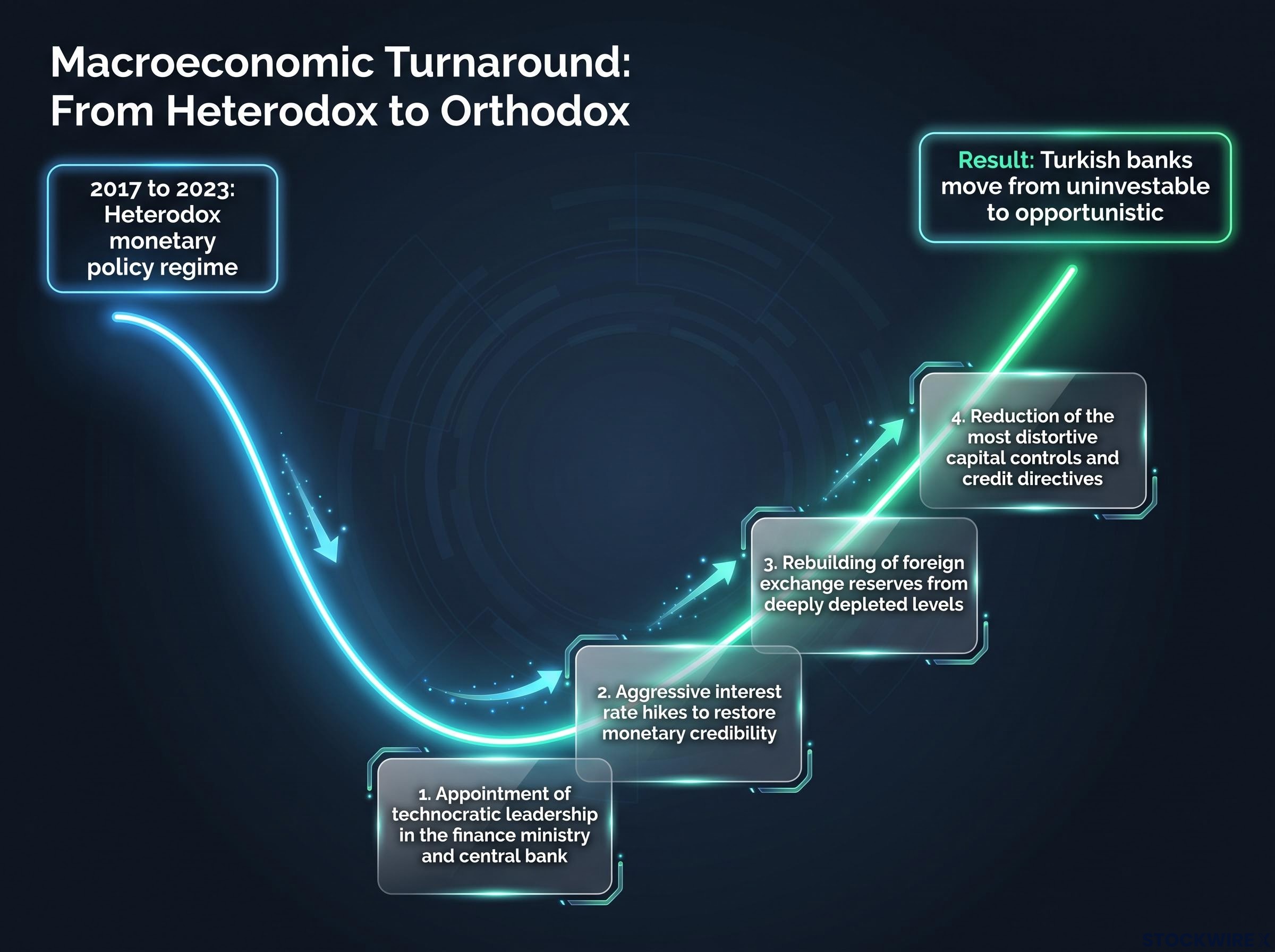
Between 2017 and 2023, Turkey ran a heterodox monetary policy regime that made its equities effectively uninvestable for most global allocators. The sequence of changes that followed is what reopened the door:
- Appointment of technocratic leadership in the finance ministry and central bank
- Aggressive interest rate hikes to restore monetary credibility
- Rebuilding of foreign exchange reserves from deeply depleted levels
- Reduction of the most distortive capital controls and credit directives
This does not remove political risk. But it meaningfully improves the macro framework relative to the prior period, and that improvement is what matters for equity re-entry.
The IMF Article IV consultation on Turkiye, concluded in early 2026, commended Turkish authorities for maintaining a tight monetary policy stance and achieving meaningful disinflation progress, providing external institutional validation for the orthodox policy shift that has made the equity re-entry thesis analytically credible.
The risk factors are specific and worth naming: durability of policy orthodoxy depends on political will, the election calendar creates windows of vulnerability, and residual capital control risk has not been fully eliminated.
How Turkish banks move from uninvestable to opportunistic
Turkish banks dominate the equity index, and under the heterodox regime they were essentially unmodellable. Regulatory interference and extreme FX volatility made conventional earnings forecasting unreliable. A more rules-based policy setting changes that equation. Analysts can now apply conventional valuation frameworks, and starting valuations combined with normalised earnings assumptions can look compelling even after accounting for residual risk.
There is also a domestic rotation dynamic at work. As deposit rates become less punitive in real terms, some domestic capital that had been using equities as an inflation hedge is exiting. That creates space for foreign capital to re-enter at adjusted valuations, rather than competing with domestically driven demand.
Turkey’s large, young population and urban middle class underpin a secular consumption thesis. With more orthodox policy in place, investors can treat this as a genuine structural demand story rather than purely a macro speculation.
For you, Turkey is the highest-risk, highest-optionality name in this group. Understanding the specific mechanism of the re-entry thesis helps you assess whether the trade suits your own risk tolerance and time horizon, rather than treating it as simply a bet on Turkey.
What “idiosyncratic” actually means: the structural insight these flows reveal
Three separate country theses are drawing equity capital simultaneously. That makes it tempting to treat them as a single EMEA trade. The flows themselves say otherwise.
The same investor can be a net buyer of Turkish and Polish banks while remaining neutral or underweight in other EMEA markets. The positioning is driven by differentiated, country-level views on reform trajectories, sector exposures, and earnings visibility, not by a blanket emerging market allocation.
The currency and bond divergence across all three markets is the structural confirmation. If this were a broad macro beta trade driven by dollar weakness, you would expect synchronised currency strength and tightening credit spreads. Their absence tells you something specific: investors are separating equity fundamentals from currency views and treating FX risk as a known cost of the equity thesis rather than free upside.
Commodity currency dynamics reinforce the structural argument here: BNY iFlow data confirms that commodity FX baskets including the South African rand rotated to net selling even as equity inflows into South African names continued, which is precisely the currency and bond divergence pattern the current flows are exhibiting.
The FX divergence embeds a potential second leg. If currencies stabilise or strengthen, existing equity holders benefit from FX tailwinds on top of earnings and dividends. If currencies deteriorate, the domestic-oriented parts of each thesis become more fragile, particularly in Turkey and South Africa.
The practical implication is that generic EM ETFs or regional baskets may not capture these opportunities at all. The trades driving current flows operate at the country-plus-sector level, and investors who do not engage at that level of specificity risk either missing the trade entirely or diluting it with unrelated exposures.
| Market | Key equity thesis | Sector concentration | Primary risk to watch |
|---|---|---|---|
| Poland | EU-anchored reform, defence spending, bank earnings | Banks, construction, defence and logistics | EU-Poland political dynamics and reform reversals |
| South Africa | GNU political optionality, resource leverage, rand-hedge structure | Mining, dual-listed multinationals, financials | GNU coalition stability, Eskom and logistics reform |
| Turkey | Policy normalisation and bank rehabilitation | Banks, consumer-facing sectors | Durability of orthodox policy, election calendar |
For any investor thinking about emerging market allocation, these flows reframe the question. It is no longer “should I have EM exposure?” It is “which specific country and sector thesis am I underwriting?” That is a more useful and more honest framing for the current environment.
Three separate theses, one region, and what to watch from here
Each of these markets represents something distinct in portfolio terms. Poland offers institutional-quality, EU-anchored reform paired with defence spending and bank earnings. South Africa provides resource and rand-hedge exposure under reduced political tail risk. Turkey delivers normalisation and rehabilitation optionality at higher risk and higher potential reward.
The macro facilitator, softening U.S. real yields, holds the window open. If U.S. real yields re-accelerate sharply, the relative appeal of these equity positions compresses, even if the country-level theses remain fundamentally sound. Country-level political backslides in any of the three markets could close the window from the other direction.
The variables worth monitoring from here:
- U.S. real yield trajectory as the single most important external variable affecting the macro facilitator
- Currency direction across all three markets as a signal of whether the thesis is broadening beyond equity-only flows
- GNU coalition stability in South Africa and the reform delivery timeline on energy and logistics
- Turkey’s election calendar and any signals of retreat from orthodox monetary policy
The trade is in the specificity. Investors who engage with these markets as a bundle are likely to either over-diversify the thesis or misattribute performance when one market outperforms or underperforms the others. The flows themselves are telling you that the best allocators are not buying EMEA. They are buying Poland, South Africa, and Turkey, each for its own reasons.
For investors wanting to build a systematic framework for assessing these tail risks before they become headlines, our dedicated guide to policy-driven market risk mapping examines how diplomatic and policy events translated into specific equity market moves across three case studies in 2026, including the South Africa GNU formation.
This article is for informational purposes only and should not be considered financial advice. Investors should conduct their own research and consult with financial professionals before making investment decisions. Past performance does not guarantee future results, and emerging market equities carry currency, political, and liquidity risks that may not be present in developed market investments.