Intuit fell as much as 9-13% in after-hours trading on 25 August 2026, the evening management guided FY27 revenue to $23.279-$23.512 billion, a figure that landed roughly $200-$450 million below consensus expectations. The headline read as a straightforward guidance miss. The detail underneath was harder to reconcile: the same guidance package projected 23-24% non-GAAP EPS growth.
That gap between the market’s reaction and the company’s own profitability outlook is where the real analytical question sits. The revenue deceleration, from 14% growth in FY26 to a guided 9-10% in FY27, is real. Management explicitly tied it to deliberate pricing and customer acquisition tradeoffs inside TurboTax rather than to demand erosion or competitive loss. Whether those tradeoffs are credible or convenient framing is what separates the buy case from the avoid case.
Here is a framework for weighing the four factors that matter most: the guidance itself, the cash flow profile the sell-off ignored, the growth engines underneath the headline, and the AI disruption risk that actually explains the multiple compression. Each carries its own evidentiary weight, and each changes the read on whether the current price is an opportunity or a warning.
What the guidance actually says (and what it does not)
Start with the number that moved the stock. Intuit guided FY27 revenue to $23.279-$23.512 billion, representing 9-10% year-over-year growth against FY26 revenue of $21.4 billion (which itself grew 14%). The consensus midpoint sat at approximately $23.72-$23.74 billion. The miss was material, roughly $200-$450 million below where Wall Street had anchored.
But the headline number obscures sharp divergences at the segment level.
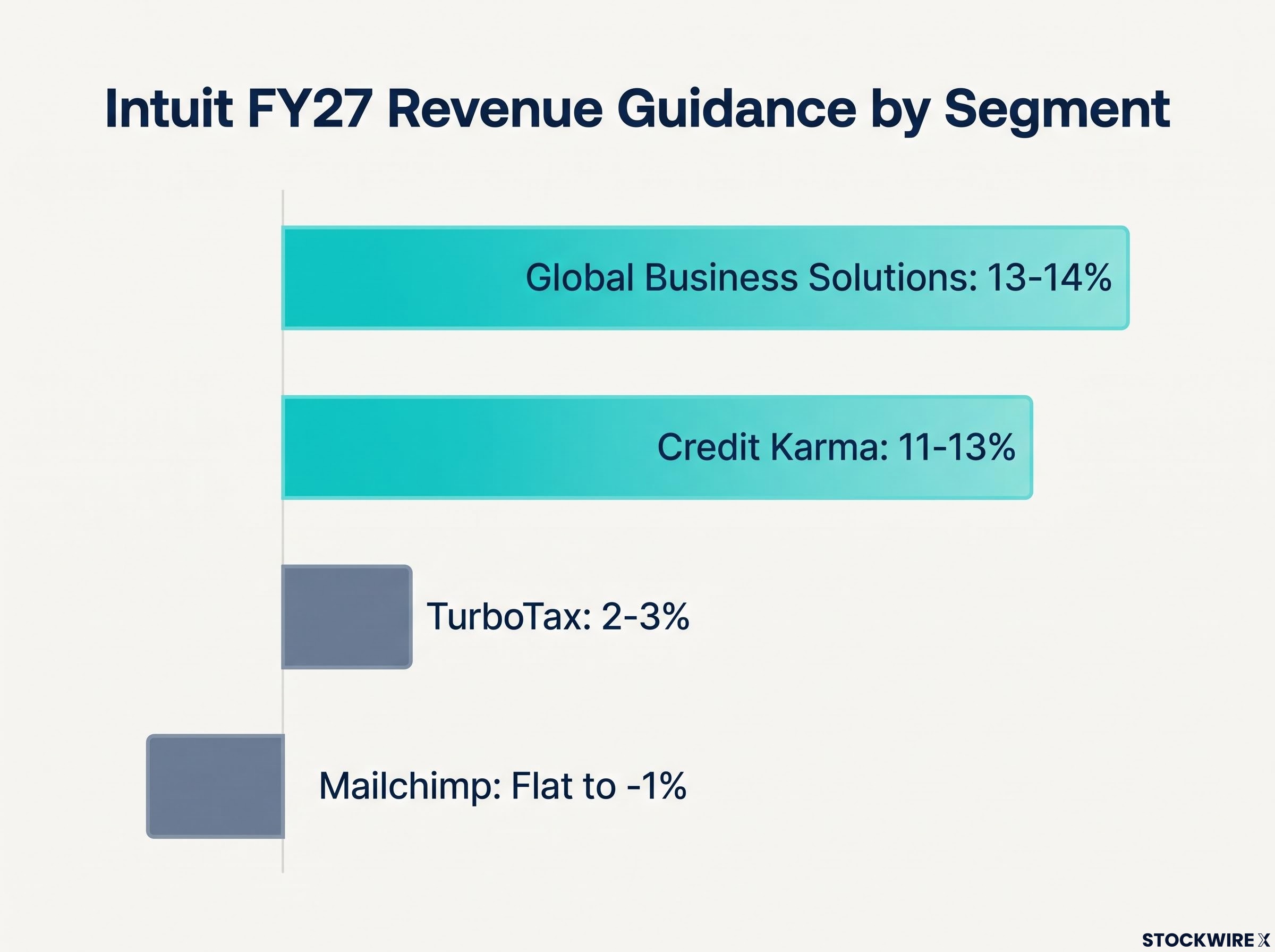
| Segment | FY26 Growth | FY27 Guidance |
|---|---|---|
| TurboTax | ~7% | 2-3% |
| Global Business Solutions | — | 13-14% |
| Credit Karma | — | 11-13% |
| Mailchimp | — | Flat to -1% |
TurboTax is doing the damage. A deceleration from approximately 7% to 2-3% is what pulled the consolidated number down and gave the sell-off its justification. Global Business Solutions (GBS), guided at 13-14%, is growing at more than four times the rate of the tax franchise. Credit Karma at 11-13% adds a second double-digit grower. The “guidance miss” is really a TurboTax story wearing a company-wide label.
Management described the TurboTax slowdown as the result of intentional decisions to prioritise customer volume and market share over near-term revenue per user, accepting a lower initial yield per customer in pursuit of a larger long-term base.
The TurboTax Live pivot is the structural subplot that the FY27 guidance number compresses into a single deceleration figure: TurboTax Live crossed $2.8 billion in revenue and grew 36% in FY26, now representing over half of total TurboTax revenue and signalling a deliberate repositioning toward higher-value, human-assisted filing rather than volume-driven DIY growth.
FY27 Non-GAAP EPS Guidance: $22.88-$23.12, representing 23-24% year-over-year growth, guided on the same evening the revenue figure disappointed.
Profitability growing faster than revenue: what that signals
A business posting 23-24% EPS growth alongside 9-10% revenue growth is not exhibiting the hallmarks of structural deterioration. It tells you management is expanding margins, likely through operating leverage and disciplined cost management, even as it accepts near-term top-line pressure. The specific guided range of $22.88-$23.12 lets you verify the calculation directly. A reader who stops at “revenue miss” without examining the profitability layer is reading half the story.
When big ASX news breaks, our subscribers know first
The cash engine most investors overlooked in the sell-off
The sell-off priced the stock on revenue growth optics. The cash flow statement told a different story entirely.
FY26 free cash flow: approximately $8.617 billion (from operating cash flow of $8.838 billion), representing the capital generation capacity that funds everything else in the investment case.
That $8.617 billion in free cash flow powered three capital return actions in FY26:
Intuit’s 8-K filing with the SEC, dated 25 August 2026, formally discloses the $5.5 billion in share repurchases, the non-GAAP EPS guidance range of $22.88-$23.12, and the free cash flow figures that underpin the capital return programme.
- $5.5 billion in share repurchases
- A quarterly dividend raised 15% year-over-year to $1.38 per share, payable 16 October 2026
- Continued reinvestment into the strategic growth initiatives covered below
Here is the mechanical relationship that matters at the current price. When a stock falls on a guidance disappointment, the free cash flow yield improves for anyone buying at the new level. At approximately $326 per share following the sell-off, the yield on that $8.617 billion cash flow figure is materially more attractive than it was at the pre-earnings price.
This does not make the guidance miss irrelevant. It means the entry point has shifted. An investor evaluating whether Intuit belongs in a portfolio needs to anchor the free cash flow yield first, then layer growth assumptions on top of it, not the other way around. The capital return programme, $5.5 billion in buybacks and a 15% dividend increase, is itself a signal that management views the cash generation as durable enough to commit to shareholders rather than hoard for defensive purposes.
Cash generation is what compounds returns over time. The revenue growth rate is a contributor to that compounding, not a replacement for it. The sell-off focused on the contributor while ignoring the engine.
The growth engines investors are underweighting in the sell-off narrative
The consolidated revenue growth rate of 9-10% understates where Intuit is actually building momentum. Intuit’s FY26 results showed that the company’s three strategic growth priorities, referred to internally as “Big Bets,” delivered combined year-over-year expansion of 34% in FY26 and together made up roughly 30% of total company revenue.
Those three initiatives are:
- Live and assisted tax services: Expanding TurboTax beyond pure do-it-yourself software into human-assisted and AI-assisted filing, targeting the large population of filers who want more help than DIY offers but less cost than a traditional accountant.
- Consumer financial services: Credit Karma-adjacent offerings that monetise the platform’s user base through personalised financial product recommendations and services.
- Mid-market accounting solutions: Expanding QuickBooks upmarket to serve larger small and mid-sized businesses (SMBs) with more complex accounting, payroll, and operational needs.
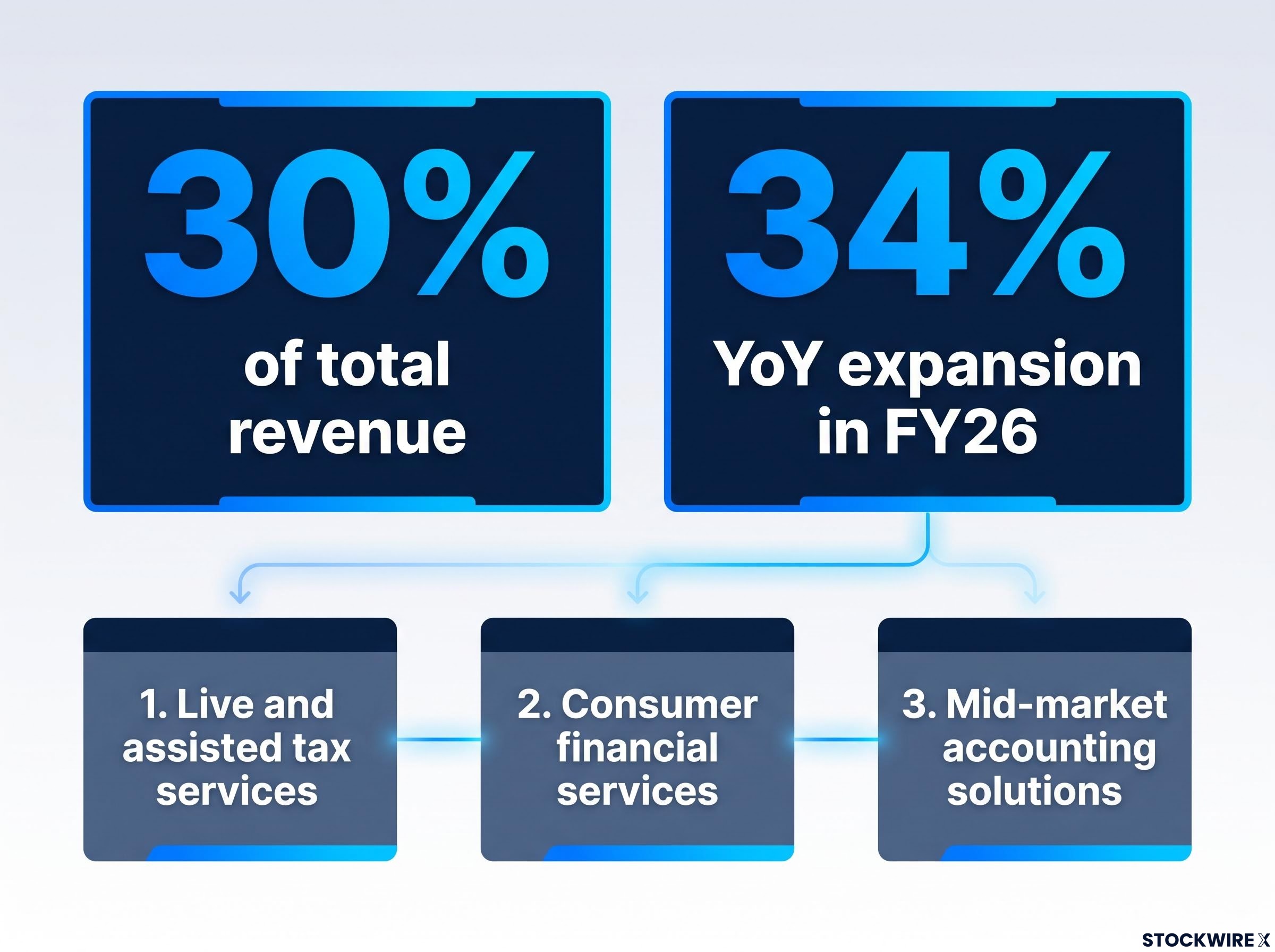
A segment growing at 34% and representing 30% of total revenue is not a marginal initiative. It is the growth engine of the business. The TurboTax drag is real, but it is sitting alongside a 34% growth layer that the headline revenue number compresses into invisibility. Pricing the investment case requires separating these trajectories rather than averaging them into a single deceleration narrative.
The Global Business Solutions trajectory reinforces the Big Bets framing: GBS grew 15% in the most recent quarter, with online accounting revenue up 22% and the enterprise tier up 38%, and the segment is projected to represent approximately 70% of total operating profit within a few years, making it the dominant earnings engine of the business even as it remains underweighted in the headline revenue narrative.
Intuit as an AI participant, not just a target
The AI disruption risk to TurboTax gets significant attention, and deservedly so (more on that below). But Intuit is simultaneously running an offensive AI strategy within QuickBooks, using the technology to widen the product’s appeal and pull in larger SMB customers that the platform previously could not serve. The distinction matters: rather than treating AI purely as an external threat to manage, the company is actively using it to extend its addressable market into higher-value customer segments.
The risk that actually explains the multiple compression
The sell-off was not just about a revenue miss. It was about what the TurboTax deceleration implies for the long-term franchise value of Intuit’s largest consumer brand.
The concern is specific and analytically grounded: autonomous AI filing tools could, over time, reduce demand for both DIY tax software and live-assisted services. Analyst commentary suggests TurboTax’s long-term annual growth range may need to be reset to 4-6% per year, down from a prior implied range of approximately 6-10%.
The AI cost per return dynamic is what gives the structural disruption argument its sharpest edge: AI-native tools can process a standard tax filing for approximately $0.12, versus TurboTax’s blended average of roughly $162, a cost gap wide enough to sustain aggressive competitive pricing without requiring venture capital subsidy.
The growth reset in focus: Analyst estimates suggest TurboTax’s long-term trajectory may settle at 4-6% annually, versus a prior implied range of approximately 6-10%. This is analyst commentary, not company guidance, but it frames the structural question the market is pricing.
That is the overhang compressing the valuation multiple. It is not a market panic narrative. It is a legitimate scenario in which the most recognisable product in the portfolio faces secular erosion from a technology wave that is still accelerating.
The counterarguments are structural, not dismissive:
- Behavioural inertia: Financial decisions are among the most habit-driven areas of consumer behaviour. Tax filing requires sharing sensitive personal data, and the credibility threshold required for an AI-only alternative to win that trust is considerably steeper than in most software categories.
- Switching costs in small-business accounting: Established workflows, historical records, and third-party integrations inside QuickBooks make rapid displacement unlikely in the near term, even if AI alternatives improve quickly.
- Offensive AI deployment: As noted above, Intuit is using AI to expand its own product capabilities, not simply waiting to be disrupted.
None of these counterarguments eliminate the risk. They moderate the timeline. The downside scenario, accelerated AI disruption, sustained TurboTax pressure below the 2-3% guided figure, and a permanently compressed multiple, is a coherent outcome path. Buying Intuit at the current price means explicitly accepting and pricing that uncertainty, not assuming it resolves in the company’s favour.
Weighing the scenarios at today’s entry price
The current price is not pricing in optimism. It is pricing in a structurally challenged business. The long-term question is whether that characterisation is accurate or overdone.
| Scenario | Key Assumption | Implied Outcome |
|---|---|---|
| Base | 9-10% FY27 revenue growth; GBS at 13-14%; margin expansion continues | Estimated 5-10% annual organic diluted growth layered on prevailing free cash flow yield |
| Upside | Market concludes Intuit is not structurally declining; multiple re-rates | Re-rating toward 15-20x free cash flow delivers additional upside beyond base |
| Downside | AI disruption accelerates; TurboTax growth stays at or below 2-3%; multiple stays compressed | Permanently lower growth profile; limited upside from current levels |
Scenario framing note: The upside re-rating toward 15-20x free cash flow is a valuation scenario, not a forecast. It represents what the stock could command if the market’s structural-decline thesis proves wrong. The 5-10% annual organic diluted growth estimate in the base case is a scenario assumption, not company guidance.
The base case anchors on the FY27 guidance itself: 9-10% revenue growth, GBS at 13-14%, and non-GAAP EPS of $22.88-$23.12. Built on top of a free cash flow yield that has shifted more favourably through the sell-off, this combination can generate meaningful total returns without requiring any valuation expansion from current levels.
The upside requires the market to change its mind about the structural narrative. The downside requires AI disruption to arrive faster than current behavioural patterns suggest is near-term likely. Neither outcome is implausible. Both should be weighted.
What a disciplined investor does with this information now
The sell-off is based on a real and documented guidance miss. The revenue deceleration from 14% to 9-10% is not a rounding error. But the cash flow profile, the capital return programme, and the 34% growth in the Big Bets collectively suggest the market may be over-weighting near-term revenue optics at the expense of the compounding story underneath.
The variables that will determine which scenario unfolds are specific and trackable:
- TurboTax growth trajectory in Q1 and Q2 FY27: Does the 2-3% guidance hold, or does growth deteriorate further? Early data will signal whether management’s customer acquisition tradeoff is producing results.
- Big Bets revenue share progression: Watch whether the 30% share of total revenue moves toward 35% or higher. That trajectory determines how quickly the growth engines offset the TurboTax drag.
- Observable AI substitution signals in consumer tax filing: Any measurable shift in consumer behaviour toward AI-only filing tools would accelerate the downside scenario and invalidate the behavioural inertia argument.
The next significant data point will be Intuit’s Q1 FY27 earnings release. Until then, the investment decision comes down to how much weight you assign to the AI disruption scenario and how quickly you believe it could materialise. That is not a hedge; it is the genuine crux of the analytical problem. The evidence available today does not resolve cleanly in favour of either the opportunity case or the risk case, which means your own assessment of that probability is the deciding variable.
This article is for informational purposes only and should not be considered financial advice. Investors should conduct their own research and consult with financial professionals before making investment decisions. These statements regarding future scenarios are speculative and subject to change based on market developments and company performance.