
Intuit just reported that TurboTax lost real DIY customers in fiscal 2026, not the disposable free-tier users management had previously implied were being strategically pruned. Shares fell roughly 12-13% the day after the 25 August results. The stock market, it turns out, noticed the difference.
This is not a story about a company having a bad quarter. It is a story about a pricing strategy hitting its structural ceiling in one segment while management races to prevent the same ceiling from appearing in another. TurboTax and QuickBooks together represent the core of Intuit’s profit engine, and both are now being managed under a fundamentally different set of assumptions than the ones that drove the bull case for the past several years.
Here is how to think about where the damage is real, where Intuit is acting ahead of the problem, and whether the repricing of the stock’s risk is already done or whether the market is still catching up.
TurboTax customer losses: when management’s narrative and the data stopped matching
For most of the past two years, Intuit’s management consistently characterised TurboTax unit losses as an acceptable trade-off, arguing that departing users were low-revenue free filers who contributed little to the bottom line. The implication was clear: these were customers the business was happy to release. The unit decline was a feature, not a fault.
The fiscal 2026 numbers tell a different story.
What the numbers actually show
The unit declines are no longer confined to the bottom of the funnel:
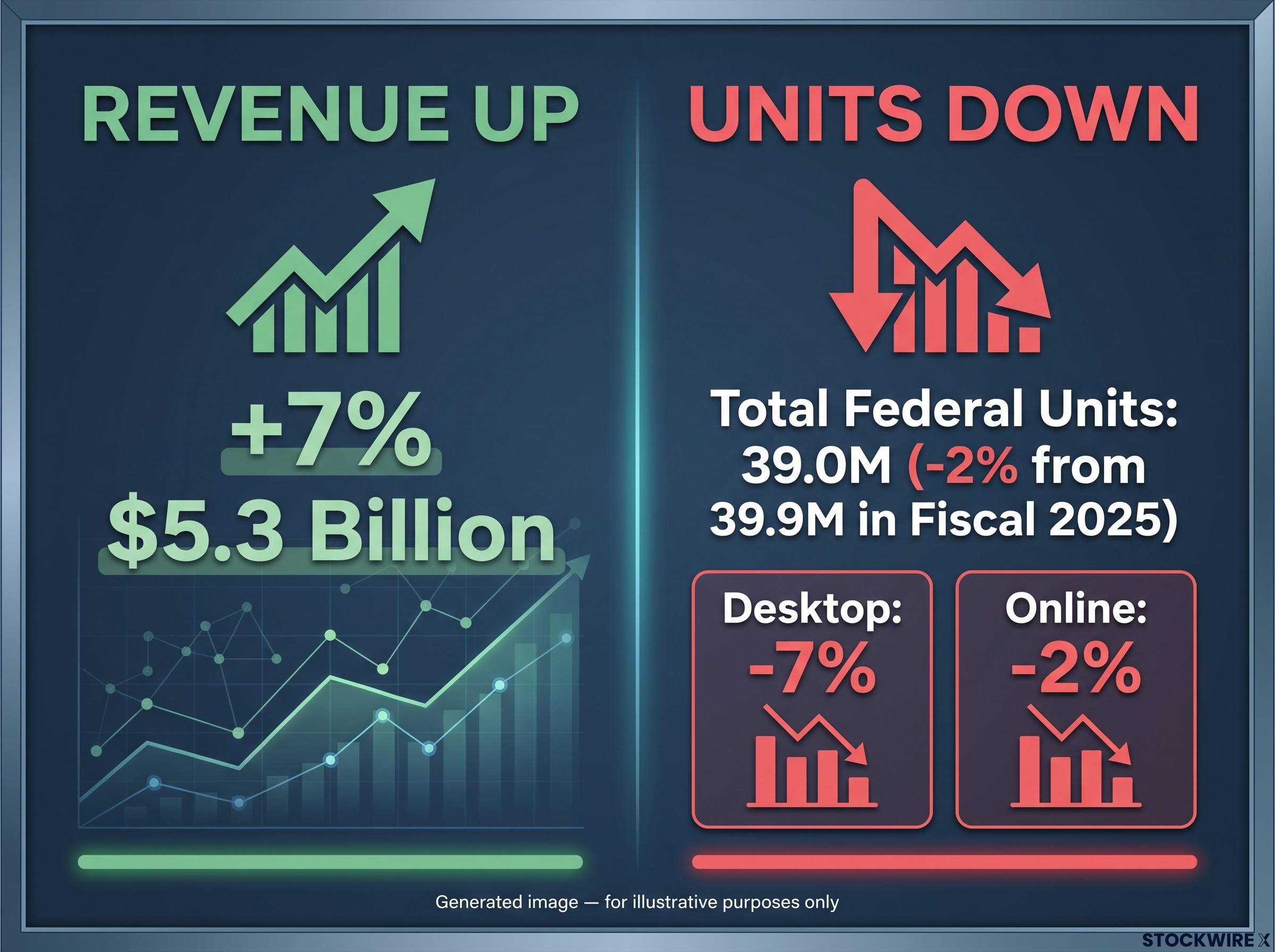
- Total TurboTax federal units came in at 39.0 million, down approximately 2% from 39.9 million in fiscal 2025
- Desktop units fell 7%
- Online units fell 2%
The early signal was visible during the 2024 tax season, when approximately 1 million free users dropped away (from roughly 11 million to 10 million), a loss attributed at the time to IRS Direct File and intensifying competition. That episode was partially discounted. What was not discounted was the possibility that the pressure would migrate upward into the paying DIY base.
Total TurboTax revenue still rose 7% to $5.3 billion. But management cut its revenue guidance anyway. That is the dispositive data point.
The gap between rising revenue and falling units used to be Intuit’s proof that it was trading up the value chain. Now that guidance was still cut despite the revenue gain, the gap reveals a floor problem: price and mix are no longer rescuing the unit trajectory the way the prior investment thesis required them to.
If you held Intuit on the strength of that trade-up story, the fiscal 2026 numbers are the moment to recalibrate. In a mature software business, whether customer departures are self-directed or driven by competitor pressure is not a semantic distinction; it determines whether the loss is recoverable. When the data begins contradicting the framing management has offered, the reliability of forward guidance becomes harder to price.
When big ASX news breaks, our subscribers know first
Why a tax software company is losing customers to a competitor that charges nothing for federal returns
The most dangerous competitor to TurboTax is not a well-resourced incumbent. It is FreeTaxUSA, a lean, low-overhead service that does not need to recoup legacy infrastructure costs.
The pricing arithmetic is worth feeling in your own pocket:
| Service | Federal filing | State filing |
|---|---|---|
| FreeTaxUSA | $0 | ~$16 |
| TurboTax | Significantly higher across tiers | Additional fee per tier |
According to third-party data, FreeTaxUSA has been drawing inquiries from prospective new customers at several times its prior rate. That is not a fringe competitor picking up bargain hunters. That is a service reshaping the reference price for the entire category.
Morgan Stanley has explicitly linked TurboTax’s market share losses to Intuit’s reliance on significant price hikes in a saturated DIY market, noting that rising prices have outpaced customers’ willingness to pay.
Then there is the competitor Intuit cannot price against at all. IRS Direct File is a government-provided free filing option. Intuit cannot undercut it, acquire it, or lobby it away. Its expansion is a variable that sits entirely outside the company’s control.
The AI competitive threat to TurboTax extends beyond FreeTaxUSA: Goldman Sachs projects that AI-native preparation tools processing returns for roughly $0.12 can sustain aggressive pricing without venture capital subsidy, a cost structure that makes TurboTax’s blended $162 average revenue per return increasingly difficult to defend on price alone.
The real risk is not this year’s unit decline. It is the habit-formation dynamic. People use tax software once annually, and the friction of switching is substantial ahead of that first successful move to a new platform, but negligible once it has been completed. A DIY filer who successfully files through FreeTaxUSA or IRS Direct File faces a sharply lower barrier to doing the same thing next year. Each lost customer compounds rather than recovers. If you are pricing Intuit as though churn is recoverable, the habit-driven nature of the product suggests otherwise.
What TurboTax and QuickBooks pricing actually have in common
The TurboTax problem is not contained to the tax segment. It is an expression of a broader playbook that Intuit has applied across both of its largest products: persistent price hikes on a captive installed base as the primary growth mechanism in a mature segment.
QuickBooks has followed the same trajectory. The question is whether management can intervene before it produces the same result.
Price elasticity, in simple terms, is the degree to which customers respond to price changes. A product with low price elasticity can raise prices without losing many buyers. A product with high price elasticity cannot. The conventional assumption was that TurboTax and QuickBooks both had low price elasticity because of switching costs and habit. TurboTax’s unit data suggests the ceiling was lower than modelled.
The QuickBooks pricing trajectory in numbers
The specific price increases that took effect on 1 August 2026 show how aggressively the playbook has been applied:
- QuickBooks Plus rose from approximately $115 to $140 per month
- QuickBooks Advanced rose from approximately $275 to $340 per month
The statistical fingerprint of the same pattern is already visible. The QuickBooks online paying customer base stood at 8.9 million, expanding by just under 3% compared with the prior year. Over the same period, average revenue per QuickBooks customer climbed by roughly 15%.
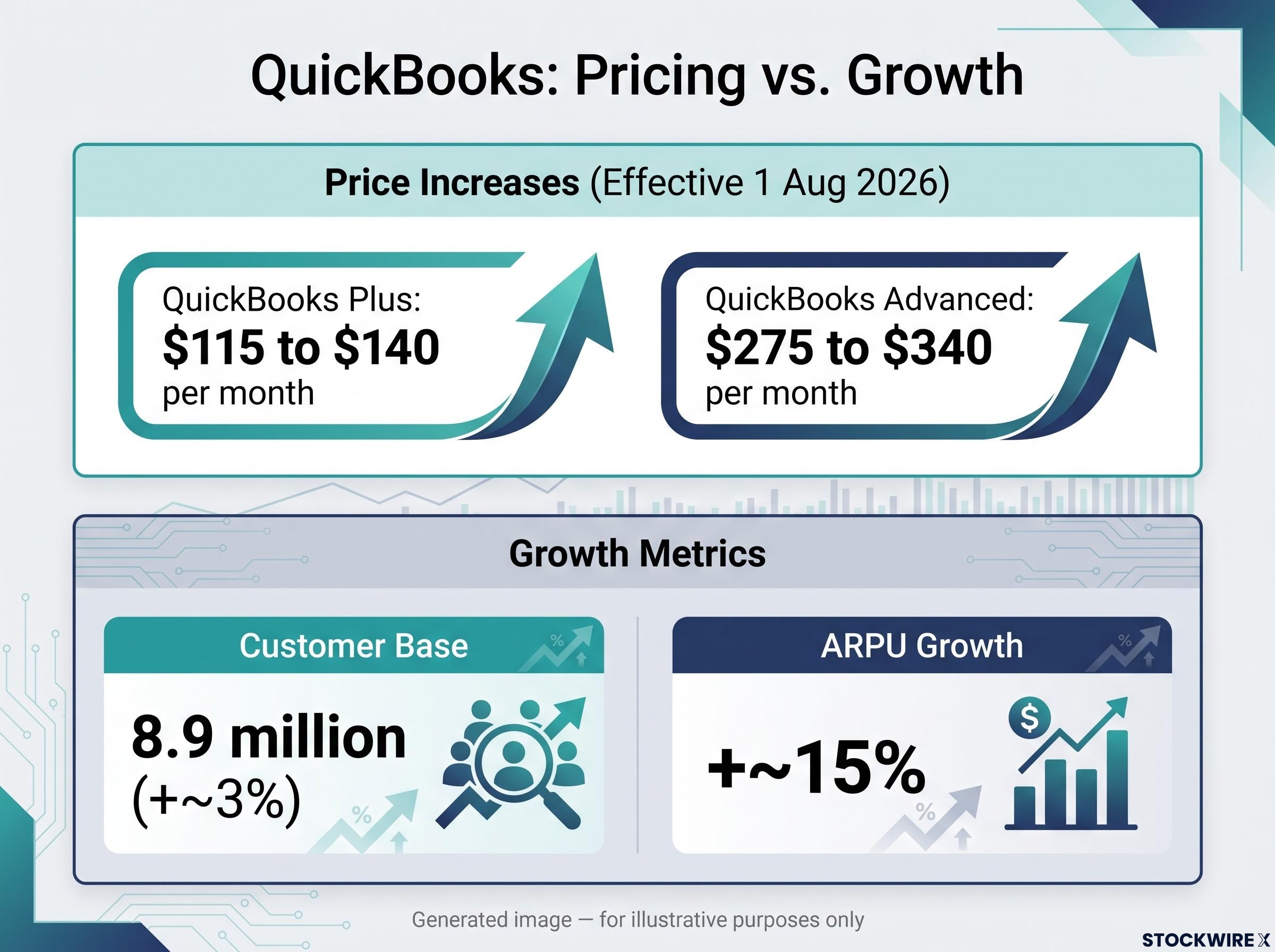
That 3% customer growth figure alongside 15% ARPU (average revenue per user) growth is the same dynamic that preceded TurboTax’s problems. It looks like a smart monetisation strategy right up until the base stops growing and the concentrated pricing exposure becomes visible. For investors, recognising this structural parallel is what turns the fiscal 2026 results from a tax-segment event into a business-model-level question.
How Intuit is rewriting the QuickBooks strategy before the problem becomes a crisis
To management’s credit, they are not waiting for the QuickBooks ceiling to arrive. The course correction is already underway, and the early data on the upmarket push is genuinely strong.
Intuit’s restructuring payback period is shorter than most investors have modelled: the 17% global workforce reduction is projected to generate $800 million to $1 billion in annualised savings against a one-time charge of $600-700 million, a ratio that compresses the recovery timeline even as revenue guidance is cut.
The strategy operates on two fronts at once. At the higher end, Intuit is pursuing mid-sized businesses whose operational complexity justifies a meaningfully larger spend on software. At the lower end, it is rolling out more affordable entry-level tiers aimed at very small and solo operators, widening the total pool of addressable customers even if some existing revenue is cannibalised in the process.
| Metric | Figure | Period | What it signals |
|---|---|---|---|
| Mid-market revenue growth | ~39% | FY2026 | Upmarket push is gaining traction |
| Mid-market customer count growth | ~28% | FY2026 | New customers, not just higher prices |
| Online financial services revenue growth | ~31% | FY2026 | Ecosystem monetisation is scaling |
| GBS forward guidance | ~13-14% | FY2027 | Growth re-anchored, not collapsing |
The QuickBooks Online segment posted revenue growth of roughly 23% over the prior year, a solid headline figure. But the forward guidance is the more telling figure.
The 13-14% Global Business Solutions (GBS) growth guidance for fiscal 2027 is management telling the market that the QuickBooks growth rate has been re-anchored around customer acquisition and service expansion rather than price. That recalibration comes at a cost to near-term revenue per user.
The dual-direction strategy is structurally sounder than continuing to escalate core subscription prices. But it requires simultaneous execution on multiple fronts, each carrying lower individual certainty than the prior playbook of raising prices on a captive base. Whether that trade is already priced into the stock is the live question.
The three things that have to go right for the Intuit investment case to hold
The stock market has already delivered two verdicts in quick succession. Shares fell sharply after the May 2026 TurboTax revenue miss and restructuring announcement. Then they fell approximately 12-13% on 26 August following the full-year results.
Two rounds of significant declines in three months. The first was the TurboTax bear case arriving. The second was QuickBooks guidance moderation adding a new risk layer on the same day. The cumulative re-rating tells you the market does not yet consider the repricing complete.
For the investment case to hold from here, three things need to go right at the same time:
- Stabilise TurboTax DIY units in the face of FreeTaxUSA and IRS Direct File, two competitors that cannot be outspent or acquired
- Shift QuickBooks growth onto a new footing by prioritising customer additions and expanded services over annual price increases, even if that means accepting lower revenue per user in the near term
- Prove that ecosystem monetisation can offset the structural headwinds: TurboTax Live assisted filing expanded at roughly 37-38% year-over-year, and customers enrolled across both TurboTax and Credit Karma produced around double the revenue of the average single-product user, though neither stream is yet large enough to fill the gap left by unit losses and reduced guidance
What a credible bull case requires from here
TurboTax Live and Credit Karma monetisation would need to demonstrate sustained acceleration at scale, not just percentage growth off a smaller base. Within the QuickBooks business, the mid-market segment posted roughly 39% revenue growth and 28% customer count growth in fiscal 2026, making it the most important near-term indicator of whether genuine product-led expansion can substitute for pricing leverage.
The TurboTax Live revenue trajectory tells a more complicated story than the DIY unit decline alone: at $2.8 billion in revenue and 36% growth, the assisted filing segment now represents over half of total TurboTax revenue, a structural shift that changes how the division’s unit economics should be read by investors assessing whether the selloff reflects real impairment.
The question is whether the stock is pricing in a return to form or a sustained growth recalibration. A 12-13% single-day decline after an already-weak prior quarter suggests the market is leaning toward the latter, and investors who bought Intuit as a clean price-escalation compounder are now holding a more complex execution story.
What the Intuit re-rating tells investors who are still in the stock
The fundamental shift is in the character of the growth story itself. Intuit has transitioned from a business where a single high-conviction lever, raising prices on a captive base, drove predictable returns, to one where several lower-certainty initiatives must all deliver simultaneously to replicate the prior trajectory.
The specific metrics to track in fiscal 2027 to test whether the course correction is working:
- TurboTax DIY unit trends into the 2027 tax season: the primary indicator of whether the pricing recalibration is stabilising the base
- QuickBooks customer acquisition growth rate: whether new customer adds accelerate beyond the 3% figure that signalled saturation in fiscal 2026
- Mid-market customer count trajectory: the most concrete current evidence that Intuit can expand through product capability rather than price escalation
The question for existing shareholders is not whether Intuit is a bad business. It is whether it is still the business they originally underwrote. On the evidence of 25 August, the honest answer is: not entirely. That does not necessarily mean sell. It means the investment carries a different risk profile than the one that justified the original position sizing.
IRS Direct File remains the variable entirely outside Intuit’s control. Its expansion could accelerate or stall depending on political and budgetary decisions that have nothing to do with Intuit’s product quality. That non-commercial risk cannot be managed away, only sized for.
Position sizing, not binary conviction, is the appropriate response to a thesis that has changed shape but not collapsed.
This article is for informational purposes only and should not be considered financial advice. Investors should conduct their own research and consult with financial professionals before making investment decisions. Past performance does not guarantee future results. Financial projections are subject to market conditions and various risk factors.