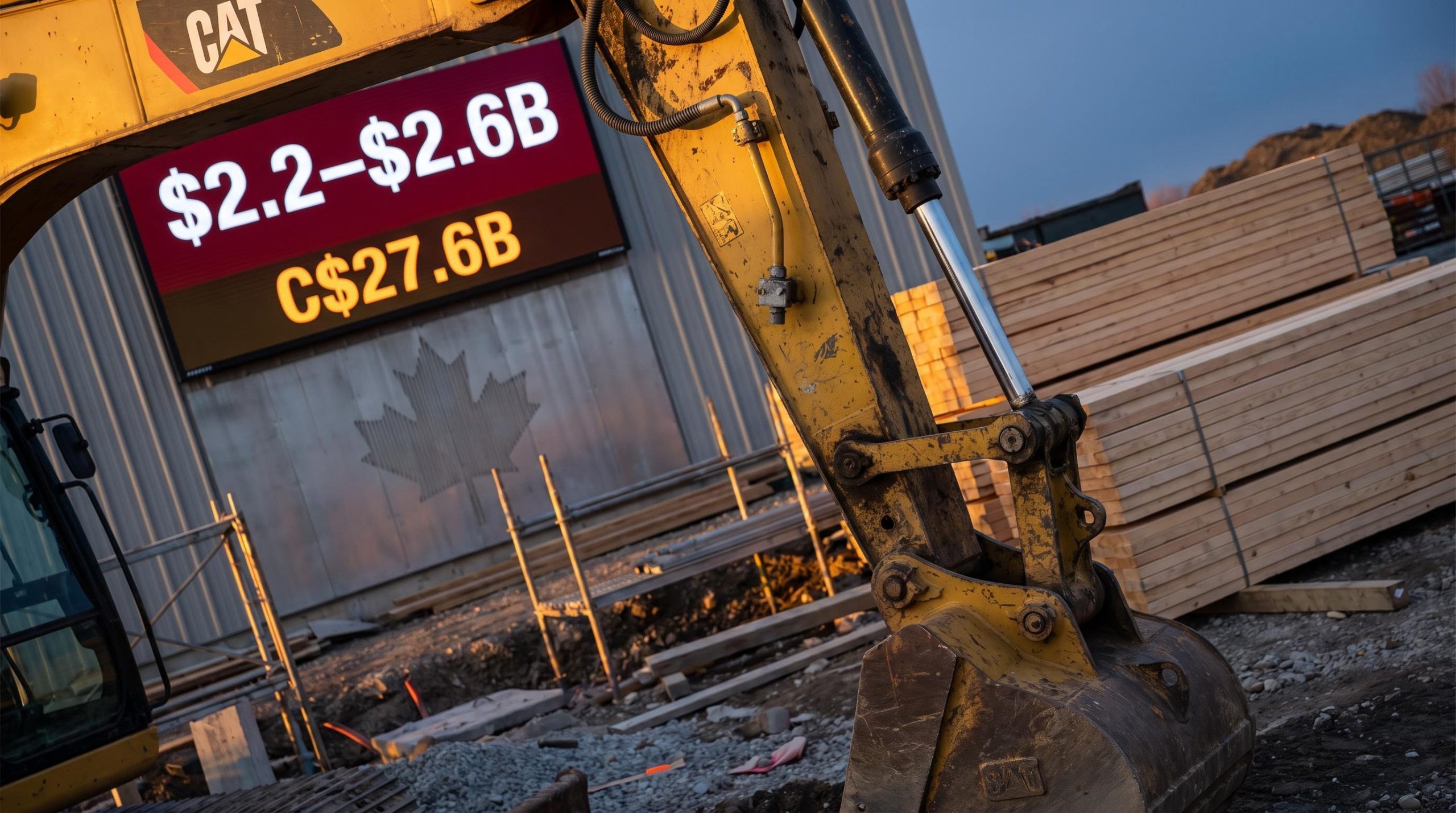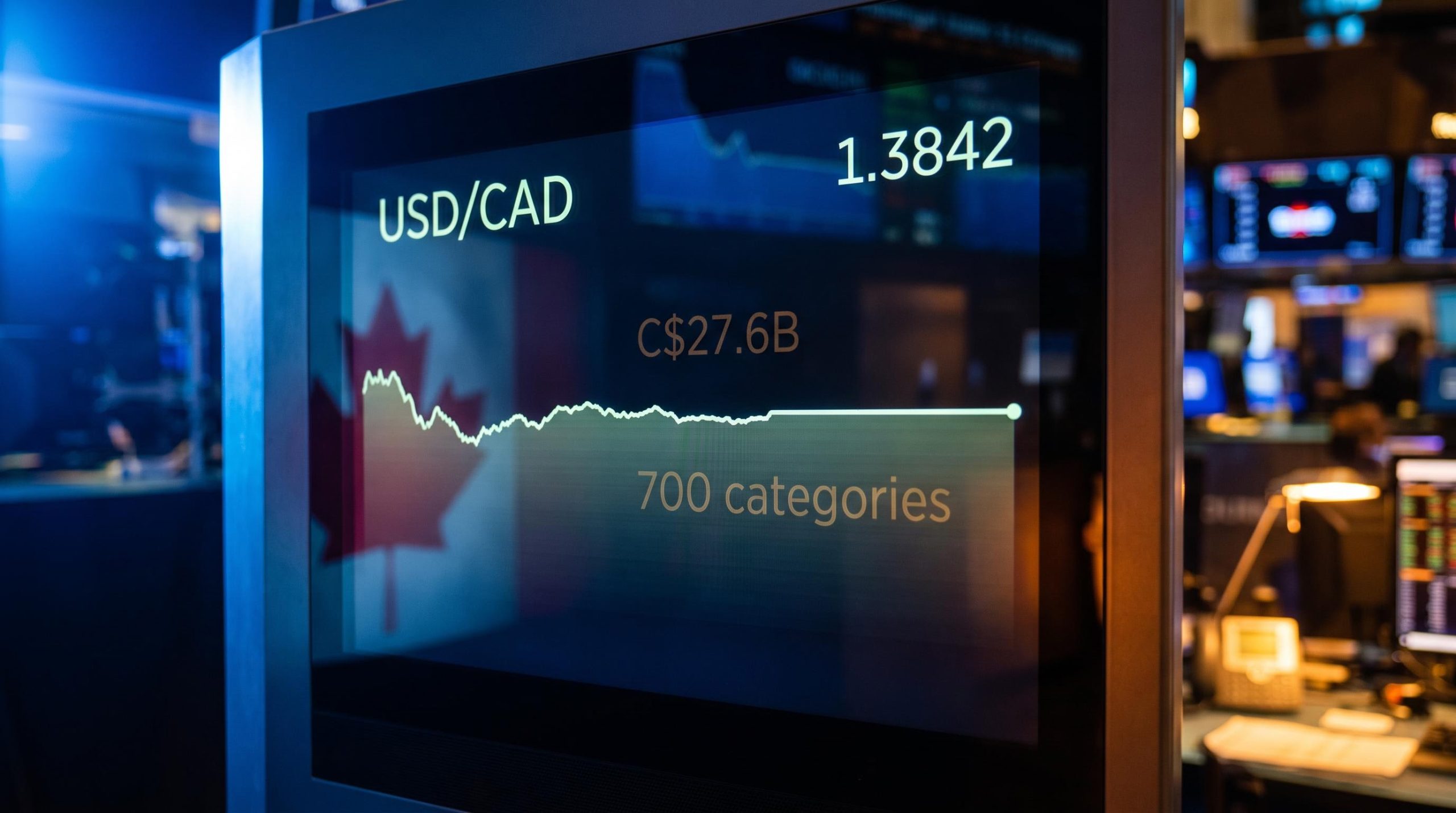
Canada announced one of its largest retaliatory trade packages in recent memory on 25 August 2026, covering roughly 700 product categories and worth C$27.6 billion. USD/CAD barely moved. The pair traded close to 1.3842, Scotiabank’s fair-value estimate, with only modest intraday movement. For a package of this scale, the foreign exchange market’s response was almost silent.
The contrast between the announcement’s weight and the market’s indifference is the puzzle worth working through. A C$7.5 billion domestic support fund accompanied the tariffs, adding further headline gravity. Yet the loonie held its ground, and the institutional explanation for why it did so tells you more about how currency markets actually price trade policy than the tariff numbers themselves.
Here is what the market’s non-reaction tells you about trade-driven currency moves, and the specific conditions that would have to change to produce the sharp CAD selloff the headlines seemed to warrant. The framework that explains this episode is the same one that will help you read the next trade-driven FX non-reaction, wherever it occurs.
The anatomy of a non-reaction: what USD/CAD actually did on August 25
On the session, spot USD/CAD held right around Scotiabank’s fair-value estimate of 1.3842, with intraday price action remaining contained. The short-term interest rate differential between Canadian and US government bonds showed little movement, and the prevailing global risk tone was broadly constructive.
That is the factual baseline: a C$27.6 billion retaliatory package landed, and the currency market’s response was measured in basis points, not percentage points.
The earlier CAD sell-off and recovery sequence from the initial tariff announcement illustrates the same probability-weighting logic at work: the market posted a sharp single-session move on announcement day, then reversed sharply when a pause was introduced, confirming that traders were pricing negotiation optionality throughout rather than treating any single headline as a permanent structural shift.
Pre-embedded risk and the information content of this announcement
Scotiabank FX strategists Shaun Osborne and Eric Theoret, in their 25 August 2026 commentary, offered the clearest institutional explanation. The muted reaction was not an oversight. It was rational positioning.
Scotiabank explicitly attributed the session’s calm to interest-rate differentials and risk sentiment as the dominant CAD drivers, not tariff headlines themselves.
The key word there is “dominant.” Tariffs were not irrelevant; they were simply not the variable moving the needle on this particular day. CAD’s level already incorporated the cumulative weight of prior tariff episodes, meaning the marginal information content of the August 25 announcement was lower than the headline numbers implied. The market had already done the work of pricing Canada-US trade risk before this package landed, which is precisely why the package itself moved almost nothing.
VP Vance’s acknowledgment that US-Canada trade talks were continuing added a moderating signal. If the worst-case scenario still had active negotiations working against it, the probability distribution facing traders had not shifted enough to justify aggressive repositioning.
The fact that USD/CAD sat at Scotiabank’s fair-value estimate tells you something specific: the market was not ignoring the tariffs. It had already absorbed them into the price. That distinction matters, because it means identical headlines can produce very different FX outcomes at different points in a trade dispute cycle.
When big ASX news breaks, our subscribers know first
Two dates that explain everything: September 8 and January 1, 2027
The tariff story is not one event. It is a two-stage architecture with built-in time buffers, and understanding the structure explains why markets felt no urgency to reprice sharply.
The two-stage repricing structure now facing markets emerged directly from the US-Canada trade war escalation that activated 50% tariffs on roughly $20 billion of Canadian imports while simultaneously setting the September 8 retaliation date, creating the calendar architecture the current calm depends on.
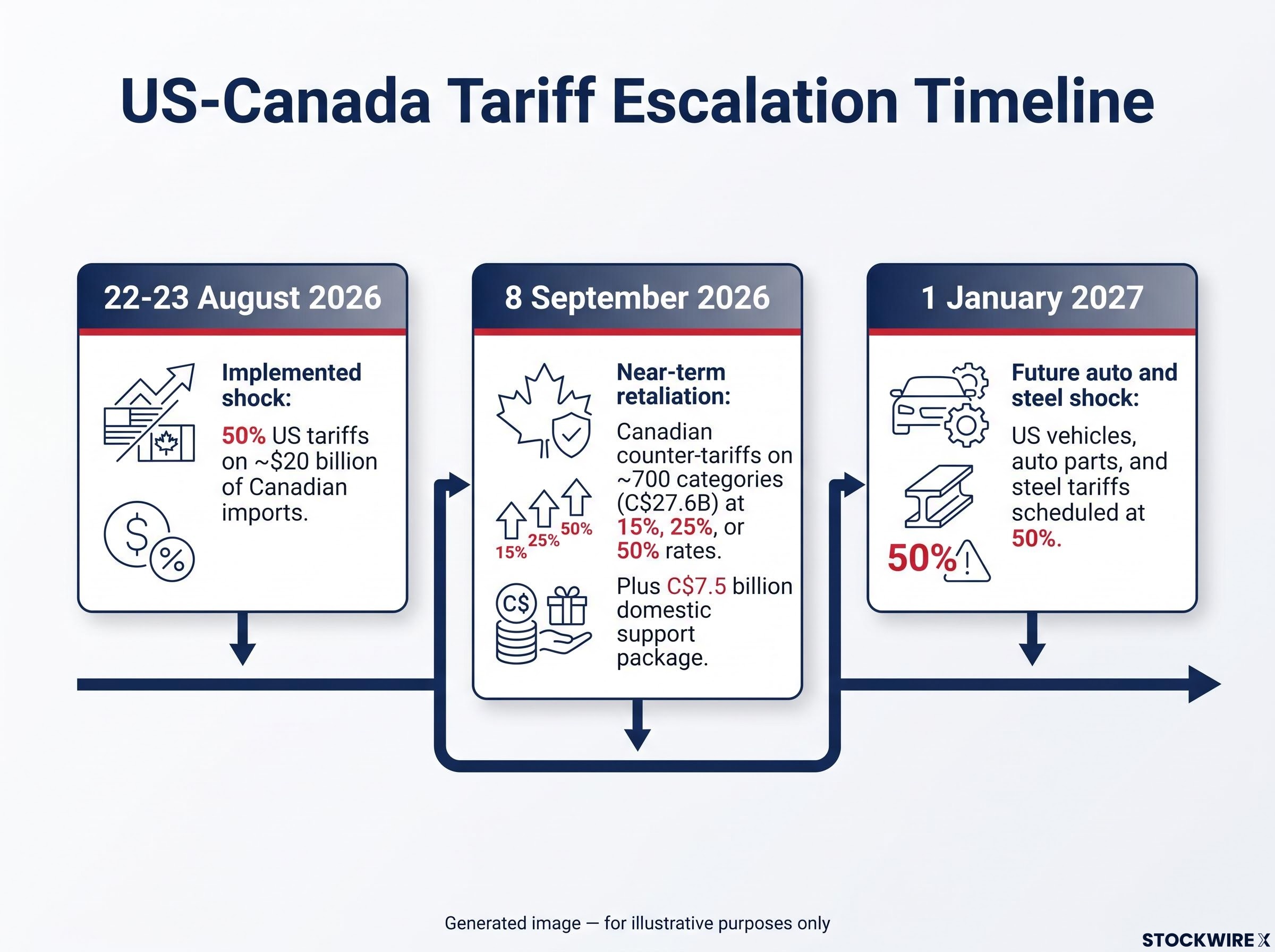
Stage one is already in force. A fresh round of 50% US tariffs on roughly $20 billion of Canadian imports took effect over the weekend of 22-23 August 2026, after trade talks collapsed. The retaliatory measures Canada has announced span 700 product categories with rates of 15%, 25%, or 50%, but they do not take effect until 8 September 2026, leaving both sides a runway of several weeks before the next escalation materialises.
Stage two sits further out. The January 2027 deadline brings a further escalation, with US tariffs on Canadian vehicles, auto parts, and steel all set to reach 50%, a substantial step up from the rates currently in force.
The escalation unfolds in three distinct phases:
- Implemented shock (22-23 August 2026): 50% US tariffs on approximately $20 billion of Canadian imports, now in force
- Near-term retaliation (8 September 2026): Canadian counter-tariffs across 700 categories at 15%, 25%, or 50% rates, plus a C$7.5 billion domestic support package covering SMEs, liquidity support, and worker assistance
- Future auto and steel shock (1 January 2027): US vehicles, auto parts, and steel tariffs rising to 50%
| Date | Measure | Scope | Rate | Status |
|---|---|---|---|---|
| 22-23 August 2026 | US tariffs on Canadian imports | ~$20 billion of goods | 50% | In Force |
| 8 September 2026 | Canadian retaliatory tariffs | ~700 categories (C$27.6B) | 15%, 25%, or 50% | Scheduled |
| 1 January 2027 | US auto, parts, and steel tariffs | Vehicles, auto parts, steel | 50% | Scheduled |
The six-month-plus gap before the January scenario is not a deadline. It is a pressure valve. As long as it sits in the future, the market can assign meaningful probability to a negotiated outcome, which is precisely why the worst-case FX scenario has not yet been priced. Traders have a runway to assess negotiation progress before aggressively repositioning CAD, and they are using it.
That distinction between implementation timelines as administrative footnotes and implementation timelines as market variables is what separates a surface reading of this story from an institutional one.
How markets price trade uncertainty: probability distributions, not headlines
Currency markets do not react mechanically to worst-case headline scenarios. They price a distribution of possible outcomes, weighting each by probability. A probability distribution, in this context, is the range of scenarios the market considers plausible, from full de-escalation to maximum tariff implementation, with each assigned a likelihood that informs the current spot price. This is the foundational concept for understanding any trade-driven FX move, and it is the reason a C$27.6 billion tariff package can land without moving USD/CAD.
Four reinforcing factors compressed the immediate CAD impact on this session:
- Pre-embedded risk: CAD’s spot level already reflected the cumulative weight of prior tariff episodes, reducing the marginal information content of the new announcement
- Time-buffered implementation: The September 8 and January 1, 2027 dates give traders a runway to gather information before repricing aggressively
- Ongoing negotiations: With US-Canada trade talks still active, the worst-case scenario carries lower probability, dampening the FX response
- Supportive global conditions: A positive risk backdrop and stable front-end yield spreads provided a mechanical cushion against CAD weakness
When all four factors align in the same direction, they do not just add up; they reinforce each other. Pre-embedded risk means the surprise value is low. Time buffers mean there is no urgency to act. Active negotiations mean the worst case is possible but not probable. And a constructive risk environment means the broader FX regime is not amplifying bilateral trade stress.
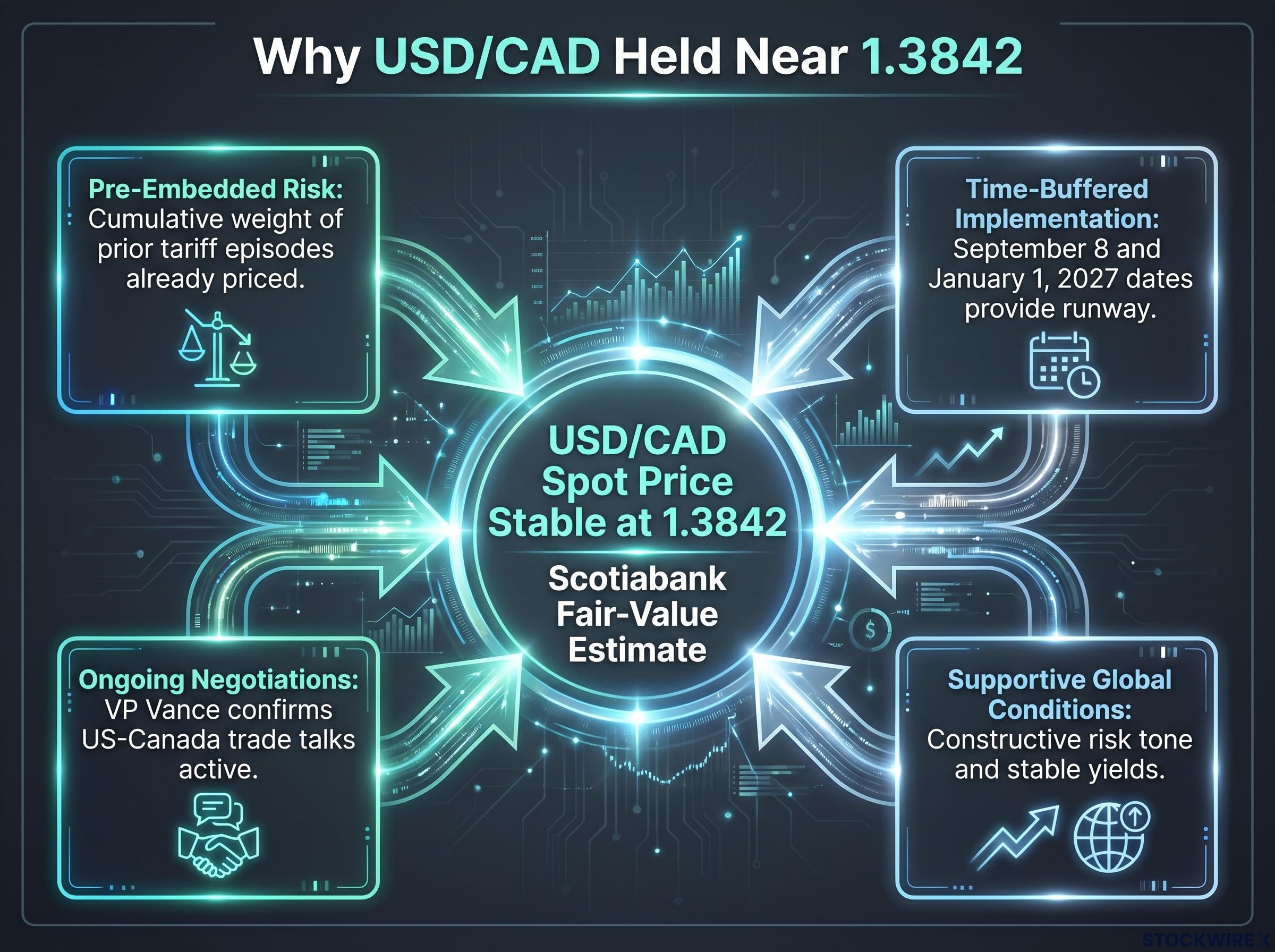
Scotiabank’s Osborne and Theoret explicitly characterised rate differentials and risk sentiment, not the tariff announcement itself, as the dominant drivers of CAD on August 25.
The right question when a tariff headline lands is never “how big is the tariff?” It is always “how much has the market already priced, and what is the probability-weighted path from here?” That reframing completely changes how you read FX non-reactions to political headlines.
The commodity currency multiplier
A counterfactual sharpens the point. If this same announcement had landed on a risk-off day, with weaker oil prices and broader stress across emerging market and commodity-linked currencies, the CAD move would have been materially larger. CAD is a commodity-linked currency, meaning global risk sentiment and oil price conditions act as an amplifier or dampener on bilateral trade news.
Bank of Canada research on oil and CAD risk premiums identifies a systematic oil factor that shapes CAD/USD exchange rate dynamics, confirming that global commodity conditions are not a secondary consideration for the loonie but a primary one that operates alongside bilateral trade variables.
On 25 August 2026, the amplifier was switched off. The constructive risk backdrop actively dampened the tariff signal rather than compounding it. On a different day, with different global conditions, the same package produces a different outcome. That is what makes the concurrent risk regime as important as the tariff rate itself.
What would have to change to move the loonie sharply lower
According to Scotiabank, the Canadian dollar’s near-term downside looks contained so long as trade conditions do not deteriorate materially from current levels. The staggered policy timelines provide a natural de-escalation window.
Scotiabank assessed that downside risks to CAD are likely limited in the near term, absent a significant worsening in trade conditions.
Four conditions could shift that baseline:
TD Securities research on CAD breakdown risk quantified this asymmetry precisely: a negotiation failure would produce a sharper, more rapid move higher in USD/CAD than current market pricing reflects, while a successful deal delivers only a modest 0.1-0.2 percentage point GDP boost with much of that already priced into current positioning.
- Negotiation breakdown: If US-Canada trade talks collapse entirely, the probability-dampening effect of ongoing dialogue disappears, and markets would need to reprice the worst-case scenario at higher odds
- Timeline acceleration: If the January 2027 tariff escalation is pulled forward or 50% tariffs are extended to additional sectors before the scheduled date
- Full auto and steel materialisation: If the vehicle and steel tariff shock takes effect at the scheduled 50% rate without negotiated reduction, the economic hit would be substantially larger than current in-force measures
- Global risk-off shift: Weaker oil prices or broad commodity FX stress would remove the supportive backdrop that cushioned CAD on this session, compounding bilateral trade pressure through the commodity currency channel
The scenario most likely to be underweighted by those anchored to the bilateral tariff story is the Bank of Canada (BoC) policy channel. If trade headwinds translate into weaker Canadian economic data, the BoC may ease more aggressively than currently expected. That would widen the Canada-US rate gap further, adding fundamental downside pressure to CAD through interest rate differentials on top of the direct tariff impact. Two separate transmission mechanisms compounding simultaneously would produce a sharper move than either channel alone.
Three milestone dates give you a concrete monitoring framework, ordered by proximity:
- 8 September 2026: Canadian counter-tariffs take effect
- 1 January 2027: US vehicles, auto parts, and steel tariff escalation to 50% scheduled
- Ongoing: The state of US-Canada trade negotiations in the intervening period
Those three inputs will tell you whether the current calm is a stable equilibrium or a pause before a sharper repricing.
What the market’s non-reaction actually tells you
The muted response to Canada’s retaliatory tariffs on 25 August 2026 was not a market failure. It was the correct response given the probability-weighted path of outcomes available on that session. Pre-embedded risk, time buffers, ongoing negotiations, and a supportive global risk backdrop all reinforced each other, compressing what could have been a volatile session into one where USD/CAD held near Scotiabank’s fair-value estimate of approximately 1.3842.
Muted market reactions to tariffs follow a consistent pattern across asset classes: rational Bayesian updating after more than a year of announce-delay-revise cycles has widened the gap between headline tariff rates and what markets believe will actually be implemented, causing both equity and FX markets to discount announced rates until hard implementation evidence arrives.
The forward-looking question is whether those four conditions hold. 8 September 2026, 1 January 2027, and the trajectory of US-Canada negotiations are the three inputs that will determine whether the current calm persists or gives way to a sharper repricing. A shift in any one of them, particularly a negotiation breakdown coinciding with weaker global risk sentiment, could move CAD faster than any tariff announcement did.
The framework to carry forward is this: when the next trade-driven FX non-reaction arrives, check what was already priced, how much time the market has to gather information, and what the concurrent risk regime looks like. A “no reaction” day is not silence. It is a snapshot of how the market is weighting probabilities at that moment, and that snapshot is only as stable as the conditions underneath it.
This article is for informational purposes only and should not be considered financial advice. Investors should conduct their own research and consult with financial professionals before making investment decisions. These statements are speculative and subject to change based on market developments and policy outcomes.