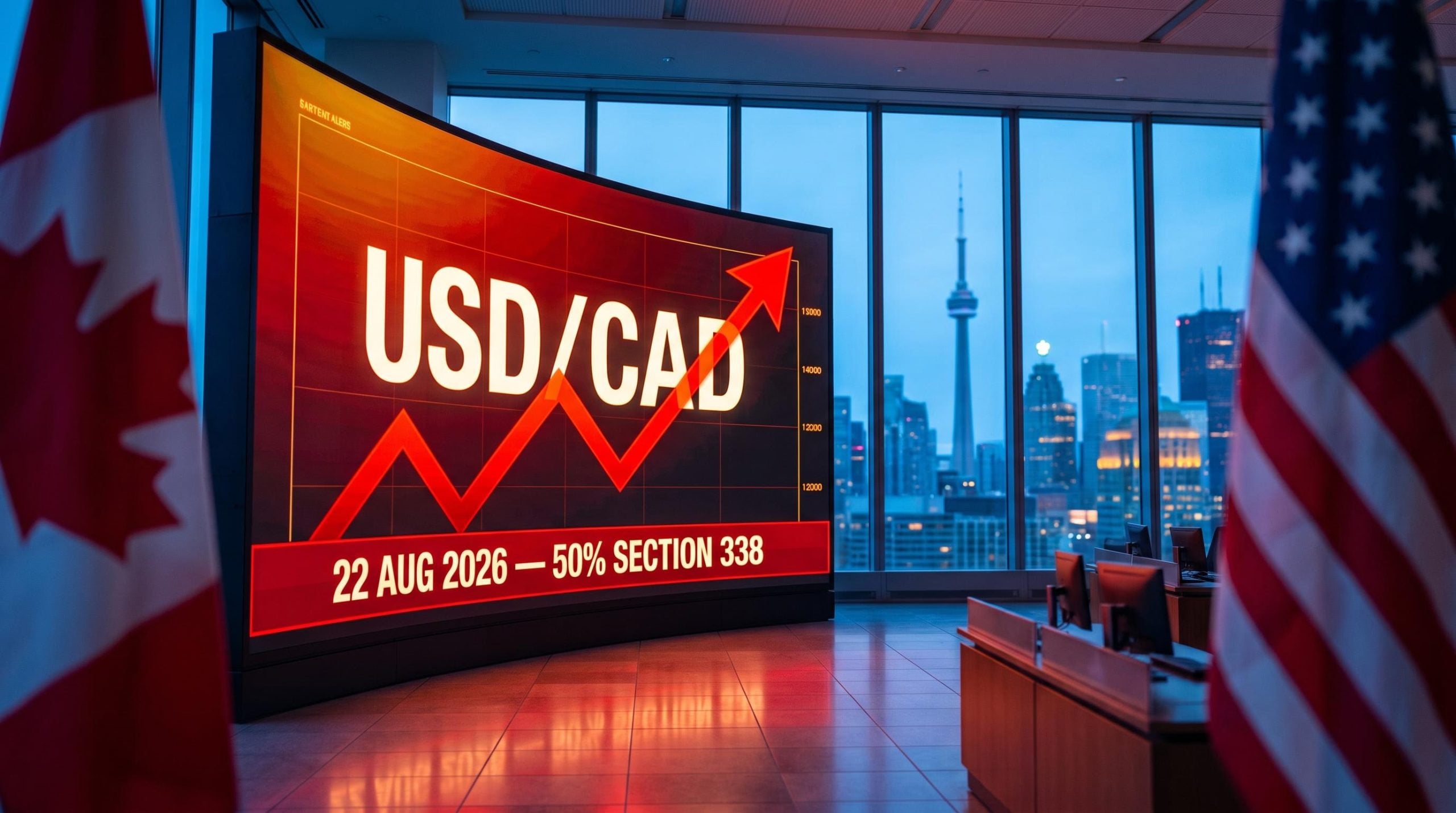
The Saturday deadline on US-Canada tariff negotiations is not a routine trade checkpoint. It is a hard legal trigger: absent a deal or further suspension, an additional 50% duty on roughly $20 billion of Canadian exports activates at 12:01 a.m. ET on 22 August 2026, with no automatic expiration date. Markets, for the most part, are not positioned for that outcome.
According to TD Securities strategists, the setup around this deadline is structurally lopsided. While a successful negotiation would provide some relief for the Canadian Dollar, that relief is modest and partly anticipated. A breakdown, by contrast, would deliver a jolt that current market positioning has not adequately accounted for. With the Bank of Canada expected to hold rates regardless of the outcome, even the deal scenario provides limited upside for CAD through the conventional monetary policy channel.
Here is what the data structure of this event tells you that market positioning does not yet reflect: the actual payoff distribution around this deadline, what Section 338 does and why its invocation is unprecedented, why the Bank of Canada removes one of the usual CAD relief valves, and what that asymmetry means for anyone with exposure to the pair heading into this weekend.
Why Section 338 is a different kind of tariff threat
Markets have spent years learning to price tariff risk through familiar instruments. Section 232 tariffs on steel. IEEPA-based emergency actions. These have become part of the furniture. Section 338 of the Tariff Act is not.
“This is the first known invocation of Section 338 to impose tariffs.”
Section 338 authorises the US to impose additional duties on countries judged to have discriminated against US commerce. The provision has existed for nearly a century, but until now it had never been used to actually impose tariffs. That distinction matters: markets have no precedent for how Section 338 negotiations resolve, how they escalate, or how long the resulting duties persist.
The Section 338 tariff mechanics that matter most for investors go beyond the headline rate: the statute requires no formal investigation, carries no sunset clause, and permits escalation to a full import ban by presidential proclamation alone, making the ceiling on this dispute genuinely open-ended in a way that Section 232 and IEEPA-based actions are not.
The proclamations were issued on 20 July 2026, with the original effective date set for 19 August 2026, calibrated to the statute’s minimum 30-day lead time requirement. A three-day extension to 22 August 2026 was granted for additional negotiating time, not as a signal of substantive progress.
The scope is broad: approximately $20 billion of Canadian exports across hundreds of eight-digit HTSUS tariff lines. Covered categories include motor vehicles, alcoholic beverages, and dairy. Exclusions apply for a narrower set:
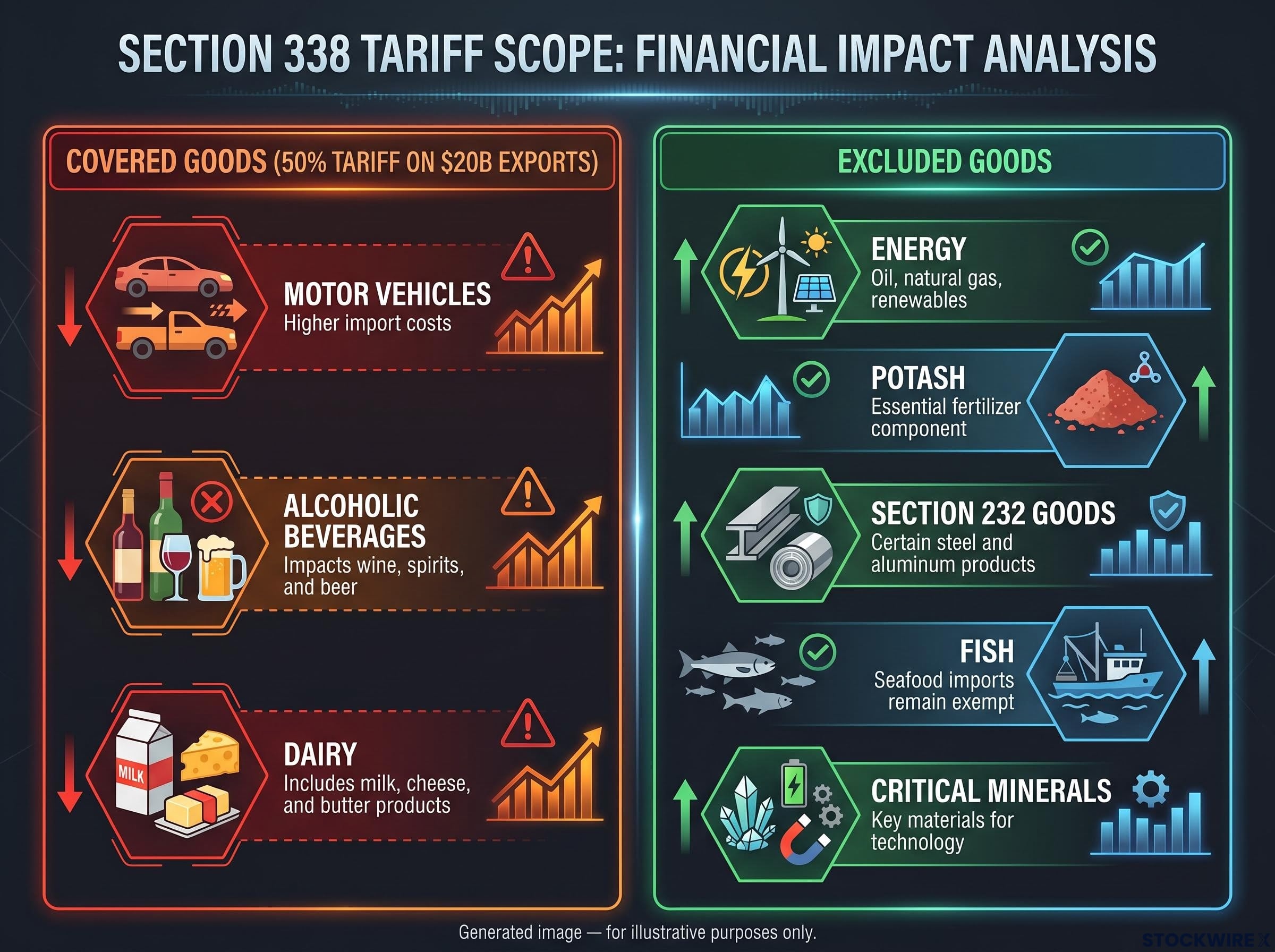
- Energy
- Potash
- Section 232 goods
- Fish
- Critical minerals
The detail that changes the risk calculus entirely is this: the 50% ad valorem tariff applies regardless of USMCA qualification. The trade architecture Canada has relied on for stability, the framework that normally shields qualifying exports from punitive duties, provides no protection here. That structural exposure is what makes a breakdown genuinely dangerous rather than merely inconvenient.
When big ASX news breaks, our subscribers know first
The deal scenario: what a successful negotiation actually delivers
A deal would be good news. The question is how good.
What the numbers actually show
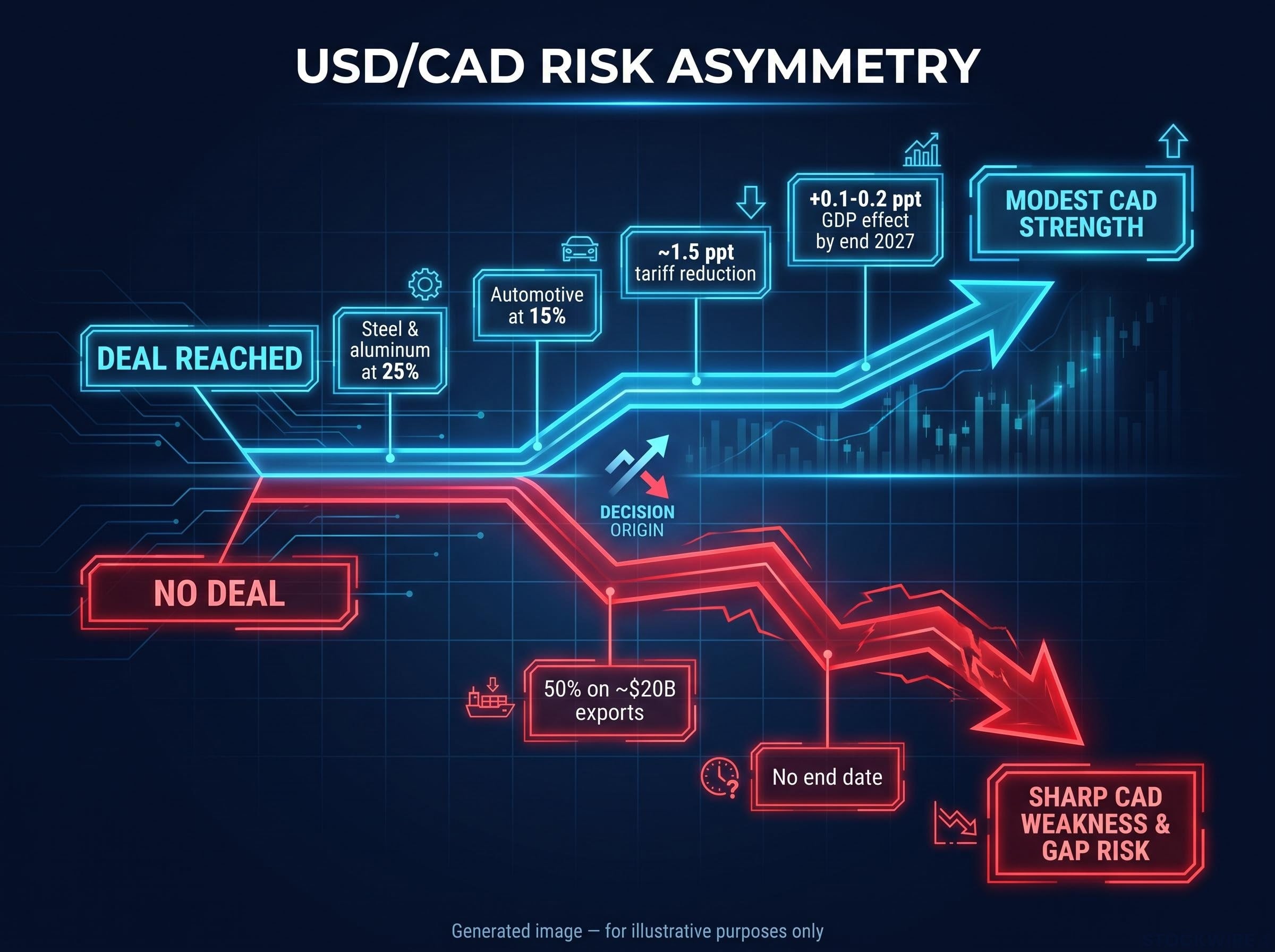
Under a finalised agreement, TD Securities puts the reduction in policy-implied tariff rates at 1.5 percentage points, with the resulting boost to Canadian GDP running to approximately 0.1 to 0.2 percentage points over the course of 2027.
That 0.1-0.2 percentage point GDP figure is the number to sit with. It represents a real but limited economic benefit, and the fact that markets have already partially priced the deal scenario means the net incremental upside for CAD from a successful negotiation is smaller than the headline might imply.
| Tariff Category | Current Rate | Discussed Reduction |
|---|---|---|
| Section 338 (broad categories) | 50% | Removal or suspension under a comprehensive deal |
| Steel and aluminum | Current elevated rates | 25% |
| Automotive | Current elevated rates | 15% |
Even under a successful deal, some tariffs would likely remain in place. Steel and aluminum at 25% and automotive at 15% are reductions, not removals. Ongoing uncertainty around the broader USMCA framework persists. And Canada’s structural asymmetry, its greater dependence on US market access relative to the reverse, is not resolved by near-term tariff relief.
If you treat a deal as a straightforward CAD catalyst, you risk being wrong twice: once about the magnitude of the macro gain, and again about how much of that gain is already in the price.
What a breakdown actually looks like for USD/CAD
The downside is not a mirror image of the upside. It is larger, faster, and compounds in stages.
A no-deal outcome is not a single event. It is a cascade:
- Stage one: The 50% Section 338 tariffs snap into force on approximately $20 billion of Canadian exports with no sunset clause, creating an immediate, discrete shock to Canada’s trade outlook.
- Stage two: Confidence and investment in affected sectors take a direct hit. Business sentiment deteriorates as the open-ended nature of the tariffs removes any basis for planning around a resolution timeline.
- Stage three: Safe-haven demand flows into the US Dollar. A breakdown in US-Canada trade negotiations is a clear risk-off catalyst for Canadian assets specifically, amplifying the currency move beyond what the trade data alone would imply.
TD Securities strategists consider a breakdown in talks to be inadequately reflected in current market pricing, warning that such an outcome carries the potential for a pronounced move upward in USD/CAD.
The gap risk is what matters most for your own decision-making. Orderly markets price risk gradually. But when a market is positioned for one outcome and the other materialises, the adjustment is rapid and often overshoots. USD/CAD can gap higher quickly when positioning and options markets have not priced in adequate premium for a breakdown scenario. The effective downside for CAD is larger than the theoretical tariff impact alone would imply, because the repositioning shock compounds the trade shock.
The USD/CAD rate drivers operating simultaneously in this environment include oil’s commodity channel, Fed rate expectations, and geopolitical safe-haven flows, and when these forces are roughly balanced they can produce apparent currency stability that masks the scale of repositioning that a single catalyst, like a tariff breakdown, can trigger.
Why the Bank of Canada removes the usual CAD safety net
In a normal trade relief scenario, improved economic prospects flow into expectations for a more hawkish central bank, supporting the domestic currency. A deal gets done, the outlook brightens, rate expectations shift, and the currency strengthens through two channels rather than one.
That logic does not apply here.
TD Securities expects the Bank of Canada to hold its policy rate through 2026 irrespective of how tariff negotiations conclude. Data showing the real-world effects of any shift in the tariff environment will not be available for assessment until November 2026, making earlier policy adjustment impractical. On that basis, TD Securities anticipates the first rate increase arriving in January 2027, with no action before that point.
The Bank of Canada rate path into 2027 is shaped not only by tariff outcomes but by core inflation measures that are already tracking below the 2% target on both CPI-trim and CPI-median, a configuration that removes the policy flexibility needed to respond to a trade shock with anything other than holding rates steady through the data accumulation window.
This removes the conventional post-deal playbook. Without a credible hawkish Bank of Canada signal, the CAD upside from a deal is capped by the absence of the policy transmission mechanism that normally amplifies trade relief into currency strength.
Where recent CAD strength actually comes from
The CAD’s recent gains owe more to broad US Dollar weakness than to any improvement in Canada’s own economic standing. According to TD Securities, three forces have pressed the Dollar lower: weaker-than-expected US economic readings, a pullback in market expectations for imminent Federal Reserve rate rises, and unease about a more interventionist stance from the US Treasury in financial markets. Canadian economic data, while holding up comparatively well, has added only limited independent lift to the currency.
The CAD transmission channels operating in this environment are more complex than the tariff-to-currency link alone: Scotiabank research indicates the CAD-oil beta has weakened materially over the past decade, and the same safe-haven USD flows that mute oil’s commodity tailwind would amplify the currency impact of a tariff breakdown, compressing CAD from two directions simultaneously.
The distinction matters: borrowed CAD strength is more fragile and would reverse faster in a no-deal scenario than strength rooted in Canadian economic outperformance. If the USD dynamic reverses on a risk-off catalyst, the CAD weakness that follows would compound the tariff shock rather than cushion it.
Making sense of the asymmetry before the deadline passes
This is a skewed risk event, not a coin flip. The distribution of outcomes favours larger losses than gains for CAD if negotiations collapse.
| Scenario | Tariff Impact | GDP Effect | CAD Direction | Key Risk |
|---|---|---|---|---|
| Deal reached | ~1.5 ppt tariff rate reduction | +0.1-0.2 ppt by end 2027 | Modest CAD strength (partly priced) | Upside capped by Bank of Canada hold |
| No deal | 50% on ~$20B exports, no end date | Significant negative (unquantified) | Sharp CAD weakness, gap risk | Underpriced by current positioning |
Being unhedged into this deadline is not a neutral position. It is effectively a bet that the deal scenario materialises, and that bet is priced more aggressively than the underlying probability of a clean resolution justifies.
Four signals to monitor into and through the deadline:
- Official government communications: Tone, level of detail, and whether language references further delay versus substantive resolution.
- USD/CAD spot and implied volatility: Any sudden rise in vol or shift in risk reversals would indicate markets are beginning to reprice breakdown risk.
- Specific tariff language in any announced deal: Which categories are reduced (steel and aluminum at 25%, automotive at 15%), which remain, and whether reductions are conditional or immediate.
- Bank of Canada commentary: How trade outcomes feed into its reaction function and the timing of any policy response.
Short-USD or long-CAD positions carry asymmetric downside here. The cost of hedging that downside is relatively low while markets remain positioned for a benign outcome.
This article is for informational purposes only and should not be considered financial advice. Investors should conduct their own research and consult with financial professionals before making investment decisions. These statements are speculative and subject to change based on market developments and negotiation outcomes.
What the asymmetry means when the deadline expires
The risk distribution around this deadline is not symmetric, and the market’s current positioning for a benign outcome is precisely what creates the vulnerability on the downside. A successful deal offers limited, largely anticipated gains for CAD. A collapse would land a blow the market has not priced adequately.
Even a successful deal does not resolve Canada’s structural trade exposure. The dependence on US market access, the broader USMCA uncertainty, and the Bank of Canada’s unwillingness to move on rates before sufficient data accumulates all remain in place regardless of what happens this weekend.
The next signposts arrive on the same timeline either way: the Bank of Canada’s November 2026 data window and the January 2027 rate decision become the points at which any tariff outcome, good or bad, begins to translate into observable policy. Until then, the asymmetry that defines this deadline does not disappear. It simply shifts to the next one.