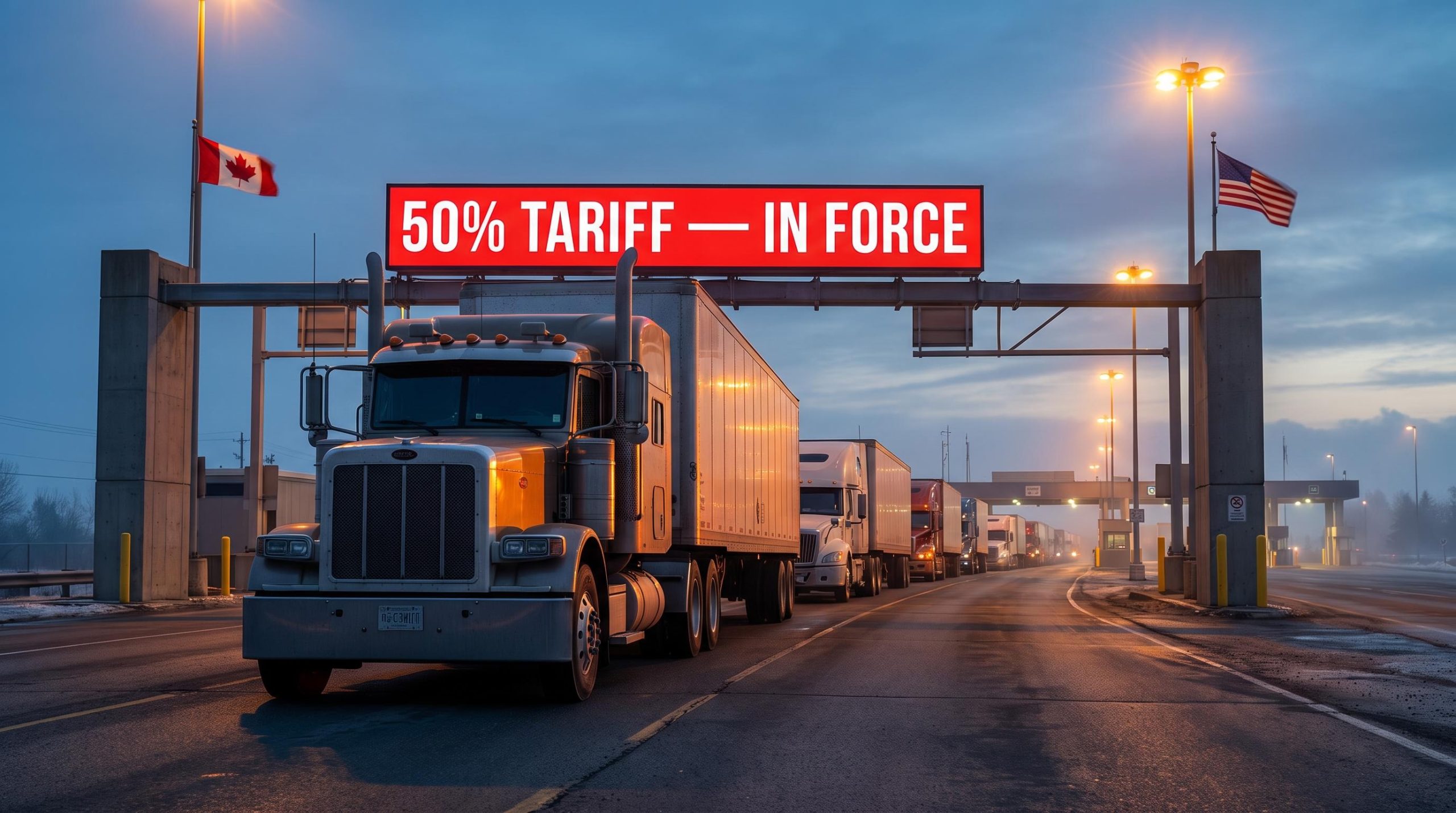
Talks collapsed. Tariffs landed. And before North American markets open on Monday 24 August 2026, investors have a narrow window to understand what a 50% levy on $20 billion in Canadian goods actually means for portfolios exposed to cross-border trade.
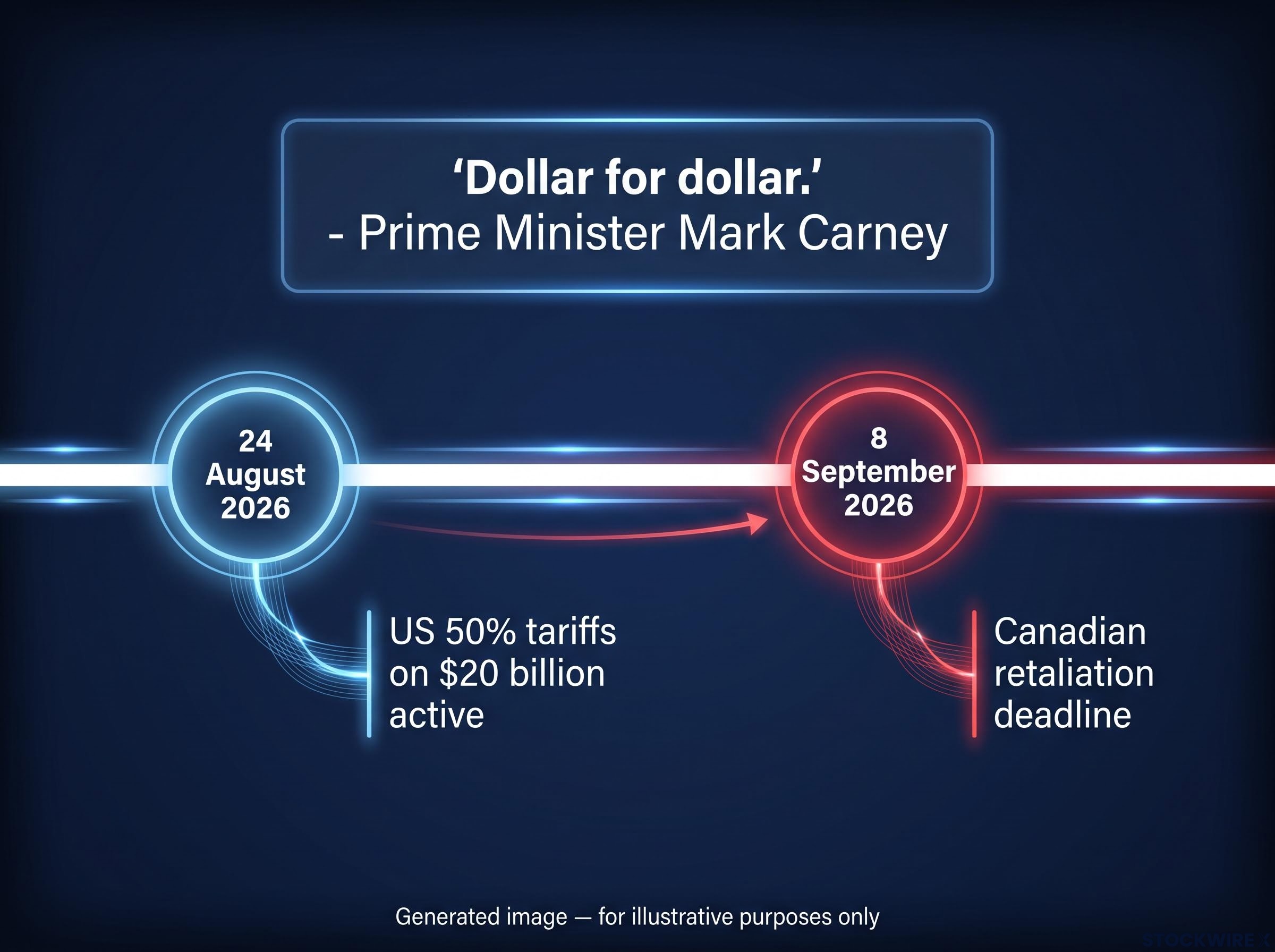
The US and Canada entered the weekend with three days of Washington negotiations on the table. They ended it with a bilateral tariff escalation, a Prime Ministerial pledge to match every dollar of US duties with Canadian counter-measures, and an 8 September retaliation deadline that gives businesses roughly two weeks before the next wave of disruption hits supply chains.
This is not a threat. The tariffs are live. Here is what they cover, which sectors face the sharpest cost pressure, what Canada’s retaliation schedule means in practice, and the specific signals worth watching before and after Monday’s open.
What broke down, and what the US has now imposed
Washington talks ran for three days before hitting a midnight deadline with no deal reached, and the US wasted no time in responding. 50% duties on roughly $20 billion worth of Canadian imports are now in force, with timing calibrated to the weekend so that the full weight of the escalation falls on Monday’s opening session when markets begin pricing it in.
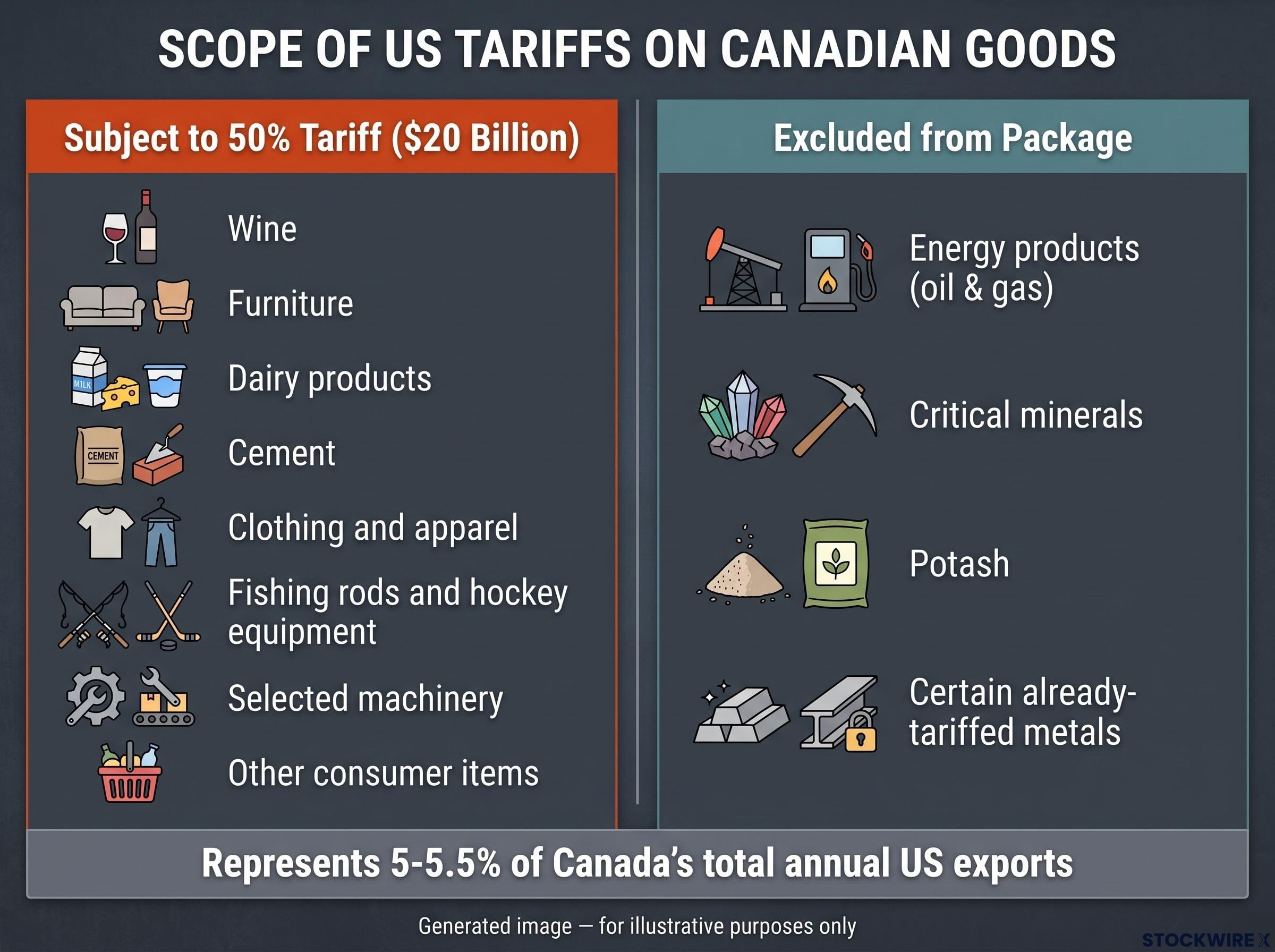
The product list is broad but targeted. Goods now carrying the 50% levy include:
- Wine
- Furniture
- Dairy products
- Cement
- Clothing and apparel
- Fishing rods and hockey equipment
- Selected machinery and industrial inputs
- Other consumer and household items
What is not on the list matters just as much. The following categories are excluded from this package:
- Energy products (oil and gas)
- Critical minerals
- Potash
- Certain already-tariffed metals
That split is deliberate. The $20 billion in affected goods represents roughly 5-5.5% of Canada’s total annual US exports by value, but the 50% rate is steep enough to force sourcing and pricing decisions rather than being quietly absorbed into margins.
| Covered by 50% tariff | Excluded from this package |
|---|---|
| Wine, furniture, dairy | Energy (oil and gas) |
| Cement, clothing, apparel | Critical minerals |
| Fishing rods, hockey equipment | Potash |
| Selected machinery, industrial inputs | Certain already-tariffed metals |
Why USMCA protection does not apply here
Under normal circumstances, the United States-Mexico-Canada Agreement (USMCA), the free trade agreement governing North American commerce, shields qualifying Canadian goods from US tariffs through duty-free treatment. These new 50% levies override that protection for the listed categories.
That changes the risk calculus for any business, and any investor, that assumed treaty status would provide cover. USMCA compliance is no longer a guarantee of tariff-free access for these goods. The standard backstop has been bypassed, and markets will need to price in the legal uncertainty that creates on top of the direct cost impact.
When big ASX news breaks, our subscribers know first
Canada’s dollar-for-dollar response and the 8 September deadline
Canadian Prime Minister Mark Carney did not frame the response as a possibility. He framed it as a commitment.
“Dollar for dollar.” Prime Minister Mark Carney’s public pledge to match US tariff measures with Canadian counter-tariffs of equivalent value, setting an 8 September 2026 start date for retaliation.
That language matters. It signals a retaliatory posture calibrated to economic equivalence, not a negotiating concession designed to bring Washington back to the table. The 8 September 2026 start date gives businesses approximately two weeks from the US implementation to adjust before the next wave of disruption hits cross-border supply chains.
Which US sectors face Canadian counter-tariffs
Final Canadian tariff schedules have not been published, making early-indication signals the best available guide. Based on those signals, Canada is targeting:
- Steel: A sector where Canadian leverage is high and US producers compete directly
- Dairy: Symmetrical retaliation matching the US levies on Canadian dairy
- Electronics: Consumer-facing and politically visible
- Agricultural equipment: Hits US manufacturing in politically sensitive states
- Pulp and paper: A sector where cross-border integration is deep
- Other politically sensitive sectors
Each of these targets carries political weight as well as economic weight. Canada is selecting sectors where the pain is concentrated enough for US lawmakers to feel domestic pressure, which tells you the retaliation is designed to accelerate diplomatic re-engagement, not just match the cost.
Where the real cost pressure lands across sectors
Knowing which goods are caught is the first step. Knowing what the tariff actually costs, sector by sector, is the step that connects to portfolio decisions.
Consumer and retail faces the most immediate margin pressure. Higher landed costs on furniture, apparel, sporting equipment, wine, and household items create a binary outcome: retailers either absorb the cost (compressing margins) or pass it through (pushing consumer prices higher). At 50%, absorption is not realistic for most categories.
Agriculture and food takes the hit on both sides of the border. Dairy tariffs squeeze Canadian exporters who lose price competitiveness and US buyers who relied on those imports for cost-effective sourcing. The cost pressure runs through food supply chains in both directions.
Industrial and materials exposure centres on cement, selected machinery, and industrial inputs. US construction and manufacturing businesses that source from Canada face higher input costs with limited short-term alternatives.
Metals and energy are excluded from this 50% package, but they are not risk-free. Existing Section 232 measures already apply to certain metals, and any future escalation that broadens the tariff scope to include energy or critical minerals would represent a step-change in severity.
| Sector | Tariff exposure | Key risk |
|---|---|---|
| Consumer and retail | Direct: 50% on furniture, apparel, wine, household goods | Margin compression or consumer price inflation |
| Agriculture and food | Direct: 50% on dairy and agricultural products | Cost pressure on both US buyers and Canadian exporters |
| Industrial and materials | Direct: 50% on cement, machinery, industrial inputs | Higher input costs for US construction and manufacturing |
| Metals and energy | Excluded from 50% package; existing Section 232 applies | Escalation risk if future rounds broaden scope |
| FX and equities | Indirect: CAD weakness, equity volatility | Consumer-facing names with cross-border exposure most vulnerable |
Canadian dollar and equity market signals for Monday
The Canadian dollar is vulnerable to downside pressure as export earnings face new headwinds and business confidence deteriorates. That makes CAD a leading indicator of how markets are processing the severity of the escalation.
Analysts have warned of heightened volatility in North American equities at Monday’s open, particularly among consumer-facing names with heavy cross-border exposure.
Monday’s open is the first real-time pricing event for the full tariff shock. The 50% rate is steep enough that affected businesses cannot absorb it into margins, meaning the cost will either move through to consumers or trigger sourcing changes. Either outcome is a market event, not just a trade statistic.
What investors should be watching in the days ahead
The next three weeks carry two distinct repricing moments, not one. The US tariffs are active now. Canadian retaliation arrives 8 September. Between those two dates, four specific signals will determine how the risk picture evolves:
- Canadian retaliatory tariff list publication. The final schedules will clarify which US sectors and individual companies face the greatest revenue risk from 8 September onward. Markets will reprice affected names the moment the full list is out.
- Diplomatic re-entry signals. Any indication that Washington or Ottawa is willing to resume talks, even on narrow or sector-specific terms, could quickly re-price trade-sensitive assets. In the current environment, diplomatic signals are disproportionately market-moving.
- USMCA and Section 232 framework changes. Alterations to existing tariff frameworks or USMCA compliance rules would shift the medium-term outlook materially beyond what the current 50% package implies.
- Scope broadening to energy and minerals. Energy, critical minerals, and already-tariffed metals are excluded for now. Any escalation drawing these high-value sectors into the conflict would represent a step-change in economic severity for both countries.
The most asymmetric signal to watch is diplomatic re-entry. A truce, even on narrow terms, would likely produce a faster and larger positive repricing in trade-sensitive names than the tariff escalation has produced on the downside.
That asymmetry makes the diplomatic channel the highest-priority watch item for investors managing cross-border exposure over the next three weeks.
Reading the next three weeks with clear eyes
The structure of this escalation is two-stage: US tariffs active now, Canadian retaliation arriving 8 September. That means investors face two distinct repricing moments in the next three weeks, and the period between them is an active risk management window, not a waiting room.
What remains genuinely unknown is the final Canadian tariff list and the trajectory of any diplomatic re-engagement. What is known is which US and Canadian sectors are most exposed, what the 50% rate forces in terms of pricing and sourcing decisions, and which signals will resolve the current uncertainty.
Monday’s open is the first test. The four watch items above are the decision framework for the days that follow. The tariffs are live, the retaliation is dated, and the next move belongs to the investors who have already done the reading.
This article is for informational purposes only and should not be considered financial advice. Investors should conduct their own research and consult with financial professionals before making investment decisions.
These statements are speculative and subject to change based on market developments and government policy decisions. Past performance does not guarantee future results.