IVV tracks roughly 500 US stocks. VTS holds more than 4,000. On paper, the gap looks enormous, a choice between 80% of the US equity market and nearly all of it.
In practice, the gap is far smaller than the numbers suggest. Both funds are ASX-listed, ultra-low-cost, market-capitalisation weighted, and dominated by the same handful of mega-cap technology names. The real question for Australian investors is not which index is “better” but which fund structure fits their specific tax and administrative situation.
Here is what the data actually tells you about the differences that matter, the differences that don’t, and how to make a confident call between the two without second-guessing it.
The index gap is real, but smaller than it looks
The coverage contrast is straightforward:
- IVV tracks the S&P 500 Index, holding approximately 500-509 large-cap US stocks and representing roughly 80% of the US equity market by capitalisation.
- VTS tracks the Morningstar US Total Market Index (formerly the CRSP US Total Market Index), holding in excess of 4,000 US stocks across large, mid, small, and micro caps, representing nearly 100% of the investable US market.
That looks like a meaningful difference. One fund owns four times as many stocks as the other. But the index names tell you less than the weighting methodology does.
Why market-cap weighting changes the equation
Market-capitalisation weighting means each company’s share of the index is proportional to its size. The larger the company, the larger its influence on the portfolio’s returns. A $3 trillion company moves the index far more than a $500 million one, regardless of how many small names sit alongside it.
The top layer of VTS is, for all practical purposes, the S&P 500. The thousands of smaller holdings below it, the mid-caps, small-caps, and micro-caps that make VTS a “total market” fund, represent only a modest fraction of total portfolio weight. Adding them broadens the index on paper without meaningfully altering the portfolio’s daily behaviour.
What this tells you: choosing VTS over IVV does not give you a fundamentally different equity exposure. It gives you the same mega-cap core with a thin layer of smaller companies around it. If genuine small- or mid-cap US exposure is what you want, a dedicated small-cap ETF will deliver it far more effectively than the incremental coverage VTS provides over IVV.
When big ASX news breaks, our subscribers know first
Look at the top holdings and the overlap becomes obvious
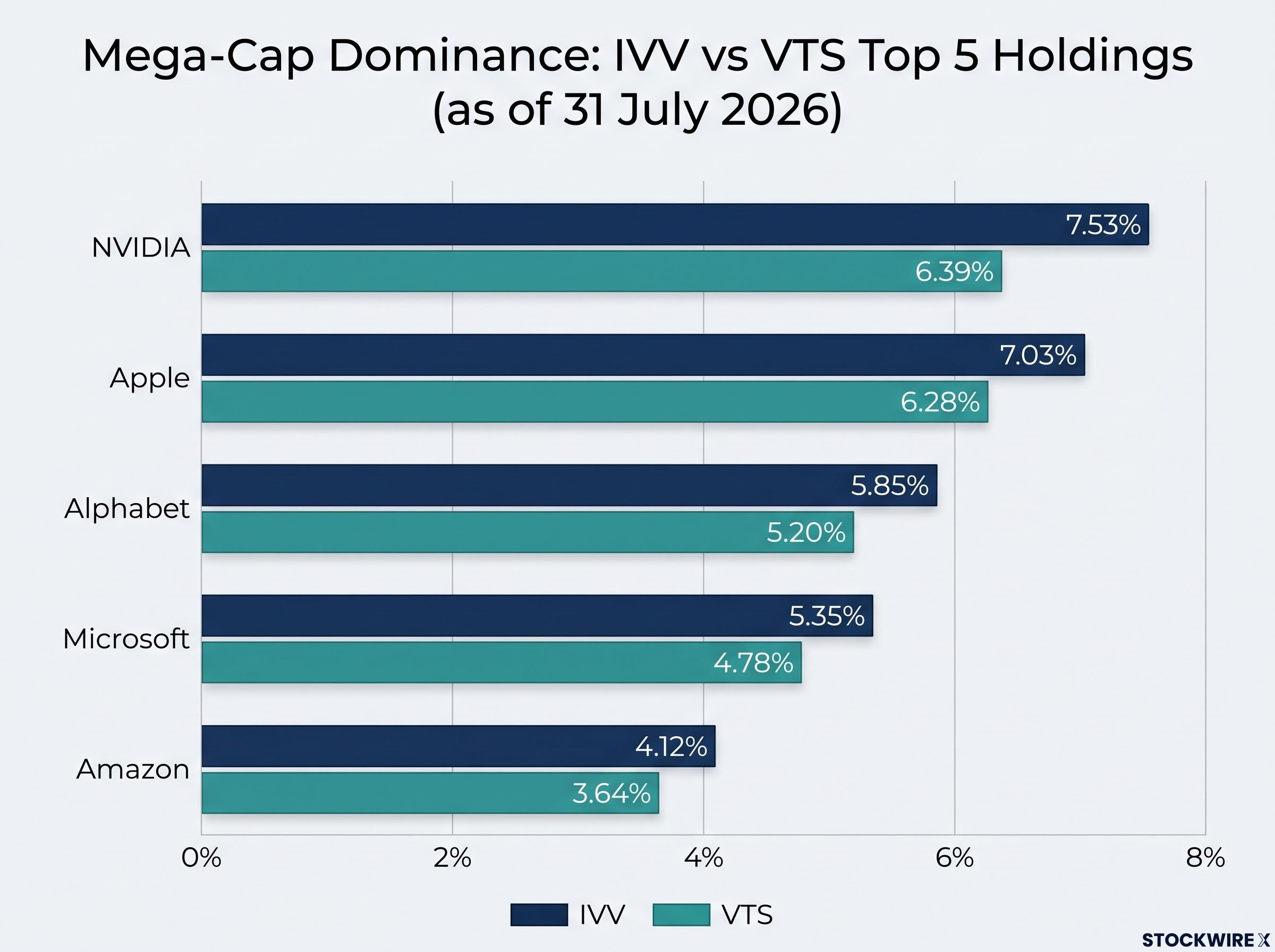
The best way to see how similar these two funds are is to compare what they actually own at the top. As of 31 July 2026, both funds held the same five companies in the same order.
| Company | IVV Weight | VTS Weight | Difference |
|---|---|---|---|
| NVIDIA (NVDA) | 7.53% | 6.39% | 1.14% |
| Apple (AAPL) | 7.03% | 6.28% | 0.75% |
| Alphabet (GOOG/GOOGL) | 5.85% | 5.20% | 0.65% |
| Microsoft (MSFT) | 5.35% | 4.78% | 0.57% |
| Amazon (AMZN) | 4.12% | 3.64% | 0.48% |
NVIDIA held the top position in both funds as of 31 July 2026, a reflection of how completely mega-cap technology dominates both portfolios regardless of their index scope.
IVV’s weights are consistently higher for each name. That is the mechanical effect of a purer large-cap focus: the same companies occupy a larger share of a smaller index. VTS dilutes them slightly across its broader universe, but the dilution is modest.
The holdings overlap between these two funds at the top ten approaches 100%. Because those mega-cap positions collectively drive most of the return and risk in each portfolio, the two ETFs move in near-lockstep over time. Whichever fund you hold, your portfolio’s daily movements will be shaped by the same handful of US technology and technology-adjacent giants.
US equity concentration inside global ETFs is a broader phenomenon than the IVV versus VTS debate suggests: standard MSCI World trackers allocate 70-75% to US equities, meaning investors who add a so-called global fund alongside either of these products may be doubling down on the same mega-cap technology names rather than achieving genuine diversification.
This is why multi-year performance charts for IVV and VTS sit almost on top of each other. The index difference is real; the portfolio difference is marginal.
Structure and tax are where the funds genuinely diverge
If the prior two sections established that IVV and VTS behave almost identically, this is where the comparison sharpens. The structural difference between the two funds is practical, compounding, and, for some investors, material enough to settle the decision on its own.
IVV is an Australian-domiciled ETF. It holds US shares through an Australian trust structure, is administered locally, and slots cleanly into standard Australian tax reporting.
VTS is an ASX cross-listing of Vanguard’s US-domiciled VTI (Vanguard Total Stock Market ETF). When you buy VTS on the ASX, you are effectively buying into a US-registered fund. That distinction carries real administrative weight.
| Feature | IVV | VTS |
|---|---|---|
| Domicile | Australian | US (ASX cross-listing) |
| Management fee | 0.04% p.a. | 0.03% p.a. |
| AUM (approx.) | A$14 billion | A$7 billion |
| US tax forms required | No | Yes (W-8BEN) |
| US estate tax exposure | No | Yes (above ~US$60,000) |
Because VTS is a cross-listed US ETF, investors typically need to file a W-8BEN form and navigate US withholding tax rules on distributions. More significantly, cross-listed US funds may carry potential US estate tax exposure for holdings above approximately US$60,000, a threshold that a long-term buy-and-hold investor can reach relatively quickly.
Vanguard itself does not offer VTS through its Personal Investor platform, citing the additional tax and administrative requirements of the cross-listed structure. When the fund’s own issuer treats it as too complex for its retail platform, that is a credible signal about the practical overhead involved.
The fee difference, meanwhile, is 0.01% per annum. On a A$10,000 holding, that works out to roughly A$1 per year. It is real, but it is not a factor that should drive the decision.
For an investor planning to hold US equities long-term and reinvest returns without active tax management, the structural simplicity of IVV is worth considerably more than VTS’s one-basis-point fee advantage, particularly as portfolio size grows toward and beyond that estate-tax threshold.
The tax context for long-term ETF holders is shifting beyond just domicile and withholding rules: Australia’s proposed CGT floor could change the after-tax calculus for investors planning to rely on the 50% CGT discount when eventually realising gains from either fund.
Performance over time confirms the convergence thesis
If the holdings data explained why these two funds move together, the performance numbers confirm it across multiple time horizons.
| Period | IVV Return | VTS Return |
|---|---|---|
| 1 year | 9.42% | 9.82% |
| 3 years (annualised) | 17.41% | 17.19% |
| 5 years (annualised) | 13.61% | 12.77% |
Performance figures are to 31 July 2026, sourced from the respective ETF providers.
VTS marginally outperformed IVV over one year. IVV held a slight edge over three and five years. Neither fund shows a consistent advantage. The gaps are small enough that they could reverse in the next reporting period without signalling anything meaningful about fund quality.
Currency is the variable neither fund controls
Both IVV and VTS are unhedged to currency. That means AUD/USD movements affect Australian investors holding either fund equally. When the Australian dollar weakens against the US dollar, both funds benefit in AUD terms. When it strengthens, both suffer.
This shared currency exposure is the dominant variable in any short-term return difference between the two. It is not something fund selection can address, and it means performance data is not a useful tiebreaker. The investor who picks the fund with the better trailing one-year number is not making a structural decision; they are reacting to a currency outcome that could just as easily flip.
The near-identical performance record across multiple horizons confirms that the fund selection decision between IVV and VTS will not materially affect your wealth outcome. The right basis for choosing is structural fit, not the marginally better recent number.
Matching the right fund to your actual situation
The analysis so far points to a clear framework. These two funds behave almost identically at the portfolio level, so the decision rests on which structure fits your circumstances, not which index sounds more complete.
Choose IVV if:
- You want Australian-domiciled simplicity with clean, straightforward tax reporting
- You prefer to avoid W-8BEN filings and US withholding tax administration
- Your US equity holding is likely to grow beyond US$60,000, making US estate tax exposure a real consideration
- You plan to build out separate small- or mid-cap US exposure through dedicated ETFs, in which case IVV’s large-cap focus is a cleaner building block that avoids unnecessary overlap
The choice between IVV and VTS sits within a broader decision about international equity allocation, specifically how much of a portfolio to direct offshore, through which vehicles, and with what complement of emerging markets or small-cap exposure alongside the US core.
Choose VTS if:
- You specifically want total-market US coverage, including thousands of mid-, small-, and micro-cap names, in a single position
- You understand and are comfortable navigating the cross-listing structure, including US tax forms and withholding obligations
- You have assessed the US estate tax threshold and it does not create a concern for your portfolio size
- You prefer a single-ticket approach to US equity exposure and do not intend to layer on additional US ETFs
If you already hold one of these funds, there is rarely a compelling reason to switch. The holdings overlap is extreme, the long-term returns are closely matched, and the fee difference amounts to roughly A$1 per year on a A$10,000 position. Switching incurs transaction costs and potential capital gains tax events that would take years to recover from the marginal differences between the two products.
IVV remains the most popular US-focused ETF on the ASX by funds under management at approximately A$14 billion, roughly double VTS’s A$7 billion. That popularity reflects the structural simplicity most Australian retail investors prefer, though it does not make VTS a lesser product for those who understand what they are buying.
The decision that matters less than staying invested
IVV and VTS behave more similarly than their index names suggest. The meaningful distinction is structural, domicile, tax treatment, and administrative overhead, rather than performance-based. Historical returns do not provide a tiebreaker, and the fee difference is negligible.
The structural hierarchy of the decision is clear: domicile and tax fit come first, the 0.01% fee gap is a distant second, and recent performance data is not a factor at all.
Both funds are credible, ultra-low-cost vehicles for long-term US equity exposure via the ASX, with combined assets under management exceeding A$21 billion and fees in the 0.03%-0.04% range. The investor who makes a confident, informed choice based on structural fit and then holds through market cycles will almost certainly achieve a better outcome than the investor who keeps revisiting the decision in search of the “better” fund.
For readers wanting to understand why the index name matters less than the weighting methodology and fund structure, our full explainer on ETF structure versus investment strategy separates the two classification axes that most fund comparisons conflate, including how passive versus active decisions drive more long-run return difference than product structure does.
The bigger win is making either choice and holding it consistently. For the majority of investors, the gap between IVV and VTS matters far less than the decision to invest in US equities at low cost and stay invested over time.
This article is for informational purposes only and should not be considered financial advice. Investors should conduct their own research and consult with financial professionals before making investment decisions. Individual tax circumstances vary; consult a qualified tax adviser for guidance on cross-listed ETF structures and US estate tax obligations.