Every Australian SME seems to be having the same conversation right now: what should we be doing with AI? The pressure is real. Vendors are pitching, competitors are experimenting, and new AI features are appearing inside tools your team already uses. But almost no one is asking the harder question underneath: is your business actually ready to use AI without creating new problems?
Genuine AI readiness has nothing to do with selecting a product. It is a foundational question about whether your data is organised enough, your security controls are mature enough, and your internal rules are clear enough to bring AI into the business without opening new risks. The vast majority of Australian SMEs have not assessed any of these areas in any structured way, and the reason is simple: nobody in the organisation has been assigned formal responsibility for raising them.
Here is what this piece gives you: a clear explanation of what AI readiness actually means in practice, what a Fractional CIO does (and why it is different from your IT support), how Hubify Limited (ASX: HFY) fits into this picture from the infrastructure layer up, and the sequence in which things actually need to happen for a business like yours.
Australian SMEs and the AI adoption gap hiding in plain sight
The pressure to adopt AI is everywhere. Chatbots embedded in customer service platforms, Microsoft Copilot licences landing in procurement inboxes, AI features quietly bolted onto accounting software and CRMs. There is a palpable sense across Australian small and medium enterprises that something must be done, and soon.
AI features inside accounting platforms like Xero are advancing faster than governance awareness in most SMEs: Xero’s XeroForce agent builder enables no-code workflow automation across connected third-party applications, meaning AI capabilities are now embedded in tools your team may already be using without a formal assessment of what data those features can access.
But there is a distinction most of those conversations miss entirely. Choosing an AI tool and being genuinely ready to use one safely and effectively are two completely different things. The first is a purchasing decision. The second is a foundational assessment that almost no SME has completed.
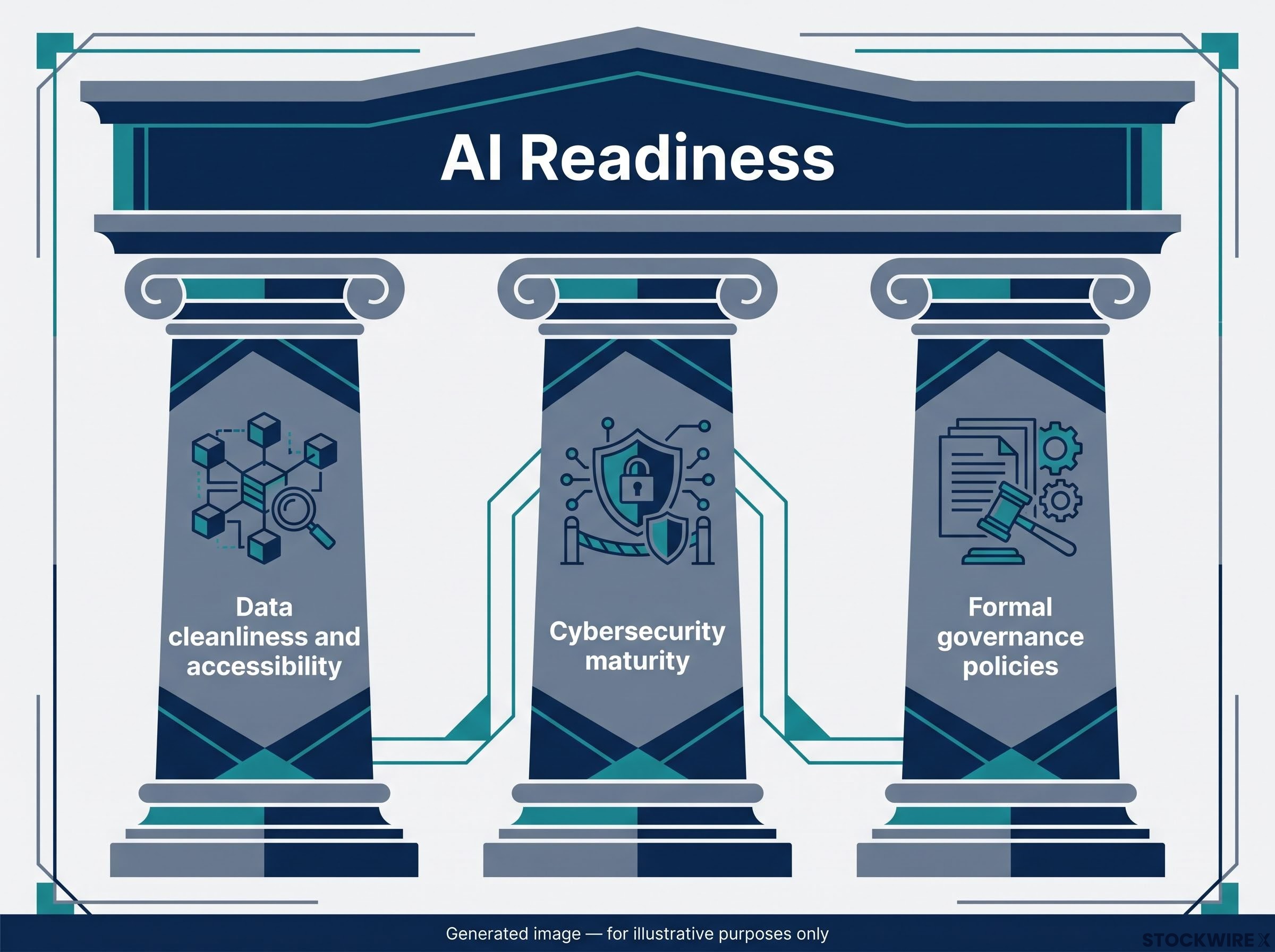
The real question is not “which AI tool should we buy?” It is whether your business’s technology, data, and security foundations can actually support AI, and whether anyone has formally asked that question. AI readiness rests on three foundational pillars:
- Data cleanliness and accessibility: Is your business data organised, integrated, and accessible in a way that an AI tool can use reliably, or is it fragmented across CRMs, accounting platforms, file shares, and inboxes with no governance layer?
- Cybersecurity maturity: Do you have controls over how staff interact with AI tools, or is usage ungoverned and unmonitored?
- Formal governance policies: Has someone defined what AI can be used for, what data can be fed into it, and who is accountable for oversight?
Most SMEs have not mapped any of these. When AI tools are introduced before the underlying data environment has been addressed, poor outputs are almost inevitable: not because the technology itself is at fault, but because fragmented, siloed, or incomplete inputs consistently produce unreliable results. When nobody senior enough holds responsibility for raising the readiness question, the business skips straight to the tool, which is the second step when the first step has not been taken. That sequencing error is where money gets wasted.
When big ASX news breaks, our subscribers know first
How uncontrolled AI use creates security exposure for SMEs
The risk is not hypothetical. A specific and now well-documented cybersecurity vulnerability shows up when staff paste confidential or sensitive company data into publicly available AI tools without oversight or policy controls. It happens because there is no formal rule against it, no monitoring in place, and no one whose job it is to notice.
The reality of ungoverned AI usage is considerably messier than most principals appreciate. Across a typical SME, several different tools will be in use simultaneously, chosen informally and for different purposes. One person runs customer data through ChatGPT. Another uses a free AI summariser for internal reports. A third pastes financial information into a tool their friend recommended. There is no unifying policy, no security assessment has been applied, and each unreviewed interaction quietly broadens the organisation’s exposure.
Without formal policies and monitoring controls, employees routinely share sensitive business data with external AI services in ways that create material security risk. Standard IT support functions are generally not structured to detect or prevent this behaviour.
This is not a carelessness problem. It is a governance problem. AI readiness and cybersecurity cannot be treated separately; gaps in one directly amplify risk in the other. SME cybersecurity alignment work now includes AI-specific elements such as data residency requirements, data loss prevention (DLP) controls for AI usage, model logging, and incident response planning for AI-related breaches. The ACSC Essential Eight remains the current Australian cybersecurity framework as of mid-2026, with transition consultation underway, and Fractional CIO services now include Essential Eight tracking as a standard component.
Australian procurement teams and insurers now treat cybersecurity maturity as a hard commercial gate, meaning businesses without documented controls are being disqualified from contracts and denied claims regardless of product quality, a shift that has made the Essential Eight an externally verifiable credential rather than an internal IT exercise.
A short governance checklist SMEs can act on now
Your business almost certainly has staff using AI tools right now in ways that nobody has formally approved or assessed. That is an active risk, not a future one. Here are five sequential steps to start closing the gap:
- Nominate an AI owner: Assign one person explicit accountability for AI governance across the organisation, even if it sits alongside another role initially.
- List all AI tools currently in use: Audit every team, department, and individual to identify which tools are being used and for what purpose.
- Write a short usage and data policy: Define what data can and cannot be entered into AI tools, which tools are approved, and which are prohibited.
- Enforce DLP and authentication controls: Apply data loss prevention rules and strong authentication to every approved AI tool.
- Review quarterly: AI usage patterns change quickly. A quarterly review ensures your policy keeps pace with how your team is actually working.
The strategic technology leadership gap, and how the Fractional CIO model fills it
There is a reason the AI readiness question goes unasked in most SMEs, and it is not about budget or awareness. It is about organisational design.
Australian SMEs typically have access to operational IT support, covering incidents, day-to-day maintenance, and helpdesk requests, but no one occupying a senior technology strategy function. The roles responsible for architecture decisions, cybersecurity posture, vendor governance, AI readiness assessment, and a 12-24 month technology roadmap are structurally absent. Those two functions serve fundamentally different purposes, and it is precisely the absence of the second that allows AI readiness questions to go permanently unanswered.
Bringing in a full-time Chief Information Officer to own strategic technology direction is a cost structure most SMEs cannot support. The result is a persistent accountability gap: decisions about whether the business is genuinely ready for AI, and what the right sequence of investments looks like, simply do not get made by anyone with the standing to make them.
| Dimension | Operational IT support | Strategic technology leadership (Fractional CIO) |
|---|---|---|
| Primary focus | Keeping systems running day to day | Setting the technology direction over 1-3 years |
| Typical activities | Break-fix, helpdesk, patching, maintenance | Architecture decisions, cloud strategy, vendor governance, licensing oversight |
| AI readiness accountability | None; not structured for strategic assessment | Owns AI readiness assessment, governance, and secure adoption sequencing |
| Who typically fills this role in an SME | In-house IT staff or managed service provider (MSP) | Part-time Fractional CIO or Virtual CIO engaged on a flexible basis |
The Fractional CIO model addresses this directly. An SME gains senior-level technology leadership on a part-time, flexible engagement rather than a permanent hire, with the strategic scope the role demands at a fraction of the salary. Fractional CIO and Virtual CIO arrangements in Australia are marketed at 50-70% of the cost of a full-time hire. The standard scope covers technology strategy and roadmap ownership, data and cloud architecture, cybersecurity alignment including Essential Eight tracking, governance of MSPs and vendors, licensing and budget oversight, and AI readiness and governance.
Your business almost certainly has someone who keeps the lights on technically. What it likely does not have is someone whose job it is to decide whether the technology direction is right before money gets spent. That is the specific gap a Fractional CIO fills, and it is exactly where AI readiness questions belong.
What a practical AI readiness sequence looks like for an Australian SME
If you wanted to actually do this, what would it look like? Here is a practical, phased sequence that covers data, cybersecurity, governance, and infrastructure over a 6-12 month horizon. The order matters: each step builds on the one before it, and skipping ahead is where most SME AI initiatives come undone.
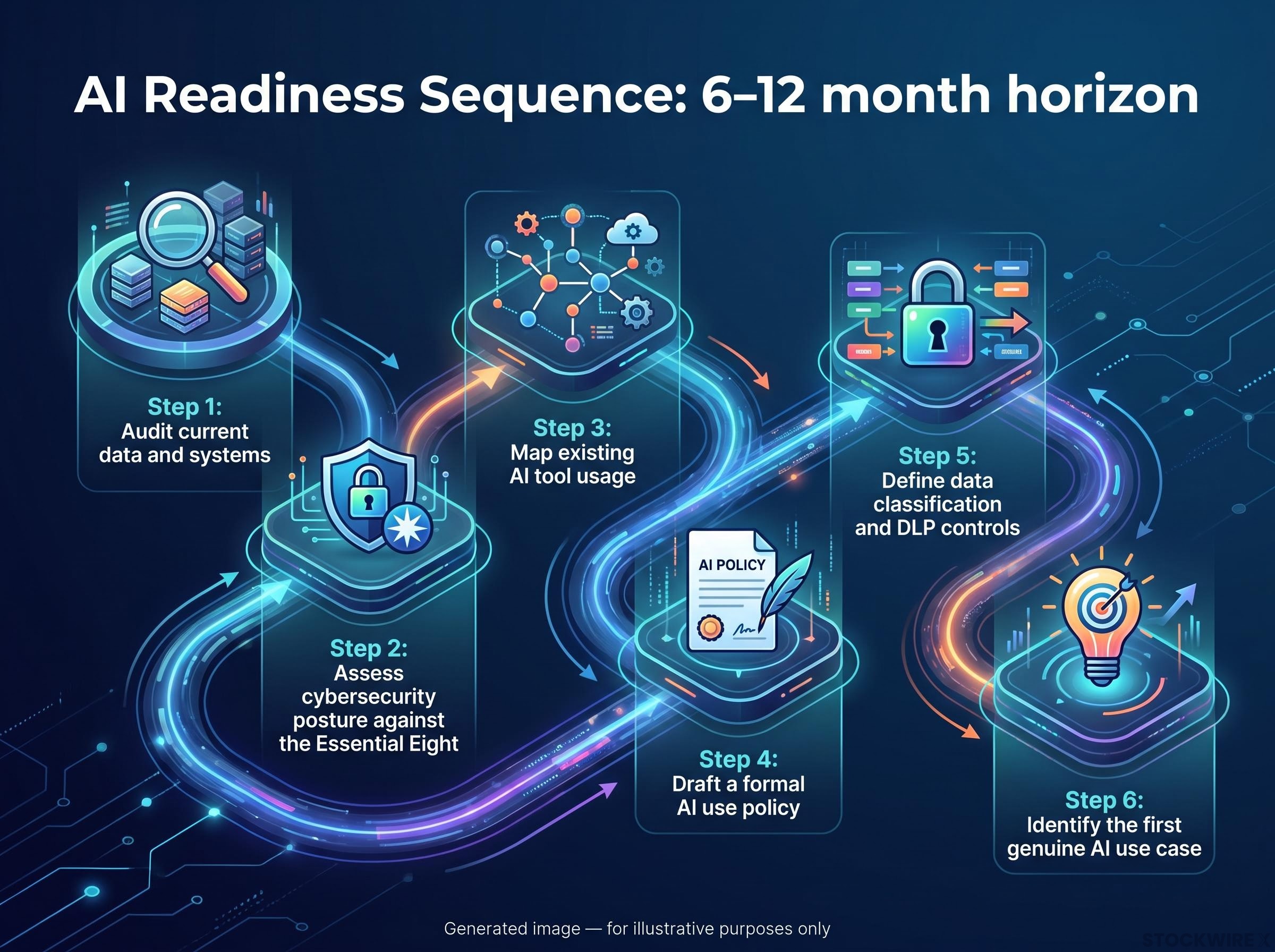
- Audit current data and systems: Map where your business data lives, how it moves between platforms, and where the gaps in integration and quality sit. Your Fractional CIO or IT Manager owns this assessment.
- Assess cybersecurity posture against the Essential Eight: Establish your current baseline and identify the gaps that would leave AI deployments exposed. The Fractional CIO drives this review and prioritises remediation.
- Map existing AI tool usage across the organisation: Identify every AI tool already in use, by whom, and for what purpose. This step almost always surfaces ungoverned usage that nobody was aware of. The Fractional CIO or IT Manager compiles and classifies the findings.
- Draft a formal AI use policy: Define approved tools, prohibited data inputs, acceptable use cases, and escalation procedures. The Fractional CIO writes or commissions this policy.
- Define data classification and DLP controls: Establish which data categories are sensitive, where DLP rules need to apply, and how AI-specific data handling fits within your broader security posture. The Fractional CIO ensures these controls are implemented and monitored.
- Identify the first genuine AI use case with verified foundations: Only now, with clean data, a secure environment, governance in place, and controls active, should you select and deploy your first AI tool. The Fractional CIO validates readiness before deployment proceeds.
The sequencing matters more than the tool choice. A Fractional CIO is the role responsible for driving this sequence and remaining accountable for whether each stage is genuinely complete before the next begins. For the first three months, that typically means steps one through three: getting a clear, honest picture of where you actually stand.
Hubify’s infrastructure-grounded entry point for AI readiness
Hubify Limited (ASX: HFY) is an ASX-listed business delivering IT, connectivity, and cybersecurity services to Australian SMEs through its consolidated Hubify One model. Rather than the piecemeal multi-vendor arrangements that many smaller businesses end up with, where different providers handle networking, security, and IT support with no single party holding the full picture, Hubify One is structured as a unified technology stack under a single relationship.
The reason Hubify’s entry point into AI readiness conversations differs from that of a typical AI vendor comes down to where its existing client relationship sits. Hubify already operates and monitors the infrastructure, connectivity, and cybersecurity environments that underpin its clients’ businesses. That prior visibility into the actual state of a client’s data, network, and security environment is what makes the readiness assessment grounded in operational reality rather than a product pitch. The assessment begins where it should, at the infrastructure layer, before any conversation about AI tools takes place.
Hubify’s service model includes two distinct groupings:
Hubify’s investment in HubLab secured exclusive Australian access to a regulatory AI platform with active enterprise rollout across financial services, construction, and government sectors, positioning the company’s advisory offering within a broader compliance automation market rather than as a generic AI reseller.
- What Hubify already manages: IT services, connectivity, and cybersecurity, delivered as a unified stack under Hubify One.
- Where the AI readiness layer sits on top: Fractional IT Manager or CIO capability, AI advisory support, and co-hosted Executive Lunch and Learn events focused on how AI is changing business operations.
Because Hubify operates its clients’ infrastructure before any AI conversation begins, its readiness assessments reflect the real condition of those systems. The starting point is operational visibility, not a preference for any particular AI product.
This model is structurally coherent with broader market direction. Fractional CIO services are increasingly sold as an overlay to existing managed service provider (MSP) and infrastructure relationships, meaning Hubify’s approach fits the pattern that is emerging across the Australian SME technology advisory market. For SME principals, it means the readiness assessment starts from a position of genuine visibility. For investors watching ASX-listed names in the cybersecurity and AI readiness space, Hubify is not pitching a new AI product; it is extending what it already does for clients into the strategic governance layer, which is a defensible and expanding position given where SME AI adoption pressure is heading.
Beyond tools: what Australian SMEs should actually prioritise in their AI planning
For most Australian SMEs, the question that deserves senior-level attention right now is not which AI tool to purchase. It is whether the data, security, and governance foundations already in place are capable of supporting one. Reaching a reliable answer to that question requires someone with both the authority and the cross-functional scope to look at all of those dimensions together, rather than treating each in isolation.
Engaging a Fractional CIO or IT Manager is the way most SMEs can access that senior accountability layer without carrying a full-time executive on the payroll. At 50-70% of the cost of a full-time hire, the model brings structured strategic oversight to AI readiness decisions at a cost point that works for smaller organisations.
For SME principals, the takeaway is about sequencing: get the foundations assessed, get a governance framework in place, and then choose the tool. For investors tracking cybersecurity-focused ASX names, what separates defensible positions from crowded ones is whether a company is operating at the infrastructure-and-governance layer or simply selling AI products into an undifferentiated market. Hubify (ASX: HFY), through its Hubify One model, Fractional IT Manager or CIO overlay, and AI advisory offering, occupies that foundational layer and provides a structured starting point for SMEs through its AI advisory and Executive Lunch and Learn engagement channels.
The businesses and service providers that get the sequencing right, governance and foundations before tools, will be in a materially stronger position when AI tool adoption accelerates further. That is the forward-looking question worth asking.
For investors tracking ASX-listed names in the cybersecurity and AI governance space, our full explainer on ASX cybersecurity vendors examines how ISM compliance, contract renewal patterns, and sovereign client depth distinguish defensible positions from commoditised ones across the sector.
This article is for informational purposes only and should not be considered financial advice. Investors should conduct their own research and consult with financial professionals before making investment decisions.
—