
Bendigo and Adelaide Bank’s FY26 numbers look like a bank under pressure: margin compression, elevated costs, and a $70 million provision that dominated the headline read. Surface-level, it is a cost story. Beneath it, something structurally different is forming.
Three concurrent programmes, a full digital platform rollout, the RACQ Bank acquisition, and a regulator-mandated risk overhaul, are being assembled in parallel. Each carries its own spend profile and its own timeline. All three are designed to pay back from FY28 onward, which means FY26 and FY27 results will keep looking expensive to anyone measuring the bank on a single-year earnings basis.
That back-weighted structure is precisely what makes a BEN stock analysis difficult right now. Here is what the operational data actually tells you about whether the medium-term repositioning is credible, and which specific signals over the next 12-18 months will confirm or contradict the thesis.
What the RACQ acquisition actually buys BEN (and what it does not)
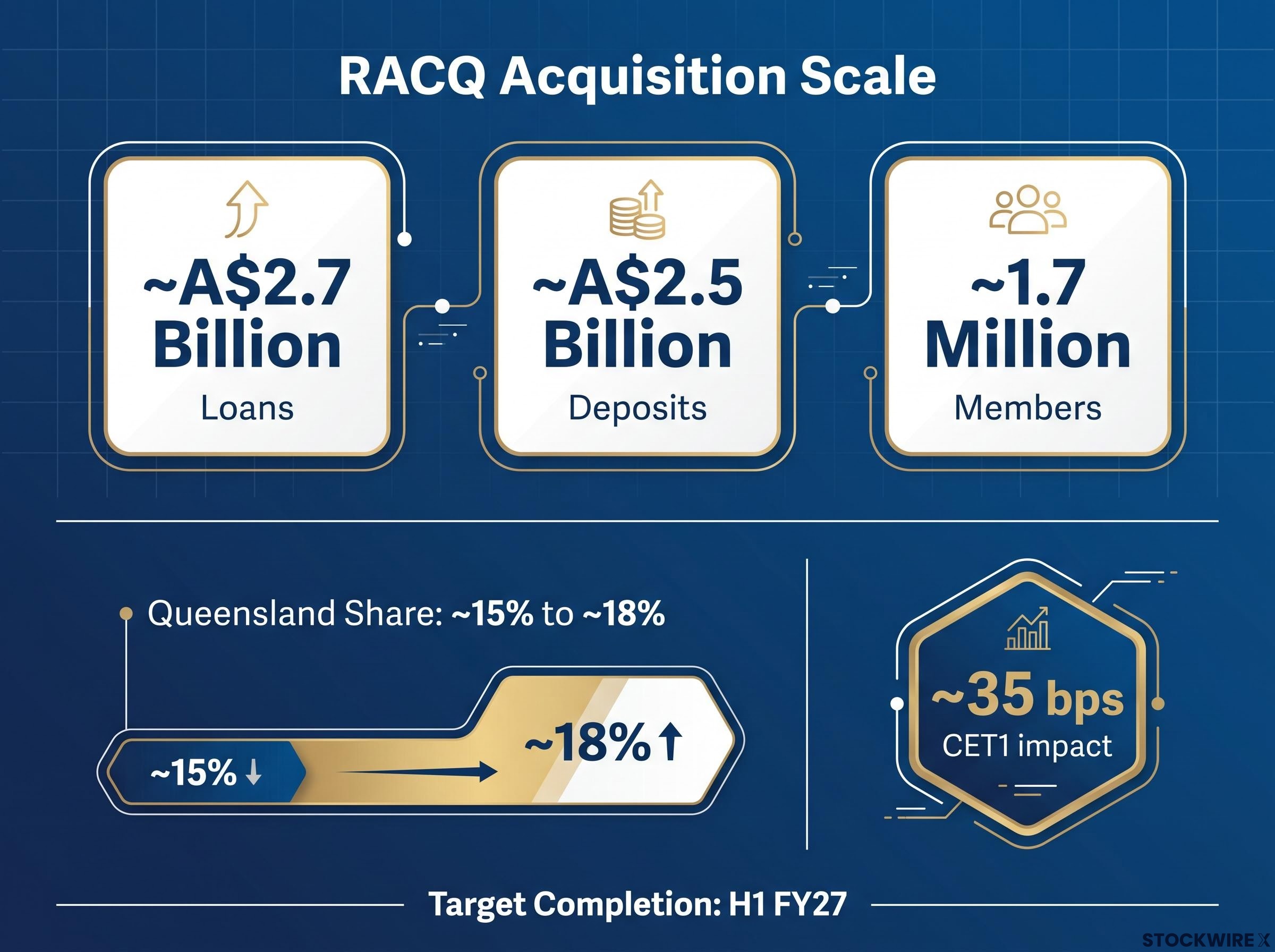
This is not a distressed-asset deal. BEN is acquiring a performing portfolio at book value, funded from cash reserves, with no capital raise required. The strategic logic is geographic: Queensland is BEN’s largest residential lending growth vector, and the RACQ Bank acquisition lifts the bank’s Queensland share from roughly 15% to approximately 18%, a gain of about 3 percentage points.
The initial transfer is substantial. At 30 June 2025, the book comprised approximately A$2.7 billion in loans and A$2.5 billion in retail deposits. But the longer-duration opportunity sits in the referral agreement with RACQ’s approximately 1.7 million members, which extends well beyond the one-off asset transfer and gives BEN ongoing access to a trusted brand’s customer base for deposits, savings, and home loans.
| Metric | Figure | Investor relevance |
|---|---|---|
| Transferring loan book | ~A$2.7 billion | Immediate scale in Queensland residential lending |
| Transferring deposit book | ~A$2.5 billion | Funding base expansion at book value |
| CET1 impact at completion | ~35 basis points | Absorbed without a capital raise; limits headroom for further deals |
| Queensland residential share (pre / post) | ~15% → ~18% | Meaningful geographic concentration increase |
| RACQ member referral access | ~1.7 million members | Longer-term pipeline; model separately from transferred book |
The 35-basis-point CET1 impact tells you that BEN can absorb this acquisition without going to shareholders, but the remaining capital headroom after completion constrains further strategic optionality until organic capital generation rebuilds the buffer. Completion remains targeted for H1 FY27 and was confirmed on track as at 24 August 2026.
Integration risk is real, but the completed single-core banking architecture (covered below) reduces execution complexity materially compared to prior integrations. The test is customer behaviour, not system migration. Three integration KPIs investors should track post-completion:
The integration risk and customer retention focus that apply to the RACQ transfer are part of a broader set of regional bank metrics, including NIM trajectory, CET1 adequacy, and ROE relative to the major bank benchmark, that together determine whether a regional bank’s discount to book reflects genuine mispricing or structurally weaker profitability.
- Customer retention rate across the transferred book over the first 12-18 months
- Credit performance of the acquired loan portfolio relative to BEN’s existing book (arrears, impairments)
- Incremental Queensland new-lending flows, not just the transferred stock
When big ASX news breaks, our subscribers know first
How BEN’s lending engine actually works now
The milestones accumulated through FY26 are worth reading as a sequence, because the pattern they form matters more than any individual figure:
- Bendigo Lending Platform extended to all branch locations, now the default origination workflow
- The lending platform now accounts for 80% of all home loan originations across the bank
- Approximately 50% of digitally eligible customers completing their account opening through the Bendigo Bank app
- Approximately 180,000 Adelaide Bank accounts migrated onto the single core platform, completing the consolidation from eight systems to one
Mortgage assessment time has been reduced from more than 300 minutes to 110 minutes on average. Conditional approvals are now achievable in approximately five minutes.
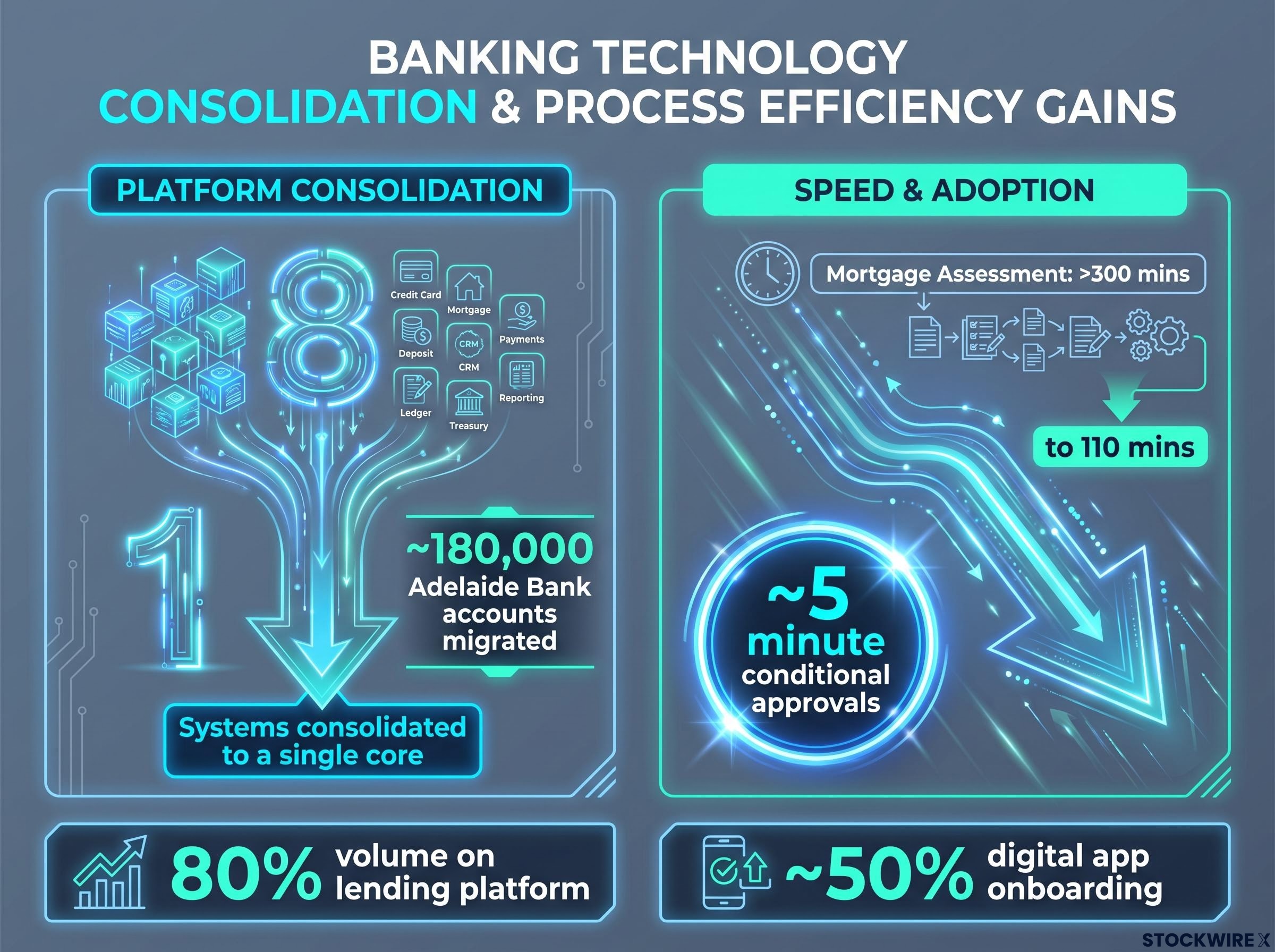
That five-minute conditional approval figure is where the competitive repositioning becomes tangible. It tells you BEN is beginning to close the speed gap with neobanks and digital-first lenders, and the question worth asking is whether that shift is already reflected in the current multiple or still being priced as a cost story.
Competitive pressure on deposit margins across Australian retail banking has intensified since Revolut received its full ADI licence in July 2026, a structural development that adds an external variable to BEN’s NIM recovery thesis beyond the internal transformation timeline management controls directly.
The single-core-platform completion is the piece that makes everything else structurally possible. It means the RACQ book migrates into one clean system rather than a patchwork. It means digital origination figures can keep climbing without systems fragmentation dragging on processing times. Prior integrations (Adelaide Bank, Rural Bank) ran on the old multi-platform architecture; this one does not.
The productivity math and its timing
BEN engaged Infosys and Genpact as external partners to deliver the second phase of its productivity programme. Restructuring costs were recognised in the FY26 results, which is why the reported cost-to-income ratio looks elevated.
The savings are back-weighted to FY28 onward. That timing gap is the core tension for investors watching the cost line: the spend is visible now, the payoff is not. The metric to track is the cost-to-income ratio excluding one-off transformation charges, not the reported ratio distorted by programme costs. That ex-one-offs figure is the leading indicator of whether structural savings are accruing on schedule.
Assessing BEN’s non-financial risk overhaul
The $70 million provision in the FY26 results drew attention, but the headline number alone tells you less than you might think. Separating the reactive layer from the proactive layer gives you a clearer picture.
APRA (the Australian Prudential Regulation Authority, the banking regulator) has imposed licence conditions on Bendigo and Adelaide Bank relating to non-financial risk management. Non-financial risk covers areas like governance, compliance, conduct, and technology risk, the operational foundations that determine whether a bank’s controls and culture are fit for purpose.
APRA supervisory expectations for Australian banks have escalated materially beyond traditional prudential metrics in 2026, with the regulator now explicitly holding boards accountable for governance and technology risk literacy, a posture that makes BEN’s CEO-sponsored non-financial risk programme both more necessary and more closely scrutinised than prior cycles would have required.
The reactive elements, meaning those directly mandated by APRA, include:
- A formal rectification plan requirement
- An independent reviewer
- Board attestations on remediation progress
- A $50 million operational risk capital add-on currently in place
- A Deloitte root-cause analysis referenced as part of the review process
The proactive elements, meaning those that go beyond minimum regulatory compliance, include:
- CEO-sponsored programme with a three-year roadmap
- Scope covering governance, compliance, conduct, operational risk, and technology risk
- Cultural embedding across the institution, not just procedural compliance
The $50 million capital add-on is the most direct financial signal of where BEN’s regulatory relationship currently stands. Its relaxation would represent a material event for the bank’s cost of equity and strategic flexibility.
The continued presence of that capital overlay tells you APRA is not yet satisfied. Investors who dismiss the $70 million as a one-off charge are missing the governance-to-capital linkage: execution quality on this programme determines when the overlay lifts, which in turn determines how much strategic room BEN has beyond 2028. The biggest medium-term risk is not the cost; it is a scenario where remediation falls short of APRA expectations and forces a longer or deeper cycle.
This article is for informational purposes only and should not be considered financial advice. Investors should conduct their own research and consult with financial professionals before making investment decisions.
Reading BEN as a medium-term thesis, not a current-year earnings trade
The three pillars (digital productivity, RACQ integration, non-financial risk overhaul) are running concurrently by design. Their payoffs are engineered to compound from FY28 rather than reward the current period. That creates a specific investor profile: this thesis suits a 2-4 year horizon with tolerance for execution risk across three simultaneous programmes. It does not suit anyone seeking near-term earnings momentum.
The structured way to monitor progress, rather than waiting for a headline earnings beat, is to track specific signals across each pillar:
| Pillar | Key metric to watch | Positive signal | Negative signal |
|---|---|---|---|
| Digital productivity | Cost-to-income ratio ex-one-offs | Declining trend from H2 FY27 onward | Flat or rising through FY28 despite programme completion |
| RACQ integration | Customer and balance retention (12-18 months post-migration) | Retention above 90%; credit quality in line with existing book | Material attrition or arrears divergence in the transferred portfolio |
| Risk programme | APRA licence condition milestones and capital overlay timing | Public APRA commentary indicating progress; overlay relaxation signalled | Extended rectification timeline or additional conditions imposed |
Net interest margin trajectory relative to peers remains the earnings-quality benchmark alongside these programme-specific signals. Credit performance of the RACQ book in its first full year post-transfer will test whether the acquired portfolio performs in line with BEN’s existing standards.
The scenario where this thesis fails has a specific shape. Governance remediation falling short of APRA standards is the highest-probability tail risk, because it constrains both regulatory flexibility and strategic optionality simultaneously. The three tail risks, ranked by probable impact:
Investors assessing whether BEN’s current discount represents a cyclical opportunity or a structural deterioration are navigating a distinction between cyclical versus systemic bank risk that has historically been the single most consequential classification error an ASX bank investor can make, given that the correct portfolio response to each scenario points in opposite directions.
- Governance programme execution falling short of APRA expectations, extending the capital overlay and licence conditions
- RACQ customer attrition post-migration exceeding retention targets
- Structural cost savings from the Infosys and Genpact programme failing to materialise by FY28
Investors assessing BEN purely on FY26 reported numbers are measuring the cost of transformation, not the value of it. The metrics above give you a specific checklist to apply over the next four to six quarters.
What the evidence says about BEN’s reinvention, and what remains to be proven
What BEN has already demonstrated
- Single-core banking platform: complete. Eight systems consolidated to one, with approximately 180,000 Adelaide Bank accounts migrated.
- Digital origination: the Bendigo Lending Platform now handles 80% of home loan volume. Approximately 50% of digitally eligible customers have completed their onboarding via the app.
- RACQ acquisition: targeted for H1 FY27 completion, with management confirming the timeline remained on schedule as at 24 August 2026.
- Non-financial risk provision: $70 million taken and disclosed in FY26 results. Programme underway with CEO sponsorship.
What investors still need to see
- FY28 productivity savings confirmed in cost-to-income ratios, not just programme announcements. This will become visible in reported results from mid-2028.
- RACQ retention data over the first 12-18 months post-migration. Customer and balance retention will be measurable from H2 FY27 through FY28.
- APRA milestone progress and any indication of licence condition relaxation or capital overlay reduction. The $50 million add-on remains in place; its relaxation timing is unknown.
The gap between those two lists is precisely where the investment debate lives. What BEN has already demonstrated is operationally real and verifiable. What it still must prove is contingent on execution across a defined window. That distinction gives you a framework for revisiting this thesis at each results cycle, rather than reacting to headline numbers that will continue to be distorted by transformation charges through at least FY27.
Past performance does not guarantee future results. Financial projections are subject to market conditions and various risk factors.