Nvidia’s earnings arrive next week, and Citi has published revenue forecasts that sit well clear of the Street, with estimates for each of the next two quarters ranging from $1 billion to $1.5 billion higher than consensus. The gap is not noise. It is a structured argument about Blackwell, data centre growth rates, and a next-generation platform cycle that most Street models have not fully priced.
The divergence matters because the market’s reaction to Nvidia’s print will be calibrated not just against consensus but against the implied bar that elevated buy-side and sell-side models create. The firm’s specific projections for B300 production acceleration, sequential data centre growth of 15% in July and 14% in October running ahead of the Street’s 13% in each period, and early signals pointing toward the Vera Rubin cycle give you a concrete framework for evaluating where the bar actually sits.
Here is what this piece covers: Citi’s specific numbers mapped against consensus, the four structural drivers underneath them, the multi-year earnings trajectory those drivers support, and exactly what to listen for on the call to determine whether the bull case is tracking or stalling. After reading, you will know which data points on the earnings call confirm or challenge the elevated thesis, not just whether Nvidia beat or missed a headline figure.
How far above the Street is Citi, and why does the gap matter?
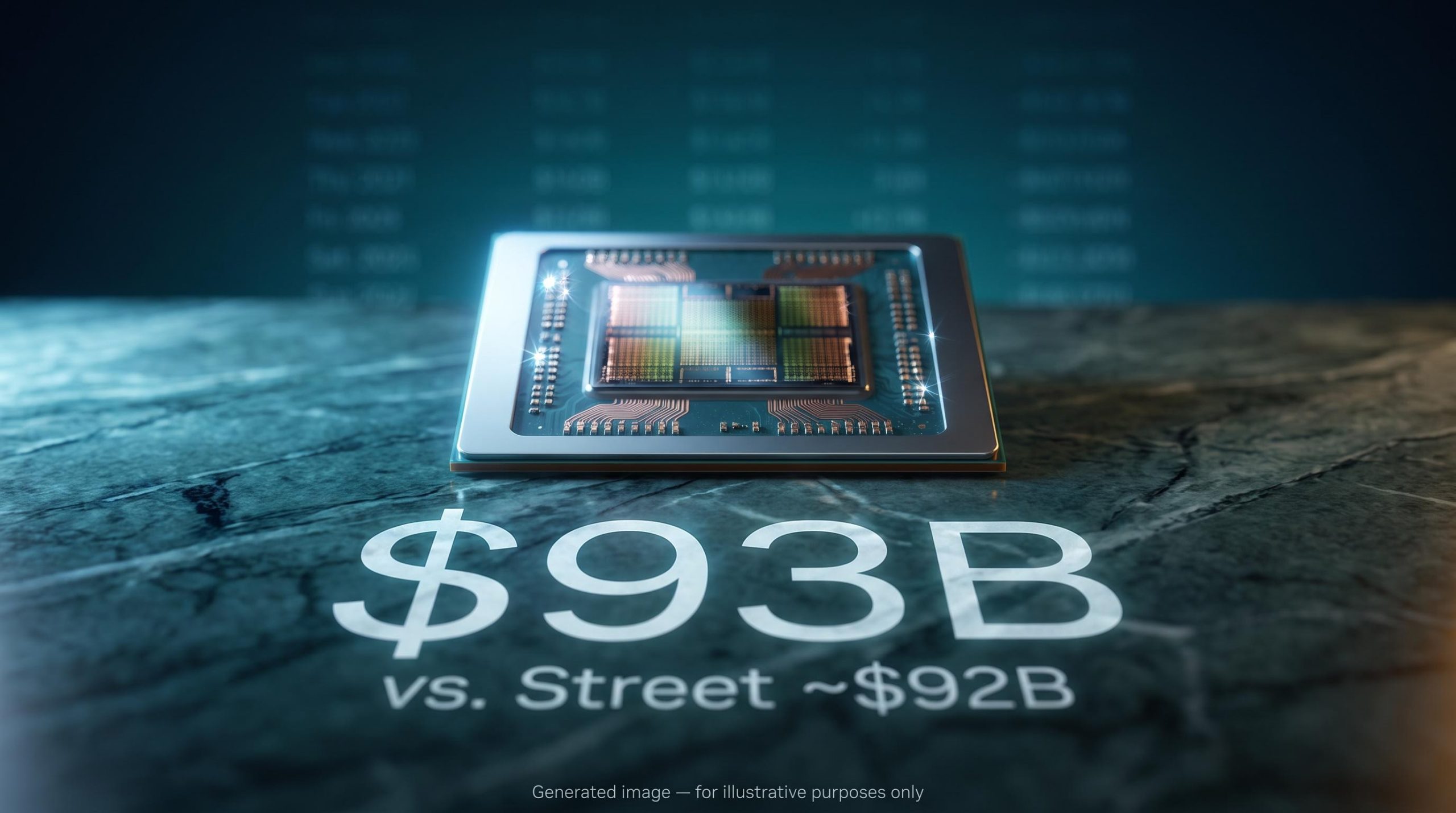
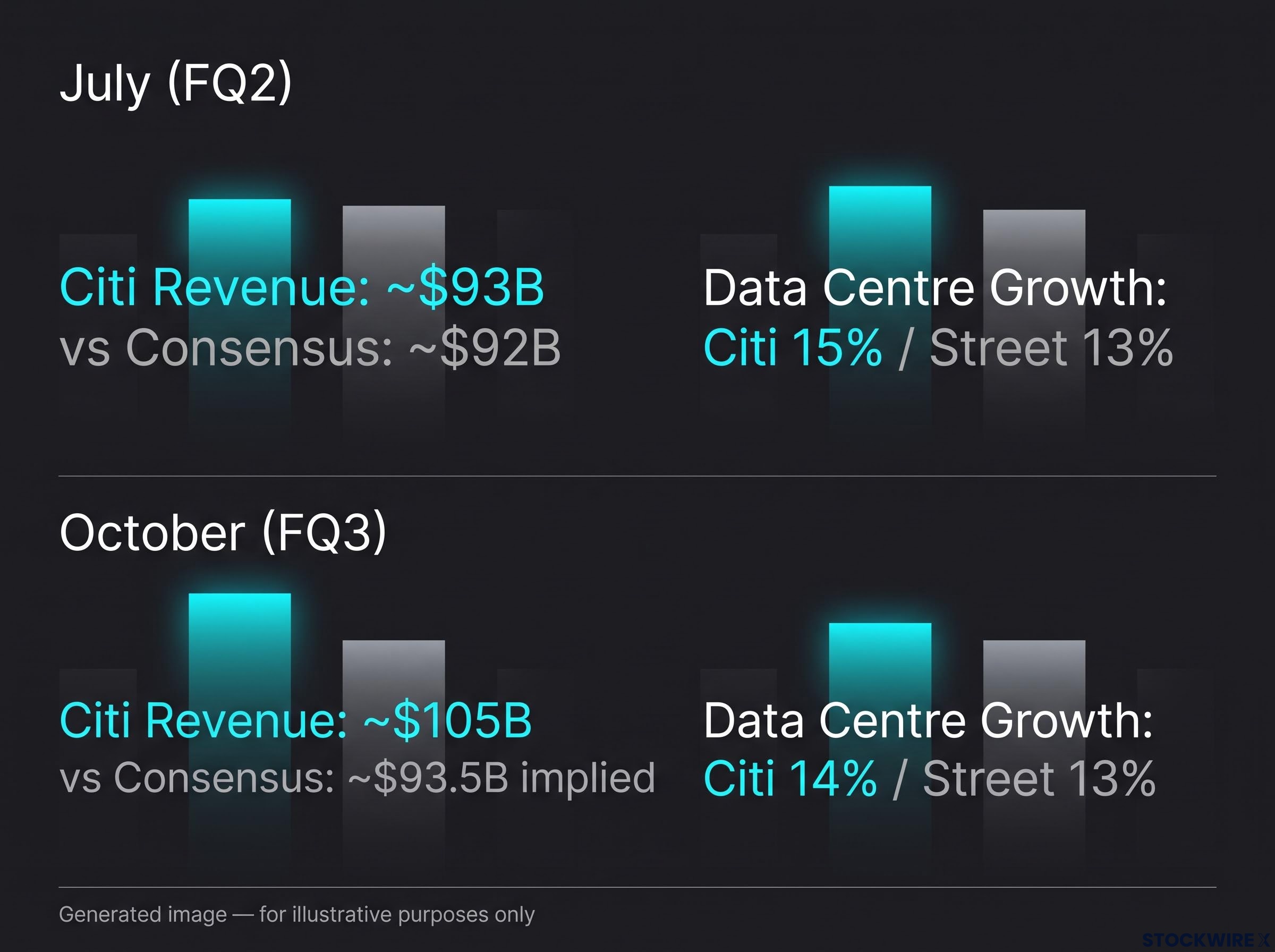
For the July quarter, Citi puts Nvidia’s revenue at around $93 billion, a figure approximately $1 billion above the implied Street consensus of roughly $92 billion, with the outperformance tied largely to a robust B300 system ramp. The October quarter sees that gap expand: the firm’s forecast of approximately $105 billion sits around $1.5 billion clear of consensus, implying sequential growth of roughly 13% from the July base.
The widening gap across two sequential quarters is itself a signal. A firm that merely expected a one-quarter beat would keep the divergence stable. Citi is doing the opposite: it is modelling a re-acceleration, not a plateau, with its data centre sequential growth assumptions of 15% for July and 14% for October running above the 13% figure that the broader Street has pencilled in for both periods.
Nvidia’s Q1 FY2027 earnings established the baseline from which Citi is projecting sequential acceleration: $81.62 billion in revenue, a $91 billion Q2 guide, and data centre contribution at approximately 92% of total revenue, the starting point for the 15% and 14% sequential growth assumptions that now sit above Street consensus.
| Quarter | Citi Revenue Estimate | Implied Consensus | Gap | Citi / Street DC Growth |
|---|---|---|---|---|
| July (FQ2) | ~$93B | ~$92B | ~$1B | 15% / 13% |
| October (FQ3) | ~$105B | ~$93.5B implied | ~$1.5B | 14% / 13% |
That widening gap into October tells you something specific: Citi is not just betting on a strong quarter but on a growth trajectory that the rest of the Street has not modelled. A result that lands near consensus in either quarter may cause the stock to underperform despite strong absolute numbers.
The “priced for perfection” dynamic: When the most prominent buy-side and sell-side models sit above consensus, the effective bar for a positive stock reaction moves up with them. A beat against the published consensus may not be enough if the elevated bar has already been priced into the shares.
This reframes how you should interpret the earnings outcome. Beating consensus by $500 million would be a strong result in isolation. If it falls short of Citi’s higher numbers, and those numbers have influenced positioning, the market reaction could still be negative.
When big ASX news breaks, our subscribers know first
The four structural drivers underneath Citi’s elevated numbers
Citi’s above-consensus forecasts do not rest on a single optimistic assumption. They rest on four drivers that connect sequentially, from supply enablement through demand signalling to the next platform cycle. Here is each one:
- Blackwell B300 production acceleration. TSMC’s Arizona Fab 21 has reached parity with its leading fabs in Taiwan, expanding the manufacturing footprint available for Blackwell architecture chips. B300 system production acceleration is the primary contributor to Citi’s stronger July-quarter outlook, and Nvidia has disclosed that Blackwell has become its fastest product ramp in history.
- HBM supply security. High-bandwidth memory (HBM), the specialised memory that sits on top of AI accelerator chips and feeds them data at high speed, has been one of the tightest bottlenecks in the AI supply chain. According to Citi, Nvidia has locked in sufficient HBM capacity to cover fiscal 2026 and 2027, a position that could allow shipment volume assumptions across the Street to move upward.
- AI networking and 1.6-terabit transceiver shipments. Faster-than-modelled deliveries of high-speed optical transceivers, including 1.6-terabit parts, indicate that hyperscale customers are preparing rack-level networking fabric for a new wave of GPU installs. Transceivers ship before the GPUs themselves, so this is a leading indicator.
- Vera Rubin early-cycle signal. The transceiver acceleration doubles as evidence that the next-generation Vera Rubin platform launch phase has begun ahead of prior Street timeline assumptions, with full production scale-up expected around fall 2026.

These four are not independent bets. They form a sequential chain: expanded fab capacity and secured memory supply enable higher shipment volumes, transceiver attach rates confirm that hyperscalers are building the infrastructure to absorb those volumes, and the transceiver data points forward to a Vera Rubin cycle that most Street models have not yet fully embedded. Tracking just one of them likely underestimates the structural coherence of Citi’s thesis.
What the 1.6-terabit transceiver signal says about Vera Rubin timing
The mechanic is straightforward: transceivers ship before GPU racks go live, because the networking fabric must be in place before the compute hardware is installed. Faster-than-expected transceiver deliveries are therefore an early indicator of imminent hyperscale GPU installs.
Citi reads the 1.6-terabit transceiver acceleration as an initial indication that the Vera Rubin platform launch phase has begun sooner than many Street models assumed. Major OEM and ODM partners are preparing systems, with shipments expected to scale around fall 2026. If that timeline holds, it means the Rubin-based upgrade cycle overlaps with Blackwell’s peak contribution rather than arriving after it, which is the sequencing that supports Citi’s elevated out-year estimates.
HBM4 supplier qualification for Vera Rubin reached a milestone in June 2026 when Jensen Huang confirmed Samsung, SK Hynix, and Micron had all cleared certification simultaneously, the first time all three major producers qualified for a single Nvidia platform, a development that materially reduces the memory supply risk that could otherwise delay the fall 2026 scale-up Citi is modelling.
EPS upgrades, GPU shipment mix, and what the multi-year trajectory looks like
Citi has raised its adjusted earnings per share (EPS) estimates across the next three fiscal years. The incremental upgrades are modest in isolation, but their significance lies in what they represent: a view that the current acceleration is structural, not episodic.
| Fiscal Year | Adjusted EPS Uplift | GPU Shipment Change | Key Driver |
|---|---|---|---|
| FY2027 | ~+1% | ~7.7M Blackwell; Rubin trimmed to ~2M | B300 ramp dominance |
| FY2028 | ~+2% | Total units raised ~7% | Memory-efficient server mix shift |
| FY2029 | ~+2% | N/A | Sustained platform cycle |
The fiscal 2027 GPU shipment picture is instructive. Citi’s model puts Blackwell shipments at around 7.7 million units for the year, driven principally by the B300 ramp, while the Rubin forecast has been cut from roughly 2.2 million to approximately 2 million units. That reduction is a function of tighter memory availability affecting specific Rubin configurations rather than any softening in underlying demand. Nvidia has secured aggregate HBM capacity, but some next-generation configurations remain constrained by component mix and timing at the product level.
The fiscal 2028 mechanism is where the story sharpens. Citi lifts its total GPU unit count for the year by around 7%, a revision grounded in an anticipated shift in product mix toward configurations that carry less HBM per chip. In practice, this means Nvidia could ship more accelerators off the same HBM supply base, supporting higher unit volume and revenue even if absolute memory capacity grows only gradually.
That is a meaningful change to the risk profile of the multi-year estimates. Nvidia’s volume upside does not require more HBM supply to materialise; it requires smarter system design, which is already underway. For an investor evaluating whether the current valuation prices in realistic or optimistic growth, this distinction matters: the constraint most likely to cap shipments is being engineered around, not merely hoped away.
HBM supply chain dynamics extend well beyond Nvidia’s own procurement position: Bernstein projects 2-2.5x contract price increases for 2027 that amplify approximately fourfold at the hyperscaler purchase level, a structural repricing that would affect the cost basis underlying the very capex commitments Citi is counting on to sustain sequential data centre revenue growth.
What to watch on the earnings call to confirm or challenge the Citi thesis
Two headline numbers matter most when the results land. The first is reported July-quarter revenue relative to both the Street consensus (approximately $92 billion) and Citi’s estimate of approximately $93 billion). The second is October-quarter guidance relative to both the implied consensus and Citi’s approximately $105 billion forecast. Where the reported and guided numbers fall within that range determines whether the Street moves toward Citi or stays put.
The single most diagnostic internal metric is data centre sequential growth. Citi’s assumptions call for 15% in July and 14% in October; the Street sits at 13% across both periods. A July result at 15% validates the thesis. A result at 13% or below signals that the broader Street, not Citi, had the right read, and the elevated out-year EPS revisions lose their most important supporting pillar. In that scenario, the stock’s reaction to an otherwise strong headline beat could be more muted than the absolute numbers suggest.
Primary metrics to watch:
- Reported July-quarter revenue versus both $92 billion (consensus) and $93 billion (Citi)
- October-quarter guidance versus $105 billion (Citi) and the implied consensus figure
- Data centre sequential growth: Citi targets 15% for July and 14% for October; a print at 13% or below in either quarter challenges the elevated model
Secondary signals:
- Blackwell and GB200 system shipment commentary and whether management reaffirms the fastest-ramp-in-history language
- HBM supply allocation signals, specifically whether multi-year security is confirmed or any renewed constraint is flagged
- AI networking attach rates and transceiver shipment volumes as a proxy for rack-level build-out pace
- Any management commentary on Vera Rubin and Rubin deployment timing relative to the fall 2026 scale-up expectation
The risk scenarios that would unwind the multi-year bull case
Four conditions would individually challenge Citi’s out-year EPS trajectory, and each could surface as a specific management statement or data point on the call:
- Renewed HBM supply bottlenecks. Any management language signalling that memory allocation constraints have re-emerged would directly undermine the de-risking argument that underpins higher shipment volume assumptions.
- Rubin platform delays. If management pushes the Vera Rubin scale-up timeline beyond fall 2026 or signals that OEM readiness is behind schedule, the overlap with Blackwell’s peak contribution weakens.
- Slower hyperscale spending growth. Commentary indicating that cloud capital expenditure plans have moderated would compress the demand side of every driver in Citi’s framework.
- Data centre sequential growth at or below consensus. A 13% or lower sequential print in either quarter would suggest the Street’s more cautious assumptions were correct all along.
Custom silicon programmes at Alphabet, Amazon, and Microsoft are advancing in parallel with the Blackwell and Vera Rubin ramps that anchor Citi’s multi-year thesis, and the strategic tension between funding Nvidia’s order book and developing competing inference chips is the structural risk that no sequential growth model fully captures.
What Citi’s elevated bar actually tells you before the print
Citi’s thesis is not a collection of independent optimistic assumptions. It is a four-pillar structural argument: faster Blackwell production enabled by expanded TSMC capacity, sequential data centre revenue gains running at 15% in July and 14% in October against the Street’s 13% assumption for each period, confirmed HBM supply coverage through fiscal 2027 that opens the door for upward estimate revisions, and transceiver shipment data pointing to a Vera Rubin platform ramp that appears to be getting underway sooner than the Street had assumed.
The asymmetry in the setup is worth understanding clearly. If Citi’s numbers prove right, the Street model upgrades that follow would act as a secondary catalyst, pulling the broader consensus toward the higher trajectory. If results land near the current consensus, the stock faces a “good but not good enough” dynamic regardless of how strong the absolute numbers are.
The “good but not good enough” risk: When the most visible sell-side models sit above consensus, a result that merely meets the published Street estimate can be interpreted as a miss against the effective bar. Strong absolute numbers do not insulate the stock if the positioning has already moved toward the higher forecast.
This earnings report is a validation event for a multi-year thesis, not just a quarterly print. The specific question it answers: does management’s guidance language confirm that Blackwell and Vera Rubin together sustain a growth trajectory above what the rest of the Street is modelling? How the call answers that question will shape how the stock is priced for the following six to twelve months.
This article is for informational purposes only and should not be considered financial advice. Investors should conduct their own research and consult with financial professionals before making investment decisions. Past performance does not guarantee future results. Financial projections are subject to market conditions and various risk factors.