Nvidia has warned a number of its largest customers that AI server pricing is set to rise by more than 15% on units dispatched in early 2027, according to a Bloomberg News report published on 22 August 2026. The news was enough to push NVDA shares down roughly 1% on the day.
The increases are not arbitrary. They are being driven by surging memory chip costs that now represent the single largest cost component in Nvidia’s flagship AI server systems. With memory inflation, foundry price pressure from TSMC, and sustained hyperscaler demand all converging, the pricing environment for AI infrastructure is tightening in ways that affect enterprise buyers, cloud compute customers, and NVDA shareholders alike.
Here is what is actually driving the price change, which product lines are affected, and what the practical implications are for anyone budgeting AI infrastructure or holding NVDA stock going into 2027.
What Bloomberg reported and what Nvidia has said
Bloomberg News reported on 22 August 2026 that Nvidia had notified major customers of AI server price increases exceeding 15% for systems shipping in early 2027, with the precise uplift dependent on which chip generation and memory configuration is involved. The report was based on unnamed sources who were said to have direct knowledge of the situation.
The sourcing structure matters here:
- Bloomberg News is the primary source, citing anonymous individuals with direct knowledge of the notifications
- Reuters covered the story but stated it could not independently verify Bloomberg’s account
- Nvidia had not issued a formal public statement as of 22 August 2026
NVDA shares closed at $214.72 on the day, down approximately 0.98%. That reaction tells you the market is treating this as credible intelligence, but the sourcing limits mean the numbers should be weighted as market intelligence rather than confirmed policy. Buyers and investors benefit from keeping that distinction sharp when adjusting their planning.
When big ASX news breaks, our subscribers know first
Which product lines are in the crosshairs
According to the report, the price increases affect server systems centred on Nvidia’s two leading AI chip platforms: Vera Rubin and Grace Blackwell. Both sit at the top of Nvidia’s training and inference stack.
Vera Rubin is the next-generation platform currently in testing and early shipment phases, with volume ramp expected in 2027. This is the system where the 15%+ figure is most likely to apply directly, because buyers placing forward orders right now are locking in pricing against these exact cost pressures.
Grace Blackwell is the prior flagship generation and remains central to hyperscaler and enterprise AI buildouts. It faces the same directional cost pressures, though the degree of increase differs by configuration.
Bernstein estimates a Vera Rubin NVL72 rack will cost approximately $9.1 million in total, giving the price increase a concrete scale: 15% on a $9.1 million system is not a rounding error.
The exact price change varies by chip generation and memory configuration, which means a single-percentage headline does not apply uniformly. For buyers with Vera Rubin orders already in process, configuration and timing decisions are live cost levers right now.
Why memory costs are the real story behind the headline number
The 15% figure sounds like a corporate pricing decision. It is closer to an arithmetic outcome.
Memory chips, specifically HBM (high-bandwidth memory, the specialised memory stacked directly onto AI processors) and LPDDR5X (low-power DRAM suited for compact, power-efficient modules), are now the dominant cost component in Nvidia AI server systems, not the GPU itself.
HBM price surge mechanics are amplifying approximately fourfold at the hyperscaler purchase level once GPU vendors apply margin preservation, a dynamic that explains why a 2-2.5x increase in HBM contract prices translates into a much larger headline number on a finished server invoice.
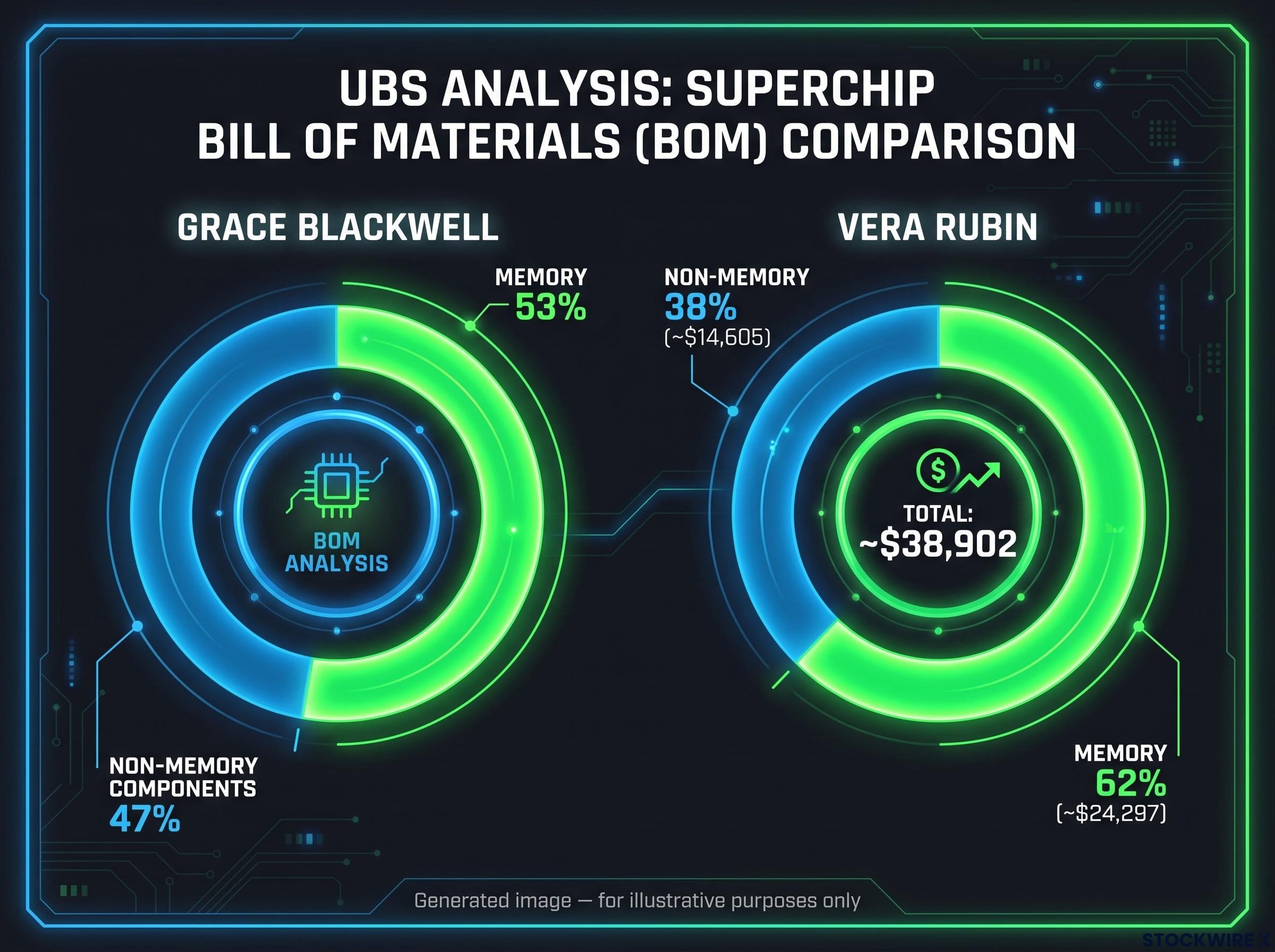
Memory now accounts for approximately 62% of the Vera Rubin superchip’s bill of materials, up from roughly 53% in Grace Blackwell systems, according to UBS analysis.
| Cost Component | Grace Blackwell Share | Vera Rubin Share | Vera Rubin (Approx.) |
|---|---|---|---|
| Memory | ~53% | ~62% | ~$24,297 |
| Non-memory components | ~47% | ~38% | ~$14,605 |
| Total superchip BOM | — | 100% | ~$38,902 |
That is a roughly 2.5 times jump in memory expenses generation-over-generation. At the rack level, Bernstein estimates memory and storage account for approximately $3.2 million of the $9.1 million total Vera Rubin NVL72 rack cost. GF Securities analyst Jeff Pu expects memory to represent approximately 20% of AI rack materials cost in 2027, noting that tight supply is already forcing specification changes, such as reducing planned Vera CPU rack memory capacity.
The TSMC foundry surcharge adds another layer
TSMC plans to raise chip prices by up to 10% starting in 2027 across advanced nodes. On top of that baseline, orders classified as high-performance computing (HPC) that exceed pre-committed volumes face an additional 10-15% surcharge.
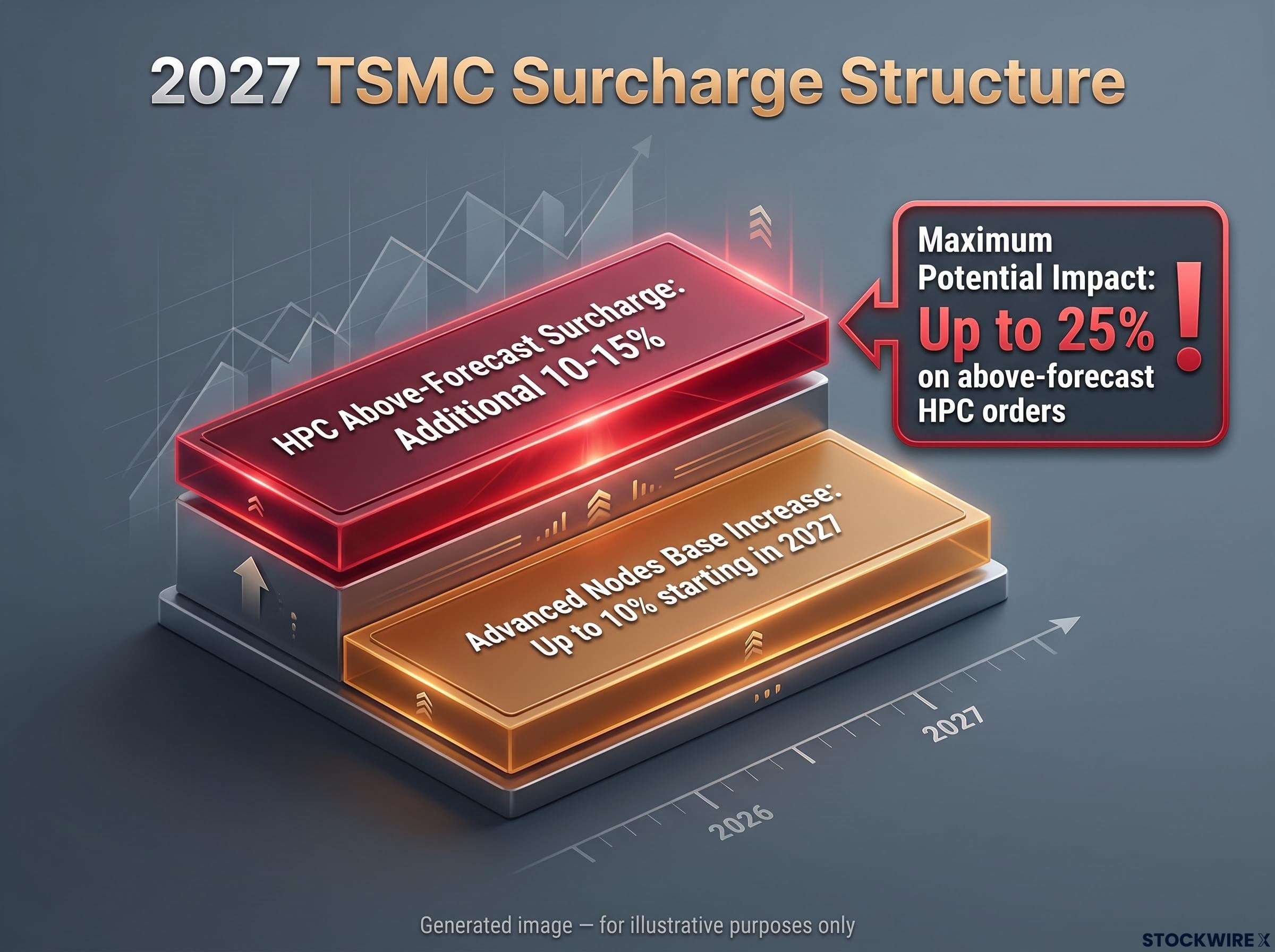
Nvidia frequently orders beyond forecast to match AI demand, which means its effective wafer cost increase could exceed the base rate. For buyers, this creates a structural incentive to commit to multi-year capacity plans rather than relying on incremental or spot purchasing, because late orders attract the most expensive tier.
TSMC foundry pricing power is rooted in a capacity gap that competitors have not closed: TSMC is targeting approximately 180,000 wafers per month at 3nm by end-2026, roughly eight times the estimated output at both Samsung and Intel, a lead that makes the HPC surcharge structure more durable than a single-cycle cost event.
With memory at 62% of the superchip cost and TSMC adding a second layer of foundry price pressure, the 15%+ server price increase is less a margin play than the mechanical result of where component costs have moved.
What this means if you are buying AI infrastructure
Layering a 15%+ server price hike on top of already elevated memory costs means large deployments could see tens of millions of dollars in additional spend against earlier planning assumptions. That is the capex reality. The question is what you can do about it.
Some customers may accelerate orders to lock in current pricing, but demand pull-forward carries its own risks if project readiness has not kept pace with procurement timelines. Pulling forward spend on systems your team is not ready to deploy is not cost savings; it is capital tied up without returns.
The more productive response is to treat memory configuration and vendor mix as active cost levers rather than fixed inputs. Specifically:
- Re-forecast AI infrastructure budgets with explicit inflation scenarios incorporating at least a 15-20% increase in server prices
- Optimise memory configuration by evaluating whether some workloads can run on lower-memory setups or a mix of HBM and LPDDR5X
- Negotiate long-term supply frameworks with both Nvidia and cloud providers to reduce exposure to spot-market volatility and the TSMC HPC surcharge
- Diversify architecture where performance allows, testing AMD accelerators, CPU-based inference, or custom silicon for less latency-sensitive workloads
Custom silicon alternatives from Alphabet, Amazon, and Microsoft are most competitive in inference workloads, which are projected to represent approximately 80% of the AI accelerator market by 2030, making workload type the critical variable when evaluating whether to diversify away from Nvidia hardware at current price levels.
GF Securities notes that tight supply is already forcing specification changes in the field. Buyers who treat configuration and vendor mix as negotiable variables before finalising 2027 commitments are carrying less pricing risk than those who do not.
What investors should be watching in NVDA
The same news event reads differently through an investor lens. The ability to pass 15%+ cost increases onto customers in a supply-constrained market is evidence of strong demand inelasticity for Nvidia’s top-tier hardware. That is structurally positive for margins.
Bernstein analysts believe Nvidia uses dynamic pricing to pass memory cost increases through to customers rather than absorbing them as margin compression, arguing that soaring HBM costs are more likely to translate into higher system prices than lower profitability.
The counter-consideration is volume and timing risk. If higher prices cause some customers to slow rollouts, compress configurations, or stretch deployment schedules, near-term shipment volumes could disappoint even as per-unit economics improve. The NVDA share price dip to $214.72, down approximately 0.98% on the report date, suggests the market is currently weighting volume risk over pricing power.
Nvidia demand durability has shifted measurably since 2023, with sovereign governments and enterprise on-premise buyers, not just hyperscalers, now leading revenue growth; that diversification across buyer types is relevant context when assessing how much volume risk a 15% price increase actually introduces.
Whether that interpretation holds depends on data that will not be visible until the next earnings cycle. The specific metrics to track:
- Memory vendor pricing and capacity: updates from SK Hynix and Micron on HBM and DRAM pricing and supply constraints
- Foundry disclosures: TSMC commentary on 2027 HPC pricing tiers and Nvidia’s wafer commitments
- Data centre margins and backlog: Nvidia’s next earnings, particularly gross margins, backlog commentary, and customer reaction to price changes
- Competitive share trends: whether AMD accelerators and hyperscaler custom silicon are gaining share in response to higher Nvidia prices, or whether Nvidia continues to command the bulk of AI training spend
What the pricing shift changes, and what it does not
The two cost drivers behind this increase, memory inflation and foundry price pressure, are structural rather than transitory. Memory represents 62% of the Vera Rubin superchip bill of materials, and TSMC surcharges could add up to 25% on above-forecast HPC orders. Neither of those forces is reversing to 2025 assumptions.
What has not changed is Nvidia’s position. At the frontier of large-scale AI training, alternatives from AMD, CPU-based inference, and custom hyperscaler silicon are genuine options for specific workloads, but they are not yet competitive for the largest training runs. That limits the volume risk that would otherwise make price increases self-defeating.
The notifications went out around 22 August 2026 for early 2027 shipments. Whether you manage AI budgets or hold NVDA stock, the key takeaway is not that the AI buildout is in trouble. It is that the cost structure underlying it has shifted materially, and planning assumptions need to catch up before formal pricing is locked.
This article is for informational purposes only and should not be considered financial advice. Investors should conduct their own research and consult with financial professionals before making investment decisions. Financial projections referenced are subject to market conditions and various risk factors.