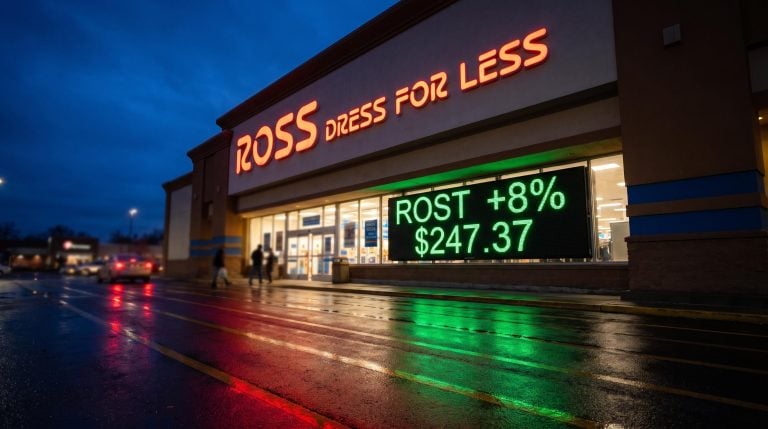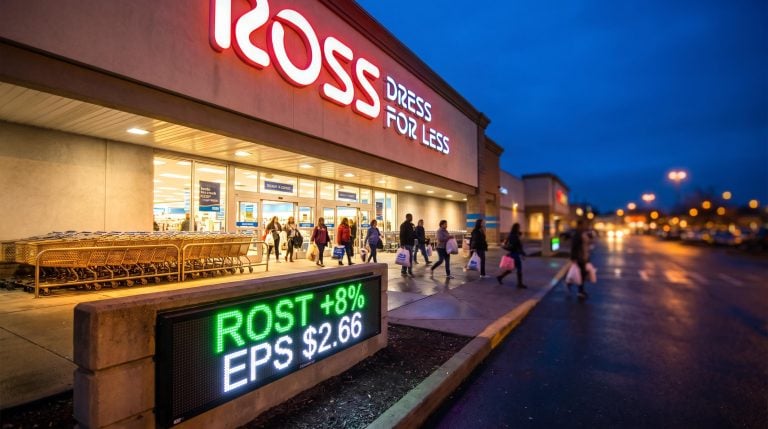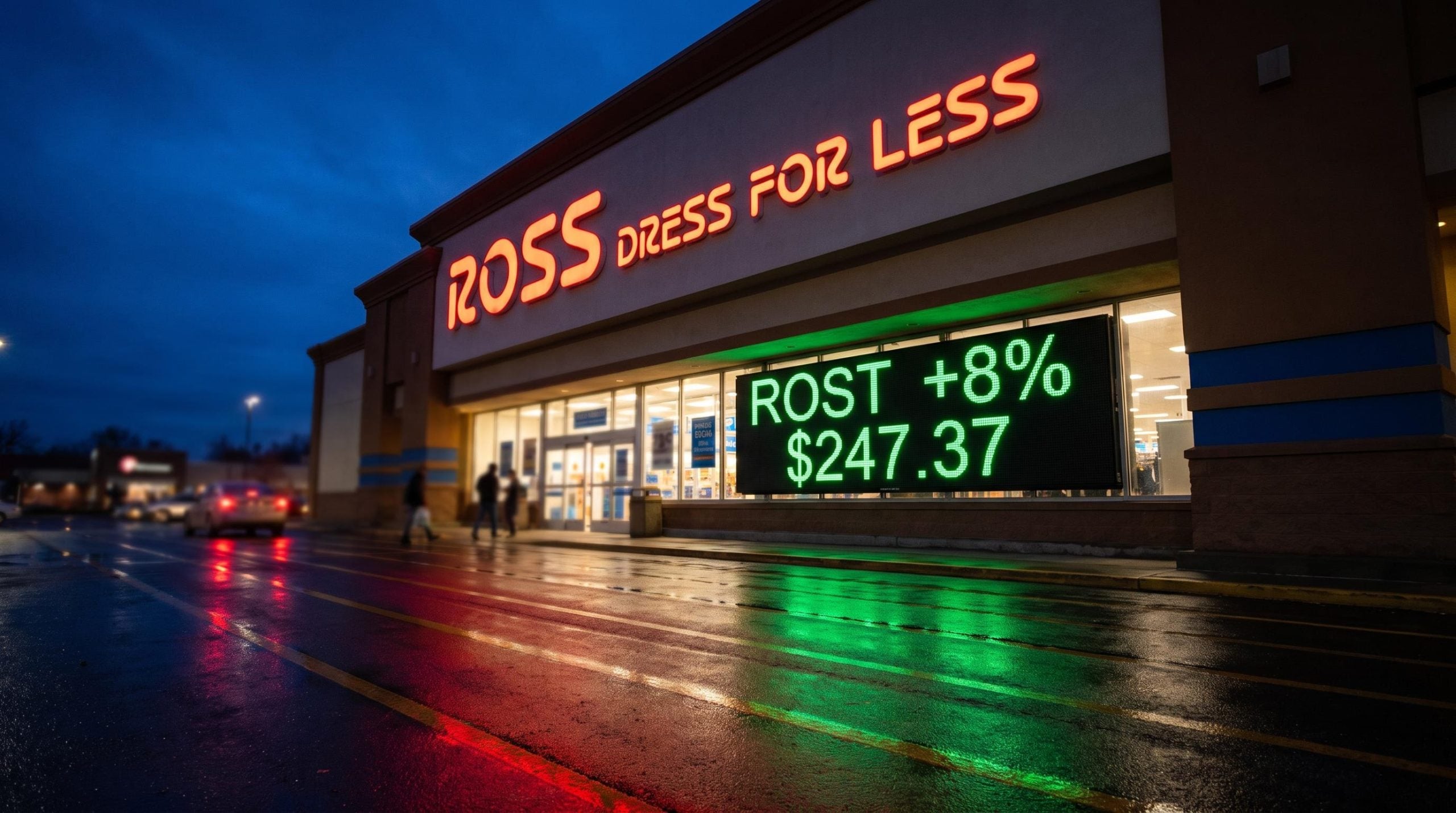
“Ross Stores shares climbed by over 8% in post-market trading on 20 August 2026, after the off-price retailer posted a second quarter that exceeded both its own projections and analyst forecasts by a wide margin. Revenue, comparable-store sales, and earnings per share all came in well above consensus, and the company raised its full-year outlook.\n\nThe headline number was striking: reported diluted earnings per share of $2.66 against a Wall Street consensus of approximately $1.94. But the story underneath that headline is more complicated than the after-hours move suggests. A significant one-time tariff refund inflated the reported figure by roughly $0.60 per share, and investors who stop at the surface risk overstating the quarter’s underlying earnings power.\n\nHere is the distinction that matters: the raw results confirm that the off-price model is pulling ahead in a cost-of-living-pressured consumer environment, but the raised full-year guidance and its relationship to the tariff refund are where the real forward-looking signal sits. This piece separates what the numbers show from what they actually tell you about where Ross Stores goes from here.\n\n## A quarter that beat everything Ross itself projected\n\nStart with the gap between what Ross told investors to expect and what it delivered. The company’s own Q2 guidance range was $1.85 to $1.93 per share. Wall Street consensus sat at approximately $1.94. The reported result: $2.66.\n\nRevenue reached approximately $6.3 billion, up roughly 13% year over year, against analyst expectations of approximately $6.15 billion. Comparable-store sales rose approximately 10%, and the driver matters: the growth came from higher customer traffic, not from consumers spending more per visit.\n\n
| Metric | Q2 FY2026 Result | Comparison |
|---|---|---|
| Revenue | ~$6.3 billion (+13% YoY) | Consensus: ~$6.15 billion |
| Comparable-store sales | ~+10% | Traffic-driven |
| Net income | ~$851 million | Prior year: ~$508 million |
| Reported diluted EPS | $2.66 | Prior year: $1.56 |
| EPS vs. guidance/consensus | $2.66 | Guidance: $1.85-$1.93; Consensus: ~$1.94 |
\n
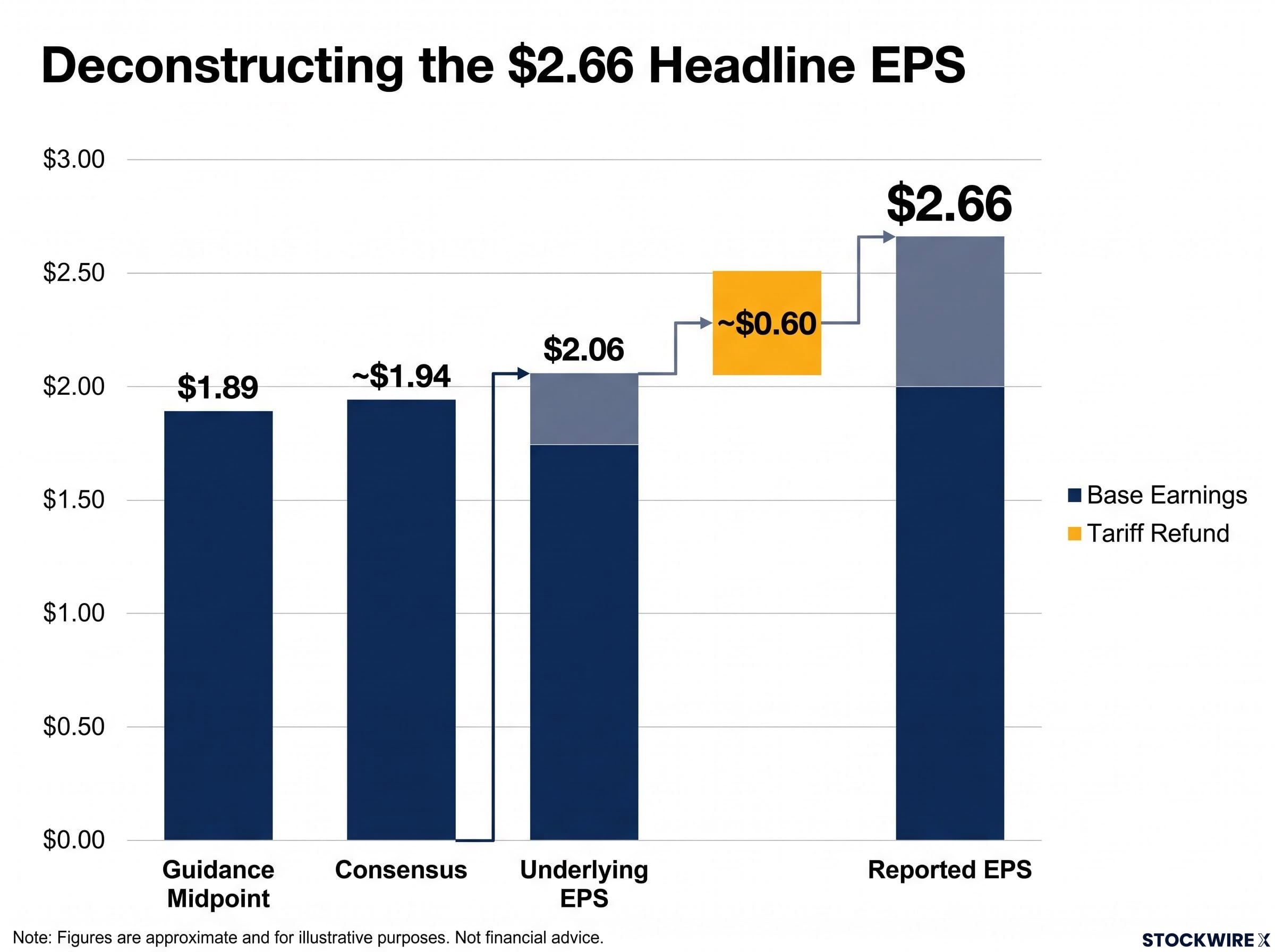
\n\nThe distance between the company’s own guidance midpoint of $1.89 and the reported $2.66 is $0.77 per share. That gap tells you one of two things: Ross was being deliberately conservative in its Q2 outlook, or the business performed materially better than its own internal projections anticipated. Both explanations carry different implications for how much weight to place on forward guidance, and the next section explains why the answer is not as straightforward as the headline suggests.\n\n## The tariff refund: what the $2.66 headline actually contains\n\nThe $2.66 reported EPS is real, but not all of it is repeatable. Approximately $0.60 per diluted share of that figure reflects a one-time refund of tariffs collected under the International Emergency Economic Powers Act (IEEPA), a law that grants the US president authority to impose emergency trade restrictions. That refund contributed approximately $253 million in operating profit impact to the quarter.\n\nThe legal status of IEEPA tariff authority has itself been in flux through 2026, with federal courts striking down the broadest pillars of emergency executive tariff powers, a development that shapes the likelihood of future refunds of this kind reaching retailers.\n\n> The $253 million IEEPA tariff refund represents a one-time operating profit contribution roughly equal to half of Ross’s prior-year quarterly net income, a scale that makes it impossible to read the headline EPS at face value.\n\nStrip the tariff benefit out and the underlying picture sharpens:\n\n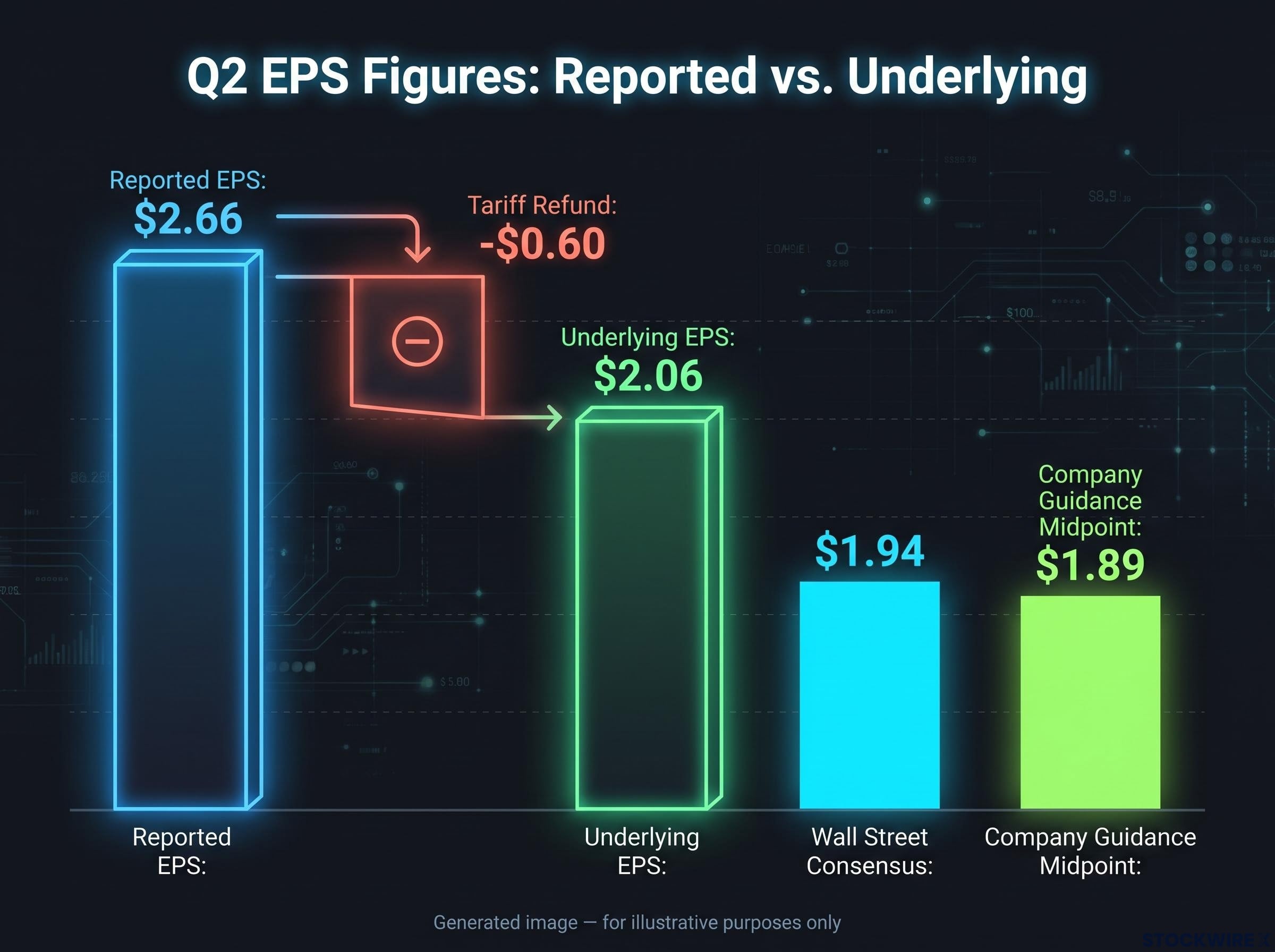 \n\n- Reported EPS: $2.66\n- Less: tariff refund per share: ~$0.60\n- Underlying/analytical EPS: ~$2.06\n- Wall Street consensus (unadjusted): ~$1.94\n- Company guidance midpoint: $1.89\n\nThe underlying $2.06 figure is an analyst-constructed adjustment, not a non-GAAP metric provided by Ross itself. It matters because the Wall Street consensus of $1.94 was built without this refund in view. On an apples-to-apples basis, the clean beat was approximately $0.12 per share, a solid result but a fundamentally different story from the $0.72 headline gap.\n\nThe analytical adjustment from $2.66 to $2.06 sits at the heart of how investors interpret GAAP vs non-GAAP earnings, a distinction that becomes especially consequential when a one-time item accounts for nearly a quarter of the reported headline figure.\n\n
 \n\nFor investors assessing the sustainability of Ross’s earnings trajectory, that $2.06 underlying figure is the number that anchors forward modelling. The $0.60 tariff refund will not recur and should not inflate valuation or run-rate profitability assumptions.\n\n## What the off-price model is, and why cost-of-living pressure fuels it\n\nOff-price retail works differently from both traditional department stores and e-commerce discount players. Retailers like Ross buy excess inventory, cancelled orders, and out-of-season stock from manufacturers and department stores at steep discounts. They then pass those savings to shoppers, offering branded merchandise at price points well below full-price retail.\n\nThe model depends on three things that distinguish it from other forms of value retail:\n\n- Inventory sourcing: Opportunistic purchasing of surplus stock, rather than ordering merchandise to plan months in advance. This keeps costs low and product assortment unpredictable.\n- Pricing strategy: Discounts of 20-60% off department store prices, funded by the buying model rather than by accepting lower margins.\n- Shopper experience: A physical, in-store \”treasure hunt\” where the selection changes constantly. This is fundamentally different from the curated, searchable experience of e-commerce value players like Shein or Amazon.\n\nThe link between the off-price model and today’s consumer climate is straightforward. Squeezed household budgets push shoppers to seek out lower-cost alternatives, and off-price retail sits in a strong position to capture that demand because it delivers recognised brands at genuine discounts rather than simply offering cheaper, lower-quality goods.\n\nThe tariff impact on household budgets, estimated at $1,830 to $2,600 in added costs per American household in 2026, is the macroeconomic pressure that makes the off-price channel structurally attractive to consumers who are actively seeking branded goods at lower price points.\n\nThe 10% comparable-store sales gain reinforces this. The growth was driven by traffic, meaning more consumers physically chose to shop at Ross, not by higher spending per visit. That distinction matters: attracting more customers is a more durable signal of structural market share gain than simply extracting more from existing ones.\n\n### How Ross stacks up against Burlington and TJX\n\nThe US off-price market is dominated by three established players. Ross, TJX (which operates Marshalls and T.J. Maxx), and Burlington each target value-focused shoppers and have all drawn on the same favourable demand backdrop in the current environment. Ross’s 10% comparable-store sales result positions it well within this group, though the quarter alone does not establish relative market share movement without comparable disclosures from the other two.\n\n## CEO Jim Conroy’s read on the consumer: spending up across categories and regions\n\nJim Conroy, who took the CEO role effective 2 February 2025 as successor to Barbara Rentler, offered investors a qualitative read on consumer behaviour following the Q2 results. On the post-earnings call, he conveyed a broadly upbeat picture, noting that shoppers lifted their spending across a range of product lines and across different parts of the country during the quarter.\n\n> In his post-earnings remarks, Conroy described a broad uplift in consumer spending spanning multiple merchandise categories and geographic markets, a signal that, if it continues, suggests demand is widely distributed rather than dependent on any single region or product vertical.\n\nConroy singled out home goods and cosmetics as categories where Ross saw particularly strong performance. This category-level detail is attributed to the post-earnings investor call and has not been independently corroborated in the third-party financial summaries reviewed at time of publication. The geographic breadth of consumer engagement, however, is more broadly supported and reinforces that the demand shift is not regionally concentrated.\n\nBroad geographic and category-level strength, if it holds into Q3, suggests Ross’s results are not dependent on a single product vertical or region. That reduces concentration risk for investors evaluating whether the quarter’s momentum is repeatable.\n\n## Raised full-year guidance and what it signals beyond the one-time boost\n\nRoss raised its full-year EPS guidance following Q2, with the directional upgrade confirmed across earnings coverage. The specific ranges reported, $8.61 to $8.77 raised from a prior $7.50 to $7.74, are drawn from the earnings source material and require direct confirmation against the official press release or SEC filing before being treated as definitive.\n\nTaking the reported figures at face value, the implied increase at the midpoint is approximately $1.07 per share. That is a material raise. The analytical question is whether the new range incorporates the non-recurring $0.60 tariff refund or reflects a clean operational upgrade, because the answer determines what the raise actually signals:\n\n- Scenario 1: The raised guidance fully reflects the tariff refund already booked in Q2. The underlying forward outlook is unchanged.\n- Scenario 2: The raise partially reflects the tariff refund and partially reflects genuine operational improvement. A mixed signal.\n- Scenario 3: The raised guidance strips out the tariff refund entirely, meaning the operational outlook alone improved materially. The strongest signal.\n\nEven on an underlying basis, a guidance raise following a 10% comparable-store sales quarter is a positive signal about management’s confidence in the back half of the fiscal year. A company lifting its outlook off a traffic-driven beat is telling you something different from one that beat on cost cuts alone. But the tariff refund layer demands analytical honesty before drawing conclusions about durable earnings power.\n\nFor investors modelling whether Q3 will deliver a clean comparable, the broader question of presidential tariff authority matters: the statutory landscape governing which emergency trade powers remain available after recent court rulings determines the probability of further one-time items appearing in future quarters.\n\nThis article is for informational purposes only and should not be considered financial advice. Investors should conduct their own research and consult with financial professionals before making investment decisions.\n\nThese forward-looking statements regarding guidance are subject to change based on market developments and company performance. Past performance does not guarantee future results.\n\n## What this result changes for Ross investors, and what it does not\n\nThe quarter confirmed several things worth holding onto:\n\nWhat Q2 confirmed:\n\n- Traffic-driven comparable-store sales growth of ~10%, the most durable form of top-line expansion for a physical retailer\n- Revenue of ~$6.3 billion, well ahead of both internal and external expectations\n- A guidance raise that, at minimum, reflects management confidence in the back half of fiscal 2026\n- Broad-based consumer engagement across categories and geographies, per CEO commentary\n\nWhat Q3 needs to answer:\n\n- Whether the guidance raise is structural (reflecting genuine operational improvement) or mechanical (the tariff refund flowing through to the full-year figure)\n- Whether comparable-store sales can hold in the high-single-digit-to-10% range without a $253 million non-recurring tailwind\n- Whether the home goods and cosmetics category strength Conroy highlighted holds up under broader scrutiny\n\nThe after-hours move from approximately $228.99 to approximately $247.37 reflects the market pricing in a strong quarter. But investors who anchor on the underlying $2.06 rather than the reported $2.66 will hold a more defensible position if Q3 arrives without a comparable one-time boost.\n\nThe Q3 report is the test. A clean quarter with traffic-driven comparable-store sales growth and no tariff refund to complicate the picture would confirm that what happened in Q2 was structural momentum, not a moment inflated by a non-recurring item. That is the distinction worth waiting for.”
The distinction between a genuine beat and a headline inflated by a one-time item is precisely the kind of separation that rigorous earnings report analysis surfaces, using frameworks that compare GAAP figures against free cash flow, strip non-recurring items, and assess whether forward guidance reflects operational confidence or accounting mechanics.
Ross’s Q2 result adds another data point to the case that the consumer discretionary sector is priced for a demand collapse that the spending data do not support, with the sector’s ratio to the S&P 500 near a 20-year low even as companies like Ross post traffic-driven double-digit comparable-store sales growth.