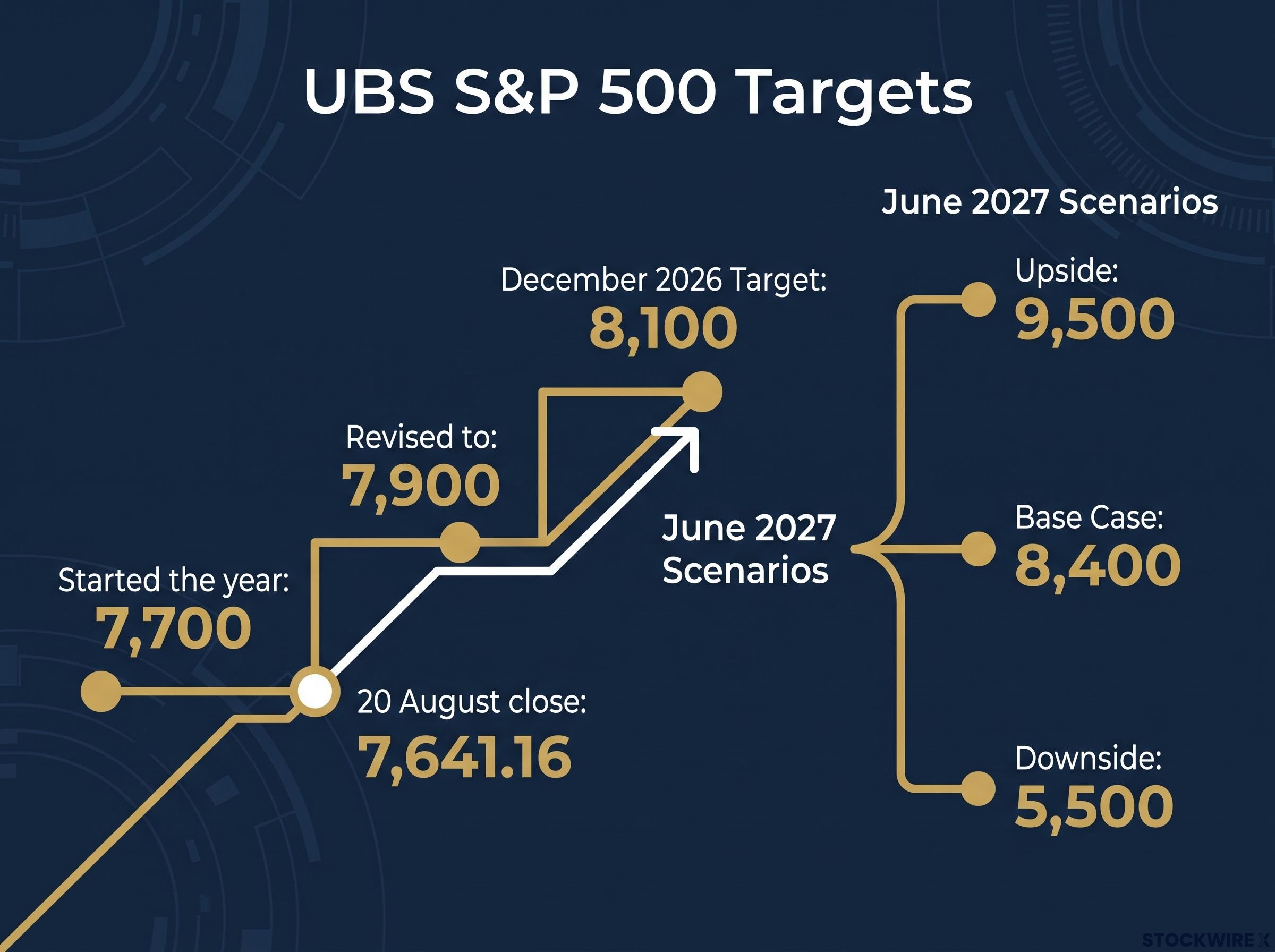
UBS raised its S&P 500 year-end price target to 8,100 on 21 August 2026, the third upward revision to its house view this year and one that implies roughly 6% upside from the index’s 20 August close of 7,641.16. The call arrived alongside material earnings upgrades that do the heavy lifting behind the headline number.
This is not the first time the bank has moved the goalposts higher in 2026. UBS Global Wealth Management started the year with a 7,700 target, revised it to 7,900, and has now stepped up again. Each revision has tracked accumulating evidence of earnings strength that exceeded the bank’s own prior assumptions.
The prior UBS revision, published in May 2026, established the 7,900 year-end target and a June 2027 destination of 8,200, with semiconductors accounting for roughly half of that round’s EPS upgrade and energy contributing approximately a quarter.
Here is what the updated targets, revised earnings per share forecasts, and scenario band from David Lefkowitz and the UBS strategist team tell you about where one of Wall Street’s largest institutions sees the market heading through mid-2027, and what specific conditions would have to break for the thesis to fail.
UBS’s new numbers: what the bank actually changed
The headline revision is the December 2026 S&P 500 target of 8,100, up from the prior 7,900. Beyond year-end, UBS projects a June 2027 base case of 8,400, accompanied by a scenario band whose outer limits sit at 5,500 on the bear side and 9,500 on the bull side.
The earnings revisions are what power those targets mechanically. Higher expected earnings per share support higher index levels, and the step-up here is material.
| Metric | Prior estimate | Revised estimate | Change |
|---|---|---|---|
| 2026 EPS | $335 | $350 | +4.5% |
| 2027 EPS | $375 | $400 | +6.7% |
| S&P 500 year-end 2026 target | 7,900 | 8,100 | +2.5% |
The June 2027 scenario band puts three distinct destinations on the table:
- Downside: 5,500
- Base case: 8,400
- Upside: 9,500
That range is wide by design. It signals that UBS is building its call around a probabilistic framework, not issuing a directional guarantee. The EPS revisions are the engine; the scenario band is the acknowledgement that the engine runs inside an uncertain environment.
When big ASX news breaks, our subscribers know first
Why earnings strength is the foundation of the upgrade
The immediate catalyst for the revision was the Q2 2026 reporting season, which UBS judged to have delivered results well above prior expectations. What matters more than the magnitude of the beat, though, is where it came from.
The Q2 2026 earnings season delivered a blended headline growth rate of approximately 50.6%, though stripping out non-recurring mark-to-market gains at Alphabet and Amazon reduces the operationally relevant figure to roughly 30-32%, the adjusted baseline that belongs in forward EPS models.
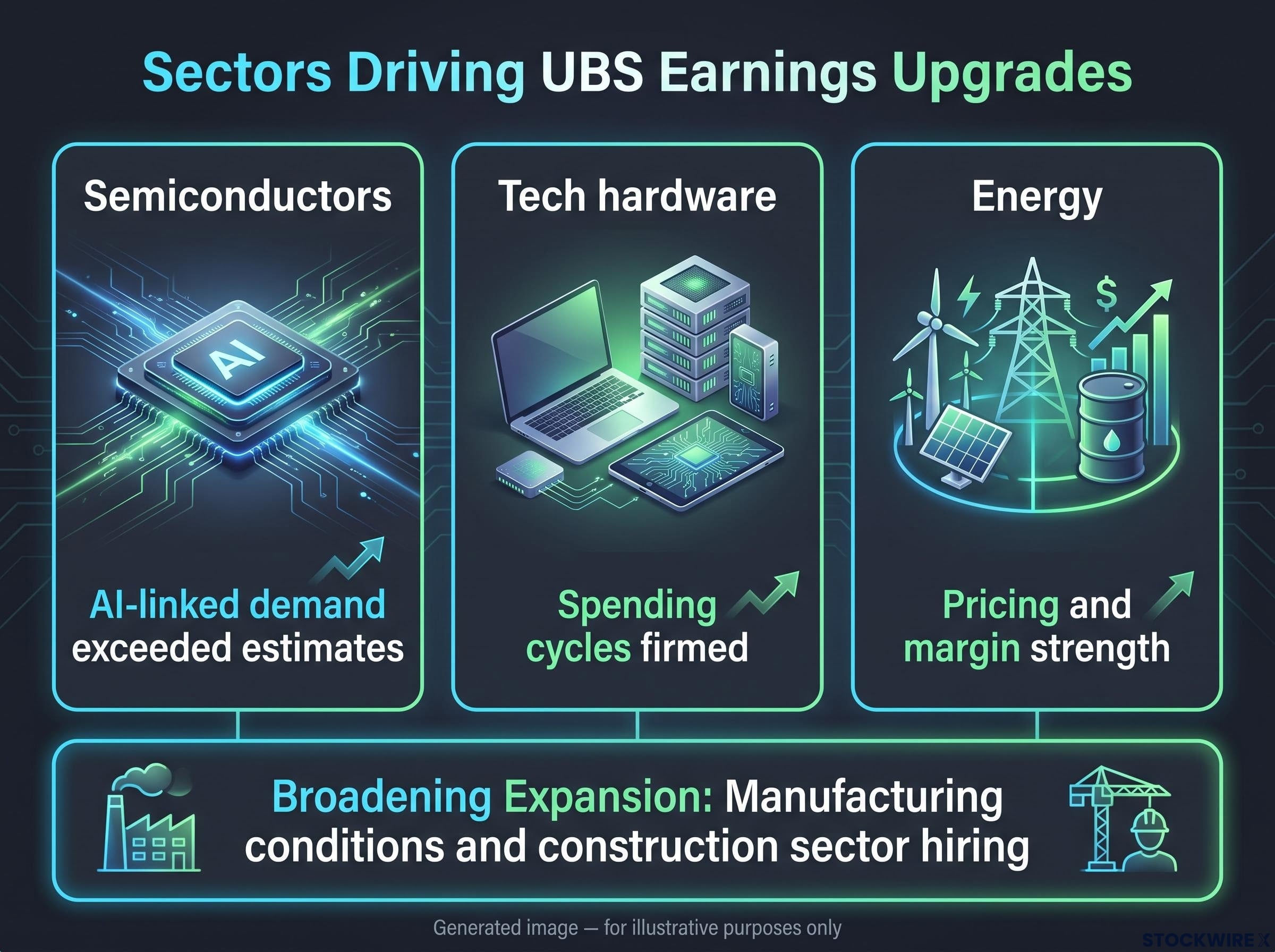
The main sectors behind the earnings upgrades were three in number, each identified by David Lefkowitz and the strategist team:
- Semiconductors, where AI-linked demand continued to exceed estimates
- Tech hardware, where spending cycles firmed beyond initial forecasts
- Energy, where pricing and margin strength surprised to the upside
But the more analytically significant signal sits underneath those leaders. Beyond those leading sectors, earnings estimates were lifted across virtually the full breadth of the market. UBS pointed to the advance becoming more widely distributed, noting that gains in manufacturing conditions and hiring in the construction sector indicate the expansion is taking hold across a broader range of the economy, not retreating into a narrow cluster of winners.
That breadth distinction matters. A rally driven by broad earnings participation across multiple sectors is historically more durable than one concentrated in a handful of large-cap names. UBS sees the U.S. economy growing fast enough to support double-digit EPS gains, and it is the breadth of that growth, not just the headline rate, that underpins the bank’s upgraded conviction.
What UBS actually means when it calls AI a structural tailwind
AI fatigue is real, and healthy. Most investors have heard the pitch enough times to have built some scepticism. So it is worth being precise about what UBS is and is not claiming here.
The bank is not treating AI as a speculative theme trade, the kind of momentum play where capital chases a narrative and valuation decouples from earnings. What UBS is claiming is that AI represents a structural productivity shock: one that lifts margins and earnings per share across multiple industries beyond chipmakers and cloud providers. That is a narrower, more testable claim.
UBS frames AI as a “structural productivity shock” rather than a cyclical theme, meaning the bank expects AI-driven efficiency gains to show up in corporate earnings across sectors, not just in the share prices of AI builders.
Cloud growth and AI demand are cited as supporting stronger profit trajectories than previously assumed, and AI adoption is a direct justification for higher EPS into 2027. But this pillar carries a built-in falsifying condition: if AI capex does not produce commensurate productivity and earnings gains, the pillar collapses. UBS‘s own downside scenario accounts for exactly that risk.
Whether or not AI delivers the productivity gains UBS is projecting is the single variable with the most leverage over whether the 8,100 and 8,400 targets hold. That is not editorial opinion; it is the logical structure of the bank’s own call.
The AI productivity paradox sits at the centre of this debate: task-level efficiency gains of up to 55% in software development have not yet translated into comparable GDP-level growth, a disconnect that makes UBS’s claim of a broad-based structural earnings shock testable against macro data over the next 12-18 months.
Conditions that could derail the forecast
UBS itself named three specific conditions under which the outlook fails. Each operates as a causal chain, not an abstract label.
- A sustained oil price spike. Durably higher oil prices would re-ignite inflation, compress corporate margins, and force the Federal Reserve to resume tightening from its current policy rate of 3.50%-3.75%. That tightening would undermine the equity multiple support UBS assumes in its base case.
- Persistent non-energy inflation. Services inflation and wage pressures could keep CPI elevated past the point at which UBS expects the drag from tariffs to have dissipated through the latter part of 2026. If inflation remains sticky for reasons unrelated to energy, the Fed’s hand is forced regardless of what oil does.
- AI capex failing to deliver. If the enormous capital expenditure flowing into AI infrastructure does not produce commensurate productivity and earnings gains, the valuation premium on AI-exposed names compresses and drags index-level EPS expectations lower.
The June 2027 downside scenario of 5,500 sits approximately 28% below the 20 August close of 7,641.16. This is not a garden-variety correction; it is a significant bear market condition.
These are not tail risks buried in a footnote. They are the explicit conditions that map directly to UBS‘s 5,500 downside scenario. The bank is telling you what would have to go wrong, and the destination if it does.
What the UBS revision means if you hold U.S. equities now
The 8,100 year-end target implies roughly 6% upside from current levels. That is constructive, not euphoric. UBS is not calling for a melt-up; it is calling for a continuation of a broad-based advance at a measured pace.
The more durable value in this note, though, is the framework. The three supporting pillars UBS identifies (sustained economic expansion, a Federal Reserve content to remain on hold, and AI-driven productivity gains) work as a diagnostic tool you can run in real time. If any pillar weakens, the call itself weakens. The variables to watch are specific:
- Fed communications on rate trajectory. Any shift from hold to tightening bias directly undermines the second pillar and compresses equity multiples.
- Oil price movements. A sustained move higher re-ignites inflation risk and feeds into the first pillar’s failure condition.
- Early corporate signals on AI capex returns. Earnings calls that begin showing AI spending without corresponding margin improvement would erode the third pillar.
The wide scenario band, 5,500 to 9,500 by June 2027, is itself a useful reminder. A forecast with that much spread is not expressing high certainty about where the index lands. It is expressing confidence in the analytical framework and appropriate caution about the variables.
Where the call lands, and what has to hold for it to get there
UBS‘s revised outlook, published the week of 21 August 2026 by the strategist team led by David Lefkowitz, is a probabilistic base case anchored in two observable conditions: broadening earnings participation and AI-driven productivity gains lifting EPS across sectors.
UBS’s July 2026 global outlook frames the same earnings expansion thesis as broadening beyond U.S. mega-cap tech, with European equities upgraded to Attractive on roughly 18% projected 2027 profit growth and the AI trade rotating from semiconductors into software applications and real-economy adopters in financials and industrials.
The scenario band from 5,500 to 9,500 by June 2027 spans 4,000 points. That spread is the bank’s own acknowledgement that the bull case requires several things to go right simultaneously: the economy staying expansionary, the Fed staying on hold, and AI capex translating into real margin gains.
What makes this note more useful than a headline target is the structure underneath it. UBS has specified both the thesis and the falsifying conditions. For investors managing real portfolios, that kind of structured framework, where you know what to monitor and what would change the call, is worth considerably more than a single number.
This article is for informational purposes only and should not be considered financial advice. Investors should conduct their own research and consult with financial professionals before making investment decisions. These forward-looking statements are subject to change based on market developments and company performance.