
The European Central Bank spent the better part of a decade flooding the banking system with cheap, plentiful liquidity. Asset purchases, pandemic programmes, and successive waves of targeted lending operations pushed excess reserves to levels that would have seemed unthinkable before 2015.
Now, as the ECB carefully drains that surplus, it is designing a new permanent instrument to ensure banks never quite run dry. That tension, between withdrawing extraordinary support and building a permanent backstop, sits at the centre of one of the most consequential plumbing decisions in European monetary policy.
The ECB’s March 2024 operational framework review set structural longer-term refinancing operations (LTROs) on a formal path. Governing Council deliberations were projected for late 2025 or early 2026, and as of mid-2026, the instruments remain firmly in the design phase, with deployment anticipated around 2027. If you have exposure to EUR-denominated floating-rate debt, fund in euros, or simply want to understand what is coming before it arrives, here is what you need to know: what structural LTROs are, why they are being designed differently from their crisis-era predecessors, and what their arrival means for EUR money-market rates.
The building blocks: what an LTRO actually is and how it differs from the ECB’s standard toolkit
A longer-term refinancing operation is, at its simplest, a collateralised loan. The ECB lends euros to an eligible bank, the bank posts approved collateral, and the loan carries a maturity longer than the standard weekly cycle. That weekly cycle is handled by Main Refinancing Operations (MROs), the ECB’s primary tool for managing short-term liquidity frictions across each reserve maintenance period.
Where MROs cover weekly needs, LTROs extend the horizon. Standard LTROs today are three-month operations conducted monthly, giving banks a predictable source of term funding beyond the one-week window. The current reserve ratio stands at 1%, with zero remuneration on minimum reserves.
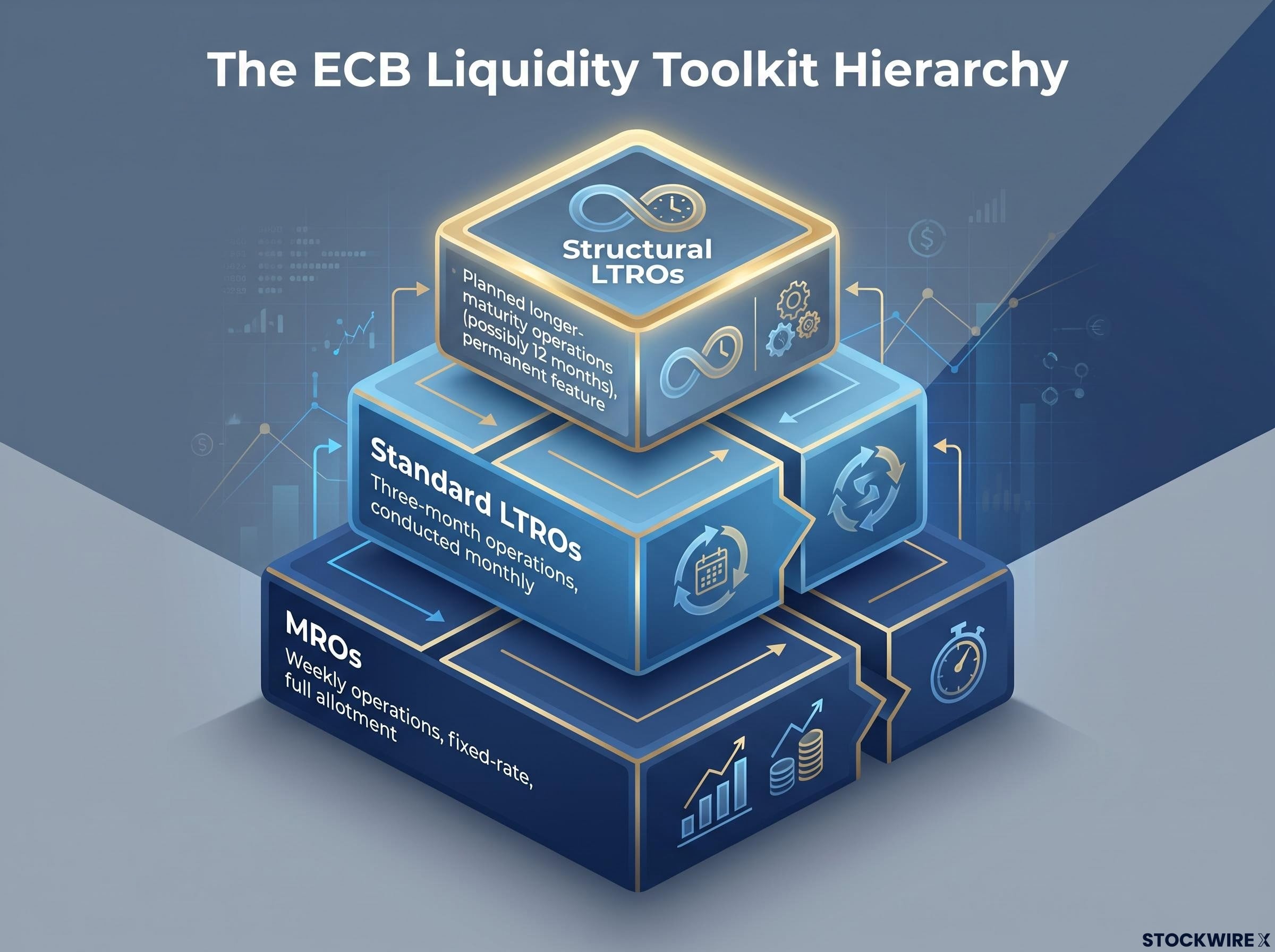
The three instruments sit in a clear hierarchy:
- MROs: Weekly operations managing short-term liquidity. Fixed-rate, full allotment.
- Standard LTROs: Three-month operations smoothing funding over each maintenance period. Conducted monthly.
- Structural LTROs: Planned longer-maturity operations (possibly 12 months, though the exact tenor is unconfirmed) designed as a permanent feature of the framework.
What “structural” means in the ECB’s new framework
The word “structural” is doing specific work here. In ECB terminology, structural operations are designed to implement the chosen monetary policy stance rather than steer it. Think of the distinction this way: the ECB’s deposit facility rate is the thermostat, setting the temperature for the eurozone economy. Structural LTROs are the plumbing, ensuring the system can actually deliver that temperature consistently to every part of the banking network.
That distinction is not semantic. It tells you that structural LTROs will not function as a new interest rate lever. They will not signal a policy direction. They are a delivery mechanism, and understanding that shapes every question about their market impact. The ECB has also indicated that structural operations will incorporate climate considerations where possible, without prejudice to the primary monetary policy objective.
When big ASX news breaks, our subscribers know first
Why the ECB is designing a new permanent liquidity instrument right now
The story starts with the balance sheet. Between the Asset Purchase Programme (APP), the Pandemic Emergency Purchase Programme (PEPP), and successive waves of targeted longer-term refinancing operations (TLTROs), the Eurosystem’s balance sheet swelled to unprecedented size. Excess reserves were enormous. Banks had more central bank money than they could use. Money-market activity, in some segments, nearly disappeared.
The ECB is now moving toward what it describes as a “relatively ample” reserve regime: enough liquidity to keep the system stable, not so much that it suppresses all market-based price discovery. The Governing Council decision of 13 March 2024 formally set out the architecture for this transition, built on three components:
The ECB’s March 2024 operational framework decision formally set out the three-component architecture for the transition to a relatively ample reserve regime, establishing structural LTROs and a structural securities portfolio as the twin instruments for the medium term.
- Demand-driven reserves via MROs, conducted at fixed-rate full allotment, covering banks’ immediate weekly liquidity needs.
- Three-month LTROs at fixed-rate full allotment initially, providing term funding continuity during the transition.
- Structural LTROs and a structural securities portfolio as twin instruments for the medium term, keeping reserves relatively ample even as legacy bond holdings roll off.
Structurally funded but not flooded.
That phrase captures the target state. Structural LTROs allow quantitative normalisation, the gradual shrinking of APP and PEPP holdings, to continue without stranding banks that depend on term central bank funding. Monetary policy transmission stays intact even as excess reserves fall far below QE-era levels.
The broader debate about monetary policy transmission sits directly behind the structural LTRO design: if the ECB’s rate signals cannot reach the parts of the banking system that matter most, the deposit facility rate becomes a less reliable thermostat regardless of where it is set.
The point for you is that structural LTROs are not a crisis response. They are a deliberate architectural choice for a world where the ECB is smaller and less dominant in funding markets. That context determines what their market effects will and will not be.
How structural LTROs will actually work: auction design, triggers, and the variable-rate question
Several important design questions remain unresolved, and separating what is confirmed from what is analyst inference matters if you want to read future ECB communications accurately.
What is confirmed: structural LTROs will carry longer maturities than today’s three-month operations, they will be recurring and scheduled (not ad-hoc crisis tools), and they will sit alongside a structural securities portfolio. Rabobank analyst Bas van Geffen has assessed 12 months as a viable maturity option, though the ECB has not committed to a specific tenor.
What is widely anticipated but unconfirmed: the auction format. The ECB has historically used both fixed-rate full-allotment and variable-rate tender procedures. MROs switched to variable-rate tenders with minimum bid rates in 2000, then moved to fixed-rate full allotment during the financial crisis. Market commentary, including analysis from Rabobank, has focused on the likelihood that structural LTROs will reintroduce variable-rate auctions, but this has not been formally confirmed.
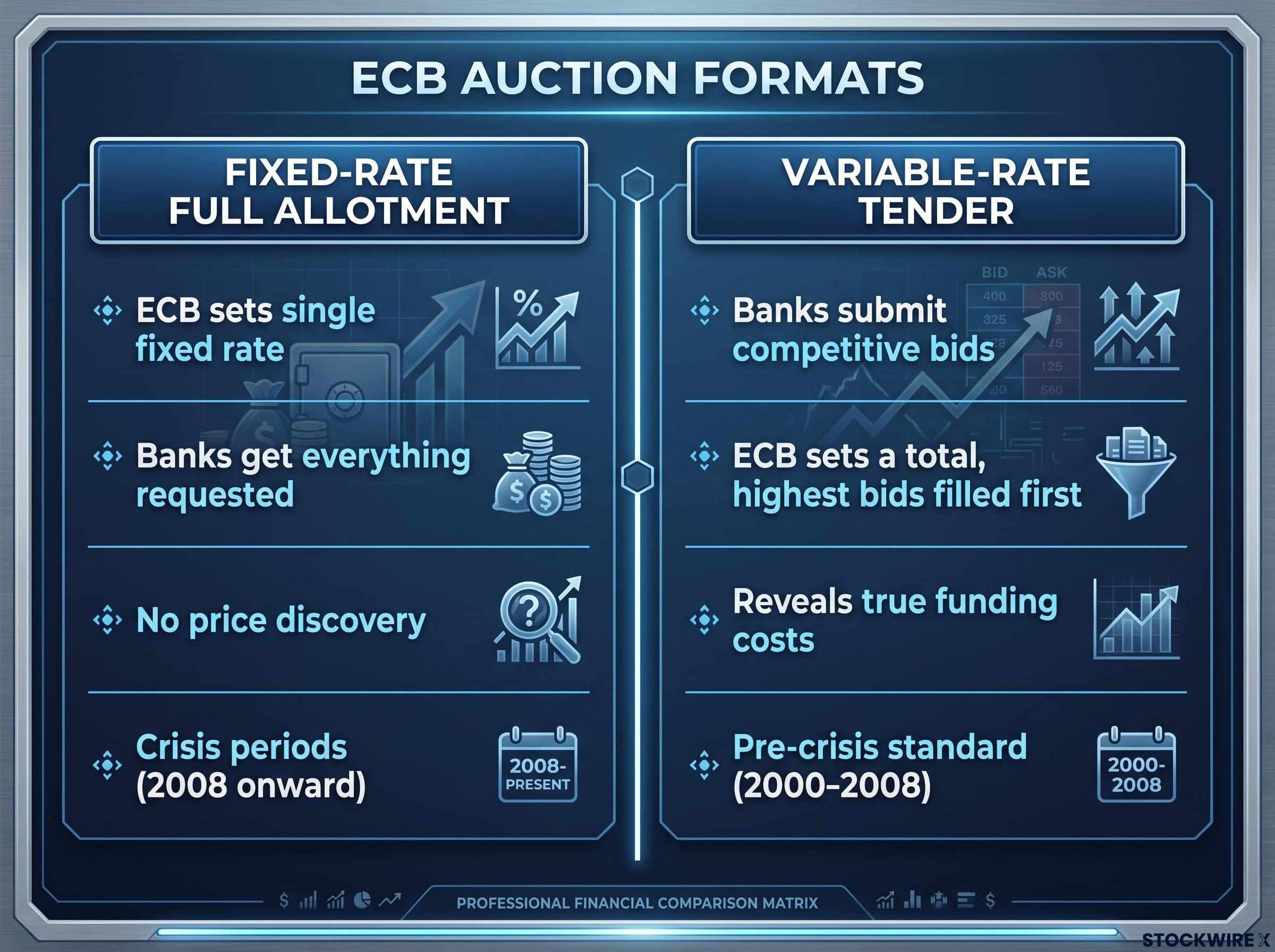
The difference between the two formats matters directly for how these operations affect money-market rates:
| Feature | Fixed-rate full allotment | Variable-rate tender |
|---|---|---|
| Who sets the rate | The ECB (single fixed rate) | Banks submit competitive bids |
| How volume is determined | Banks get everything they request | ECB sets a total; highest bids filled first |
| Price discovery outcome | None; rate is administered | Bids reveal banks’ true funding costs |
| Historical ECB usage | Crisis periods (2008 onward) | Pre-crisis standard (2000-2008) |
Under variable-rate tenders, banks’ revealed bids create genuine price discovery. That is the mechanism through which structural LTROs would most directly affect term money-market rates, and you should understand that link before evaluating any rate-impact claims.
What the reserve-demand trigger tells us about timing
Historical data offers a practical signal for when structural LTROs move from design to deployment. According to analysis by Rabobank, MRO demand in the range of €100-125 billion is the threshold at which LTRO issuance has historically become warranted. Prior data also shows that the smallest three-month LTRO on record was around €15 billion, issued during a period when weekly MRO take-up was running at a sustained floor of roughly €100 billion.
When banks are drawing that much from weekly operations on a sustained basis, the system is demonstrating structural liquidity need rather than temporary friction. Should the ECB choose to lift the 1% minimum reserve requirement, such a move would itself generate additional demand for central bank funding and bring the case for structural LTROs forward more quickly. Official ECB language describes structural operations arriving “in the coming years,” with a 2026 review of key framework parameters formally foreseen. Operational deployment is anticipated around 2027, though this remains a market-derived timeline rather than a formal ECB commitment.
What structural LTROs will do to EUR money-market rates (and what they will not)
The rate-impact question is the one with the most direct commercial relevance, and the answer is more nuanced than either “big compression” or “no effect.”
Start with the substitution mechanism. When structural LTROs become available, banks facing higher term funding costs in wholesale markets gain the option to borrow directly from the ECB instead. The institutions most likely to use them are those with weaker credit profiles, more concentrated funding bases, or higher unsecured borrowing spreads. Three categories stand out:
- Smaller eurozone banks with limited wholesale market access, for whom ECB term lending offers a cheaper alternative to interbank borrowing.
- Institutions with concentrated funding bases that rely heavily on a narrow set of wholesale counterparties and face capacity constraints.
- Higher-spread names that currently pay a premium in unsecured term markets and would benefit most from policy-linked pricing.
When these banks shift a portion of their term borrowing from wholesale markets into structural LTROs, they reduce marginal demand in the unsecured term market. The result is a gravitational pull on the system’s blended term funding cost, nudging the short end of the curve gently lower without dramatically repricing the market.
But Euribor is a different story. Euribor is calculated from submissions by a panel of large, generally well-rated banks with diversified funding access. These panel banks already borrow at relatively tight spreads and are less likely to be heavy structural LTRO users purely for cost reasons. The direct impact on the rates they report is therefore limited.
The ECB deposit rate trajectory through 2027 also shapes the commercial relevance of structural LTROs: if the deposit rate returns to 2% or below by end-2027, the spread between policy-linked LTRO pricing and wholesale unsecured term rates narrows, reducing the substitution incentive for the banks most likely to use the facility.
System-wide term funding costs may fall modestly; Euribor fixings will move less.
That distinction matters. If you are pricing hedging strategies or assessing floating-rate exposures tied to Euribor, structural LTROs are unlikely to drive the kind of rate compression you might anticipate from a major new ECB liquidity facility. The instrument is a stabiliser, not a suppressor.
There is also the quantitative tightening overlay. Structural LTROs do not reverse QT; they operate within it. APP and PEPP roll-off continues to reduce excess reserves, which is inherently supportive of higher term rates relative to the QE era. Structural LTROs add a controlled source of term liquidity that can moderate, but not fully offset, that upward pressure. The net result: relative to a world with QT but without structural LTROs, the EUR term curve should be modestly flatter. Relative to the QE era, term rates will still be higher.
Five signals that will tell you structural LTROs are moving from design to deployment
Understanding the instrument is half the picture. Watching it arrive in real time is the other half. These five indicators, all drawn from publicly available ECB data and communications, give you a practical monitoring framework:
- MRO and LTRO take-up volumes. The ECB publishes detailed tender data after each operation. Persistent increases in take-up toward the €100-125 billion MRO threshold signal banks are reaching structural reliance on central bank funding rather than managing temporary mismatches.
- Aggregate reserve levels versus minimum requirements. As the buffer of excess reserves shrinks toward required reserves, structural operations gain urgency. A narrowing gap means the system is approaching the point where recurring liquidity support becomes necessary.
- Euribor-OIS spreads. Widening spreads signal declining excess reserves and mounting term funding premia. The introduction of structural LTROs should correlate with stabilisation of these spreads, even if not dramatic compression.
- Governing Council communication language. The shift from conceptual language (“options,” “structural operations”) to specific operational parameters (maturities, allotment procedures, collateral rules) marks the transition from design to imminent deployment. The formal 2026 framework review is the next major signpost.
- Minimum reserve requirement changes. A decision by the ECB to raise the current 1% reserve ratio would increase banks’ structural need for central bank funding, sharpening the case for early deployment of structural LTROs and compressing the expected timeline.
These are not abstract policy metrics. For anyone with exposure to EUR-denominated floating-rate debt, swap books, or bank funding cost assumptions, these five signals are the practical way to position ahead of a structural shift in European money-market dynamics.
ECB Governing Council communication is doing double duty in this period: each statement simultaneously manages near-term rate expectations and shapes the framing around longer-run operational framework decisions, meaning the language shifts that matter for structural LTRO deployment often appear first in the same press conferences that move rate markets.
What the 2027 horizon means for EUR funding strategy before structural LTROs arrive
The anticipated 2027 deployment date is a planning window, not a hard deadline. The actual timeline is balance-sheet-contingent: it depends on how quickly excess reserves drain, how fast MRO demand rises, and what the 2026 formal framework review concludes about operational parameters. That review, formally foreseen in official ECB texts, is the next decisive signpost.
Geopolitical shocks and ECB policy interact through the inflation channel in ways that affect structural LTRO timing: supply-driven energy price surges that lift eurozone inflation force the Governing Council into a tighter stance that drains excess reserves faster, compressing the expected window between the 2026 framework review and first structural LTRO deployment.
The twin-instrument design, structural LTROs alongside a structural securities portfolio, is not a transitional patch. It represents the ECB’s long-term operating model for a permanently smaller, more market-sensitive balance sheet.
For your purposes, three concrete actions follow from this:
- Monitor the 2026 framework review for the transition from conceptual language to specific maturities, auction procedures, and collateral rules.
- Track the five indicators above as a real-time gauge of proximity to deployment; they will move before any formal launch announcement.
- Calibrate floating-rate assumptions for modest term-curve flattening rather than sharp Euribor compression; the stabiliser framing, not the suppressor framing, is the one supported by the evidence.
The structural LTRO story is not a 2027 event to file away and revisit later. The design decisions being made now, in Governing Council deliberations and the upcoming framework review, will determine the rate environment for EUR term funding across the next business cycle. Informed positioning starts with the 2026 review, not a launch announcement.
This article is for informational purposes only and should not be considered financial advice. Investors should conduct their own research and consult with financial professionals before making investment decisions. These statements regarding future ECB operations are subject to change based on evolving policy decisions and market conditions.