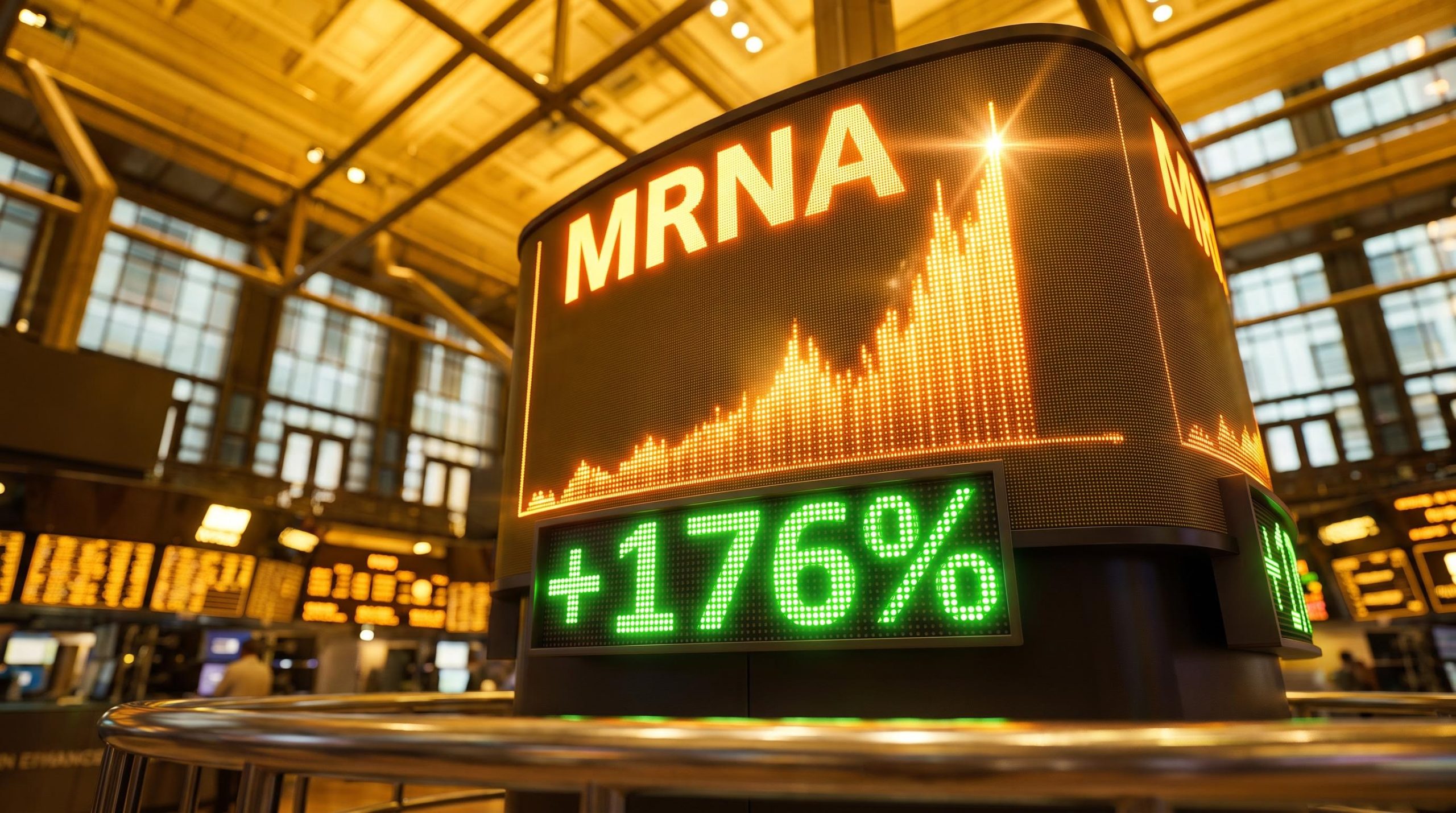
Moderna stock more than tripled in a single trading session on 19 August 2026, adding roughly $44 billion in market value after a Phase 3 clinical trial produced a result the biotech world had never seen before: the first time a personalised mRNA cancer therapy had cleared a late-stage clinical trial successfully.
Before the announcement, Moderna was worth approximately $25 billion. After it, the company’s market capitalisation sat at roughly $69 billion. The repricing happened overnight, ahead of regular-hours trading on 20 August, meaning most retail investors are waking up to a stock that has already moved. The easy money from the binary event has been captured.
Here is what actually happened in the trial, why the stock reacted the way it did, and what investors evaluating the new price need to understand before acting.
The trial result that changed the equation for mRNA oncology
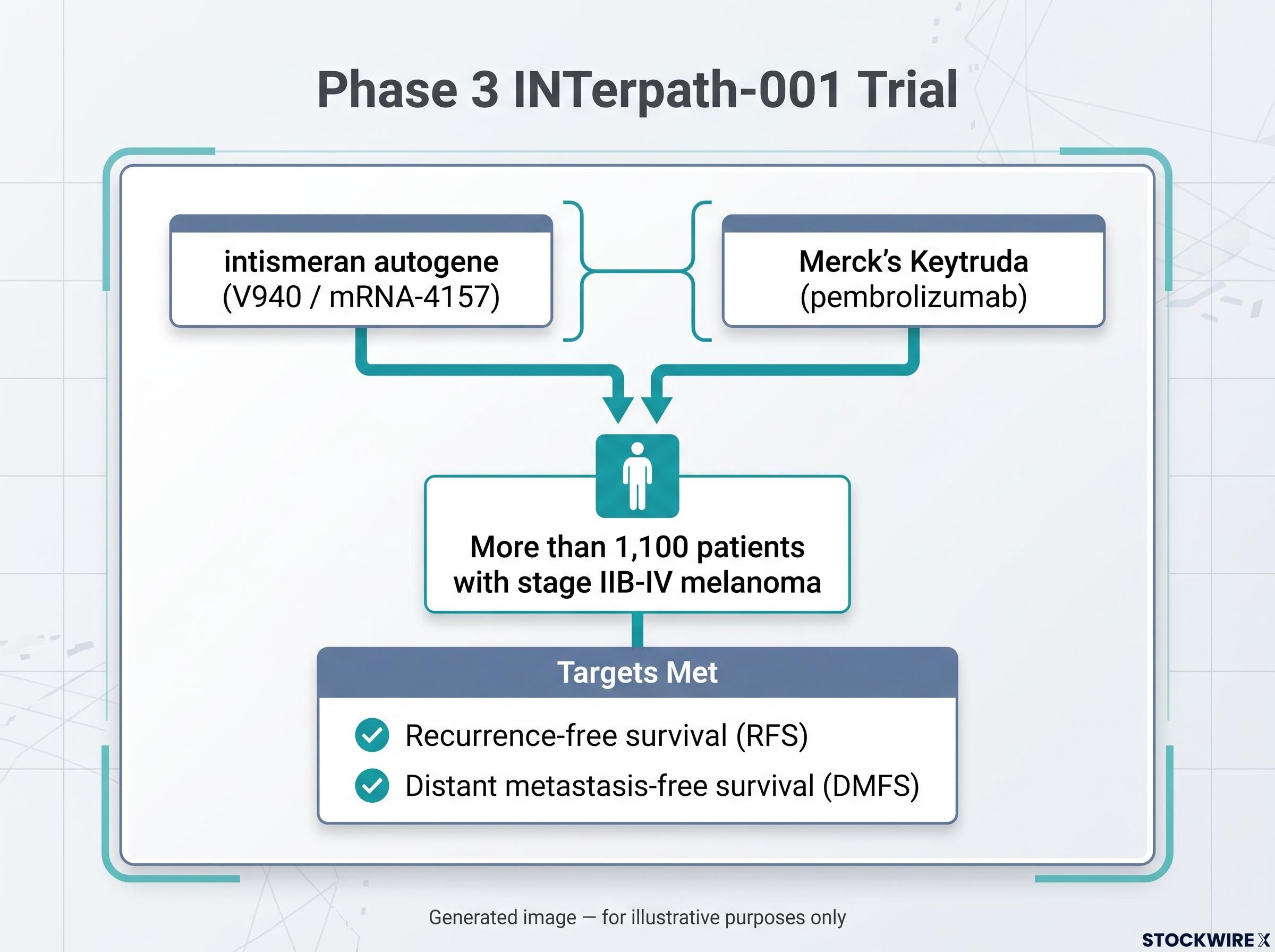
The Phase 3 INTerpath-001 trial tested intismeran autogene (also known as V940 or mRNA-4157), a personalised mRNA cancer therapy, combined with Merck’s Keytruda (pembrolizumab) in more than 1,100 patients with high-risk, surgically resected stage IIB-IV melanoma. These are patients whose tumours were removed but who remain at elevated risk of the cancer returning or spreading.
Peer-reviewed research on mRNA-4157 neoantigen vaccines, including Phase 2 Keynote-942 data, established that the combination with pembrolizumab improved both recurrence-free survival and distant metastasis-free survival in resected melanoma, providing the scientific foundation that justified advancing the programme to Phase 3.
The combination met both of its key targets, outperforming Keytruda alone:
- Recurrence-free survival (RFS): the primary endpoint, measuring how long patients lived without their cancer returning after surgery
- Distant metastasis-free survival (DMFS): a key secondary endpoint, measuring how long patients lived without cancer spreading to other parts of the body
Moderna and Merck described this as “the first positive Phase 3 readout for an individualised neoantigen therapy” and the first Phase 3 success for an mRNA-based cancer therapy.
For retail investors, the “first-ever” designation is what matters most. The market is not just valuing a single melanoma drug. It is revising upward its entire assessment of what mRNA technology can do in cancer, a platform inflection that reprices every oncology programme in Moderna’s pipeline.
What makes intismeran different from a standard vaccine
Each patient’s vaccine is manufactured using genetic sequencing of their individual tumour to identify unique mutations called neoantigens (proteins found only on that patient’s cancer cells). The mRNA construct is then built specifically for that person. This is the opposite of an off-the-shelf drug; “personalised” is both the scientific breakthrough and, as later sections explain, the commercial complexity.
When big ASX news breaks, our subscribers know first
How a clinical trial result becomes a $44 billion overnight stock move
The magnitude of this move looks irrational at first glance. It is not. Before the data release, the market implicitly assigned a low-to-moderate probability that this Phase 3 trial would succeed. A positive interim analysis collapses that uncertainty in one moment, forcing a rapid, discontinuous reprice. The stock does not drift upward; it jumps to reflect a fundamentally different probability landscape.
Moderna’s pre-announcement valuation of roughly $25 billion reflected declining COVID vaccine revenues and genuine investor scepticism about whether the oncology pipeline would deliver. The positive Phase 3 data directly challenged that sceptical thesis, and the market responded by repricing not just the melanoma programme but the probability-weighted value of Moderna’s entire mRNA cancer pipeline.
| Company | Pre-announcement market cap | Post-announcement market cap | Single-day move |
|---|---|---|---|
| Moderna | ~$25 billion | ~$69 billion | ~176-177% |
| Merck | — | — | ~7-8% |
Moderna’s market capitalisation moved from approximately $25 billion to $69 billion in a single session, a gain nearly double the company’s entire prior valuation.
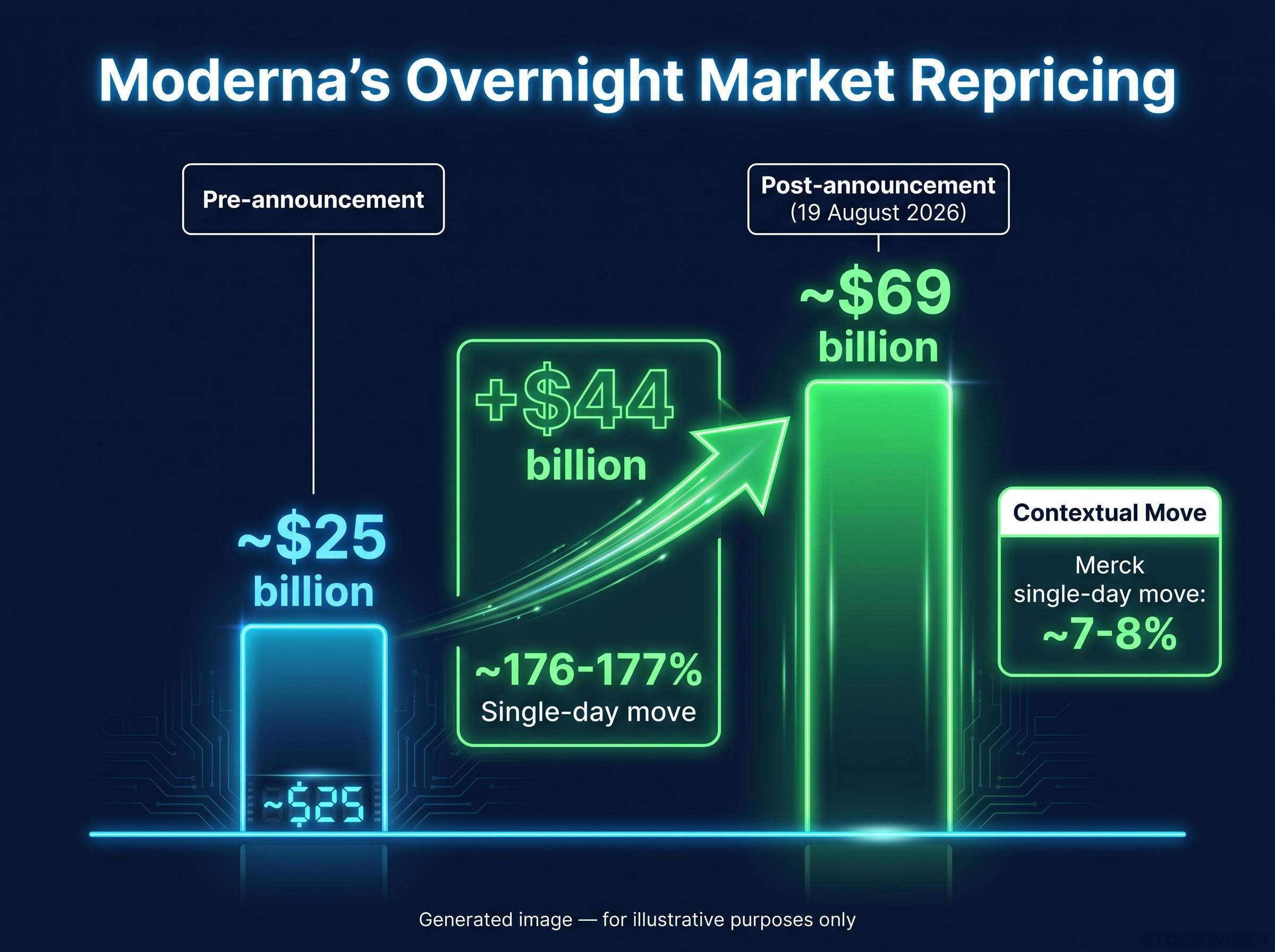
The Merck move is the subtler signal worth paying attention to. A $200+ billion company does not rise 7-8% on the back of a speculative long shot. That move tells you the market is treating this as a validated commercial platform with real revenue implications for Merck’s Keytruda franchise.
What mRNA’s cancer pivot actually means for the broader technology
COVID-19 vaccines proved that mRNA technology works in infectious disease prevention. This result is the first evidence it can succeed in oncology at Phase 3 scale. Financial and scientific media are describing it as a “second chapter” for mRNA medicine, and the framing is not hyperbole; it reflects a genuine expansion of the technology’s validated use cases.
The melanoma result is the second major mRNA regulatory milestone Moderna has reached in 2026; mRNA regulatory milestones this year also include the FDA’s August approval of mFlusiva, the first mRNA flu vaccine cleared in US history, giving the platform two distinct validated use cases within a single calendar year.
The platform optionality argument is what drives the valuation maths. A validated personalised mRNA approach in melanoma opens analogous development pathways across other tumour types. Moderna’s pipeline includes potential applications in areas such as:
The broader pattern of Big Pharma deploying capital into personalised oncology platforms reflects a structural conviction that tumour-targeted therapies with identifiable biological markers represent durable competitive moats, the same logic now driving the market’s reassessment of Moderna’s mRNA cancer pipeline.
- Non-small cell lung cancer, where Keytruda combinations are already a standard of care
- Other solid tumours with identifiable neoantigen profiles
- Adjuvant settings across cancers where patients remain at high risk after surgery
- Combination immunotherapy regimens pairing personalised mRNA with checkpoint inhibitors beyond Keytruda
For a reader trying to assess whether the stock’s new valuation is justified, this is the critical point. The market is not pricing only this drug. It is pricing the probability that mRNA can now be applied systematically across oncology, a total addressable market far larger than melanoma alone.
What still has to go right before this translates into revenue
The current readout is an interim analysis. The full Phase 3 trial continues, and more mature data, including overall survival endpoints, will emerge over time. Between today’s positive headline and a product generating meaningful revenue, several milestones remain:
- Full data presentation at a major medical meeting (timing not yet confirmed as of the announcement)
- Biologics License Application (BLA) submission to the Food and Drug Administration (FDA), the regulatory filing required before any approval decision
- FDA regulatory review, including scrutiny of safety data, manufacturing consistency, and robustness of the efficacy signal
- Commercialisation and market access, including manufacturing scale-up, pricing negotiations, and competitive positioning against existing melanoma treatments
Each of these carries execution risk, and the stock price is currently pricing in success across all of them. A reader evaluating the investment case needs to understand that today’s share price is a bet on a future that has not yet been delivered.
Why personalised manufacturing is a different problem from a standard drug
Each patient requires a uniquely manufactured vaccine, meaning standard batch-production economics do not apply. The manufacturing challenge is both scientific (ensuring consistency and rapid turnaround for individual constructs) and commercial (cost per patient, reimbursement pricing, and scaling capacity). This is a fundamentally different supply chain from any drug currently on the market.
The commercial tension between personalised versus off-the-shelf oncology approaches runs through the entire next-generation cancer therapy sector; allogeneic CAR T therapies, which are manufactured in advance and administered to any patient, represent the opposite end of the manufacturing spectrum from intismeran autogene’s individual-by-individual construct.
What retail investors should understand before reacting to the new price
The 176-177% repricing occurred overnight and ahead of regular-hours retail participation. The binary event gain has already been captured by institutional positioning. That does not mean the stock cannot move further, but it does mean the risk profile has changed.
Entry price discipline is the variable that separates a genuinely transformative company from a genuinely profitable investment, a distinction that applies with particular force when a stock has already repriced 176% before most retail participants could act.
Key considerations before acting:
- The move has already happened. At approximately the mid-$170s, the positive news is embedded in the price.
- Binary risk cuts both ways. The same dynamics that produced a near-tripling can produce severe downside if later data, regulatory decisions, or commercial execution disappoint.
- Revenue is a multi-year proposition. Even in a best-case scenario, meaningful earnings contributions from this product are years away.
- The platform thesis still needs further validation. A significant portion of the repriced market value reflects implied upside for Moderna’s broader mRNA oncology pipeline, not just the melanoma programme.
Buying a stock after a 176% overnight move means buying the optimistic outcome at full price. Any shortfall in subsequent data or execution is now a downside risk from a much higher base.
This article is for informational purposes only and should not be considered financial advice. Investors should conduct their own research and consult with financial professionals before making investment decisions. Past performance does not guarantee future results.
What the next 12 months will tell us about whether the repricing was justified
The question is no longer whether mRNA can work in cancer. The Phase 3 data answered that. The question now is whether Moderna and Merck can convert a clinical milestone into a commercial product, and whether the platform thesis holds across additional tumour types. Four milestones will shape that answer:
- Overall survival data: The single most important data point still outstanding. Regulators and payers assign more weight to overall survival than to recurrence-free survival, meaning this readout will carry significant commercial and regulatory implications.
- FDA BLA submission timeline: No submission date has been confirmed. When the companies file, and what the FDA’s review timeline looks like, will set the clock on any potential approval.
- Early pipeline readouts in additional tumour types: The platform thesis depends on successful outcomes beyond melanoma. Initial data from other Moderna mRNA oncology programmes will either validate or narrow the broader investment case.
- Manufacturing scale-up progress: Demonstrating that personalised vaccines can be manufactured at commercial scale, with acceptable turnaround times and costs, is a prerequisite for any meaningful revenue generation.
Merck’s behaviour as a co-development partner is itself a signal worth tracking. The company’s 7-8% stock move reflects genuine commercial conviction, and its continued investment, data-sharing, and regulatory collaboration will indicate how seriously the partnership is advancing.
Readers who track these specific milestones will be better positioned than those who treat the story as resolved. This result opened the question of mRNA oncology’s commercial future without answering it. The answer will arrive in stages over the next one to two years.