
On Tuesday, the S&P 500 and Europe’s Stoxx 600 both fell 0.7% in the same session. No single earnings miss triggered it. No geopolitical headline drove it. Long-term bond yields rose, and suddenly equities across two continents looked like the wrong place to be.
That kind of synchronised, macro-driven selling is worth paying attention to. Rising long-end bond yields are reshaping how investors price every asset class, from high-growth technology stocks to dividend-paying consumer staples. The rotation now underway is not random volatility. It follows a documented historical pattern that connects yield levels to sector leadership, and understanding that pattern changes how you read market moves.
Here is the framework, step by step: why yields move stock prices the way they do, how the rotation from growth into defensives typically unfolds in two distinct phases, where the nuances sit (not all defensives behave the same way), and what practical portfolio adjustments follow from the current regime. This gives you a way to interpret the headlines and make deliberate positioning decisions rather than reactive ones.
The mechanics start with three pressure channels, and they are all active right now.
What rising bond yields actually do to stock prices
The simultaneous decline across US and European equity markets was not a coincidence. It was the predictable output of three mechanisms that activate whenever long-term bond yields climb.
Danske Bank research documented simultaneous 0.7% declines in both the S&P 500 and the Stoxx 600 on Tuesday, with futures markets continuing downward the following morning, confirming the move had duration behind it.
Those three mechanisms work like this:
- Higher discount rates. Equity valuations rest on discounted future cash flows, the sum of all the earnings a company is expected to generate, adjusted back to what those earnings are worth in today’s money. When the risk-free rate embedded in that discount rises, the present value of future earnings falls. Long-duration growth stocks, whose cash flows are concentrated years into the future, take the largest hit because a higher discount rate has more time to compound against them.
The concept of equity duration explains why the damage concentrates so unevenly across sectors: growth stocks carry long duration because most of their value reflects earnings expected 5-20 years out, and a higher discount rate has more compounding time to work against those distant cash flows than against the near-term earnings of value-oriented businesses.
- Higher opportunity cost. With risk-free yields now sitting closer to 4-5% in several major markets, you can earn a meaningful return without taking equity risk at all. That raises the hurdle rate for volatile growth exposures. Investors demand a clearer equity risk premium, which is the extra return stocks need to offer above a risk-free bond to justify the additional volatility.
- Higher financing costs. Elevated yields feed into higher corporate borrowing costs, squeezing margins and forward investment plans, particularly in capital-intensive sectors like industrials and materials.
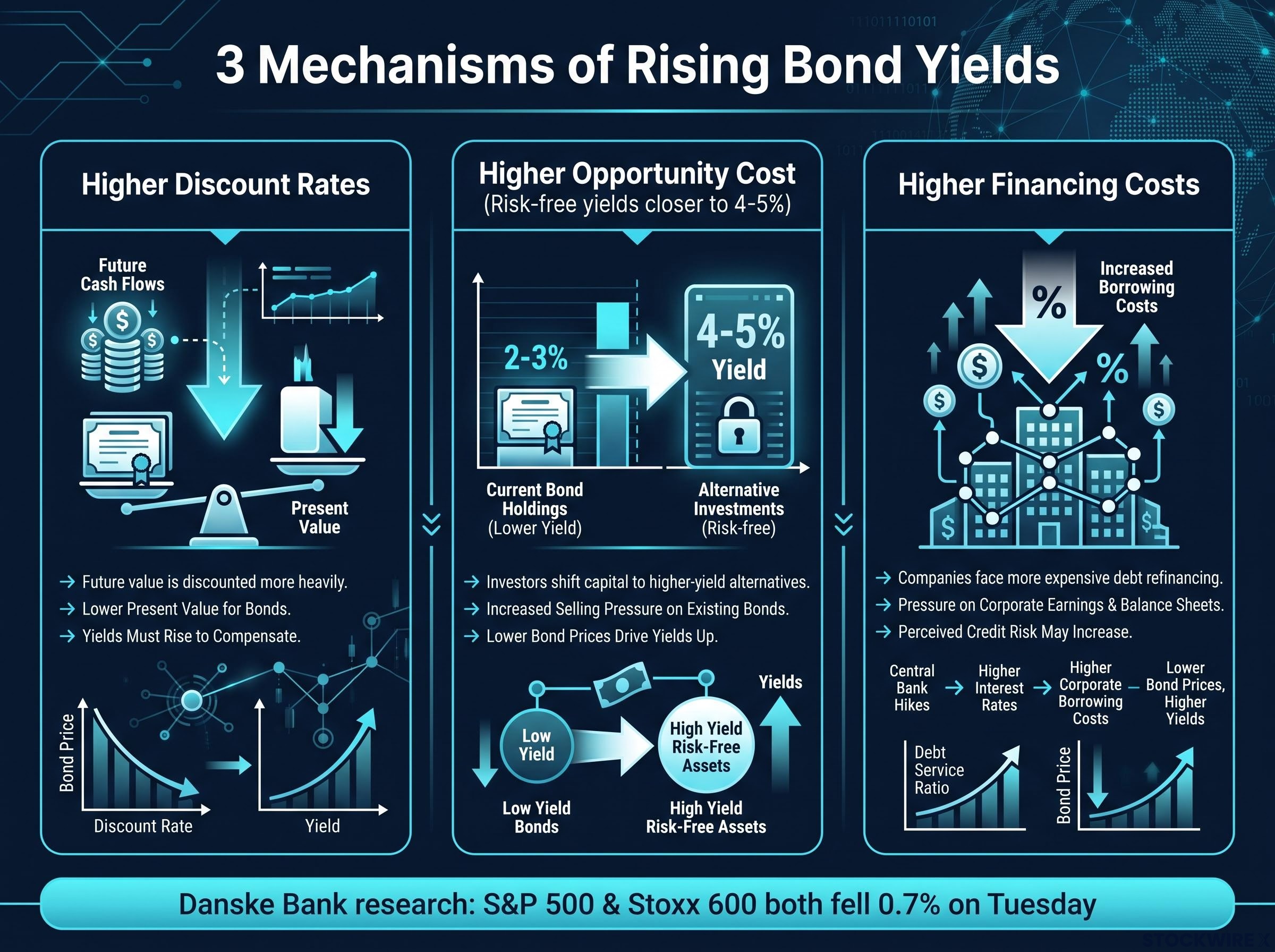
Together, these three channels mean that when bond yields rise, growth stocks are getting hit from three directions at once: a lower valuation, a higher hurdle to clear, and a more expensive balance sheet. That is why Tuesday’s selloff felt so broad rather than stock-specific. Understanding which of your holdings sits in the crosshairs of all three channels helps you diagnose your exposure before the market reprices it for you.
The Federal Reserve Bank of Minneapolis equity premium research applies a variation of the Gordon stock valuation model to show precisely how changes in bond yields compress the present value of future cash flows, providing the academic foundation for why long-duration growth stocks absorb the steepest valuation damage when the risk-free rate rises.
When big ASX news breaks, our subscribers know first
How the rotation unfolds: two phases investors typically miss
The selloff in technology and cyclical names on Tuesday was not the beginning of the story. It was the second act. Danske Bank’s equity and cross-asset strategy team has documented the rotation unfolding in two distinct phases, and investors who only see the second one are already late.
Phase 1: financials and real estate diverge
The initial market reaction to rising long-end yields did not show up as a defensive rotation. It showed up as a value-versus-growth divergence. European banks materially outperformed rate-sensitive real estate as higher long-end yields supported net interest margins (the spread banks earn between what they pay depositors and what they charge borrowers) while compressing valuations and raising financing costs for leveraged property holdings.
Danske Bank data shows that in the period following the meaningful rise in long-end yields, European banks pulled ahead of the real estate sector by roughly 7 percentage points across approximately one month. The logic was straightforward: higher rates made banks more profitable and property companies more expensive to fund.
Phase 2: the defensive rotation arrives
In the more recent phase, capital moved into consumer staples and healthcare at the expense of technology, industrials, and materials. Danske Bank data shows that those cyclical sectors shed between 2% and 3% apiece on Tuesday as investors repositioned away from rate-sensitive and economically sensitive exposures.
The investor reasoning connects directly to the yield mechanics above: once yields are high enough, the concern shifts from “which sectors benefit from rising rates” to “will tight financial conditions eventually slow growth and earnings?” That concern pushes capital toward sectors with resilient cash flows regardless of the economic cycle. Danske Bank characterised this transition as consistent with expectations outlined in a prior weekly strategy publication, establishing the pattern as anticipated rather than reactive.
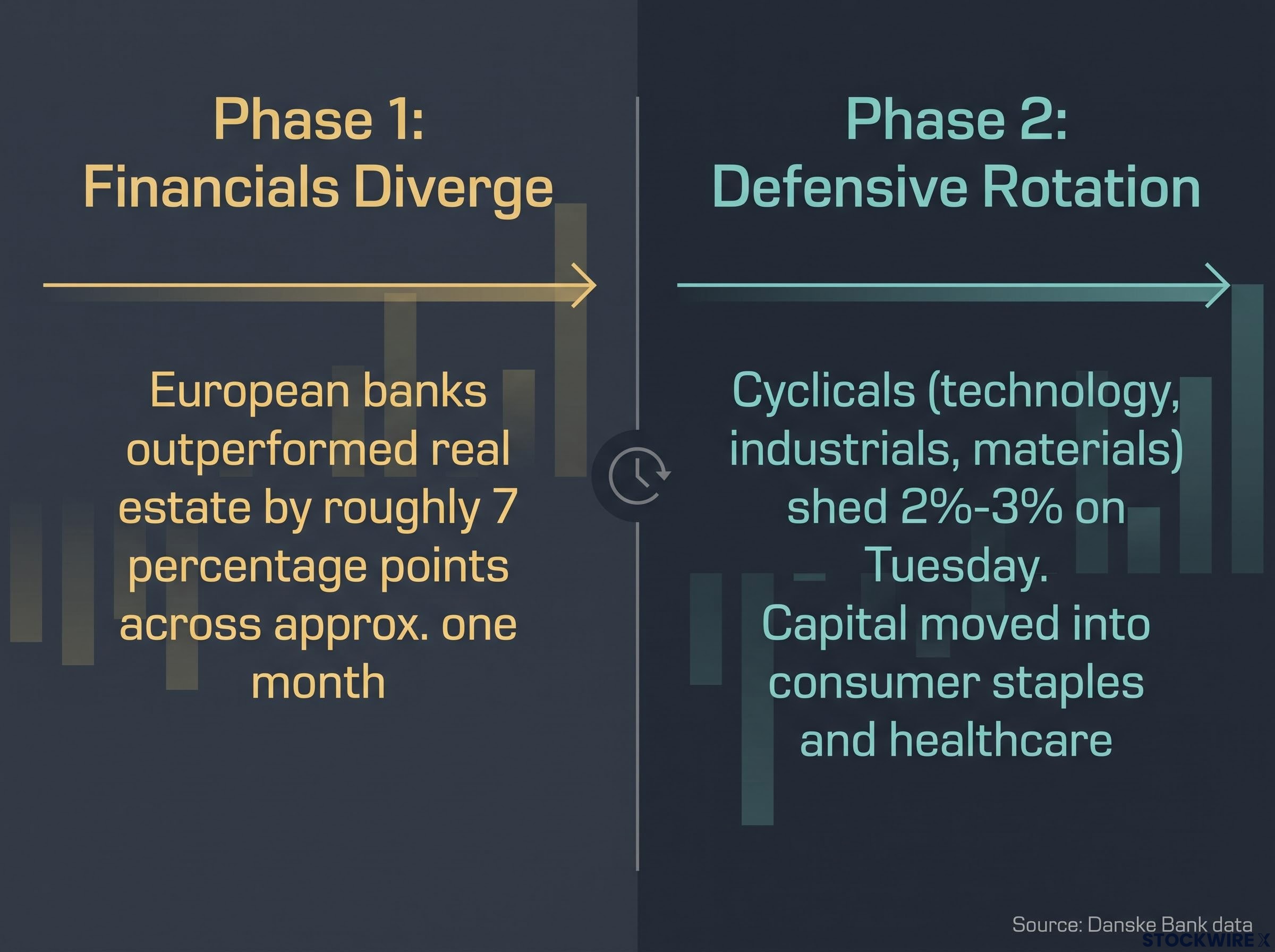
If you are watching the market and only see a single-day selloff in tech, you are reading the end of Act Two. Understanding that the rotation began weeks earlier in financials and real estate changes where you think the cycle is, and what might come next.
Why defensive sectors hold up when yields are high (and when they do not)
Here is where the story gets more nuanced than most coverage suggests. Defensive sectors do not behave uniformly across all yield environments. The reason yields are rising determines which defensives actually protect you.
The distinction matters:
- When yields rise because growth and inflation are strong: Bond-proxy defensives like utilities and consumer staples can initially underperform. Their valuations had often been bid up by income-seeking investors during low-rate years, making them sensitive to rate shocks even as the broader economy strengthens. In this scenario, the “safety” trade is actually losing money.
- When yields are high and investors begin to fear that tight conditions will drag down leading indicators and earnings: Defensives tend to outperform because their cash flows and dividends are more resilient through a slowdown. Consumers still buy groceries, patients still need medication, and the cash these companies generate holds up when cyclical earnings compress.
The current environment more closely resembles the second scenario.
The distinction between cyclical and defensive allocation becomes especially consequential once yields reach the level where leading indicators begin to soften, because the optimal blend between the two shifts meaningfully depending on where the economy sits in the contraction cycle, not just whether conditions are tight.
Danske Bank expects elevated yields to increase the probability of a rollover in leading economic indicators, which are currently sitting at elevated levels, making them inherently more vulnerable to a downturn. The team anticipates this will reinforce defensive sector outperformance in the near term.
One warning worth heeding: not all defensives are equally attractive at current prices. The same interest rate increase that hurts growth stocks can also undermine expensive quality stocks that had been treated as bond substitutes. The practical takeaway is that buying defensives indiscriminately because “yields are high” is not the same as buying them with a strategic rationale. The quality of the balance sheet, the dividend track record, and the current valuation all determine whether a defensive holding actually provides the protection you expect.
What this means for your portfolio right now
The three yield pressure channels and the two-phase rotation logic point toward five specific portfolio actions. These are calibration moves, not a crisis response. They suit a regime where yields stay elevated long enough to compress leading indicators, and the degree of adjustment should reflect how exposed your current portfolio already is to long-duration and leveraged cyclical risk.
- Audit your cyclical and long-duration exposure. Review how much of your equity allocation sits in high-growth technology, cyclicals (industrials, materials, consumer discretionary), and highly leveraged real estate names. Ask whether the earnings and valuations of those holdings still justify their risk if financing costs stay elevated and leading indicators soften over the next 6-12 months.
- Increase allocation to high-quality defensive and dividend-paying sectors. Consumer staples, healthcare, and utilities provide products and services people need in any economic environment. Favour companies with strong balance sheets, stable earnings through cycles, and long, consistent dividend records. Valuation discipline matters here: avoid overpaying for bond-proxy defensives whose stretched valuations carry their own rate sensitivity.
- Re-evaluate fixed income. Higher yields hurt the price of existing bonds but improve the prospective return on new fixed-income investments. Higher 10-year government and investment-grade corporate yields now offer income levels that were unavailable for much of the 2010-2020 low-rate era. For investors with multi-year horizons, a ladder of high-quality bonds can both diversify equity risk and potentially benefit if yields later fall as growth slows.
- Maintain a global perspective. Yield-driven pressures and opportunities are distributed unevenly across geographies. As long-end yields climbed, European banks gained from the improvement in net interest margins while European real estate came under pressure, with the two sectors diverging by close to 7 percentage points over approximately one month, per Danske Bank. Opportunities may sit in defensive or value sectors in one region even as others face greater pressure.
- Preserve partial cyclical exposure. This is the action most investors skip, and it matters.
Adjust, do not overreact
Historical sector studies show that leadership often changes again once yields peak or central banks shift policy direction. Cyclicals can rebound sharply after a period of defensive outperformance. Rotating partially toward defensives and income makes sense in the current regime, but abandoning cyclicals entirely risks being underexposed when the next upswing begins. The appropriate investor posture is incremental rebalancing, not wholesale rotation.
For readers wanting to move from principle to execution, our dedicated guide to portfolio rebalancing walks through the specific triggers, tax-efficient sequencing, and alternative asset destinations that make incremental rebalancing practical rather than theoretical.
The historical pattern behind the current rotation
The current episode is not unique. It follows a pattern that has repeated across multiple yield-rising cycles, and recognising that pattern builds confidence in the framework and helps you anticipate what comes next.
In the early phase of a yield-rising episode, the market’s initial reaction typically favours sectors that benefit from stronger nominal activity:
- Financials, industrials, and materials have historically outperformed the broader market in this phase
- Consumer staples and utilities often lag because rising yields signal better economic momentum and pricing power, reducing the relative appeal of their stability
As the yield move matures, the transition point arrives. Investors begin to worry that tight financial conditions will eventually choke off growth, and positioning shifts toward classic defensives. That is the Phase 2 pattern described earlier, and it is the transition currently underway.
Danske Bank sees defensive outperformance continuing in the near term, with persistently high yields expected to bear down on leading economic indicators and keep capital flowing toward more resilient sectors.
The same historical record reveals what happens after the defensive phase runs its course. Once yields peak or central banks signal a pivot toward easing, the pattern reverses. Cyclicals and growth sectors often outperform sharply in the recovery phase, rewarding investors who maintained partial exposure through the defensive period.
Classifying a selloff correctly before acting on it matters as much as the rotation framework itself: the same yield-driven decline that signals a genuine regime shift in one sector may represent a temporary setback in another, and conflating the two produces very different portfolio outcomes.
Knowing this cycle has repeated before tells you two things: the current defensive outperformance has historical precedent supporting it in the near term, and you should already be thinking about the conditions that would signal the next regime shift back toward cyclicals.
What changes your calculus and what to keep watching
Rather than leaving you with a backward-looking summary, here are the three specific variables that will tell you when the current regime is shifting. Think of these as your early warning system for when to start unwinding the defensive tilt and rebuilding cyclical exposure.
- Leading economic indicators. A stabilisation or upturn in leading indicators would reduce the defensive outperformance thesis. Currently, these indicators are running at high absolute levels, which historically leaves them more exposed to a pullback if financial conditions tighten further. A clear inflection point here is the strongest signal that the rotation is maturing.
- Central bank signalling on rate paths. Any pivot toward easing changes the yield backdrop and the relative attractiveness of growth equities. Watch for shifts in language around forward guidance, not just actual rate decisions.
- Credit conditions. Widening corporate credit spreads (the gap between corporate bond yields and government bond yields) would reinforce the defensive case by signalling growing stress in corporate funding markets. Tightening spreads would suggest the growth scare is receding and cyclicals may be due for a recovery.
Danske Bank sees the combination of high yields and already-stretched leading indicators as a recipe for continued defensive sector strength over the near term. That is your baseline. These three variables are what you check against it.
The appropriate investor posture is attentive and incremental. Monitor these signals, adjust positioning in response to shifts, and resist the temptation to make a single large directional call. Checking these three variables periodically is more useful than watching daily index moves.
This article is for informational purposes only and should not be considered financial advice. Investors should conduct their own research and consult with financial professionals before making investment decisions. Past performance does not guarantee future results. Financial projections are subject to market conditions and various risk factors.
—