
When markets turned volatile in April 2025, something unusual happened. Investors did not rush into the dollar or US Treasuries the way they had for decades. The reflexive flight to American safety, the pattern that had defined every major stress episode since the global financial crisis, hesitated.
That hesitation is the signal worth examining. The dollar still dominates global payments, reserve portfolios, and trade invoicing by a wide margin. No rival comes close. But identifiable, slow-moving forces are gradually raising the cost of that dominance, and the structural conditions that once made the dollar’s position self-reinforcing have quietly started to work in the other direction.
Here is a framework for separating the real risks from the overstated ones. The fiscal trajectory, the shift in who actually holds Treasuries, and the changing intentions of the world’s largest reserve managers each tell a distinct part of the story. By the time you finish, you will have a clearer map of which de-dollarisation pressures are accelerating, which remain distant, and what the specific triggers look like.
What “exorbitant privilege” actually means, and why it is under pressure now
Exorbitant privilege is the structural advantage the United States gains from issuing the world’s reserve currency. It means lower borrowing costs, seigniorage income (the profit earned from issuing currency that others hold as reserves), and the ability to run persistent deficits financed in its own currency. For decades, that privilege was self-reinforcing: the more the world used dollars, the cheaper it became for America to borrow, which made dollar assets more attractive, which deepened the cycle.
Jane Foley, Rabobank’s Head of FX Strategy, noted that the tariff announcements by President Trump on 2 April 2025 provided a demonstration of how the US’s exorbitant privilege could erode over time, placing both the dollar and Treasuries on a different long-term footing. Source: Rabobank via FXStreet
One distinction shapes everything that follows. The dollar’s reserve currency role and the Treasury market’s risk-free designation are linked but not identical. Central banks can reduce Treasury exposure while maintaining the dollar’s central role in their payment operations. Erosion of one does not automatically destroy the other, but over longer time horizons, sustained weakness in Treasuries feeds back into confidence in the currency itself. The dollar’s share of official reserves sits in the mid-to-high 56% range per IMF COFER data through 2025-2026, down from higher levels in prior decades but still more than double the euro’s approximately 20% share. Foley notes that the dollar’s dominance in payments infrastructure provides independent support, separate from Treasury dynamics.
The dollar appears on one side of 89.2% of all global FX trades in a market turning over $9.6 trillion daily, a figure that reveals the gap between the reserve share story and the payments-infrastructure story: even as central banks’ stated intentions have turned net-negative for the first time, the dollar’s operational grip on global transactions has barely been dented by two decades of measured reserve diversification.
When big ASX news breaks, our subscribers know first
How hedge funds became the marginal buyer of the world’s supposed safest asset
The composition of Treasury holders has shifted materially, and who holds an asset changes how that asset behaves under stress. The key data points tell the story:
- Between early 2023 and September 2025, large hedge funds’ Treasury holdings rose from approximately 4.5% to approximately 8.5% of total privately held Treasuries by market value, exceeding holdings of mutual funds and US-chartered depository institutions.
- Over the same period, gross Treasury exposures roughly doubled to approximately $4 trillion, split between roughly $2.4 trillion in long positions and $1.6 trillion in short positions.
- The cash-futures basis trade alone accounted for approximately $830 billion of hedge fund long exposures, representing 35% of their total long Treasury positions, nearly double its prior peak.
- Cayman-domiciled fund underreporting means true exposures are likely larger than official custodial data indicate.
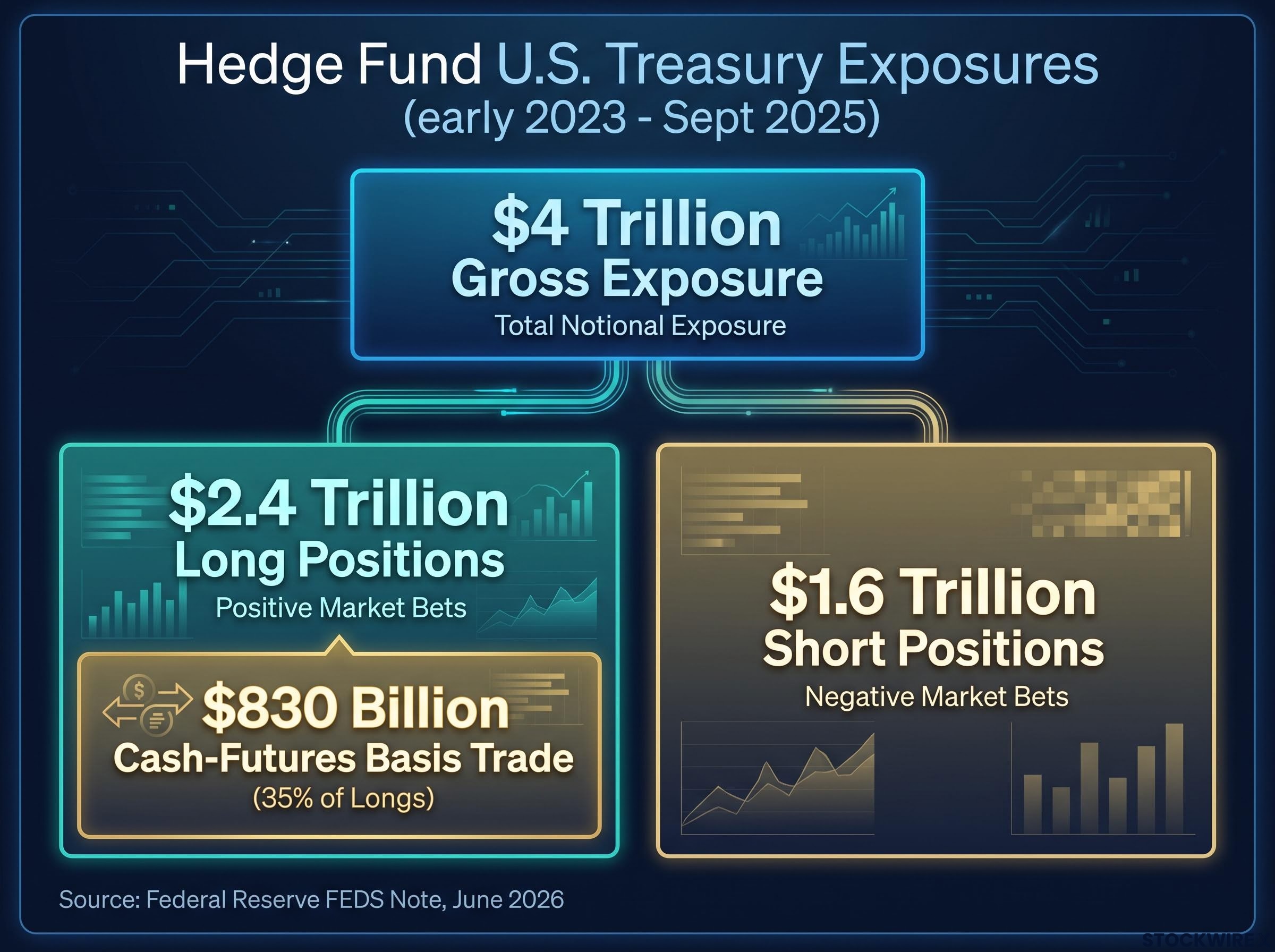
Source: Federal Reserve FEDS Note, “Decomposing Hedge Funds’ U.S. Treasury Exposures,” June 2026.
That shift matters because of what it implies about behaviour during stress. The marginal buyer of Treasuries is no longer a central bank or pension fund with a multi-decade horizon. It is a leveraged fund running a specific arbitrage strategy, funded by short-term borrowing, and vulnerable to forced unwinds.
Major institutional managers including PIMCO, BlackRock, and Schroders are actively reducing long-dated Treasury exposure even at yields of 5.21%, the highest since 2007, citing a combination of persistent inflation, a $2 trillion annual deficit trajectory, and a retreating central bank buyer base that forces price-sensitive private investors to absorb increasing long-end supply at progressively higher yields.
The basis trade and what it means for market stability
The cash-futures basis trade works by buying physical Treasuries and selling Treasury futures to capture the spread between the two, financed through repo borrowing (short-term collateralised lending). In normal conditions, the spread is small, the financing is cheap, and the trade generates steady returns with apparent low risk.
The fragility sits in the financing. When repo funding costs spike or futures margin requirements rise, the trade reverses from a gentle income stream into a forced-selling mechanism. Positions built over months unwind in days. The March 2020 Treasury market dislocation is the established precedent: it required direct Federal Reserve intervention to stabilise a market that is supposed to be the world’s safest. With basis trade exposures now nearly double their prior peak, the pool of potential forced-unwind pressure is larger than it was then.
What this tells you is that the asset class institutional investors rely on as a shock absorber can itself become a source of volatility in stress periods, which is precisely when the safe-haven designation matters most.
Why US debt trajectories belong in every currency risk conversation
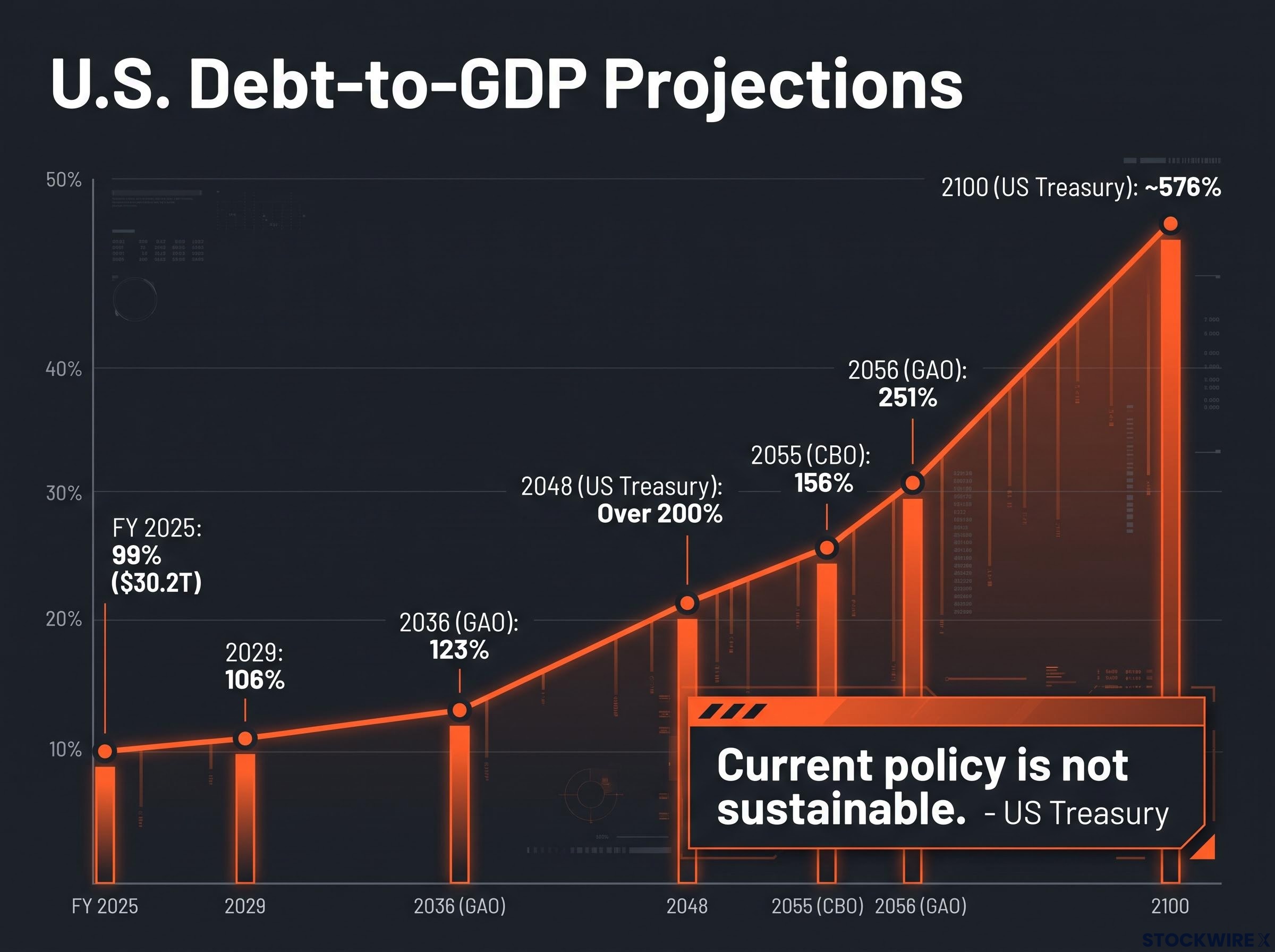
The numbers build a picture that requires no editorial emphasis. Start with the current position: debt held by the public stood at $30.2 trillion, equal to 99% of GDP, at the end of fiscal year 2025. That level is projected to surpass the post-WWII peak of 106% of GDP by 2029.
| Source | Projection year | Debt-to-GDP |
|---|---|---|
| GAO (June 2026) | 2036 | 123% |
| GAO (June 2026) | 2056 | 251% |
| CBO Long-Term Budget Outlook | 2055 | 156% |
| US Treasury FY 2025 Financial Report | 2048 | Over 200% |
| US Treasury FY 2025 Financial Report | 2100 | Approximately 576% |
The US Treasury’s own FY 2025 Financial Report explicitly concludes: “Current policy is not sustainable.”
The far-out projections are not the point. The 2100 figure is an extrapolation, not a forecast. What matters is the absence of a legislated consolidation path. Markets can absorb high debt levels when a credible plan exists. What erodes confidence is the combination of high debt and no plan, which is precisely the current configuration.
Piper Sandler’s May 2026 declaration that the United States is already in the early phase of a fiscal crisis goes further than most institutional language, and the fiscal monitoring signals it identifies — including Treasury auction performance, term premium trajectory on long-dated bonds, and TIC foreign-holdings data — provide a practical watchlist for investors tracking whether the debt trajectory is repricing duration risk in real time.
For your currency and duration decisions, the takeaway is specific: fiscal risk is already a live variable, not a distant theoretical concern. The trajectory means that the risk premium the market demands to hold dollar-denominated duration is structurally biased upward, even if near-term Treasury liquidity remains deep.
What central bank reserve data actually shows about de-dollarisation
Reserve data tells a more nuanced story than the headlines suggest. The dollar’s share of allocated reserves has declined gradually, sitting in the mid-to-high 56% range per IMF COFER data through 2025-2026, still more than double the euro’s share. This is erosion, not collapse.
IMF COFER data for 2026 Q1 places the dollar’s share of allocated reserves at 57.13%, confirming the gradual erosion from prior-decade highs while the euro holds approximately 20%, leaving the dollar’s lead structurally intact but narrower than it once was.
Two major 2026 reserve-manager surveys offer complementary readings of where the trend is heading:
| Survey | Timeframe | Key finding |
|---|---|---|
| HSBC Reserve Management Trends 2026 | Near-term | Most central banks intend to hold or increase dollar and Treasury holdings |
| OMFIF Global Public Investor 2026 | Next decade | For the first time, more central banks plan to reduce rather than increase dollar allocations |
These are not contradictory. They describe different time horizons. Near-term, the dollar’s role remains secure. Over a decade, stated intentions have turned net-negative for the first time, with political risk cited as the primary driver.
The OMFIF Global Public Investor 2026 survey marks the first time more central banks plan to reduce rather than increase dollar allocations over the next decade, citing rising political risk attached to the currency and US policy.
Gold’s rising share of official reserves reinforces the pattern. Central banks are adding hedges, gold and non-traditional currencies, around a still-core dollar position rather than replacing it outright.
The OMFIF finding is the qualitative signal worth watching. It marks the moment stated intentions crossed a psychological threshold among the world’s most patient, best-resourced asset allocators. Central bank directional preferences over a ten-year horizon are a leading indicator of where structural demand for dollar assets is heading, and that indicator has just shifted.
Identifying the triggers that could compress de-dollarisation’s timeline
The default pace of de-dollarisation is gradual, a multi-decade process with no near-term replacement currency in sight. But three identifiable mechanisms could compress that timeline:
- A forced unwind of leveraged Treasury positions. With approximately $830 billion in basis trade exposure and $4 trillion in gross hedge fund Treasury positions, the pool of potential forced-selling pressure is substantial. The March 2020 dislocation, which required Federal Reserve intervention, is the established precedent for what this looks like at smaller scale.
- A fiscal shock that disrupts the risk-free designation. A credit-rating event, a failed auction, or a political crisis that calls into question the full-faith-and-credit commitment could trigger a reassessment of Treasury pricing that cascades into currency markets.
- A perceived threat to Federal Reserve independence. The Fed’s credibility as an inflation-control anchor underpins the dollar’s structural appeal. Any political development that calls that independence into question severs a load-bearing pillar of the system.
These are not hypothetical tail risks. Each has a historical precedent or a live political dimension. The OMFIF 2026 finding on political risk as a newly explicit driver of allocation decisions suggests reduced institutional patience for stress events. Reserve managers who once absorbed volatility as the cost of dollar convenience are now explicitly stating they plan to diversify.
Jane Foley’s observation about the dollar’s payments-infrastructure anchor provides meaningful insulation: even under a stress scenario, the dollar is unlikely to be displaced rapidly from its central role in global payment systems. But the combination of elevated leverage, an unsustainable fiscal trajectory, and shifting central bank intentions creates a configuration that rewards earlier rather than later reassessment of dollar and duration exposure.
What de-dollarisation’s slow march means for how you position now
The central bank hedging pattern, adding gold and alternative currencies around a still-core dollar position, offers a reasonable template for long-horizon investors reassessing their own currency and duration exposure. The five takeaways from this analysis converge on a specific practical frame:
- Fiscal monitoring is a markets issue, not just a macro issue. Official projections flag current US fiscal policy as unsustainable. That has direct implications for currency and duration risk now, not in 2055.
- Treasury market liquidity is more fragile than headline depth suggests. The rise of leveraged hedge-fund participation makes Treasury liquidity more pro-cyclical, increasing the likelihood of sharp moves in stress periods.
- Central bank diversification provides a directional signal. Reserve managers are gradually diversifying without abandoning the dollar. That pattern is informative for any investor running a structurally dollar-heavy portfolio.
- Political and sanctions risk is now an explicit variable. The OMFIF 2026 survey documents a net intention among central banks to reduce dollar allocations over the next decade. Political risk attached to the currency is now a stated driver.
- The transition is slow but has identifiable acceleration mechanisms. Forced Treasury unwinds, fiscal shocks, and threats to Fed independence could each compress what is currently a gradual process.
The distinction between Treasury safe-haven risk and dollar reserve-currency risk matters for how you think about hedging. Investors who conflate the two may be under-hedged on Treasury volatility while over-hedging against outright dollar collapse scenarios that remain unlikely in the near term.
The most actionable takeaway is not to sell dollars. It is to treat dollar and duration exposure as requiring active structural-risk monitoring, in the same way you now treat credit risk, rather than leaving them as the unexamined default foundation of a portfolio.
For investors ready to translate the structural analysis into portfolio decisions, our dedicated guide to de-dollarisation positioning covers the specific instruments — gold ETFs, hard currencies, and uncorrelated assets — that provide proportionate tail-risk hedging without requiring full portfolio repositioning.
This article is for informational purposes only and should not be considered financial advice. Investors should conduct their own research and consult with financial professionals before making investment decisions.
These statements are speculative and subject to change based on market developments. Past performance does not guarantee future results.
The crown is still on, but the fit has changed
The dollar retains its dominant role in reserves, trade invoicing, and global payments. No rival currency is close to displacing it. But the structural conditions that made that dominance self-reinforcing have quietly deteriorated across fiscal, market-structure, and geopolitical dimensions. The process of de-dollarisation is genuine and unhurried, with no credible near-term alternative currency positioned to take its place, though the dollar retains considerable insulation through its central role in global payments infrastructure.
The honest conclusion resists resolution. The relevant question for your portfolio is not whether the dollar will be replaced. It is how much additional risk premium the market will gradually demand to hold it, and whether your positions are built to absorb that repricing when it arrives.
—