China’s central bank has formally rejected claims that the yuan is undervalued. The People’s Bank of China (PBoC) published its position on 8 October 2026, the same day EU Trade Commissioner Maroš Šefčovič opened two days of trade talks in Beijing.
The paper, titled “PBoC’s View on the RMB Exchange Rate”, came with an official English translation. It also included a commitment to report foreign exchange (FX) operations data to the International Monetary Fund (IMF) from 2027.
The paper arrived the day after official data showed China’s FX reserves fell to about US$3.40 trillion in September. Its timing places Beijing’s argument in front of Brussels just as France and Germany press the European Commission for sharper trade weapons.
The real contest here is over who sets the story about China’s currency. Here is what the paper changes for yuan pricing, and what it leaves exactly where it was.
What are the markets actually pricing after the PBoC’s statement?
The currency barely moved. USD/CNY slipped 30 pips to 6.70, according to Commerzbank, while USD/CNH, the offshore yuan traded outside mainland China, held steady at 6.70.
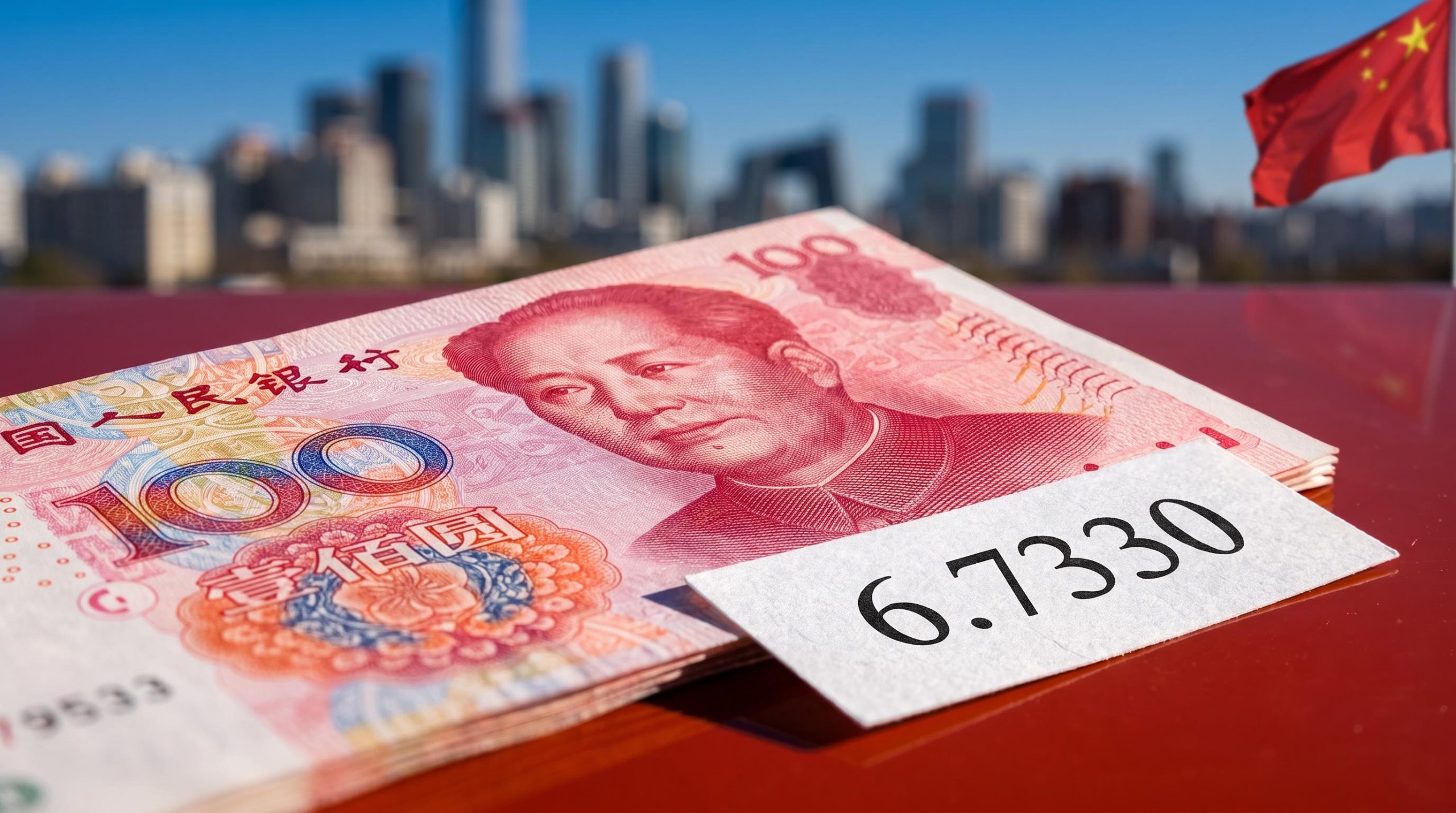
The PBoC’s daily fixing told a similar story. The fixing is the central bank’s official reference rate, around which onshore trading is allowed to move each day. On 9 October 2026 it was set at 6.7330, a touch stronger than the previous 6.7367.
The daily fixing mechanism blends the prior onshore close, overnight moves in a currency basket and a discretionary counter-cyclical factor, which is why the gap between fix and spot is read as a policy signal.
| Measure | Level | Note |
|---|---|---|
| USD/CNY spot | 6.70 | Down 30 pips |
| USD/CNH spot | 6.70 | Little changed |
| PBoC fixing (9 October 2026) | 6.7330 | Slightly stronger yuan |
| Previous fixing | 6.7367 | Prior reference rate |
That stillness is the finding. Commerzbank’s FX team treats the paper as clarifying communication, not a policy shock.
Commerzbank’s read The bank frames the paper as an effort to defend the yuan narrative: Beijing will resist the undervaluation charge, keep its managed float and open its data gradually, with no sign of an imminent regime change.
The paper itself reinforces that reading, insisting the PBoC targets no specific level and keeps “two-way floating” flexibility. For you, a muted market means traders priced the paper as continuity. On its own, it is not a reason to reposition yuan exposure.
When big ASX news breaks, our subscribers know first
How does the PBoC defend its case against yuan undervaluation?
The central bank builds its argument as a chain of claims, each resting on the one before. Read in sequence, they look like this:
- China runs a managed floating exchange rate, set by supply and demand with reference to a basket of currencies.
- The PBoC does not target any particular yuan level or long-term path.
- Regular FX intervention has been phased out since 2017.
- Export strength comes from industrial competitiveness, not a cheap currency.
- The exchange rate and the current account do not move together in any simple, linear way, and China’s gains in export market share did not speed up during earlier spells of a weaker yuan.
The headline evidence comes from Bank for International Settlements (BIS) data. Since the 2005 reform, the PBoC says, the nominal effective exchange rate (NEER) has risen more than 50% and the real effective exchange rate (REER) about 35%.
NEER measures the yuan against a weighted basket of trading partners’ currencies. REER adjusts that same measure for differences in inflation between countries.
The paper states that China has “no need or intent to gain competitive advantages through currency devaluation.” Keep in mind that these are Beijing’s own claims, built on metrics it selected. They show you how China wants the debate framed, not a settled verdict.
Beijing’s no-devaluation pledge costs little today because record current-account surpluses are already pushing the currency higher; the harder test is whether rate cuts or fixing changes later alter that picture.
What the paper concedes and what it leaves open
The PBoC acknowledges that some operations continue, aimed at countering excessive volatility. It also argues that no internationally agreed method exists for judging a currency’s equilibrium value, so outside models should not count as proof of undervaluation. The research found no named economist challenging these claims in coverage so far.
Why does the IMF reporting pledge matter, and what does the reserve drop really show?
On paper, the transparency pledge sounds substantial. China has published more granular balance-of-payments data since joining the IMF’s Special Data Dissemination Standard (SDDS) in 2015, a framework that sets benchmarks for how often and how fully countries release economic data. Reporting FX operations from 2027 would go a step further.
Readings differ. Yicai presents the pledge as continuity with existing SDDS compliance, while Commerzbank calls it a modest but well-timed concession that signals goodwill as friction with Europe rises.
Either way, the data is more than a year away. September’s reserve figures show why it may not settle much even when it arrives.
| Item | Figure | Context |
|---|---|---|
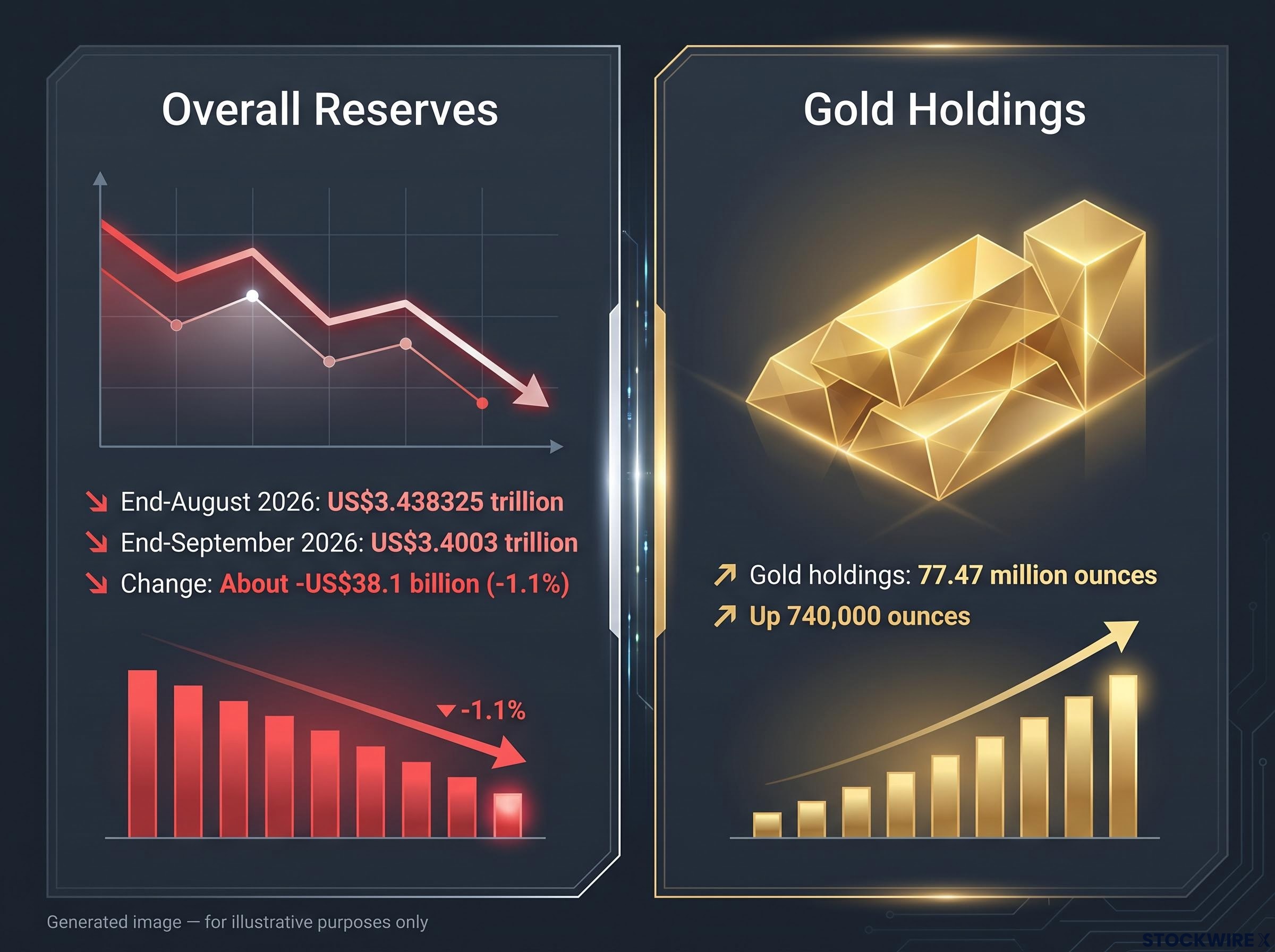
| End-August 2026 reserves | US$3.438325 trillion | SAFE |
| End-September 2026 reserves | US$3.4003 trillion | SAFE, 7 October 2026 |
| Change | About -US$38.1 billion (-1.1%) | Month on month |
| Bloomberg consensus | About US$3.43 trillion | Result came in below |
| Gold holdings | 77.47 million ounces | Up 740,000 ounces |
Valuation effects played a role, but sources disagree on which ones. Commerzbank points to weaker gold prices, while other research cites a stronger US dollar and shifting asset prices, even as gold volumes rose.
Gold volumes rose even as the headline total fell, consistent with China’s gold buying, which has run for 20 consecutive months and reflects reserve diversification policy more than short-term price views.
You cannot read this drop as proof of intervention or capital flight. Until the 2027 data arrives, treat any such claim with caution.
Why is Brussels listening, and how far will the Franco-German push go?
The rhetoric from Paris and Berlin is sharp. Their joint non-paper to Commission President Ursula von der Leyen calls for faster protection mechanisms, a new tool to restrict imports or market access for countries that distort the single market, and a reported ability to shut out Chinese goods and services within 24 hours.
Beijing’s talks told a quieter story. Politico reported EU diplomats expected no deal that week, and the outcome bore that out: initial understandings on hybrid vehicles and rare-earth export licences, but no comprehensive agreement. Meanwhile the EU’s trade deficit with China runs at roughly €1 billion a day.
China’s Ministry of Commerce The ministry warned Brussels against politicising economic issues or turning trade disputes into national-security questions, and signalled reciprocal measures if a rapid shut-out tool goes ahead.
The currency angle needs care. Brussels’ stated concerns are imbalance and market distortion, and no formal EU currency proceeding was found. The view that the PBoC is pre-empting calls for exchange-rate adjustment is Commerzbank’s reading, not an official EU position.
- 5-8 October 2026: Franco-German letter and non-paper reported.
- 7 October 2026: SAFE releases September reserves.
- 8 October 2026: PBoC paper published; Šefčovič talks begin.
- 9 October 2026: Talks conclude; fixing set at 6.7330.
- 2027: China begins reporting FX operations data to the IMF.
If you hold European or China-exposed stocks, trade-defence risk is rising as a political theme. The timeline, and any link to the currency, remain unproven.

What to watch before the 2027 data arrives
The paper shapes the narrative without changing the regime. The IMF data is a 2027 event, and the Beijing talks produced open channels rather than a deal.
Three signals will tell you whether that holds:
- The daily fixing against spot: a widening gap would suggest a more active hand than the paper describes.
- The next SAFE reserve release: look for commentary that separates valuation effects from operations.
- The Commission’s response to the Franco-German non-paper.
Gaps remain, including named IMF or US Treasury assessments and historical comparisons, so treat this as a developing story.
Investors exploring portfolio exposure can turn to our detailed coverage of European equity valuations and trade policy, which tracks the 172 EU trade-defence measures now in force.
This article is for informational purposes only and should not be considered financial advice. Investors should conduct their own research and consult with financial professionals before making investment decisions. These statements are speculative and subject to change based on market developments and policy decisions.
—