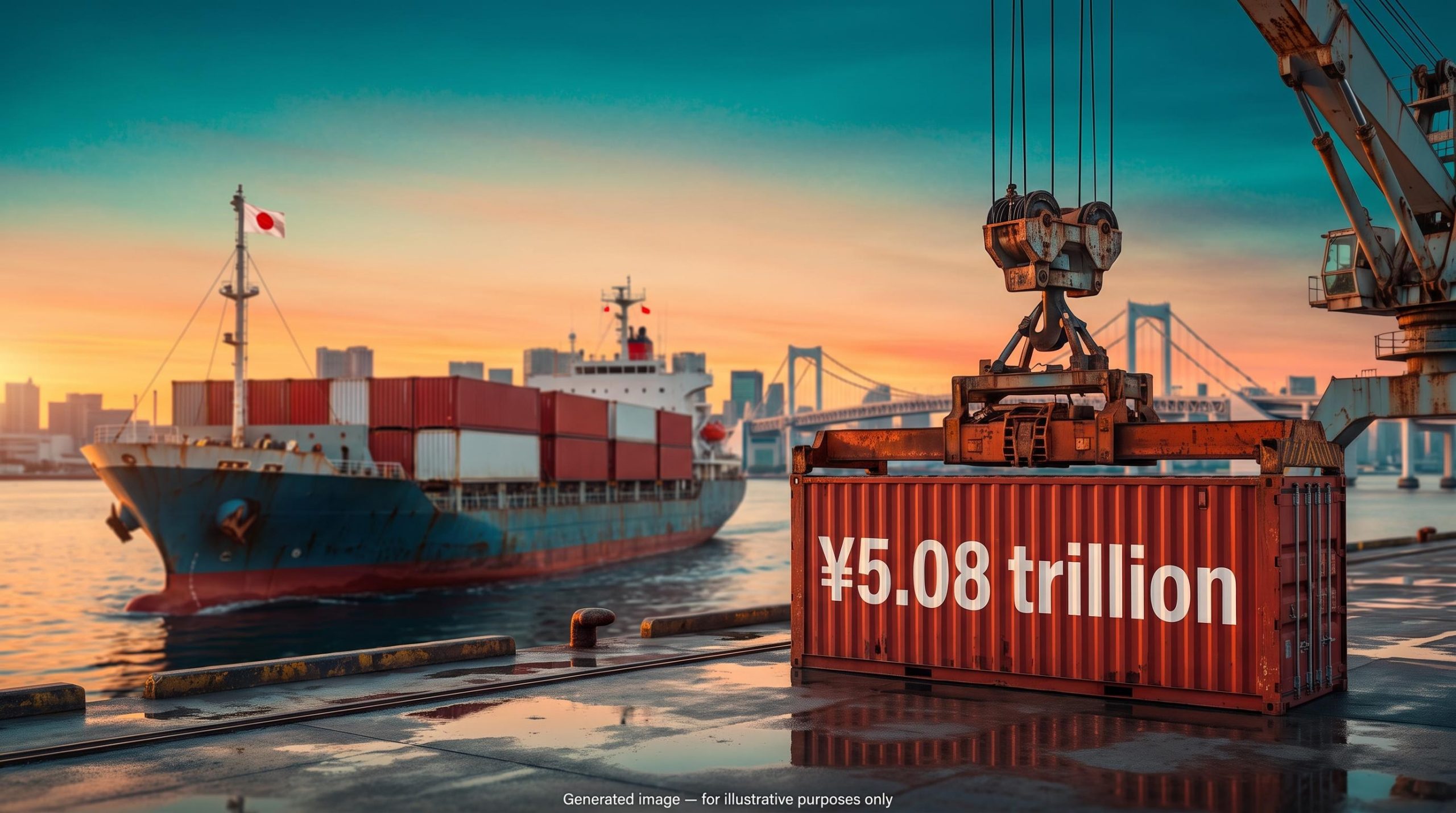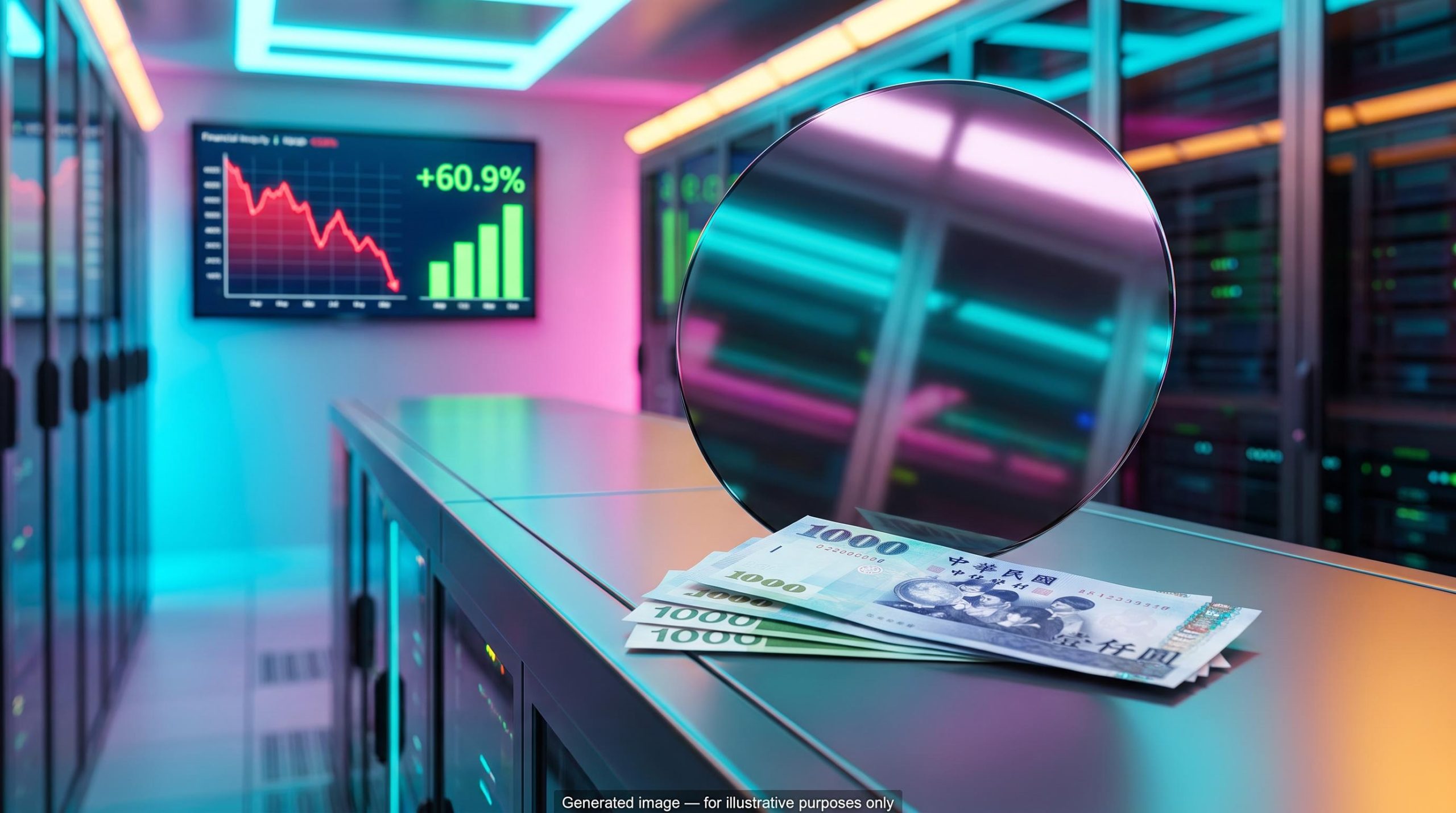
Taiwan’s exports jumped roughly 61% in September. South Korea is running a current account surplus near 20% of GDP. On paper, that is the kind of data that should send Asian currencies sharply higher, yet the near-term outlook for the region’s currencies is better described as “mixed” than strong.
That gap is the puzzle. Record trade numbers are arriving at the same time as falling technology shares, and the dollar is only somewhat softer.
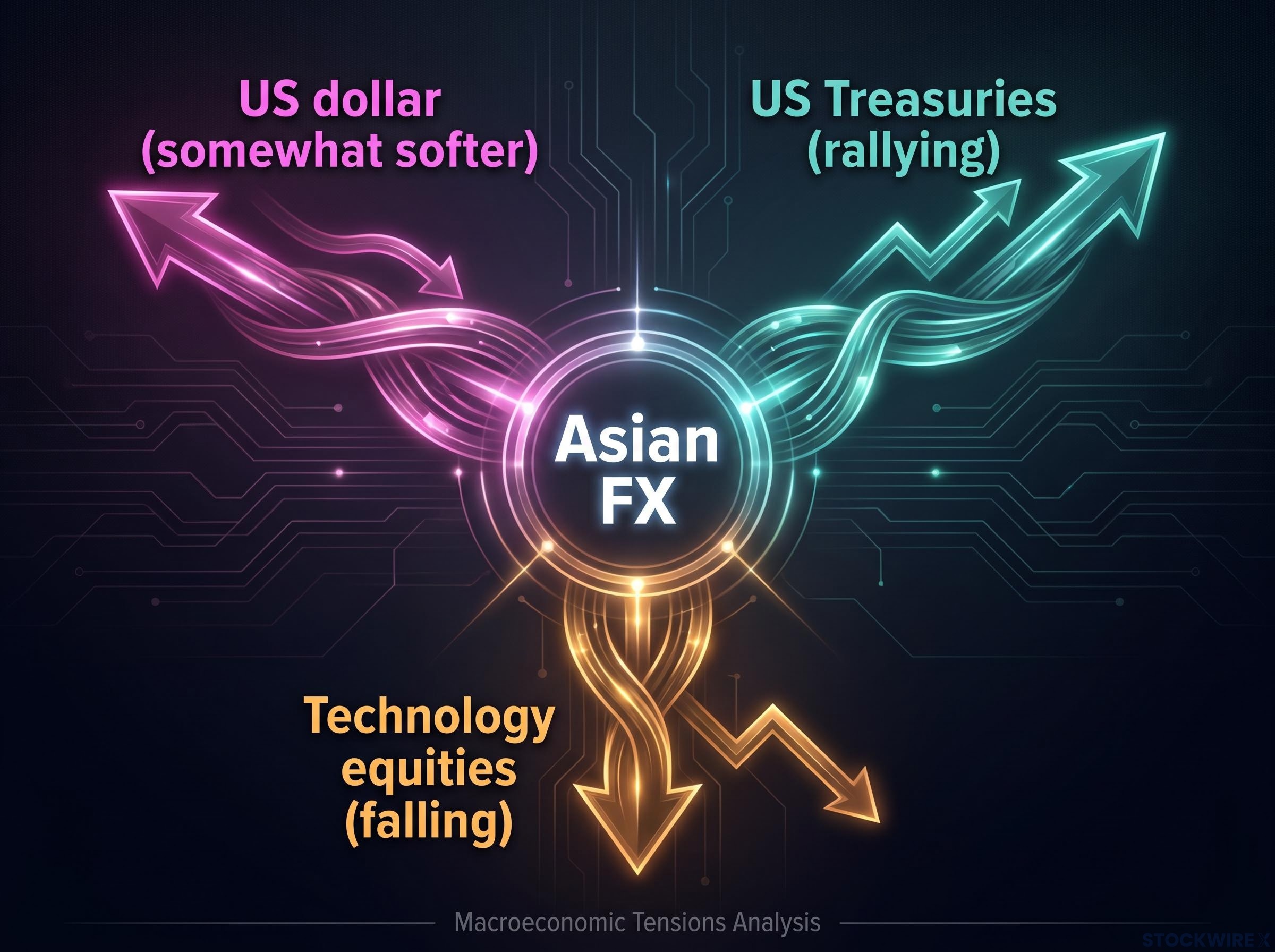
MUFG‘s Michael Wan sees a softer US dollar, rallying US Treasuries and slumping tech equities pulling against solid regional data. On top of that sits a policy layer: the People’s Bank of China (PBoC) has issued a pointed statement on the yuan, and EU-China trade talks are underway.
Here is how to separate the forces supporting Asian FX from the ones diluting that support, and which signals deserve your attention over the coming months.
Why are record exports not translating into a straight-line rally in Asian currencies?
Strong exports usually mean foreign buyers converting dollars into local currency to pay for goods. So why is the market not simply bidding up the won and the Taiwan dollar?
Wan’s answer starts outside Asia. He describes the global backdrop as pulling in three directions at once:
- US dollar: somewhat softer, which on its own helps Asian currencies.
- US Treasuries: rallying, a sign investors are seeking safety.
- Technology equities: falling, which hits the exact sector driving Asia’s export boom.
MUFG’s read on the backdrop Wan characterises the global environment for Asian currencies as mixed: supportive in parts, but with risk sentiment weakening even as regional data hold up.
The result is strong fundamentals meeting weak risk appetite. MUFG expects export growth to cool somewhat from here, yet with activity still so high, the bank thinks the AI investment trend will last through 2027 and likely well past it.
When fundamentals and tech shares diverge like this, you should read currency direction as a contest between trade flows and portfolio flows. Good export data supports a currency, but foreign investors pulling money out of falling chip stocks can offset it.
The dollar and equity correlation matters here because equity inflows have replaced bond flows as the marginal source of dollar demand; that link is regime-specific and tends to break when safe-haven mechanics dominate during acute stress.
Wan also names two swing factors for sentiment: EU-China trade negotiations and the PBoC’s currency stance. Both get their own treatment below. One caveat: current spot rates for USD/KRW, USD/TWD and USD/CNY were not available for this analysis, so the read here is directional rather than level-based.
When big ASX news breaks, our subscribers know first
How does AI hardware demand flow through to the won and Taiwan dollar?
To judge any export headline, you need to see the chain linking a data centre order to a currency move. It runs in four steps:
- AI capital spending lifts exports. Capital expenditure, or capex, means money companies spend on long-term assets. Cloud providers and governments are spending heavily on AI infrastructure, pulling in chips and servers.
- Exports build surpluses. A current account surplus means a country earns more from the rest of the world, mainly through exports, than it pays out.
- Surpluses create currency support. Exporters earn dollars and convert them to local currency, which in theory pushes that currency higher.
- Supply-chain relocation adds resilience. Production shifting to Taiwan and networks outside China may make those earnings less exposed to any single market.
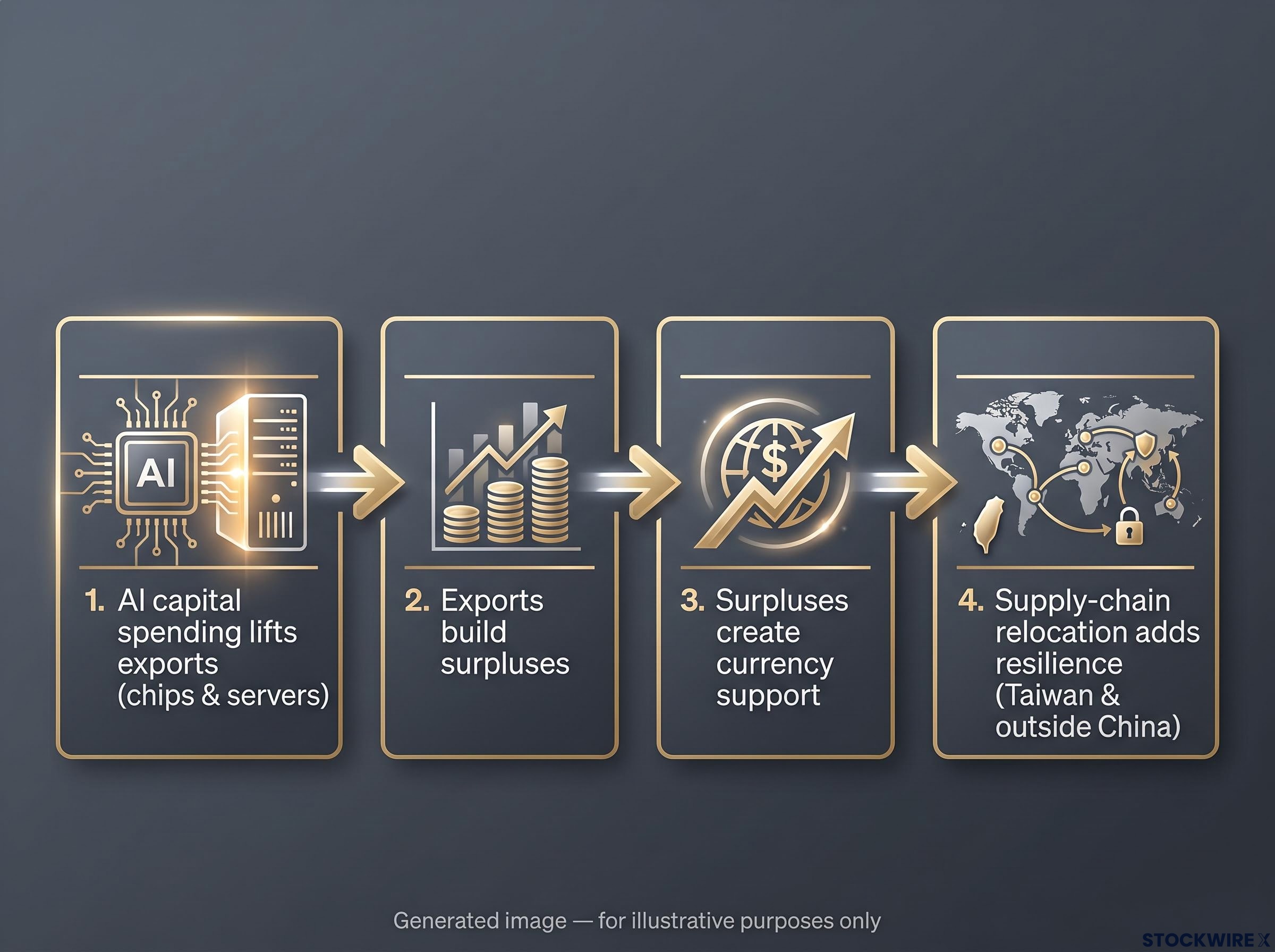
Step three is where support leaks away. Exporters often hedge, locking in exchange rates in advance, and authorities can intervene or manage their currencies, softening the effect on spot rates.
| Indicator | Taiwan | South Korea | Latest period | Driver |
|---|---|---|---|---|
| Exports | US$87.22B (+60.9% y/y) | US$104.80B (+82.1% y/y) | Sep 2026 (TW); Aug 2026 (KR) | AI servers and semiconductors |
| Current account surplus | Not available | US$46.11B | Aug 2026 | Semiconductor exports |
| Year-to-date surplus | Not available | US$279.20B | Jan-Aug 2026 | AI-driven chip demand |
Taiwan: servers overtake chips
Taiwan’s Ministry of Finance (MOF) reported this week that information, communications and audio-video products roughly doubled to about US$39.13 billion in September. Electronic components rose 45.3% to around US$31.13 billion.
The bigger shift sits in the mix. Servers and data processing machines made up 33.5% of exports from January to August, overtaking integrated circuits at 33.1%. The MOF links this to AI hardware demand and to production moving to Taiwan. Taiwan’s current account figures were not available, so its currency support is inferred from trade data.
Korea: a surplus above the IMF benchmark
Korea’s January-August surplus of US$279.20 billion compares with US$69.67 billion a year earlier. A Bank of Korea research note on the IMF’s External Balance Assessment model calls Korea a “persistent surplus economy”, with a gap in the “substantially stronger” range against the IMF norm.
Surplus size tells you the direction of underlying pressure. A surplus that stays well above the benchmark, year after year, tells you policy and hedging have been absorbing much of that pressure rather than letting the won adjust fully.
What is the PBoC signalling on the yuan, and why does it matter for the rest of Asia?
The timing of the PBoC’s statement says a lot. According to Wan, it landed on the day of the EU-China negotiations, setting out Beijing’s position before the bargaining began. The central bank’s stance, as relayed by MUFG, has three parts:
- The yuan is not undervalued.
- China does not seek a competitive edge through devaluation.
- Exchange rate adjustments cannot fix structural imbalances in the global economy.
The PBoC also explicitly rejected the IMF’s assessment that the yuan is undervalued. At the same time, it offered a transparency concession.
The PBoC no-devaluation pledge costs little while record surpluses already push the currency higher; a fix set weaker than spot suggests Beijing is moderating yuan strength rather than defending against weakness.
The 2027 commitment The PBoC said it will begin reporting certain foreign exchange operations data to the IMF from 2027, in a move framed as improving transparency.
Why should a Korean or Taiwanese currency care? The yuan acts as a regional anchor. If it stays steady, neighbours keen to protect export competitiveness against China have less room to let their own currencies climb, and investors positioning on relative value take their cue from it.
For you, a yuan held steady in the face of IMF criticism means regional currencies cannot count on a China-led appreciation tailwind. These details come from MUFG’s account; the full PBoC text, IMF language and talk outcomes were not independently verified.
What EU safeguards could change
Wan points to a key question: will Brussels really put trade safeguards into effect, such as those floated in a recent Germany-France paper sent to the European Commission? The EU has used safeguards and anti-dumping duties before, against Chinese solar panels and steel.
Extending that approach to EVs, batteries or AI-related hardware is plausible, but it remains inference rather than confirmed policy. If it happens, the hit would come directly through the export channel.
Which risks could break the Asian FX support story?
The export story is strong, but its scale is also its vulnerability. The MOF says AI applications are “continuing to deepen”, and capacity relocation points to structural drivers. Yet growth of 60.9% in Taiwan and 82.1% in Korean exports leaves plenty of room for a sharp slowdown on even modest normalisation.
The MOF itself concedes that AI exports are offsetting uncertainty over trade policy and geopolitical tension. Strip away that offset, and the underlying exposure returns.
Not every Asian currency faces the same strain: structural and cyclical pressure split the region, with energy importers like India and the Philippines exposed while the won’s weakness is judged more cyclical and tied to AI supply chain support.
| Risk | Channel | Direction of pressure | Signal to watch |
|---|---|---|---|
| Deeper tech equity correction | Portfolio outflows; slower capex | Weaker Asian FX | Chip and AI share prices |
| US dollar rebound | Stronger US growth, higher yields, safe-haven demand | Weaker Asian FX | US yields and dollar index |
| EU safeguards | Export volumes | Weaker Asian FX | Commission decisions |
| IMF scrutiny of surplus economies | Policy pressure on FX management | Could favour more flexible currencies | IMF assessments; PBoC reporting from 2027 |
History tempers expectations. During the early-2000s PC and handset boom and the mid-2010s smartphone cycle, Taiwan and Korea ran large surpluses, yet their currencies strengthened gradually over several years rather than in sharp jumps.
Ranked by immediacy, three signals matter most:
- Tech equity direction, which drives portfolio flows week to week.
- The US dollar, which can overwhelm trade flows quickly.
- EU safeguard and PBoC developments, which play out over months and into 2027.
The read to take from this: the AI export boom looks like a medium-term tailwind, not a trading signal. In the short term, dollar direction and risk appetite set the pace. Past performance does not guarantee future results, and forecasts are subject to changing market conditions.
What the export boom supports, and what it cannot guarantee
The fundamentals behind Asian currencies are strong. Transmission to spot rates is diluted by hedging and official management, and policy and risk sentiment decide the timing.
Your watchlist is short: EU safeguard decisions, PBoC and IMF developments through 2027, the direction of tech shares, and the US dollar.
When the next Taiwan and Korea trade releases land, treat a strong headline as confirmation of underlying pressure, not a forecast for next week’s exchange rate. Ask whether risk appetite and the dollar are cooperating. Forecasts from banks beyond MUFG would sharpen this picture, and they are worth tracking as they appear.
This article is for informational purposes only and should not be considered financial advice. Investors should conduct their own research and consult with financial professionals before making investment decisions. Forward-looking statements are speculative and subject to change based on market developments.
—